

Does the Sinclair Method work? That question usually arrives late at night, after a search that stopped dead at one number: a 78% success rate. For alcohol, where so much has already been tried, that figure is enticing. So it is worth slowing down. So this guide neither cheerleads the method nor dismisses it. Instead, it looks at what the trials actually found, where the numbers come from, what the results look like in practice, and who the approach suits.
Here is the short answer, up front. The science underneath this is sound. The mechanism has been tested against its rivals and held up; three separate controlled trials agree on the key point, and the drug itself is well tolerated. That specific 78% figure, though, is weaker than it sounds, and not for the reason most critics assume.
Please read this first if you get shakes, sweats or bad anxiety in the morning, or if you drink to steady yourself, do not stop or cut down on your own. Sudden cuts in heavy drinking can cause seizures. Speak to your GP or alcohol service first.
Five Key Takeaways
- The mechanism is well evidenced. Naltrexone blocks the reward alcohol delivers. Pair that block with drinking, often enough, and the learned urge fades. Researchers call it pharmacological extinction, and it has been tested against rival explanations.
- Three trials agree on the key point. Naltrexone beat placebo whenever patients kept drinking on it. None of the three found any benefit when patients were pushed to abstain instead.
- The 78% figure is weaker than the trials. It comes from an open-label programme with no placebo group, counting only people who completed it. The controlled evidence is the stronger case.
- Most success means drinking less, not stopping. Only about a quarter of that group reached full abstinence. Set your expectations accordingly.
- Taking it every time is the whole game. Miss the tablet and drink anyway, and that session pushes against you rather than for you. The protocol is also open-ended rather than a fixed course.

How the Sinclair Method Is Meant to Work
The mechanism separates this from every other alcohol treatment you may have met, so it is worth grasping properly.
First, alcohol triggers a release of endorphins. Those land on opioid receptors and deliver the pleasant, reinforcing signal that teaches your brain to want more. However, naltrexone occupies those receptors, so the signal goes quiet.
Here is the clever part. If you drink while that block is active, your brain gets the alcohol without the payoff. Repeat that across many sessions, and the learned urge weakens. Researchers call this pharmacological extinction, and it is the backbone of the whole approach.
Timing is therefore not a detail. It is the point. The original protocol specifies taking a naltrexone tablet an hour or two before you plan to drink, and abstinence is not required first.
That claim has been tested properly, which is worth knowing. Researchers ran an experiment designed to separate extinction from a rival explanation. Rats that actively drank alcohol while on an opioid blocker cut their drinking and kept drinking less afterwards. Littermates given exactly the same amount of alcohol by injection or feeding tube showed no such drop, and afterwards drank slightly more. The animal had to make the response on its own while the reward was blocked. Only extinction predicts that pattern.
That is what separates it from standard NHS prescribing, where naltrexone is used to prevent relapse in someone who has already stopped. Same drug, opposite starting position.
Does the Sinclair Method Work? The Trial Evidence
In short, several strands of evidence bear on this, and they are not equally strong.
The Finnish trials matter most.
Sinclair worked in Helsinki, and the key study there tested targeted naltrexone in people who had not been detoxed first. Over 32 weeks, 27% of those on naltrexone plus coping-skills therapy had no relapse to heavy drinking, against 3% on placebo. Above all, that is a genuine randomised comparison of the actual approach, rather than an approximation.
The strongest finding is about drinking versus abstaining.
Three separate controlled trials tested naltrexone against a placebo under two different therapies. One taught people to cope with slips, so they generally drank some alcohol while medicated. The other pushed complete abstinence from day one.
All three found naltrexone beat placebo in the coping groups. None found any benefit in the abstinence groups. In the Finnish trial, naltrexone with coping therapy also beat naltrexone with abstinence support directly. That is three independent research teams arriving at the same answer, and it is the single best-supported claim in this field.
Other targeted-dosing trials exist too.
In one, men taking naltrexone only before drinking showed bigger reductions in drinks per day than men on daily naltrexone, daily placebo, or targeted placebo. Targeted dosing has also been tested in heavy drinkers who were not ready to stop, with good adherence.
The wider naltrexone evidence is strong.
COMBINE, one of the largest alcohol pharmacotherapy trials ever run, found people on naltrexone had more abstinent days than those on placebo, 80.6% against 75.1%, and a lower risk of any heavy drinking day.
That said, COMBINE deserves a caveat the internet usually skips. It used 100 mg daily, twice the usual UK dose, and everyone enrolled had already been abstinent for at least four days. So it supports naltrexone generally. It does not test the Sinclair protocol.

Where the Sinclair Method evidence runs out
Here is the honest gap. No large, independent randomised trial has tested the complete Sinclair Method as branded, over the years-long timescale its advocates describe, against a proper comparison.
Its building blocks are well supported. Mechanism, drug and targeted timing all have evidence behind them. What lacks evidence is the full package as sold.
You will also see “eight double-blind trials in five countries” quoted often. That comes from Sinclair’s own review, and the point he was making was that these trials demonstrated the safety and efficacy of naltrexone when combined with coping strategies to reduce drinking. However, he also states that three of the trials found no difference between placebo and naltrexone when naltrexone and support therapy were used for abstinence. This reinforced his point that naltrexone works best when the patient is not told to first become abstinent, because this then does not allow pharmacological extinction to occur. The patient has to be drinking alcohol for the benefits of naltrexone to occur, by reducing the alcohol’s reinforcing effects. So, in essence, the eight double-blind trials in five countries are like clickbait designed to get our attention, but are used to justify the method by which naltrexone is used to reduce drinking.
Trials show targeted naltrexone one hour before drinking can result in abstinence, with one Finnish study finding 27% attained abstinence after 8 months. However, only 3% of the trial participants listed abstinence as a goal.

Compounding at Courier
When the standard option isn’t the right fit, we can make one to order
Courier is a compounding pharmacy. Where a prescriber decides it’s appropriate for you, we can prepare bespoke, made-to-order preparations — tailored to the individual, under full clinical governance. It’s the same principle that runs through everything we do.
Where the 78% Figure Comes From
You will see this number everywhere, so it deserves proper handling.
It traces to an open-label Finnish programme run by Sinclair himself. Of 147 people who completed enough treatment to be classified, 115 were judged successful, giving you 78%.
Open-label means everyone knew what they were taking. There was no placebo group, so there is nothing to compare that 78% against.
Therefore, three things follow from that sentence, and all three matter.
It counts completers only.
Anyone who started and stopped, whether due to side effects, cost, or the method not helping, is excluded from the calculation. Statisticians call this completer bias, and it inflates every treatment it touches. The honest reading is that 78% describes people who stuck with it, not people who tried it. Nor is “successful” defined anywhere by a fixed threshold.
Success mostly meant drinking less.
Meanwhile, only around a quarter reached full abstinence. That being said, only 3% of the trial participants listed abstinence as an objective; the vast majority joined the trial to control their drinking. The typical successful person came down to roughly nine or ten drinks a week. That is a real, meaningful change. It is not the same as stopping, and anyone hoping for abstinence should know that going in.
It came from the method’s originator.
Of course, that does not make it false. It does mean it has not been reproduced by anyone without a stake in the answer.
So treat 78% as a description of what happened to a committed group under one researcher, rather than as your personal odds.
Pharmacist’s tip: ask any service quoting a success rate what counts as success, and who got counted. A good answer is specific. A vague one tells you something.
How Long Does the Sinclair Method Take to Work
In practice, patience is part of the protocol. Most people who respond notice craving easing over three to six months, and fuller change often takes six to twelve. The Finnish study found benefits holding for at least 8 months of targeted dosing.
This is a slow loosening rather than a switch flipping. For many people, that is exactly why it feels manageable.
Meanwhile, compliance drives everything else. The tablet has to be taken before every drinking occasion, because each unmedicated session works against learning rather than for it. Skipping doses does not just pause progress. It actively undoes some.
That is not a criticism of anyone. It is a practical reality that shapes who does well. Planning ahead, building a routine, and having someone to troubleshoot with all lift adherence and adherence lift results.
Besides that, a few other things influence the outcome. Wanting to cut down rather than stop fits best with the approach. Being able to see drinking occasions coming makes the timing possible. And having a prescriber who knows the protocol and will adjust it when side effects bite makes a practical difference.

Does the Sinclair Method Work for Everyone?
No, and any service telling you otherwise is overselling.
In practice, it suits people who can plan their drinking, want reduction rather than abstinence, and will take a tablet reliably for months. It fits poorly where drinking is unplanned, chaotic, or driven by a bad day rather than an occasion.
Even so, some people simply do not respond. Others find the side effects outweigh the benefits. Both outcomes happen, and neither is a personal failure.
Finally, physical dependence completely changes the picture. If you get morning shakes or drink to steady yourself, a cut-down plan is not the right starting point, and stopping suddenly on your own can be dangerous. That situation needs a proper assessment first.
Safety and What UK Prescribers Check
The reassuring part first. In the Finnish trial, no severe adverse effects occurred at the start of medication; the drug was well tolerated over 8 months, and side-effect rates were not significantly different from placebo. At no point did the trial see signs of severe alcohol withdrawal in people who continued drinking during treatment.
Side effects
Common side effects usually appear early and usually fade: nausea, stomach upset, headache, tiredness, and poor sleep. Taking the tablet with food and plenty of water helps considerably.
One finding rarely makes it into consumer articles, and it is oddly encouraging. In that same trial, side effects were far more common among patients told to abstain than among those who kept drinking. Among the abstinence group, 74% on naltrexone reported side effects against 40% on placebo. Among the coping group, who drank, the figures were 50% and 49%, essentially identical. Some of what people call early side effects may in fact be unrecognised alcohol withdrawal.
Opioids and naltrexone
Yet some checks are absolute. Anyone using opioids must not take naltrexone, because it can trigger a sudden, severe withdrawal. That covers codeine, tramadol, morphine and methadone, including short courses after dental work. Anyone likely to need opioid pain relief soon should raise that before starting rather than after.
Liver health and naltrexone
Liver health matters too, so testing comes first. Your prescriber should test liver function before you start and again during treatment, with particular care where enzymes run above three times normal. Acute hepatitis, liver failure and severe kidney problems all rule treatment out.
Naltrexone does not lower blood alcohol
One point deserves stating plainly, and Sinclair himself insisted on it. Naltrexone does not lower your blood alcohol. You get just as drunk. Worse, opioid blockers do not reduce the motor impairment alcohol causes, and there is evidence that they can make divided attention harder while you are drinking.
So this is not a licence to drink more freely, and it is emphatically not a reason to think you are safer to drive. Sinclair recommended that patients receive strong warnings on exactly this point. Plan your transport before you take the tablet.
Does the Sinclair Method Work Within UK Guidance?
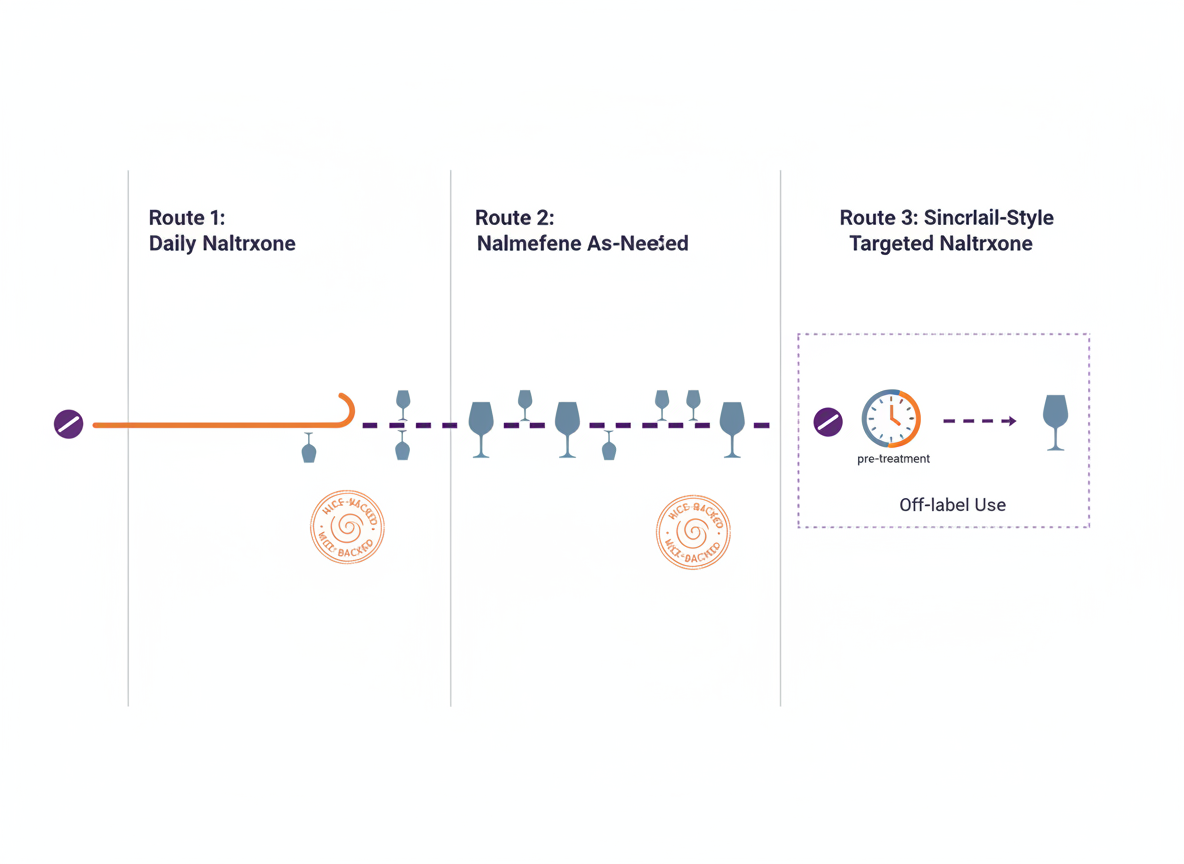
NICE recommends oral naltrexone for alcohol dependence, starting at 25 mg and building to 50 mg daily, usually for up to six months with regular review.
The original protocol takes a different view of duration, and you should be aware of this before starting. Sinclair argued there is no scientific reason to stop after a fixed period, and advised patients to carry a tablet indefinitely and take it whenever they might drink. His reasoning is that extinction can be relearned, so drinking without the tablet gradually rebuilds the habit. In practice, this is closer to a long-term arrangement than a course of treatment.
However, NICE frames that within a post-withdrawal, relapse-prevention model alongside psychological support. The Sinclair Method, as a named protocol, appears in no current UK guidance. Using naltrexone this way is therefore off-label.
That said, off-label is not the same as improper. Prescribers routinely use medicines off-label, with good reason and proper records. It does mean you deserve a prescriber who can explain the choice.
There is also a licensed alternative that rarely gets mentioned in Sinclair Method articles. Nalmefene is taken on days you expect to drink, and NICE recommends it for people cutting down from a high level of drinking. Most UK prescribers will consider that first, and reasonably so.
Getting Assessed in the UK
Still, many GPs have not come across this approach. Some will only prescribe naltrexone after abstinence, which excludes the very people the method targets. That gap is real, and it frustrates people who have done their reading.
Instead, Courier Pharmacy offers an online assessment reviewed by a UK-registered prescriber. It covers your drinking pattern, opioid history, liver and kidney health, other medicines, mental health and your goal.
What happens next depends on that review, not on what you request. The prescriber may approve treatment, ask for blood tests first, suggest nalmefene instead, or decline and explain why. Where physical dependence looks likely, we refer to NHS services rather than prescribing, because supervised withdrawal is the safer route.
Our alcohol addiction page sets out what we can and cannot offer. For the practical details on dosing and safety, see our Sinclair Method guide.
Meanwhile, NHS alcohol services remain free, and self-referral is usually possible. For anyone wanting counselling wrapped around treatment, that route is often better than a private one.

Summary
So, does the Sinclair Method work? The measured answer is yes for many people, and the science underneath it is sound. The mechanism has survived testing against rival explanations, three independent trials agree that naltrexone works best when paired with drinking, and the drug proved well-tolerated over eight months in controlled conditions.
What does not hold up is the 78% headline. That figure comes from an open-label programme with no comparison group, counting only people who finished, where success usually meant drinking considerably less rather than stopping. The controlled trials make a better case than the marketing does.
Results depend most on taking the tablet before every drinking occasion, over months rather than weeks. Where that fits your life, the approach is worth taking seriously. Where it does not, other options exist, including a licensed one.
If you are worried about your drinking, your GP or local alcohol service is a good place to start. Courier Pharmacy offers clinician-led appointments for people who want a structured private route with proper follow-up.
FAQs

Does the Sinclair Method work better than daily naltrexone?
One trial found that targeted dosing beat daily dosing on drinks per day. The evidence is not extensive enough to call it settled, and daily dosing has more guideline support in the UK.
How long before I know if it is working?
Most people who respond notice craving easing between three and six months. Fuller change often takes six to twelve months.
Is the 78% success rate real?
It reflects real data from people who completed Sinclair’s programme. It excludes anyone who dropped out, and success mostly meant reduced drinking rather than abstinence.
Do I have to stop drinking first?
No. The approach depends on drinking while the tablet is active, which is what separates it from standard NHS use.
Is it available on the NHS?
Not as a named protocol. NHS routes are daily naltrexone after withdrawal, or nalmefene for cutting down from a high level.
What if I miss a dose and drink anyway?
That session works against the process. Occasional slips will not undo everything, but a pattern of them stalls progress.
Can I still get drunk on it?
Yes. Naltrexone blocks the reward, not the alcohol. Your blood alcohol and impairment are unchanged.
Who should not try it?
Anyone taking opioids, anyone with acute liver disease or severe kidney problems, and anyone with physical alcohol dependence who needs supervised withdrawal first.
This article is for information only. It does not replace a clinical assessment. Naltrexone is a prescription-only medicine and should only be started by a clinician experienced in treating alcohol dependence.
References
- Anton, R.F., O’Malley, S.S., Ciraulo, D.A., Cisler, R.A., Couper, D., Donovan, D.M. et al. (2006) ‘Combined pharmacotherapies and behavioral interventions for alcohol dependence: the COMBINE study’, JAMA, 295(17), pp. 2003–2017
- Heinälä, P., Alho, H., Kiianmaa, K., Lönnqvist, J., Kuoppasalmi, K. and Sinclair, J.D. (2001) ‘Targeted use of naltrexone without prior detoxification in the treatment of alcohol dependence: a factorial double-blind, placebo-controlled trial’, Journal of Clinical Psychopharmacology, 21(3), pp. 287–292.
- Kranzler, H.R., Tennen, H., Armeli, S., Chan, G., Covault, J., Arias, A. and Oncken, C. (2009) ‘Targeted naltrexone for problem drinkers’, Journal of Clinical Psychopharmacology, 29(4), pp. 350–357.
- National Institute for Health and Care Excellence (2011) Alcohol-use disorders: diagnosis, assessment and management of harmful drinking (high-risk drinking) and alcohol dependence. NICE guideline CG115. Available at: https://www.nice.org.uk/guidance/cg115 (Accessed: 2 August 2026).
- National Institute for Health and Care Excellence (2014) Nalmefene for reducing alcohol consumption in people with alcohol dependence. NICE technology appraisal guidance TA325. Available at: https://www.nice.org.uk/guidance/ta325 (Accessed: 2 August 2026).
- Sinclair, J.D. (2001) ‘Evidence about the use of naltrexone and for different ways of using it in the treatment of alcoholism’, Alcohol and Alcoholism, 36(1), pp. 2–10. doi: 10.1093/alcalc/36.1.2.
- Courier Pharmacy (2026) The Sinclair Method for alcohol use disorder: how it works. Available at: https://courierpharmacy.co.uk/the-sinclair-method-for-alcohol-use-disorder-how-it-works/ (Accessed: 1 August 2026).
- Harvard Health Publishing. Can you retrain your brain to stop excessive drinking? Available at: https://www.health.harvard.edu/medications-and-treatments/can-you-retrain-your-brain-to-stop-excessive-drinking
- Courier Pharmacy. The Sinclair Method for alcohol dependence, UK guide. Available at: https://courierpharmacy.co.uk/the-sinclair-method-blocking-endorphin-driven-reward/
- Courier Pharmacy (2026) Can you drink while on the Sinclair Method? a UK guide. Available at: https://courierpharmacy.co.uk/can-you-drink-while-on-the-sinclair-method-a-uk-guide/ (Accessed: 2 August 2026).
- Courier Pharmacy (2026) Who should avoid naltrexone? A UK safety guide. Courier Pharmacy. Available at: https://courierpharmacy.co.uk/who-should-avoid-naltrexone-a-uk-safety-guide/ (Accessed: 5 August 2026).