

The Sinclair Method gets a lot of attention online because it sounds simple, take a tablet before you drink and, over time, drinking should lose its pull. That idea does appeal to people who don’t want instant abstinence. In the UK, though, the bigger question is not whether it sounds clever, but whether it fits real clinical practice, NHS care, and your own drinking pattern.
The Sinclair Method for alcohol use disorder is a targeted naltrexone protocol, not a quick fix. If you’re wondering whether it’s legitimate, who it helps, and how people access it in the UK, this guide walks through the science, the evidence, the limits, and the practical routes to treatment in plain English.
Five key takeaways
- It uses naltrexone before drinking, not as a daily prevention pill.
- It aims for pharmacological extinction, which means the brain slowly learns less from alcohol’s reward.
- It is discussed widely online, but it sits outside mainstream UK guideline-based AUD care.
- It may suit people who want to reduce drinking, not people who need immediate abstinence.
- Safe access matters, especially because opioid use, liver issues, and unstable drinking patterns can change the picture.

Why the Sinclair Method Sparks Debate in the UK
The Sinclair Method attracts attention in patient groups because it starts from a different place. It asks people to take naltrexone before planned drinking and then let repeated exposure weaken the reward link over time. That approach makes sense to people who are not ready to stop drinking altogether, but it also explains why the method sits uneasily beside standard UK alcohol care.
A UK clinical review says the approach is not recommended in evidence-based AUD pharmacotherapy guidelines. Standard guidance prefers naltrexone as daily or monthly dosing plus counselling, rather than intermittent take-before-drinking use. In plain terms, the method may be discussed, but it is not the usual NHS first-choice pathway. For many readers, that is the first surprise, because online discussion can make it sound much more established than it is in routine UK practice.
What does off-label means in real life
Off-label means a medicine is used in a way that differs from the standard label or usual guideline pathway. That does not automatically mean unsafe, but it does mean the prescriber needs a clear reason, proper review, and a plan for follow-up. With alcohol treatment, that distinction matters because people often assume that anything discussed online is automatically routine on the NHS.
Reducing alcohol gradually rather than abstinence
The gap between online enthusiasm and day-to-day access keeps the topic alive in the UK. The method is often presented as a moderation route, which can feel less confrontational than abstinence-based care. For some people, that is a helpful starting point. For others, it can blur the line between a promising option and a mainstream service.
A simple check helps. If a treatment sounds straightforward online, ask how it fits real prescribing, real monitoring, and real guidelines before you rely on it.
Reduction in alcohol related deaths in the UK
The wider public-health context also helps explain the interest. Reporting based on ONS figures says alcohol-specific deaths registered in the UK fell in 2024. That does not prove the Sinclair Method is the answer, but it does show why people keep looking for relapse-reduction approaches that fit real life.
How Naltrexone and Pharmacological Extinction Work

Alcohol can turn into a learned habit because the brain starts pairing drinking with reward. Each time alcohol triggers endorphin activity, the brain stores that reward signal. The Sinclair Method aims to weaken that link by blocking the signal first, so the usual reward response has less chance to take hold.
The brain reward loop in simple terms
The process is easier to understand if you picture a song you once liked being turned down until it is no longer pulling your attention. The song is still there, but it no longer feels as compelling. Naltrexone blocks opioid receptors before drinking, so alcohol does not deliver the same reward message and the learned pull starts to fade.
Harvard Health explains this as retraining the brain by weakening the learned alcohol-reward association. They also advise to take the medicine should be taken an hour or two before you drink, every time.
Dosing
The recommended dose is naltrexone 50 mg orally one hour before drinking. However, many clinics, including Courier Pharmacy, use a titration phase to help the body get used to naltrexone.
What “before drinking” really means
Timing matters because the dose needs to be in place before the first drink. The practical routine is usually about 1 hour prior to drinking, so the reward response is blocked from the start. If the tablet is taken after drinking has already begun, the protocol has missed its target.
Pharmacist’s tip: plan the dose with the drink, not with the day. If the drinking occasion changes, the dose timing needs to change too.
The timing question is where many people get confused. They hear that the treatment is about not drinking on the medication, when the reverse is true at the start. The treatment depends on drinking while the reward is blocked. This is because that repeated pairing is what creates the learning effect over time. For a fuller explanation of the reward pathway, this guide to blocking endorphin-driven reward sets out the same idea in more detail.
How pharmacological extinction works
Pharmacological extinction means the brain keeps expecting alcohol to feel rewarding, but the usual payoff does not arrive in the same way. After enough repeats, that expectation weakens. This is different from trying to force cravings away by willpower, and it is also different from immediate abstinence.
One practical rule is 100% compliance on drinking occasions. No casual skipping, no “just this once,” and no treating the tablet like a backup option. It is an event-specific protocol, so consistency matters on the occasions when drinking does happen.
Many people still need support alongside medication. Reducing the reward signal does not make stress, routines, or social triggers disappear overnight. Medication can help, but it works best when the rest of the plan is organised around the same goal.
What the Evidence Shows
People often point to the 78% figure from Sinclair’s reported finding, where observed patients reached extinction after several months of treatment. That number still shapes how the method is presented online, including in UK-facing summaries. The important point is to separate the headline figure from what it can and cannot prove in everyday care.
What success means here
In extinction-based treatment, success usually means drinking loses some of its pull, cravings ease, and drinking becomes less frequent or less intense. That is different from an abstinence outcome, where the aim is no alcohol at all. The difference matters, because people may compare the method with the wrong goal and then feel confused when the result does not match what they expected.
A useful way to separate the two is to ask whether the treatment is trying to reduce the reward from alcohol or stop alcohol use altogether. Those are related goals, but they are not the same route. Someone looking for moderation may see progress in a way that someone aiming for full abstinence would not.
What the evidence does not settle
A UK press summary has also linked the Sinclair Method to broader discussion of treatment trends and research interests, but that does not settle the practical questions families usually have. It shows that the method has attracted attention over time. It does not show that it is the right choice for everyone, or that it fits neatly into UK routine care.
Comparison with other methods
The harder issue is what the research does not answer cleanly. UK-facing content often sounds enthusiastic without fully explaining how the method compares with standard psychosocial support over the long term. That leaves readers with plenty of interest, but not enough context to judge where it sits alongside NHS approaches.
A close look at the evidence suggests caution rather than hype. A trial count tells you the method has been studied, but it does not automatically tell you who does best on it, how durable the benefit is for different people, or how it compares with ordinary NHS care in day-to-day practice. The evidence base is real, but it is still not a universal answer.
Extinction versus abstinence
For readers trying to make sense of the treatment, the distinction between extinction and immediate abstinence is often the missing piece. If you want a broader explanation of how naltrexone is used in different dosing approaches, this clear guide to low-dose naltrexone helps place the medicine in context.
Practical rule: if a treatment sounds impressive, ask what “success” means and whether it matches your own goal, moderation or abstinence.
The wider UK context still matters. UK government alcohol statistics show a high burden of alcohol-related harm, which underlines why treatment choice matters, but it does not mean every person needs the same route. The best option still depends on risk level, support needs, and whether moderation is a realistic goal.
Who Benefits Most and Who Should Look Elsewhere
The Sinclair Method tends to suit people who want to reduce drinking, not people who need immediate abstinence. It also fits better when someone can follow the timing rule consistently and has fairly predictable drinking occasions. If your routine changes often, your drinking is hard to predict, or you already know that medicines are easy to forget, that matters just as much as the treatment itself.
A simple fit check
Ask yourself three questions.
- Do I want moderation rather than immediate abstinence?
- Can I take a tablet before every planned drink, every time?
- Is my drinking pattern predictable enough for event-based dosing?
If the answer to any of those is “no,” the method may be a poor fit. That does not mean you have failed. It usually means a different route, such as structured abstinence support or a more traditional prescribing plan, is likely to suit you better.
When another pathway may fit better
The method is a poor fit if you use opioid painkillers, because naltrexone blocks opioid effects. It may also be unsuitable if your drinking pattern is unstable, if you need the structure of abstinence-based support, or if you have a condition that calls for closer medical oversight. That includes situations where medication side effects need careful checking, which is why a practical guide to low-dose naltrexone side effects can be useful when people are comparing naltrexone options.
Comparison between uses of naltrexone for alcohol use disorder
| Feature | Sinclair Method | Daily Naltrexone | Community Alcohol Services |
| Dosing style | Before planned drinking | Regular daily or monthly pattern | Depends on service plan |
| Main goal | Reduce drinking through extinction | Reduce cravings more broadly | Reduce harm, support change, or support abstinence |
| Best fit | Predictable drinking, moderation goal | Less predictable drinking, simpler routine | People needing structured support |
| Main limitation | Must remember every drinking occasion | Still needs regular adherence | Access and intensity vary |
| Usual UK position | Off-label, not mainstream first-line | More aligned with standard prescribing | Common NHS pathway |
A targeted approach can feel less threatening than abstinence-based care. That is a real advantage for some people. If someone is frightened by the idea of stopping completely, a moderation route can feel like a more workable first step.
The problem is that moderation is not the same as safety. If alcohol is already causing blackouts, injuries, or withdrawal symptoms, a slow-change plan can leave too many risks untouched. People in that position usually need a proper clinical review and stronger support, not just a clever dosing plan.
I have seen people assume that “less drinking” automatically means “safe enough.” It does not. If alcohol is being used to cope with withdrawal, severe stress, or unsafe situations, the priority is to address those pressures directly and choose a treatment path that matches the level of risk.
Accessing Treatment Through UK Pathways

In the UK, the first point of contact is usually your GP or a local alcohol service, not a direct Sinclair Method prescription. That reflects how NHS care is generally organised. If you ask about the method, your GP may still start with standard alcohol support, because that is the route most services know well.
A sensible prescriber should begin with the basics. They should ask about your drinking pattern, other medicines, opioid use, and whether you have had liver checks. They should also explain the difference between daily naltrexone and taking it before drinking. If those questions are skipped, the review is too brief to be safe.
Follow-up matters as much as the first consultation. Alcohol use, general health, and medication tolerance can all change over time, so monitoring should be part of the plan. A clinic that only sends out tablets, without proper screening or review, is not giving proper care.
How private and online routes should look
Private prescribing can be appropriate, but the service should still feel clinical rather than transactional. Check that it is GPhC-registered and that a human clinician reviews your questionnaire before anything is supplied. The UK-regulated model matters because alcohol treatment often needs judgement, not a quick checkout. For example, Courier Pharmacy online pharmacy information describes an online pharmacy process with secure questionnaires and human review.
Pharmacist’s tip: if an online service skips screening, skips follow-up, or will not explain who reviews the prescription, walk away.
You may also be asked about liver function monitoring. That is a safety step, not an extra sales feature. Even when a medicine is appropriate, the prescriber still needs enough information to judge whether it is safe for you.
The most useful question is often the simplest one. Ask, “Is this being used in line with standard UK practice, or is this an off-label approach?” That usually tells you how carefully the service is thinking.

Real-Life Scenarios and Pharmacist Tips
A busy parent often says the same thing. “I don’t want to stop drinking completely, but I’m tired of feeling stuck in the same pattern.” For someone like that, the Sinclair Method may seem attractive because it can fit around familiar routines, especially if drinking is usually planned in the evening after work.
That routine is also where people run into trouble. If the tablet has to be taken before every drinking session, a parent juggling school runs, homework, and an unexpected change of plan may miss doses. A protocol that looks tidy on paper can become awkward very quickly.
A shift worker may face a different problem. Their week can move from no drinking to a few drinks after a late shift, then a social meal on a day off. The method can still make sense in principle, but only if the person can match the dose to the drinking occasion every time.
Two real-world examples
Busy parent: drinks wine most evenings, usually after the children are asleep. This pattern can suit targeted dosing if the routine stays fairly stable and the person is aiming to cut down, not stop overnight.
Shift worker: drinks unpredictably after late shifts or on off-days. This pattern is harder, because the medicine depends on planning and timing. A daily regimen or a service-led alcohol support plan may fit better.
A more cautious question is often the right one. Does this treatment suit the way you live, or does it only sound tidy in theory? If your schedule is messy, the plan needs to be realistic enough to survive real life.

Compounding at Courier
When the standard option isn’t the right fit, we can make one to order
Courier is a compounding pharmacy. Where a prescriber decides it’s appropriate for you, we can prepare bespoke, made-to-order preparations — tailored to the individual, under full clinical governance. It’s the same principle that runs through everything we do.
Pharmacist’s tip: never mix naltrexone with opioid painkillers without speaking to a clinician first. The combination can stop opioids working properly and can throw your treatment plan off course.
Pharmacist’s tip: ask about liver function monitoring before you start, especially if you’ve drunk heavily for a long time or have other health issues.
Pharmacist’s tip: if you forget a dose before drinking, don’t guess your way through it. Missed timing means the protocol hasn’t worked as intended, so speak to your prescriber about what to do next.
If you are using a private service, the process should still feel clinical, not like a quick checkout. A proper service should explain who reviews your questionnaire, how follow-up works, and what happens if your answers suggest a safety concern. For a clearer picture of that process, see how ordering treatment works at Courier Pharmacy and why you might not get a call.
A final point on fit. Some people use the method because they want control, not because they want another lecture about willpower. That is understandable. The safer version of control is still the one built on proper screening, honest follow-up, and a treatment plan that matches the person in front of you.
Key Takeaways and Trusted UK Resources
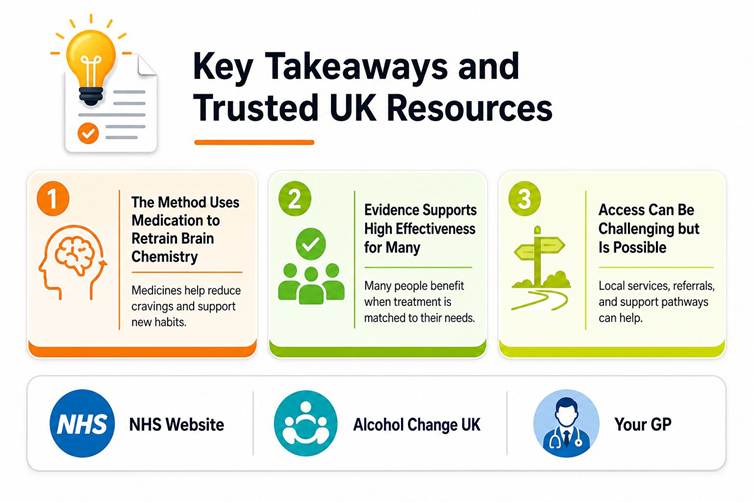
The Sinclair Method is real, but it is not magic. It is not the usual NHS first-line route. It uses naltrexone before drinking to weaken the brain’s reward link over time, rather like reducing the pull of a habit one episode at a time. For some people, that makes moderation more achievable. For others, it is the wrong fit from the start, especially if the main need is abstinence-based support or urgent medical assessment.
The evidence base is long-running, and the method still gets attention in UK-facing summaries. The better question is not just whether it has supporters. It is whether your goal, your drinking pattern, and your safety profile match the protocol, and whether you can use it under proper clinical supervision.
A sensible next step is to compare options calmly.
- NHS alcohol support services can assess risk, withdrawal, and treatment needs.
- NICE-style care usually favours structured, guideline-based alcohol treatment.
- Alcohol Change UK gives practical public information for people thinking about drinking less.
- Your GP can check medicines, liver health, and the right referral route.
If you are unsure whether you need moderation help or abstinence-based support, start with a proper clinical conversation. If you have seizures, severe withdrawal, blackouts, or any signs of an emergency, seek urgent help straight away.
Disclaimer
This article is for information only, not a substitute for medical advice. If you want a private UK pharmacy route that handles prescription medicines with clinician review and practical support, Courier Pharmacy can be a sensible place to start the conversation about whether naltrexone is appropriate for you.


References:
- Office for National Statistics (2025) Alcohol-related deaths in the United Kingdom: registered in 2024. Available at: https://www.ons.gov.uk/peoplepopulationandcommunity/healthandsocialcare/causesofdeath/bulletins/alcoholrelateddeathsintheunitedkingdom/registeredin2024 (Accessed: 1 August 2026).
- Harvard Health Publishing (n.d.) Can you retrain your brain to stop excessive drinking? Available at: https://www.health.harvard.edu/medications-and-treatments/can-you-retrain-your-brain-to-stop-excessive-drinking (Accessed: 1 August 2026).
- Courier Pharmacy (n.d.) Naltrexone Starter Pack: The Sinclair Method for Alcohol Use Disorder. Available at: https://courierpharmacy.co.uk/product/naltrexone-starter-pack-the-sinclair-method-for-alcohol-use-disorder/ (Accessed: 1 August 2026).
- Courier Pharmacy (n.d.) How does the Sinclair Method work? Available at: https://courierpharmacy.co.uk/how-does-the-sinclair-method-work/ (Accessed: 1 August 2026).
- National Health Service (2024) Alcohol misuse. Available at: https://www.nhs.uk/conditions/alcohol-misuse/ (Accessed: 27 July 2026).
- National Institute for Health and Care Excellence (2011, updated) Alcohol-use disorders: diagnosis, assessment and management of harmful drinking and alcohol dependence (CG115). Available at: https://www.nice.org.uk/guidance/cg115 (Accessed: 27 July 2026).