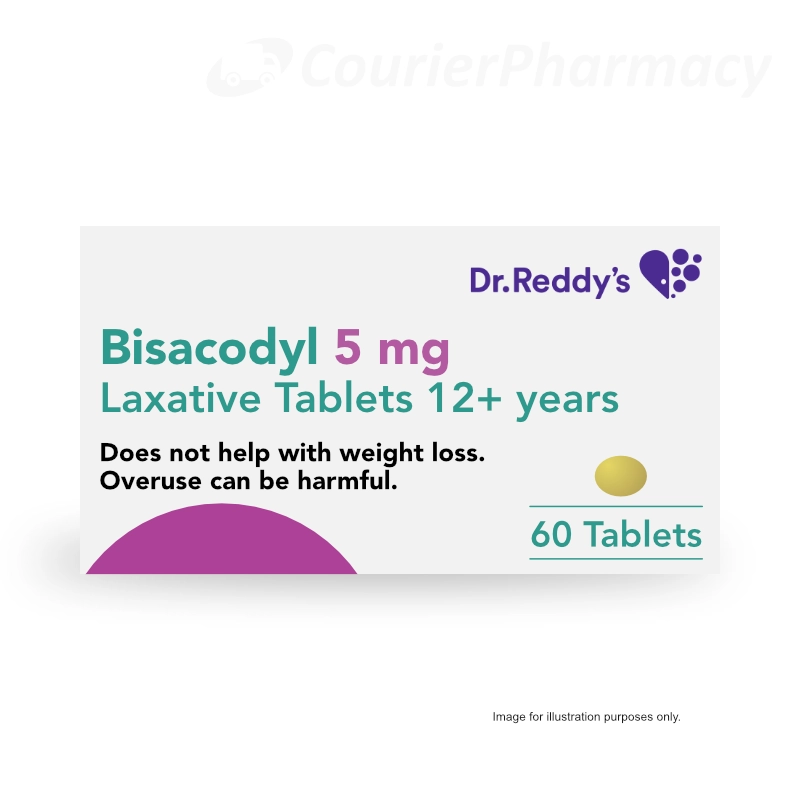
Bisacodyl 5mg tablets are a stimulant laxative for short-term constipation relief in adults and children aged 10+.
Each enteric-coated tablet contains 5mg bisacodyl, which stimulates the large bowel to help trigger a bowel movement, usually within 6–12 hours. Most adults take 1–2 tablets at night for a morning effect.
Available online from Courier Pharmacy in a 60?tablet pack, supplied under pharmacist supervision.
Bisacodyl 5mg Tablets are a stimulant laxative for short-term constipation relief. Each enteric-coated tablet contains 5mg bisacodyl. Courier Pharmacy supplies a UK-licensed generic product made to UK regulatory standards.
Key features (at a glance)
Active ingredient: bisacodyl 5mg per tablet
Form: enteric-coated tablet (swallow whole)
Pack size: 60 tablets
Who it’s for: adults and children aged 10+
Typical adult dose: 1–2 tablets at night (5–10mg)
How fast it works: usually 6–12 hours
Supply: from a UK GPhC-registered pharmacy with pharmacist support
What Bisacodyl 5mg is used for
People use bisacodyl for short-term constipation, especially when they want a predictable morning effect. It can also help during temporary constipation, such as after travel or a change in routine.
How Bisacodyl works
Bisacodyl works in the large bowel. It stimulates the bowel wall and helps trigger muscle contractions. As a result, it encourages a bowel movement.
Because the tablet has an enteric coating, it releases the medicine where it needs to work. That coating also helps reduce stomach irritation.
How long does it take to work?
Bisacodyl usually works within 6 to 12 hours. Therefore, many people take it at bedtime. You sleep through the slow onset, then feel the effect the next morning.
In comparison, some oral laxatives can take 1 to 3 days to work fully. Rectal treatments can work faster, but they are less convenient for some people.
How to take Bisacodyl tablets
Take bisacodyl exactly as directed by your pharmacist or prescriber. For most adults, the usual dose is 1 to 2 tablets at night. Swallow the tablets whole with water. Do not crush or chew them.
Also avoid taking bisacodyl at the same time as:
antacids
milk
other products that reduce stomach acid
These can damage the coating and make the tablet work too early.
Where bisacodyl fits in constipation care
Constipation care often works best as a step-by-step plan. Start with the basics first. Then add medicines if you still need them:
Stimulant laxatives (such as bisacodyl) for short-term use
So, bisacodyl often suits people who need a short boost. It is not usually the first option for long-term constipation.
When to get advice
Bisacodyl is not a good fit for daily use over long periods without review. If you need it regularly, speak to a pharmacist or GP. That way, you can check for causes such as diet changes, medicines (including opioids), or an underlying bowel issue.
Bisacodyl from Courier Pharmacy
Courier Pharmacy supplies Bisacodyl 5mg Tablets from a UK-registered pharmacy under pharmacist supervision. The 60-tablet pack suits people who may need more than a few doses. For that reason, we also check that it’s appropriate and offer practical advice.
If you want, I can add a short “Side effects and warnings” section in the same style (Yoast-friendly, short sentences, and clear subheadings).
MOJO WISDOM
Take control of your health by understanding your condition and what this medication is doing for you.
READ:
More information about this treatment.
UK-based doctors and pharmacists
Discreet and Confidential
UK-based doctors and pharmacists
Free, Expert Advice
No video link provided.
No video link provided.
UK-based doctors and pharmacists
Free, expert advice
Discrete and confidential
Fast delivery
Giving you trusted clinical advice for over 40 conditions
A UK regulated pharmacy providing safe, effective treatments online since 2014
When constipation hasn’t responded to dietary fibre and bulk-forming laxatives, or when a faster, more reliable bowel movement is needed for occasional use, bisacodyl is one of the most established stimulant laxatives in UK practice. As enteric-coated tablets taken at night, bisacodyl works directly on the wall of the large bowel to stimulate muscle contractions and produce a bowel movement the following morning.
At Courier Pharmacy, we believe healthcare should suit the person, not the marketing budget. Constipation is one of those conditions where the right answer depends on the pattern: lifestyle and bulk-forming laxatives for most chronic constipation, osmotic laxatives for ongoing management, stimulant laxatives like bisacodyl when these aren’t enough or when a faster effect is needed, and proper investigation when something doesn’t fit the standard picture. This page covers where bisacodyl fits, how to use it well, and when other options might suit you better.
Five key takeaways
Bisacodyl 5mg tablets is a UK General Sales List (GSL) and Pharmacy (P) medicine (depending on pack size and presentation) used as a stimulant laxative for short-term relief of constipation in adults and children from age 10
Taken at night, bisacodyl typically produces a bowel movement 6 to 12 hours later, making it useful when you want overnight action for morning effect
Standard adult dose is 5mg to 10mg (one or two tablets) at night. The 60 pack provides 30 to 60 days of treatment depending on dose, although stimulant laxatives are generally for short-term rather than continuous use
Bisacodyl is not first-line for chronic constipation. Lifestyle measures (fibre, hydration, exercise) and bulk-forming laxatives are usually the starting point, with osmotic laxatives next, and stimulant laxatives like bisacodyl reserved for situations where these aren’t enough
The tablets are enteric-coated and must be swallowed whole, not crushed, chewed, or taken alongside antacids or milk, because the coating is designed to release the active ingredient in the large bowel rather than the stomach
Why choose Courier Pharmacy for Bisacodyl 5mg Tablets
At Courier Pharmacy, our whole approach is built around the idea that healthcare should fit the person, not the marketing budget. For bisacodyl, that means honest framing of where it fits, how to use it well, and when to step back to consider the wider picture. Our service is shaped by the philosophy of Dr Ada Jex-Cori, our brand pharmacist, who has built her practice around accessible, honest, personalised care. Her view is straightforward: you are not broken. The system is the problem. We are here to change that.
Honest framing of where bisacodyl fits
For occasional constipation episodes, post-operative constipation, travel-related constipation, opioid-induced constipation, and specific situations where a faster overnight effect is needed, bisacodyl is a genuinely useful option. We supply the 60 pack for patients managing ongoing intermittent need rather than expecting daily use.
For chronic constipation requiring daily laxative support, the conversation needs to be different. The starting point should usually be lifestyle measures and bulk-forming or osmotic laxatives, with bisacodyl reserved for episodes rather than daily use. We are happy to work through the wider picture with you.
Pharmacist support before and after purchase
Our pharmacist is available for advice on:
Whether bisacodyl is the right option for your situation, or whether another approach would suit you better
The correct use of the enteric-coated tablets and the timing for morning effect
Managing side effects or unexpected responses
The wider stepped approach to constipation if you’re dealing with an ongoing pattern
Whether your symptoms warrant GP review
This is free and available before and after purchase. Get in touch if you have any questions.
Care for specific patient groups
We are happy to provide tailored support for:
Patients on opioid pain relief where constipation is a recurrent challenge, where we can discuss the wider opioid-induced constipation approach including newer options like naloxegol
Older patients where the gentler approaches may be safer first-line
Patients preparing for surgery or colonoscopy where bisacodyl has a specific bowel preparation role
Patients with travel-related or short-term constipation where intermittent use is appropriate
Patients with IBS-C (constipation-predominant IBS) where the wider IBS picture needs consideration rather than just laxative supply
Coordination with your GP and other care
If you have a GP, district nurse, or other healthcare professional involved in your care, we are happy to coordinate. For patients with chronic constipation, joined-up care across primary care, pharmacy, and (when needed) gastroenterology produces better outcomes than fragmented care.
Trust earned, not claimed
We are GPhC-regulated, we ground our content in NHS, NICE, BNF, and EMC guidance, and we will tell you honestly if bisacodyl isn’t the right answer for your situation. We’d rather give you the right advice than a quick sale.
How to buy Bisacodyl 5mg Tablets (60 pack) from Courier Pharmacy
Bisacodyl 5mg Tablets in the 60-pack size is supplied through Courier Pharmacy under pharmacist supervision. The supply does not require a prescription, but the pharmacist will check that the use is appropriate for your situation.
Here is how our service works:
Add Bisacodyl 5mg Tablets to your basket and complete a quick questionnaire about your symptoms, what you’ve already tried, any current medicines, and any relevant medical conditions
Our pharmacist reviews your answers to confirm bisacodyl is suitable for you. Where the pharmacist needs to ask additional questions or recommend alternatives, we will do so before completing the supply
Once approved, your order is prepared and dispatched discreetly to your door
Free pharmacist support is available before and after your purchase for any questions
If bisacodyl isn’t the right product for your situation, we will explain why and suggest alternatives. That might be:
Lifestyle and oral measures if you’ve not yet had a fair trial of these
Bulk-forming laxatives (ispaghula husk / Fybogel) if regular fibre supplementation hasn’t been tried
Osmotic laxatives (macrogol / Movicol, lactulose) for the foundation of chronic constipation management
Senna or sodium picosulfate if you’ve not responded well to bisacodyl previously and want a different stimulant laxative
Rectal preparations (glycerol suppositories, Micralax Micro-enema) if rectal loading is the dominant issue
A GP appointment if your constipation has red flags or doesn’t fit the typical picture
A different approach entirely if your symptoms suggest IBS, inflammatory bowel disease, or other underlying conditions needing assessment
Our free fortnightly drop-in clinics at Insomnia, Derby run every other week from 10 am to 12 pm. Bowel health, constipation, IBS, IBD, haemorrhoids, anal fissures, MCAS, hair loss, men’s health, weight management, and the broader conversations about wellbeing are all topics we cover regularly at these sessions. No appointment needed, no charge, no pressure.
Active ingredient
Bisacodyl 5mg tablets contain bisacodyl as the active ingredient. Each enteric?coated tablet provides 5mg of bisacodyl. The coating helps the tablet pass through the stomach before it releases the medicine in the large bowel, where bisacodyl stimulates bowel movement and helps relieve constipation.
What are bisacodyl 5mg tablets used for?
Where bisacodyl fits in constipation treatment
Constipation affects 10 to 20% of UK adults at any given time, with higher prevalence in women, older adults, and people with certain conditions or on certain medicines. Most cases respond to first-line measures, but a meaningful minority need additional treatment, and a smaller minority have refractory constipation that warrants specialist input.
The treatment of constipation in modern UK practice follows a stepped approach. The honest position of bisacodyl in this approach is the fourth-line option for most patients, although there are specific situations where it has a primary role.
First-line: lifestyle measures
The foundation of constipation treatment, and prevention of recurrence, is lifestyle. The components that matter most are:
Fibre intake: around 30g daily from food sources where possible. Wholegrains, beans and lentils, fruit, vegetables, nuts, and seeds are all good sources. Increase gradually to avoid bloating and wind.
Hydration: 1.5 to 2 litres of fluid daily, mostly water or other non-strongly-caffeinated, non-alcoholic fluids
Physical activity: regular movement supports bowel motility. A 20 to 30 minute walk most days makes a measurable difference
Toilet habits: respond to the urge promptly, use a slightly squatting position (footstool helps), keep toilet time short and focused
Address contributing medicines: opioids, iron, calcium channel blockers, some antidepressants, anticholinergics, some chemotherapy agents all cause or worsen constipation. Where alternatives exist, discuss with the prescriber
Around half of patients with mild to moderate chronic constipation respond well to lifestyle alone.
Second-line: bulk-forming laxatives
If lifestyle measures aren't enough, the first medicine option is usually a bulk-forming laxative. These mimic the effect of dietary fibre by absorbing water and adding bulk to the stool.
Ispaghula husk (Fybogel, Ispagel)
Methylcellulose (Celevac)
Bulk-forming laxatives work over days rather than hours. They need to be taken with plenty of water and are not suitable for patients with significant dehydration, bowel obstruction, or who can't drink adequate fluids.
Third-line: osmotic laxatives
If bulk-forming laxatives aren't enough or aren't tolerated, osmotic laxatives are the next step.
Macrogol (Movicol, Laxido, CosmoCol): polyethylene glycol with electrolytes. Generally well-tolerated and effective
Lactulose (Duphalac, Laevolac): a synthetic sugar drawing water into the bowel. Can cause bloating and wind
Magnesium hydroxide (Milk of Magnesia): older but still useful in selected patients
Osmotic laxatives typically work over 1 to 3 days. They are generally the medicine class of choice for chronic constipation management when lifestyle and bulk-forming options aren't sufficient.
Fourth-line: stimulant laxatives
If osmotic laxatives are insufficient, stimulant laxatives can be added or substituted. They produce a faster effect (typically 6 to 12 hours) and work through direct stimulation of bowel muscle contractions.
The main stimulant laxatives in UK practice:
Bisacodyl (Dulcolax tablets, generic bisacodyl): enteric-coated tablets typically taken at night for morning effect; also available as suppositories for faster action
Senna (Senokot, generic senna): plant-derived stimulant laxative, similar overnight-to-morning timing
Sodium picosulfate (Dulcolax Pico, Laxoberal): liquid or tablet form, similar timing, often used overnight
The choice between these is partly clinical (slight differences in side effect profile and onset) and partly patient preference (tablet versus liquid form, brand familiarity). Bisacodyl and senna are the most commonly used; sodium picosulfate has a slight edge for some patients because of its different chemistry and faster onset in some cases.
Stimulant laxatives are generally for short-term use rather than continuous daily use over months or years. The reasons:
The underlying constipation pattern usually needs different management for sustainable improvement
Long-term daily use can sometimes lead to reduced effect at the same dose (tolerance), although this is less common and less significant than the historical view suggested
Repeated daily strong bowel stimulation isn't ideal physiology over years
Patients on long-term daily stimulant laxatives often need review to consider alternatives or address underlying contributors
That said, there are clinical situations where ongoing stimulant laxative use is appropriate under prescriber supervision: opioid-induced constipation (where the underlying medicine cause persists), longstanding refractory constipation under specialist care, palliative care, and some patients with significant comorbidities affecting bowel motility.
When specialist input is appropriate
A small proportion of patients have constipation that doesn't respond to standard stepped treatment. Refractory constipation may warrant assessment for:
Underlying causes such as hypothyroidism, hypercalcaemia, diabetes, neurological conditions, or pelvic floor dysfunction
Slow-transit constipation, where colonic motility is the dominant problem
Outlet dysfunction (functional defaecation disorders), where the problem is at the pelvic floor and anorectal coordination
Newer prescription agents like prucalopride (5-HT4 receptor agonist), linaclotide (guanylate cyclase-C agonist), or lubiprostone (chloride channel activator), used under specialist guidance
Bowel cancer or other structural pathology, particularly if constipation is new, associated with weight loss, bleeding, or significant change in bowel habit, or in patients over 50
If your constipation pattern doesn't fit, or if it's not responding to sensible stepped treatment, ask for a review rather than continuing to escalate stimulant laxatives.
How bisacodyl works
Bisacodyl is a stimulant laxative belonging to the diphenylmethane class of medicines. Its mechanism of action involves direct effects on the wall of the large bowel.
After you swallow a bisacodyl tablet, the enteric coating protects the active ingredient from breakdown by stomach acid. The coating begins to dissolve in the more alkaline environment of the small intestine, but the bulk of the bisacodyl reaches the large bowel intact. Once in the large bowel, bacterial enzymes and intestinal hydrolysis convert bisacodyl into its active metabolite, BHPM (bis-(p-hydroxyphenyl)-pyridyl-2-methane), which is the molecule that produces the laxative effect.
BHPM acts on the colonic mucosa and the smooth muscle of the colonic wall through several complementary mechanisms:
Direct stimulation of colonic smooth muscle: increases propulsive peristaltic contractions that move the stool toward the rectum
Effects on intestinal secretion: increases the secretion of water and electrolytes into the bowel lumen, softening the stool and increasing its volume
Effects on enteric neurons: modulates the local neural circuits in the gut wall that coordinate peristalsis
Possible effects on prostaglandin production: contributing to the secretory and motility effects
The net effect is increased colonic motility, softer stool with greater water content, and a coordinated bowel movement that typically occurs 6 to 12 hours after the oral dose.
The pharmacokinetic profile explains the overnight-to-morning timing. After oral dosing, the tablet must pass through the stomach (around 1 to 4 hours depending on gastric emptying), the small intestine (several hours of transit), and reach the large bowel. Once there, hydrolysis to the active metabolite and the subsequent motility and secretory effects take additional time. The total transit from oral dose to bowel movement averages 6 to 12 hours, with variability between patients.
Bisacodyl is poorly absorbed into systemic circulation when taken orally as enteric-coated tablets. The small amount that is absorbed is metabolised in the liver and excreted in bile and urine. The minimal systemic exposure means bisacodyl has few significant systemic drug interactions and few systemic side effects, with most adverse effects confined to the gastrointestinal system.
When bisacodyl is used as a suppository (a different product from the tablets being discussed here), the onset is much faster, typically 15 to 60 minutes, because the active ingredient is delivered directly to the rectum and lower colon without needing transit through the upper GI tract.
How to take Bisacodyl 5mg Tablets
The information below is a summary for reference. The definitive guide is the patient information leaflet supplied with the product. If you are unsure about any aspect of dosing or timing, contact our pharmacist for support.
Dosing
Adults and children over 18: 5mg to 10mg (one or two tablets) taken once daily, typically at night before bed for morning effect. Start with 5mg (one tablet) and increase to 10mg (two tablets) if the lower dose is insufficient.
Children aged 10 to 17 years: 5mg (one tablet) once daily, taken at night. Higher doses or use in younger children should only be under prescriber or GP advice. Our online supply through Courier Pharmacy is for adults only; paediatric supply should be coordinated through the child's GP.
Older patients: standard adult dose, although it may be reasonable to start with 5mg and assess response before increasing. Older patients can be more sensitive to laxative effects.
When to take
Bisacodyl is typically taken at night before bed. The 6 to 12 hour onset means an evening dose produces a bowel movement the following morning, which is the practical and dignified timing most people prefer.
Some patients find that the optimal time for them is mid-evening (around 7 to 9pm) for a morning effect, while others prefer just before bed (10 to 11pm). Adjusting the timing by a couple of hours allows you to fine-tune when the morning bowel movement happens.
If the morning effect is not strong enough, an additional dose later the same day is not appropriate; the right adjustment is usually to increase from 5mg to 10mg the following night, or to address other factors (fluid intake, fibre intake) alongside.
How to take
Swallow the tablet whole with a glass of water
Do not crush, chew, or break the tablet, because this damages the enteric coating that protects the active ingredient from stomach acid
Do not take with milk or large quantities of dairy products, because milk raises gastric pH and can compromise the enteric coating before the tablet reaches the large bowel
Do not take within 1 hour of antacids or other acid-suppressing medicines for the same reason. If you take a PPI (omeprazole, lansoprazole, pantoprazole, esomeprazole) or H2 antagonist (famotidine), the ongoing acid suppression may slightly reduce the effectiveness of the enteric coating, although this is usually not a major clinical concern
Take with water, ideally a full glass
How long can you take bisacodyl?
For acute constipation episodes: short courses of 3 to 7 days are typical. Continue until the constipation is settled and bowel function has returned to normal, then stop and address the underlying factors with lifestyle and other measures.
For ongoing constipation requiring stimulant laxative support: discuss with our pharmacist or your GP about the wider plan. Daily continuous use over weeks to months without prescriber input is not recommended; longer-term use under prescriber guidance is appropriate in specific clinical situations.
If you find yourself needing bisacodyl every day for ongoing constipation, this is usually a signal that the underlying pattern needs different management rather than continued daily stimulant laxative use.
Missing a dose
If you miss a dose, simply take the next dose at the usual time the following day. Do not double-dose to catch up.
Storage
Store at room temperature, below 25°C, in the original packaging to protect from moisture. Keep out of sight and reach of children. Do not use after the expiry date printed on the pack.
Warnings and precautions
When not to use bisacodyl
Bisacodyl should not be used in:
Patients with known hypersensitivity to bisacodyl or any tablet excipient
Patients with intestinal obstruction or suspected obstruction
Patients with acute inflammatory bowel disease (severe flares of Crohn's disease or ulcerative colitis)
Patients with severe dehydration
Patients with acute abdominal conditions including appendicitis or undiagnosed severe abdominal pain
Patients with severe nausea or vomiting where a stimulant laxative could worsen the situation
Children under 10 without prescriber guidance
When to seek assessment rather than self-treat
The use of bisacodyl assumes the constipation is straightforward and the cause is understood. Several patterns warrant medical assessment instead of (or before) over-the-counter laxative use:
Constipation that is new and persistent in a patient over 50, particularly with weight loss, blood in stool, or significant change in bowel habit (red flags for possible bowel cancer)
Constipation associated with significant abdominal pain, vomiting, or abdominal distension (possible obstruction)
Constipation in patients with significant comorbidities including heart failure, kidney disease, liver disease, or active inflammatory bowel disease
Chronic constipation requiring daily laxative use for more than a week or two without resolution
Constipation alternating with diarrhoea (suggestive of IBS or other conditions warranting assessment)
Constipation in young children with associated soiling, behavioural symptoms, or distress
Constipation with significant rectal bleeding, anal pain, or signs of fissure or haemorrhoids needing assessment
If any of these apply, contact your GP or our pharmacist rather than continuing self-treatment.
Pregnancy and breastfeeding
Bisacodyl should not be used in pregnancy nor breastfeeding. Rather bulk-forming laxatives (ispaghula husk) and osmotic laxatives (lactulose, macrogol) are generally preferred as first-line because of their gentler mechanism.
In breastfeeding, bisacodyl is generally considered safe because of the minimal systemic absorption and lack of significant transfer to breast milk. Discuss with the prescriber or our pharmacist if needed.
Older patients
Older patients can be more sensitive to laxative effects and more vulnerable to dehydration from significant bowel actions. Start with the lower 5mg dose and ensure adequate hydration. Long-term daily use in older patients warrants review more readily than in younger adults.
Patients with kidney or liver problems
Generally no dose adjustment is needed because systemic absorption is minimal. Patients with significant comorbidities should discuss with their prescriber for the wider picture.
Diabetic patients
Most modern bisacodyl tablets are sugar-free and suitable for diabetic patients. Check the patient information leaflet of the specific product if this is relevant.
Long-term use considerations
Daily continuous use of bisacodyl over months or years is not recommended without prescriber supervision. Concerns include:
The underlying constipation pattern usually needs different management for sustainable improvement
Possible reduction in effect at the same dose with very prolonged use (tolerance), although this is less common and less clinically significant than the historical view suggested
Possible disruption to electrolyte balance with very heavy or very prolonged use, particularly potassium depletion
Mask of underlying conditions that may be contributing
For chronic constipation, the better approach is usually a combination of lifestyle measures, bulk-forming laxative, osmotic laxative as a stable foundation, and stimulant laxative like bisacodyl reserved for episodes rather than daily use.
Side effects of Bisacodyl 5mg Tablets
Bisacodyl is generally well-tolerated. Most side effects are mild and gastrointestinal in nature, reflecting the local action in the bowel.
Common side effects (affecting up to 1 in 10 patients)
Abdominal cramping or discomfort, often associated with the stimulated bowel movement
Diarrhoea, particularly if the dose is too high or if used alongside other laxatives
Abdominal pain
Nausea
Sensation of urgency before the bowel movement
Less common side effects
Vomiting
Headache
Dizziness
Loose stools persisting after the bowel movement
Mild electrolyte disturbance with heavy or prolonged use (potassium depletion is the main concern)
Rectal discomfort if used in combination with rectal preparations
Rare but more significant side effects
Significant electrolyte disturbance (hypokalaemia, dehydration) with very heavy or prolonged use
Allergic reactions including rash, itching, swelling
Severe abdominal pain (rare; would warrant review for obstruction or other underlying issue)
Syncope or significant hypotension after the bowel movement (rare; reported in some older patients with significant cardiovascular comorbidities)
Stop and seek advice if
You develop severe abdominal pain that does not settle with the bowel movement
You develop signs of significant dehydration (severe thirst, dry mouth, reduced urine output, dizziness)
You develop rectal bleeding beyond minor amounts on the paper
You develop signs of allergic reaction (rash, swelling, breathing difficulty)
The expected bowel movement does not happen and you develop signs of obstruction (severe pain, vomiting, abdominal distension)
You find yourself using bisacodyl daily without resolution of the underlying problem
"Tolerance" and long-term use
The historical concern about laxative dependence and "lazy bowel" from long-term stimulant laxative use has been moderated by more recent evidence. Modern understanding is that long-term stimulant laxative use is less harmful than was once thought, and is appropriate in specific clinical situations (opioid-induced constipation, palliative care, refractory constipation under specialist care).
That said, the underlying constipation pattern in most patients warrants different management for sustainable improvement, and most patients on long-term daily bisacodyl benefit from a review of the wider plan rather than continuing the same pattern indefinitely.
Yellow Card reporting
Suspected adverse drug reactions can be reported to the MHRA via the Yellow Card scheme at yellowcard.mhra.gov.uk. Reporting helps build the safety picture for everyone.
Drug interactions with Bisacodyl 5mg Tablets
Bisacodyl has a low overall drug interaction profile because systemic absorption is minimal. The interactions to consider are mostly about the enteric coating and the combined effects of laxatives.
Significant interactions
Antacids and acid-suppressing medicines (PPIs like omeprazole, lansoprazole, pantoprazole, esomeprazole; H2 antagonists like famotidine; antacid tablets and liquids like Gaviscon, Rennies): can raise gastric pH and potentially compromise the enteric coating before the tablet reaches the large bowel. Don't take bisacodyl within 1 hour before or after antacids. For patients on chronic PPI therapy, the effect is usually not clinically significant in practice
Milk and dairy products: don't take bisacodyl with milk or large quantities of dairy because of the gastric pH effect on the enteric coating
Diuretics (furosemide, bendroflumethiazide): combined use can increase the risk of hypokalaemia and dehydration, particularly with prolonged stimulant laxative use. Monitor electrolytes if both are used long-term
Cardiac glycosides (digoxin): hypokalaemia from prolonged laxative use can increase the risk of digoxin toxicity. Monitor potassium levels
Corticosteroids (prednisolone, dexamethasone, hydrocortisone): combined use can increase the risk of hypokalaemia
Other laxatives: combining multiple laxatives without prescriber guidance can produce excessive effect, electrolyte disturbance, and diarrhoea
Less significant interactions
Most blood pressure medicines, statins, antidepressants, hormonal contraceptives: no significant interaction
PDE5 inhibitors, antihistamines, paracetamol, ibuprofen: no significant interaction
Most antibiotics: no significant interaction, although prolonged broad-spectrum antibiotics can alter bowel flora and theoretically affect the conversion of bisacodyl to its active metabolite
For patients on any of the significant-interaction medicines above, our pharmacist will check the picture during your consultation.
Frequently asked questions about Bisacodyl 5mg Tablets
How quickly does bisacodyl work?
Bisacodyl tablets typically produce a bowel movement 6 to 12 hours after dosing, which is why an evening dose produces a morning effect. Bisacodyl suppositories work faster (15 to 60 minutes), but those are a different product.
When should I take bisacodyl?
For most patients, at night before bed. The overnight-to-morning timing means you sleep through the slow onset and wake to an effective bowel movement. If you want the bowel movement at a specific time, adjust the dose timing by a couple of hours to fit your schedule.
Can I take bisacodyl with food?
Yes, food does not significantly affect bisacodyl. The main considerations are about milk and dairy (which can affect the enteric coating) and antacids (same reason), not about food generally.
Can I take bisacodyl every day?
For short courses of a few days during a constipation episode, yes. For ongoing daily use over weeks or months, no, unless under prescriber supervision. The 60 pack supplied here is intended for intermittent use across several episodes rather than continuous daily use.
What if bisacodyl doesn't work?
If the first 5mg dose doesn't produce a bowel movement, try 10mg (two tablets) the next night. If 10mg doesn't work after one or two nights, contact our pharmacist or your GP. The right step usually isn't to keep escalating the bisacodyl dose, but to consider whether the cause needs different management.
Can I take bisacodyl alongside other laxatives?
Bisacodyl can be combined with bulk-forming laxatives (ispaghula husk) and osmotic laxatives (macrogol, lactulose) where appropriate. Don't combine multiple stimulant laxatives without prescriber guidance. Don't use bisacodyl on the same day as a rectal preparation (suppository or enema) without prescriber advice.
Is bisacodyl safe in pregnancy?
It can be used in pregnancy when needed, but gentler options (bulk-forming laxatives, lactulose, macrogol) are usually preferred first-line. Discuss with your prescriber or midwife.
Can children take bisacodyl?
The tablets are licensed for children from age 10 at the 5mg dose. Younger children, lower doses, or higher doses should only be on prescriber or GP advice. Our online supply through Courier Pharmacy is for adults; paediatric supply should be coordinated through the child's GP.
Will I become dependent on bisacodyl?
The historical concern about laxative dependence and "lazy bowel" from long-term stimulant laxative use has been moderated by more recent evidence. Long-term daily use is not ideal because the underlying constipation pattern usually needs different management, but the harm from long-term use is less than was historically feared. The conversation about long-term use should be with a prescriber rather than a default assumption.
Why do the tablets have a coating?
The enteric coating protects the active ingredient from breakdown by stomach acid. Bisacodyl needs to reach the large bowel intact to work properly. The coating dissolves in the more alkaline environment of the intestine, releasing the active ingredient where it acts.
Can I crush or split bisacodyl tablets?
No. Crushing, chewing, or splitting damages the enteric coating and exposes the active ingredient to stomach acid, which reduces effectiveness and increases the risk of stomach irritation. Swallow whole.
What if I have trouble swallowing tablets?
Discuss with our pharmacist. Bisacodyl is also available as suppositories for patients who can't take the tablets, and other laxative options (liquid sodium picosulfate, liquid lactulose, macrogol powders in water) are tablet-free.
Does bisacodyl interact with my heart, blood pressure, or diabetes medicines?
Generally no significant pharmacological interaction because systemic absorption is minimal. The interactions to know about are with antacids (timing), diuretics (potassium considerations with prolonged use), digoxin (potassium effect), and corticosteroids (potassium effect). For most patients, ongoing co-medication is not a concern.
Can I take bisacodyl if I have IBS?
For IBS-C (constipation-predominant IBS), bisacodyl can be used short-term for episodes. The wider IBS management plan (often lifestyle, FODMAP guidance, specific medicines like linaclotide for chronic IBS-C) is usually a better approach than relying on stimulant laxatives. Discuss with our pharmacist or your GP about the wider plan.
Can I take bisacodyl if I have inflammatory bowel disease?
Caution. Active flares of ulcerative colitis or Crohn's disease are a contraindication. In stable IBD, bisacodyl can sometimes be used for constipation but under gastroenterology guidance rather than as a default.
How should I store bisacodyl?
Store at room temperature, below 25°C, in the original packaging to protect from moisture. Keep out of sight and reach of children. Do not use after the expiry date.
How do I order Bisacodyl 5mg Tablets from Courier Pharmacy?
Add the product to your basket on courierpharmacy.co.uk and complete the brief questionnaire. Our pharmacist will review your answers to confirm suitability and dispatch your order. Free pharmacist support is available before and after your order.
More than a prescription: our community
Healthcare shouldn't only happen when you're paying for it. Every fortnight we run free drop-in talks and clinics at Insomnia, Derby, from 10 am to 12 pm. Bring a question, bring a friend, bring a stack of bewildering letters from another clinic; we'll sit with you. We cover bowel health, constipation, IBS, haemorrhoids, anal fissures, IBD, MCAS, hair loss, men's health, weight management, and whatever else people bring through the door. No appointment. No cost. No pressure. Learn more about our community talks.
Disclaimer: This article is for information only and isn't a substitute for personal medical advice. Always speak to a qualified prescriber before starting or changing treatment.
References
[1]Electronic Medicines Compendium (emc) (n.d.) [Title of SmPC as shown on page] – Summary of Product Characteristics (SmPC). Available at: https://www.medicines.org.uk/emc/product/13049/smpc (Accessed: 27 May 2026).