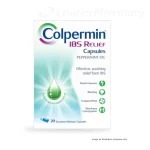
Colpermin Capsules
This is a UK licensed Pharmacy (P) medicine — gastro-resistant capsules containing 0.2ml peppermint oil (200mg) for the symptomatic relief of irritable bowel syndrome (IBS). So each capsule delivers a controlled dose of peppermint oil that releases in the small intestine (not the stomach), where menthol relaxes smooth muscle spasm, reduces abdominal cramping, and eases the pain and distension of IBS. As a result, Colpermin fits adults with diagnosed IBS wanting evidence-based antispasmodic relief without prescription medication. Important: the enteric coating is essential — capsules must be swallowed whole with water, not chewed or crushed, and mustn’t be taken alongside antacids, PPIs, or H2 blockers within 2 hours. Available at Courier Pharmacy.
Five key takeaways
- This is a UK licensed Pharmacy (P) medicine — enteric-coated capsules of peppermint oil (0.2ml/200mg) NICE-recommended first-line antispasmodic for IBS with abdominal pain, cramping, spasm, or distension
- Works through smooth muscle relaxation. Menthol (the main active constituent of peppermint oil) blocks calcium channels in intestinal smooth muscle, reducing spasm and cramping. Also has mild anti-inflammatory and antimicrobial effects, and may reduce visceral hypersensitivity
- The enteric coating is essential and non-negotiable. Capsules are designed to survive stomach acid and release peppermint oil only in the small intestine. Chewing, crushing, or taking with antacids/PPIs/H2 blockers within 2 hours breaks this coating — causing heartburn instead of intestinal relief
- Realistic timeline: some patients notice initial improvement within days, but consistent effect usually establishes over 1-2 weeks of regular use. Course typically continues until symptoms settle (often 2-4 weeks), can be repeated as needed for symptom flares
- Standard dosing: 1 capsule three times daily before meals, can increase to 2 capsules three times daily if symptoms severe. Swallow whole with water. Not for children under 15, achlorhydria (absent stomach acid), or known peppermint allergy. Safe in most other adults including short-term use in pregnancy after discussion
At Courier Pharmacy, we believe in treatment that fits the person — but only where it’s honest, safe, and consented to.
This page covers what Colpermin capsules are, how peppermint oil works as an antispasmodic through smooth muscle relaxation, who they may suit for IBS management, and how they compare to mebeverine (Colofac), Buscopan, alverine (Spasmonal), and other IBS treatment approaches including dietary strategies like the low FODMAP diet.
The peppermint oil enteric-coated capsules for irritable bowel syndrome (IBS), a widely-used over-the-counter treatment for the abdominal pain, bloating, and spasm-related symptoms of IBS.
Peppermint oil has established evidence as an antispasmodic in IBS, working directly on gut smooth muscle to reduce spasm — but only when delivered to the intestine rather than the stomach, which is what makes the enteric coating essential.
When your pharmacist might recommend it (best fit):
- Your IBS symptoms are mainly abdominal pain, cramping, and spasm
- Your GP has confirmed IBS, or your symptoms clearly match a typical IBS pattern without red flags
- You’ve already tried lifestyle steps (diet tweaks, stress support, fibre adjustment) and want an extra symptom option
- You want a non-prescription antispasmodic before moving on to prescription choices (e.g. mebeverine/Colofac, alverine/Spasmonal, hyoscine/Buscopan)
What it is (in plain English):
- Colpermin is an enteric?coated peppermint oil capsule.
- The enteric coating helps the capsule pass through the stomach and release in the intestine, where it’s more likely to help with spasm-type IBS pain.
How it’s different from other IBS options:
- Buscopan (hyoscine): an anticholinergic antispasmodic (different mechanism and side?effect profile; availability depends on pack).
- Colofac (mebeverine): a prescription antispasmodic that acts on gut smooth muscle differently.
- Fybogel / bulk-forming laxatives: mainly help stool consistency/constipation, not cramping/spasm.
- Imodium (loperamide): targets diarrhoea, not pain/spasm.
- Peppermint tea / peppermint-flavoured products: usually don’t deliver enough peppermint oil to the intestine to have a reliable antispasmodic effect.
Who it’s usually for:
Typically adults and young people aged 12+ (Pharmacy (P) medicine).
How we’ll position it on courierpharmacy.co.uk:
- Explain the enteric?coating “why” clearly (so it doesn’t sound like marketing fluff).
- Place Colpermin honestly in the IBS toolkit: lifestyle first, then symptom options, then prescription routes if needed.
- Signpost red flags that mean symptoms should be checked, not self-treated (e.g. bleeding, unexplained weight loss, persistent. However, new symptoms over a certain age, severe or worsening pain, night-time symptoms, family history of bowel cancer/IBD).
Colpermin versus other treatments
Where it fits vs alternatives
Vs Buscopan (hyoscine)
- Different mechanism: anticholinergic antispasmodic vs peppermint oil’s smooth?muscle relaxing effect
- Different side effects: Buscopan can cause dry mouth and urinary retention; peppermint oil is more likely to cause heartburn/reflux, especially if the capsule breaks or dissolves too early
Vs Colofac (mebeverine)
- Different antispasmodic
- Prescription-only option (often used when OTC choices aren’t enough)
Vs Fybogel and other laxatives
- Different target: laxatives help stool consistency/constipation, not cramping/spasm
Vs Imodium (loperamide)
- Different target: loperamide helps diarrhoea, not pain/spasm
Vs Apercap peppermint oil capsules
- Same active ingredient (peppermint oil)
- Mainly an alternative brand choice (differences may be in capsule design/excipients/price)
Treatment dosage Colpermin capsules
Standard use:
- Adults and adolescents from 12: 1-2 capsules three times daily, swallowed whole, at least 30 minutes before food
- Continue as needed for symptom control
- Longer-term use: reassess periodically
Alternative timing:
Additionally, some patients: 1 capsule 15-30 minutes before meals
Individualise timing based on symptom pattern
How to take:
- Take at least 30 minutes before food (empty stomach helps enteric coating)
- Swallow whole with water
- Never chew, crush, or break open
- Avoid dairy or alkaline foods immediately (may weaken coating)
Practical tips:
- Set reminders for pre-meal timing
- Note which meals trigger symptoms most
- Track effectiveness over 2-4 weeks
- Continue lifestyle measures alongside
- Consider dietary reflection alongside
When to expect what:
- Some patients: immediate relief with individual dose
- Some patients: gradual improvement over 2-4 weeks
- Not curative — provides symptom management
For example, when to stop and seek advice:
- Symptoms worsening rather than improving
- Red flags develop (weight loss, bleeding, etc)
- Signs of allergic reaction
- No benefit after 4 weeks
Don’t take Colpermin if:
- You’re allergic to peppermint oil or menthol
- You have symptoms with red flags (see above)
- You have severe hepatic impairment
- Children under 12 typically (paediatric assessment)
Use with care if:
- Pregnancy (limited data — discuss)
- Breastfeeding (limited data — discuss)
- Reflux disease already present (may worsen if capsules damaged)
- Absorption issues affecting enteric coating
Overview of Colpermin Capsules
Three things worth knowing:
- Peppermint oil enteric-coated — the coating is essential for gut delivery.
- Antispasmodic for pain and bloating, not for stool consistency.
- Sits within wider IBS management including diet and stress approaches.
Why choose Courier Pharmacy for IBS treatment
At Courier Pharmacy, our approach starts with a simple idea: treatment should fit the person, not force the person to fit the system.
Dr Ada Jex-Cori
Our service is shaped by the philosophy of Dr Ada Jex-Cori, our brand pharmacist.
Dr Ada represents the spirit of the pharmacy: evidence-led, community-rooted, and willing to challenge the one-size-fits-all approach to medicine. She is named in honour of three pioneering women in science: Ada Lovelace, the mathematician and visionary; Sophia Jex-Blake, the first female doctor in the UK who fought the medical establishment; and Gerty Cori, the biochemist and Nobel Prize winner.
In our fictional world of Etherwell, Dr Ada fights against pharma’s standardised approach to medicine. In the real world, she represents what we stand for. Her view is straightforward: you are not broken. The system is. And we are here to change that.

IBS deserves serious attention
IBS is often dismissed as trivial. Courier Pharmacy is different. So we recognise that:
- IBS affects 10-20% of UK adults — around 8-12 million people
- It disproportionately affects women (2:1 ratio)
- It significantly reduces quality of life
- It causes real physical symptoms with real functional impact
- It’s associated with anxiety, depression, and reduced work productivity
- It has genuine economic impact (sick days, healthcare use)
- It’s often misunderstood or dismissed by others
- Effective symptom management genuinely matters
After all, IBS has a real impact on daily life. So our pharmacist takes it seriously.
Honest framing about IBS being a syndrome, not a single condition
IBS is genuinely complex:
- IBS-C (constipation-predominant): straining, hard stools, incomplete evacuation
- IBS-D (diarrhoea-predominant): frequent loose stools, urgency
- IBS-M (mixed): alternating constipation and diarrhoea
- IBS-U (unclassified): symptoms don’t fit clear pattern
- Different subtypes need different treatment approaches
- Individual triggers vary widely (foods, stress, hormones)
- Comprehensive management often needs medication plus lifestyle/dietary approaches
Honest framing about the enteric coating
This actually matters:
- The enteric coating isn’t optional formulation detail — it’s central to how Colpermin works
- Peppermint oil released in the stomach causes heartburn, not intestinal relief
- Antacids and PPIs can prematurely dissolve the coating
- So timing matters if you take acid-reducing medications
- Following the technique guidance genuinely affects whether the medication works properly
Honest framing about peppermint oil vs mebeverine
The evidence base:
- NICE actually rates peppermint oil evidence base higher than mebeverine’s
- Well-conducted meta-analyses show peppermint oil is effective for IBS symptoms
- Peppermint oil has stronger placebo-controlled evidence than mebeverine
- Both are reasonable first-line options
- Individual response varies — worth trying if one hasn’t worked
Honest framing about diet and IBS
The often-overlooked foundation:
- Dietary triggers are important in most IBS patients
- Low FODMAP diet has 70% response rates in studies — often better than any single medication
- Regular meals and adequate fluid intake help
- Some patients need dietitian guidance
- Medication like Colpermin works alongside dietary approaches, not instead of them
Honest framing about when IBS needs assessment
Not every abdominal symptom is IBS:
- New-onset symptoms over 50 need assessment
- Red flag symptoms (bleeding, weight loss, family history) need assessment
- Progressive worsening symptoms need assessment
- Symptoms not responding to standard treatment need assessment
- Coeliac testing is often appropriate before IBS diagnosis
- Inflammatory bowel disease exclusion may be needed
If any concerning features are present, our pharmacist will recommend GP or specialist review.
IBS and the bigger picture
IBS rarely sits in isolation. So our pharmacist can discuss:
- Underlying triggers (dietary, hormonal, stress)
- Coexisting conditions (anxiety, depression, fibromyalgia)
- Menstrual cycle effects on IBS
- Sleep quality and gut function
- Physical activity and IBS
- Gut-brain axis approaches
- When dietary interventions like low FODMAP fit
- When psychological approaches (CBT, hypnotherapy) fit
- When prescription options might help
- When specialist referral makes sense
Sometimes the IBS is the visible part of a wider picture worth talking through.
Pharmacist support before and after supply
Our team is here to discuss:
- Whether Colpermin fits your IBS pattern
- Correct technique and timing
- How to combine with dietary and lifestyle approaches
- What to do if it doesn’t work
- When to consider other options
- When to seek further assessment
Trust earned, not claimed
We are GPhC-regulated, and our content is grounded in the licensed Colpermin Summary of Product Characteristics (Tillotts Pharma), NICE Clinical Knowledge Summary on IBS, NICE guideline on IBS in adults (CG61), decades of published clinical evidence on peppermint oil for IBS, British Society of Gastroenterology IBS guidelines, and the real experience of patients managing IBS.
If Colpermin isn’t the right answer for your situation, we’ll tell you honestly. After all, getting the right treatment matters more than fulfilling a request.
How supply works
This is a UK Pharmacy (P) medicine, so the supply process happens through pharmacist consultation.
How our service works
- Complete the online consultation on courierpharmacy.co.uk
- Our UK-qualified pharmacist reviews your IBS symptoms and history
- If suitable, the pharmacist arranges supply
- Your order is dispatched in plain, discreet packaging
- Free pharmacist support is available throughout use
- Review as needed to assess response
When other options might suit better
If Colpermin isn’t right, we’ll explain why. Other options may include:
- Mebeverine (Colofac) — alternative antispasmodic mechanism
- Buscopan (hyoscine butylbromide) — occasional cramp relief
- Alverine (Spasmonal) — different antispasmodic
- Fybogel Mebeverine — combined bulk + antispasmodic for IBS-C
- Simethicone — for bloating and gas
- Loperamide — for IBS-D episodes
- Cosmocol or laxatives — for IBS-C
- Dietary approach — low FODMAP diet under dietitian guidance
- Prescription options for resistant cases (linaclotide, prucalopride, low-dose amitriptyline)
- Psychological therapies (CBT, gut-directed hypnotherapy)
- GP or gastroenterology assessment if diagnosis unclear or red flags present
Our community service
Our free fortnightly drop-in clinics at Insomnia, Derby run every other week from 10am to 12pm.
Healthcare shouldn’t only happen when you’re paying for it. So we show up, even when it’s free.
We cover IBS, digestive health, constipation, pain, migraine, headache, skincare, acne, hair loss, MCAS, weight management, menopause, women’s health, men’s health, chronic pain, allergies, asthma, sleep, and whatever else people bring through the door. No appointment needed, no charge, no pressure.

How Colpermin works
Understanding the mechanism helps explain both the antispasmodic action and why the enteric coating matters so much.
The IBS mechanism
IBS involves multiple factors:
- Visceral hypersensitivity — heightened perception of normal gut sensations
- Abnormal gut motility — either too fast (diarrhoea) or too slow (constipation)
- Smooth muscle hyperactivity — causing cramping and spasm
- Gut-brain axis dysfunction — bidirectional communication between gut and brain
- Gut microbiome imbalance — dysbiosis contributing to symptoms
- Mild inflammation — low-grade immune activation
- Dietary triggers — particularly FODMAPs (fermentable carbohydrates)
- Psychological factors — stress, anxiety, past trauma
How peppermint oil targets the mechanism
- Capsule swallowed whole with water
- Enteric coating protects capsule from stomach acid
- Capsule passes intact from stomach into small intestine
- Alkaline pH of small intestine dissolves the enteric coating
- Peppermint oil released — begins working locally
- Menthol enters intestinal smooth muscle cells
- Blocks calcium channels in smooth muscle
- Reduces calcium influx into smooth muscle cells
- Muscle relaxation results
- Spasm and cramping reduce
In short, peppermint oil targets the smooth muscle spasm component of IBS directly. After all, this is why it works best for pain-predominant IBS presentations — that's where the spasm mechanism is most prominent.
Additional mechanisms
Peppermint oil has other effects:
- Mild antibacterial activity against some gut pathogens
- Mild anti-inflammatory effects
- May reduce visceral hypersensitivity through direct nerve effects
- Some effect on gas production
- May reduce small intestinal bacterial overgrowth (SIBO) in some patients
Why the enteric coating is critical
Understanding this matters:
- Peppermint oil relaxes ALL smooth muscle — including the lower oesophageal sphincter
- The lower oesophageal sphincter normally prevents stomach acid rising into the oesophagus
- If peppermint oil is released in the stomach, it relaxes this sphincter
- Causing acid reflux and heartburn
- Also causing menthol burps and unpleasant taste
- The enteric coating prevents this by keeping the peppermint oil sealed until it reaches the small intestine
- Any factor that breaks the coating causes these unwanted stomach effects
Onset timeline
What to expect:
- First few days: some patients notice early improvement in cramping
- Week 1: many patients see meaningful symptom reduction
- Week 2: consistent benefit typically established
- 2-4 weeks: standard course duration
- Beyond 4 weeks: can continue if benefit continues and pharmacist agrees
- If no benefit after 2 weeks: consider whether IBS or different diagnosis

How to use Colpermin capsules
Correct technique matters for both effectiveness and side effect avoidance.
Standard dosing
- 1 capsule three times daily before meals
- Take 15-30 minutes before meals
- Increase to 2 capsules three times daily if symptoms severe
- Continue until symptoms subside (typically 2-4 weeks)
- Can be continued longer if benefit continues
- Can be restarted for symptom flares
Correct swallowing technique
- Take capsule whole with a full glass of water
- Don't chew, crush, or break the capsule (destroys enteric coating)
- Don't take with hot drinks (may damage coating)
- Sit upright when taking
- Take before food, not during or after
The critical timing with antacids and acid-reducing drugs
Space by at least 2 hours from:
- Antacids (Rennie, Gaviscon, Milk of Magnesia)
- Proton pump inhibitors (omeprazole, lansoprazole, pantoprazole, esomeprazole)
- H2 blockers (famotidine, ranitidine — where still available)
- Alkaline mineral supplements
After all, these medications reduce stomach acidity — which causes the enteric coating to dissolve prematurely in the stomach. So the peppermint oil releases in the wrong place, causing heartburn instead of small intestinal antispasmodic effect.
What to combine with
Colpermin often works better as part of comprehensive IBS management:
- Dietary changes (regular meals, moderate fibre, low FODMAP where appropriate)
- Adequate fluid intake
- Stress management (mindfulness, relaxation, sometimes therapy)
- Physical activity
- Sleep hygiene
- Bulk-forming laxatives if constipation dominant
- Anti-diarrhoeals (loperamide) if diarrhoea dominant
- Simethicone for bloating (short-term)
What to avoid
- Taking Colpermin with antacids/PPIs/H2 blockers close together
- Chewing or crushing capsules
- Taking with hot drinks or hot food
- Doubling up if you miss a dose
- Combining with other antispasmodics (limited benefit, more side effects)
If you miss a dose
- Take the next scheduled dose
- Don't take extra to compensate
- Missing occasional doses won't significantly affect outcomes
Storage
- Store below 25°C
- In original blister packaging
- Away from moisture
- Keep out of reach of children
- Use by expiry date on packaging

Warnings and precautions
Colpermin is generally well-tolerated but some situations require caution.
Don't use Colpermin if you
- Have known allergy to peppermint oil, menthol, or any excipient
- Have achlorhydria (absent stomach acid production)
- Have severe hepatic impairment
- Are under 15 years old (not licensed)
- Have an undiagnosed abdominal pain condition (needs assessment first)
The IBS diagnosis warning
This matters:
- Colpermin is for IBS specifically, not general abdominal pain
- IBS should be diagnosed properly first
- Symptoms suggesting other conditions need assessment
- Never self-treat undiagnosed persistent abdominal pain with just antispasmodics
Red flag symptoms warning
These need medical assessment, not just antispasmodics:
- New-onset symptoms over age 50
- Blood in stool or rectal bleeding
- Unexplained weight loss
- Iron deficiency anaemia
- Family history of colorectal cancer or IBD
- Nocturnal symptoms (waking from sleep with pain)
- Severe unremitting pain
- Progressive symptoms
- Fever with pain
- Palpable abdominal mass
Use with care if you
- Have hiatus hernia or gastro-oesophageal reflux (may worsen if coating breaks)
- Take regular antacids, PPIs, or H2 blockers (needs timing separation)
- Have significant hepatic impairment
- Are pregnant (limited data — discuss with prescriber)
- Have gallstone disease
- Are elderly with multiple conditions
Pregnancy and breastfeeding
Limited data:
- Colpermin is not recommended during the first trimester of pregnancy
- Later pregnancy: use only if benefit clearly outweighs risk
- Breastfeeding: menthol excretion in breast milk unclear; avoid unless necessary
- Discuss with prescriber if pregnant or planning pregnancy
Use in older adults
Generally well-tolerated:
- No specific dose adjustment needed
- Higher risk of undiagnosed serious conditions — assessment particularly important
- Consider polypharmacy interactions
- Consider gastric acid production (lower in some elderly patients)
Driving and machinery
Colpermin doesn't affect driving or operating machinery.
When to seek medical advice
- Any red flag symptoms as listed above
- Symptoms not improving after 2 weeks
- Symptoms worsening despite treatment
- Severe reflux or heartburn
- Signs of allergic reaction
- Persistent anal irritation or burning
- Yellow discoloration of skin or eyes

Side effects
Colpermin is generally well-tolerated when taken correctly. So most side effects relate to enteric coating issues or individual sensitivity.
Common side effects
- Heartburn or acid reflux (typically from coating breach)
- Menthol taste in mouth (from coating breach)
- Menthol burps
- Anal irritation or burning sensation
- Perianal discomfort
Less common side effects
- Nausea
- Vomiting
- Headache
- Skin rash
- Contact dermatitis around the mouth
Rare side effects
- Allergic reactions
- Elevated liver enzymes (very rare)
- Blurred vision
- Ataxia (unsteadiness)
Very rare side effects
- Severe allergic reactions (anaphylaxis)
- Severe hepatic reactions
The heartburn question
This is important:
- Heartburn with Colpermin often means the enteric coating has been compromised
- Check: are you chewing/crushing? Taking with hot drinks? Taking with antacids?
- Correct the technique and heartburn often resolves
- If heartburn persists with correct use, discuss with pharmacist
The anal burning question
Uncomfortable but understandable:
- Some patients experience anal irritation from menthol excretion
- Usually mild
- Adequate hydration and softening stools helps
- If severe, reduce dose or discontinue
Stop and seek medical help if
- Signs of severe allergic reaction
- Yellow discoloration of skin or eyes
- Severe or persistent abdominal pain
- Severe headache or vision changes
Yellow Card reporting
If you notice any side effects, please report them through the MHRA Yellow Card scheme at https://yellowcard.mhra.gov.uk/, or talk to our pharmacist.

Drug interactions
Colpermin has fewer systemic interactions than many prescription IBS treatments. The most important interactions are related to the enteric coating.
The critical enteric coating interactions
Space by at least 2 hours:
- Antacids (Rennie, Gaviscon, Alka-Seltzer, Milk of Magnesia)
- Proton pump inhibitors (omeprazole, lansoprazole, pantoprazole, esomeprazole, rabeprazole)
- H2 blockers (famotidine, ranitidine — where still available)
- Alkaline mineral supplements
- These raise gastric pH and can cause premature dissolution of enteric coating
Systemic interactions
- Ciclosporin — peppermint oil may affect ciclosporin levels; monitor if combined
- Some CYP450 substrate drugs — mild effects possible
- Menthol may affect metabolism of certain drugs at high doses
Generally safe combinations
Most medicines are fine alongside Colpermin:
- Paracetamol
- NSAIDs (though these may worsen IBS)
- Most antibiotics
- Blood pressure medicines
- Diabetes medicines
- Antidepressants (including amitriptyline commonly used for IBS)
- Contraceptives
- HRT
- Loperamide (for IBS-D)
- Cosmocol or other osmotic laxatives (for IBS-C)
- Bulk-forming laxatives (Fybogel)
- Buscopan (though usually not needed together)
Alcohol
- Alcohol can worsen IBS symptoms
- No direct interaction with peppermint oil
- Reducing alcohol often helps IBS management
Herbal remedies
- Don't combine with other herbal preparations without pharmacist advice
- Menthol-containing preparations may have additive effects
Frequently asked questions

How is it different from Buscopan?
Different mechanisms:
- Colpermin: peppermint oil — smooth muscle calcium channel blocker
- Buscopan: hyoscine butylbromide — antimuscarinic
- Buscopan works faster for acute cramps
- Colpermin is for regular management
- Both can be used together if needed
How is it different from mebeverine (Colofac)?
Two well-established antispasmodics:
- Colpermin: peppermint oil
- Mebeverine: musculotropic antispasmodic
- Both target smooth muscle spasm
- Peppermint oil actually has stronger evidence base per NICE
- Individual response varies — worth trying if one hasn't worked
How fast does it work?
Gradual effect:
- Some early improvement in cramping within days
- Consistent benefit typically at 1-2 weeks
- Standard course 2-4 weeks
- Not for acute cramp relief (Buscopan better for that)
Why must I take it before meals?
Two reasons:
- Empty stomach helps enteric coating pass through more quickly
- Timing before meals means peppermint oil is active in the small intestine when food arrives
- Post-meal cramping is a common IBS trigger — pre-meal dosing addresses this
Why can't I chew the capsule?
Chewing destroys the enteric coating:
- Peppermint oil then releases in the mouth and stomach
- Causes heartburn, reflux, menthol taste
- Doesn't reach the small intestine where it should work
- Swallowing whole is essential
Why can't I take it with antacids?
Antacids raise stomach pH:
- The enteric coating is designed to dissolve in alkaline pH
- Antacids make the stomach alkaline
- Coating dissolves in the stomach instead of the small intestine
- Peppermint oil releases in the wrong place
- Space by at least 2 hours
Can I take it with PPIs like omeprazole?
Yes, with careful timing:
- PPIs reduce stomach acid production
- Higher gastric pH can affect enteric coating
- Take Colpermin at least 2 hours before or after PPI dose
- Or discuss whether the PPI is still needed with your GP
What if I get heartburn?
Check technique first:
- Are you chewing or crushing? — must swallow whole
- Are you taking with hot drinks? — use cold water
- Are you taking with antacids/PPIs? — space by 2 hours
- If heartburn persists with correct technique, may not be right for you
Can I take it long-term?
Standard courses are 2-4 weeks:
- Can be continued longer if benefit continues
- Can be restarted for symptom flares
- No specific evidence of harm with longer use
- Review periodically with pharmacist
Can I take it during pregnancy?
Not recommended in first trimester:
- Limited pregnancy safety data
- First trimester: avoid
- Later pregnancy: only if benefit clearly outweighs risk
- Discuss with prescriber or GP if pregnant
Can I take it while breastfeeding?
Best avoided:
- Menthol excretion in breast milk unclear
- Alternative options usually preferred
- Discuss with pharmacist or GP
What if it doesn't work?
Options after inadequate response:
- Try alternative antispasmodic (mebeverine, alverine, Buscopan)
- Consider dietary approach (low FODMAP)
- Add psychological therapies
- Review diagnosis with GP
- Consider prescription options
Does it work for all types of IBS?
Best for pain-predominant IBS:
- Works across all IBS subtypes (IBS-C, IBS-D, IBS-M)
- Best evidence for pain and cramping
- May not address constipation or diarrhoea alone
- Often combined with subtype-specific treatment
Can I combine with dietary changes?
Yes — often the best approach:
- Colpermin plus dietary changes often more effective than either alone
- Low FODMAP diet particularly effective for many IBS patients
- Regular meals, adequate fluid, moderate fibre all help
- Identifying and avoiding personal triggers matters
Can I combine with stress management?
Yes — often essential:
- Stress is a major IBS trigger for many patients
- Mindfulness, relaxation, CBT can all help
- Gut-directed hypnotherapy has strong evidence for IBS
- Combined approach (medication plus stress management) often best
What if I get anal burning?
Uncomfortable but common:
- Some patients experience anal irritation from menthol
- Usually mild
- Adequate hydration helps
- If severe, reduce dose
- If persistent, may need to discontinue
How should I store the capsules?
- Below 25°C
- In original blister packaging
- Away from moisture and heat
- Keep out of reach of children
- Use by expiry date
Is my packaging discreet?
- Plain packaging with no mention of contents
- Suitable for delivery to home or workplace
How do I order from Courier Pharmacy?
Complete the consultation on courierpharmacy.co.uk. Our pharmacist will review your IBS symptoms and arrange dispensing if suitable. Your order goes out in plain, discreet packaging with support available throughout your use.
More than a prescription: our community
Healthcare shouldn't only happen when you're paying for it.
Every fortnight we run free drop-in talks and clinics at Insomnia, Derby, from 10am to 12pm. So we show up, even when it's free.
Bring a question, bring a friend, bring a stack of bewildering letters from another clinic. We'll sit with you.
We cover IBS, digestive health, constipation, pain, migraine, skincare, acne, hair loss, MCAS, weight management, menopause, women's health, men's health, chronic pain, allergies, asthma, sleep, and whatever else people bring through the door. No appointment. No cost. No pressure. Just real support and treatment that fits.
This page is for information only and isn't a substitute for personal medical advice. Colpermin is a licensed Pharmacy medicine for IBS symptomatic relief. Don't use if you have known allergy to peppermint or menthol, achlorhydria, severe hepatic impairment, or if you're under 15 years old. New-onset symptoms over age 50, blood in stool, unexplained weight loss, iron deficiency anaemia, family history of colorectal cancer, or nocturnal symptoms need medical assessment before symptomatic treatment. Colpermin must be swallowed whole and separated from antacids/PPIs/H2 blockers by at least 2 hours. Not recommended in first trimester pregnancy or breastfeeding. Seek urgent medical help for severe allergic reaction, yellow discoloration of skin/eyes, or severe or persistent abdominal pain. Signs of severe allergic reaction (facial swelling, breathing difficulty, widespread rash) need immediate medical attention (999).
How this content was created
Written by the Courier Pharmacy editorial team and reviewed by a GPhC-registered pharmacist.
The content is grounded in the licensed Colpermin Summary of Product Characteristics (Tillotts Pharma), NICE Clinical Knowledge Summary on IBS, NICE clinical guideline CG61 on IBS in adults, British Society of Gastroenterology IBS guidelines, decades of published clinical evidence on peppermint oil for IBS, and the real experience of patients managing IBS under pharmacist-guided care. In addition, it draws on the real questions patients bring to our consultation pathway and drop-in clinics in Derby.
References
[1] Electronic Medicines Compendium (emc) Colpermin IBS Relief — Summary of Product Characteristics. Available at:https://www.medicines.org.uk/emc/product/1076/smpc
[2] National Institute for Health and Care Excellence — Clinical Knowledge Summary on Irritable Bowel Syndrome. Available at: https://cks.nice.org.uk/topics/irritable-bowel-syndrome/
[3] National Institute for Health and Care Excellence (2008, updated 2017) Irritable bowel syndrome in adults: diagnosis and management (CG61). Available at: https://www.nice.org.uk/guidance/cg61
[4] NHS (2024) Irritable bowel syndrome (IBS). Available at: https://www.nhs.uk/conditions/irritable-bowel-syndrome-ibs/