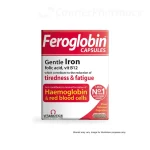
The UK’s No.1 iron supplement with 17mg iron plus B12, folic acid, B6, zinc, and copper
Slow-release capsule spreads iron release over hours, gentler on the stomach than standard iron tablets
For adults with low iron intake: monthly cycle, athletes, slimmers, or dietary shortfall. Not for treating diagnosed anaemia
One capsule daily with main meal. 30-pack lasts one month. Take with vitamin C for better absorption
Halal-certified but NOT suitable for vegetarians or vegans. NOT for children. Food supplement (not a licensed medicine). Available from Courier Pharmacy
Feroglobin Capsules (also called Feroglobin-B12 Capsules) are a daily iron food supplement from Vitabiotics. Each capsule holds a moderate dose of iron along with a group of blood-forming nutrients: vitamin B12, folic acid, vitamin B6, zinc, and copper.
Notably, Vitabiotics is the UK’s leading vitamin brand. Feroglobin is their flagship iron supplement and the UK’s No.1 iron supplement brand.
The 30-capsule pack lasts one month at one capsule per day.
The slow-release format
The standout feature of Feroglobin is the slow-release capsule. Because standard iron tablets deliver their full iron dose all at once, this can hit the stomach lining hard and cause nausea, constipation, or dark stools. So many people can’t tolerate standard iron tablets for this reason.
However, Feroglobin’s capsule holds sustained-release pellets. So iron and the other nutrients release gradually over several hours after the capsule dissolves. As a result, no single point delivers a big iron pulse to your stomach. This makes Feroglobin much gentler than traditional iron tablets, and many people who can’t tolerate other iron supplements manage Feroglobin well.
Why iron matters beyond just anaemia
Iron is essential for haemoglobin, the protein in red blood cells that carries oxygen. So low iron reduces your body’s oxygen delivery, which shows up as tiredness, breathlessness on exertion, pale skin, and reduced exercise tolerance.
Also, iron plays a role in cognitive function, immune function, temperature regulation, and thyroid hormone production. So low iron can affect concentration, memory, mood, susceptibility to infection, and hair or nail quality.
Many people fall short of the daily iron target (8.7mg for men, 14.8mg for pre-menopausal women) from diet alone, particularly if they eat little red meat, follow vegetarian or vegan diets, drink lots of tea (which reduces iron absorption), or lose iron through heavy periods.
Why the added nutrients matter
Iron alone isn’t always enough for optimal blood health. So Feroglobin adds:
Vitamin B12: needed for red blood cell formation. B12 deficiency causes its own type of anaemia (megaloblastic anaemia)
Folic acid: also needed for red blood cell formation. Folic acid deficiency causes megaloblastic anaemia too
Vitamin B6: supports haemoglobin synthesis
Zinc: supports immune function and general cellular metabolism
Copper: helps iron transport in the body
Together, these nutrients support blood formation more effectively than iron alone.
Food supplement status
Feroglobin Capsules sit in the food supplement category, not the licensed medicine one. So they don’t carry MHRA approval and can’t make medical claims.
We can only use the approved EU/UK health claims for its nutrients. So we can’t say the product ‘treats anaemia’ or ‘cures’ anything. However, we can say the nutrients support normal red blood cell formation and help reduce tiredness and fatigue.
Key features and details
Main features: slow-release iron plus B12, folic acid, B6, zinc, and copper in a once-daily capsule
Iron: 17mg (as ferrous fumarate, an organic iron compound)
The UK’s No.1 iron supplement brand, with slow-release iron plus B12, folic acid, B6, zinc, and copper for gentle daily support
Feroglobin Capsules are a daily food supplement from Vitabiotics. Each capsule holds a moderate dose of iron (17mg as ferrous fumarate) plus vitamin B12, folic acid, vitamin B6, zinc, and copper. These nutrients work together to support normal red blood cell formation and help reduce tiredness and fatigue.
The standout feature is the slow-release delivery system. In fact, the capsule releases its contents gradually rather than all at once. Because standard iron tablets can cause stomach upset, nausea, or constipation from the high iron pulse hitting the stomach lining, the slow-release format spreads the release over hours. So this makes Feroglobin much gentler on the stomach than traditional iron tablets.
Notably, Feroglobin is the UK’s No.1 iron supplement brand. Vitabiotics has been making it for decades, and the formula has stayed largely consistent, which speaks to how well it works for the target users.
Who is Feroglobin for? Primarily, women during their monthly cycle (which depletes iron each month), athletes (who lose iron through sweat and muscle turnover), slimmers on restricted diets, and anyone whose dietary iron intake falls short.
However, Feroglobin is a maintenance and prevention supplement, not a treatment for diagnosed iron deficiency anaemia. If you have confirmed anaemia from blood tests, you’ll need higher-dose iron from your GP. Prescription ferrous sulphate provides around 65mg of elemental iron per tablet, and prescription ferrous fumarate around 100mg. Feroglobin’s 17mg suits topping up, not treating deficiency.
Take one capsule daily with your main meal. Any main meal of the day works. So taking with food helps absorption and reduces the small chance of stomach upset (already low with the slow-release format).
Feroglobin also contains B12 (5 micrograms) and folic acid (500 micrograms) alongside iron. These three nutrients work together in red blood cell formation. So iron alone isn’t always enough. Notably, if you have low B12 or folic acid, iron supplementation on its own won’t fully address your tiredness or blood picture.
An important note: Feroglobin Capsules contain bovine gelatin in the capsule shell. So they’re not suitable for vegetarians or vegans. However, the gelatin is Halal-certified. For vegetarians, Vitabiotics makes Feroglobin B12 Liquid (a vegetarian option), or you can consider Floradix liquid iron (another vegetarian option we stock).
Feroglobin is a food supplement, not a licensed medicine. So it works best alongside a healthy diet with iron-rich foods (red meat, poultry, fish, dark leafy greens, beans, lentils, fortified cereals). Also, vitamin C helps iron absorption, so pair with a glass of orange juice or take with vitamin-C-rich foods.
At Courier Pharmacy, we stock Feroglobin Capsules as part of our women’s health and general wellness range. Our pharmacy team can help you decide if Feroglobin suits your needs, or whether a stronger option (Floradix liquid, or a GP prescription for confirmed deficiency) would fit better.
When to see a doctor about iron levels or tiredness
Feroglobin Capsules provide daily iron support for maintenance and prevention. However, some situations need medical assessment rather than just a supplement.
Persistent tiredness that doesn’t improve with rest, adequate sleep, and a good diet: needs blood tests to check for iron deficiency anaemia, B12 deficiency, thyroid disease, and other causes
Very heavy or prolonged periods (menorrhagia): needs GP assessment for cause and treatment beyond just iron replacement
Blood in stools, black tarry stools, or blood in urine: needs urgent investigation for possible bleeding
Pale skin, breathlessness, dizziness, or fast heartbeat: possible signs of anaemia, needs blood tests
Hair loss beyond normal shedding: often linked to iron deficiency, needs proper assessment
Restless legs syndrome: often linked to iron deficiency, needs blood tests to confirm
Suspected pregnancy: iron needs go up. Talk to your midwife or GP about the right iron and folic acid intake, and switch to a pregnancy-specific supplement like Pregnacare
Breastfeeding: iron needs stay elevated. Use Pregnacare Breast-feeding or discuss with your midwife
Haemochromatosis or other iron-loading conditions: don’t use Feroglobin. Iron supplements can worsen iron overload
Epilepsy: consult your GP first, as the manufacturer advises caution
You take other iron supplements, multivitamins, or medicines that interact with iron
Blood test results showing borderline or low ferritin, haemoglobin, or MCV: proper GP-led investigation matters, not just self-supplementation
Feroglobin Capsules are the UK’s No.1 iron supplement, with 17mg iron (as ferrous fumarate) plus B12, folic acid, B6, zinc, and copper in a slow-release capsule.
The slow-release system spreads iron release over hours, making it gentler on the stomach than standard iron tablets.
For maintenance and prevention (monthly cycle, athletes, slimmers, low dietary intake). NOT a treatment for diagnosed iron deficiency anaemia (which needs higher-dose GP prescription).
Dose: one capsule daily with main meal. 30-pack lasts one month. Pair with vitamin C (orange juice) for better absorption.
Contains bovine gelatin (Halal-certified). NOT suitable for vegetarians or vegans. NOT for children (iron poisoning risk). Food supplement, not a licensed medicine. Available from Courier Pharmacy.
What is Feroglobin Capsules: overview
Where Feroglobin fits in iron supplementation
Iron support falls into two main categories: prevention/maintenance (for people with low intake or higher demand) and treatment (for diagnosed deficiency). Feroglobin sits firmly in the prevention/maintenance category.
For diagnosed iron deficiency anaemia (from GP blood tests), prescription-strength iron is needed. Options include ferrous sulphate 200mg (65mg elemental iron per tablet), ferrous fumarate 322mg (100mg elemental iron), or ferrous gluconate 300mg (35mg elemental iron). These deliver much more iron than Feroglobin’s 17mg.
So Feroglobin’s 17mg is enough for maintenance but not for treating established deficiency. Notably, the trade-off is worth it for many people, as prescription iron often causes more stomach upset than Feroglobin’s slow-release format.
Feroglobin Capsules vs Feroglobin B12 Liquid
Feroglobin B12 Liquid is the liquid version, suitable for people who can’t swallow capsules, for children (under adult supervision), and for vegetarians (no gelatin). It provides similar nutrients in liquid form.
Choose Capsules if you can swallow capsules, don’t need a vegetarian option, and prefer the compact format. Choose Liquid if you need a liquid, a vegetarian option, or a supplement suitable for children.
Feroglobin Capsules vs Floradix Liquid Iron
Floradix is a liquid herbal iron supplement (with ferrous gluconate 10mg per 10ml serving), suitable for vegetarians and vegans. It also holds B vitamins and herbal extracts.
Feroglobin Capsules provide more iron per dose (17mg vs 10mg), come in convenient capsule format, and have a longer track record as a brand. However, Floradix is the standard choice for vegetarians and vegans, and many people prefer its gentle liquid format.
Feroglobin Capsules vs Spatone
Spatone is naturally iron-rich water in sachets (7mg iron per sachet). It’s popular in pregnancy for its very gentle profile and lack of GI side effects. However, the iron dose is lower than Feroglobin.
Choose Spatone if you want the most gentle option and can accept lower iron content. Choose Feroglobin for more iron per dose in a convenient capsule.
Feroglobin Capsules vs prescription iron
Prescription iron (ferrous sulphate, ferrous fumarate, or ferrous gluconate tablets) provides 3-6 times more elemental iron per dose than Feroglobin. So this is what you need for treating diagnosed iron deficiency anaemia.
However, prescription iron often causes more stomach upset. Some patients simply can’t tolerate it. So switching to Feroglobin (slower release, lower dose) is sometimes suggested by GPs for maintenance after initial replenishment, or as a gentler starting option.
Feroglobin Capsules vs Pregnacare
Pregnacare Original contains 17mg iron plus 400?g folic acid, 10?g vitamin D, and 16 other nutrients specifically balanced for pregnancy needs. So during pregnancy, Pregnacare is the more appropriate choice.
Use Feroglobin outside pregnancy for maintenance iron support. Switch to Pregnacare (with midwife or GP advice) during pregnancy.
Feroglobin Capsules vs standalone folic acid
Standalone folic acid 400 micrograms is inexpensive and covers just that one nutrient. It’s ideal for preconception (folic acid alone is fine before pregnancy for most women).
Feroglobin’s 500 micrograms folic acid is bundled with iron and other blood-forming nutrients. So it’s more expensive per unit of folic acid but adds the iron and B-vitamin support.
Feroglobin Capsules vs Boots or supermarket own-brand iron
Own-brand iron supplements from Boots, Superdrug, or supermarkets often provide similar iron content at lower prices. Also, some use slow-release formats too.
Feroglobin’s advantage is the brand consistency (over 30 years on the market), the combined nutrient formula, and the Vitabiotics research background. Own-brands can offer basic iron support at lower cost.
Why choose Courier Pharmacy for your Feroglobin
Registered, independent, and patient-led
Courier Pharmacy is a UK-registered independent pharmacy regulated by the General Pharmaceutical Council. For iron support, getting the right product matters, and getting proper blood tests when needed matters even more.
Our team can help you decide if Feroglobin suits your specific situation, or whether a different iron supplement, or a GP referral for blood tests, would fit better.
Dr Ada Jex-Cori, our brand pharmacist
Our brand pharmacist is Dr Ada Jex-Cori. She represents the spirit of what we do. Named for Ada Lovelace, Sophia Jex-Blake, and Gerty Cori, she stands for evidence-led, unafraid-of-questions medicine. Her message is straightforward. You’re not broken. The system is. We’re here to change that.
Care that keeps showing up
Iron support often runs over months. So we’re here for the follow-up questions along the way: adjusting when your needs change, switching formats, coordinating with GP blood test results, or moving to a different product if Feroglobin isn’t giving you the effect you want.
Buy Feroglobin Capsules 30 Pack from Courier Pharmacy
Feroglobin Capsules 30 Pack is a food supplement available at courierpharmacy.co.uk.
Add Feroglobin Capsules 30 Pack to your basket
Our pharmacy team reviews the sale as part of our routine check
Your order dispatches promptly
Follow the pack directions. Contact us if you have questions
If Feroglobin Capsules aren’t right for your situation, we’ll explain why. Options include Feroglobin B12 Liquid (liquid format, suitable for vegetarians), Floradix Liquid Iron 250ml (liquid, vegetarian, herbal), Spatone (natural iron water sachets), Pregnacare Original or Plus (during pregnancy), Pregnacare Breast-feeding (after birth), Perfectil (beauty focus with some iron), Boots or supermarket own-brand iron (basic budget options), standalone folic acid 400?g or 5mg (for preconception or specific needs), standalone vitamin B12 (for B12 deficiency), or a GP referral for blood tests if underlying iron deficiency is suspected.
Above all, we won’t sell you a supplement that isn’t right for your situation, and we’ll flag when a GP visit matters more than another supplement.
Summary
A daily food supplement providing 17mg iron plus B12, folic acid, B6, zinc, and copper.
Slow-release capsule format spreads iron release over hours, making it gentler on the stomach than standard iron tablets.
Supports normal red blood cell and haemoglobin formation. Helps reduce tiredness and fatigue.
For adults with low dietary iron: women during monthly cycle, athletes, slimmers, or restricted diets. NOT for diagnosed iron deficiency anaemia.
Food supplement, not a licensed medicine. UK’s No.1 iron supplement brand. Available from Courier Pharmacy.
Main nutrients in Feroglobin Capsules
Iron 17mg (as ferrous fumarate)
Iron is essential for haemoglobin, the oxygen-carrying protein in red blood cells. Also, low iron reduces oxygen delivery to tissues, causing tiredness, breathlessness, pale skin, and reduced exercise tolerance.
The 17mg dose is moderate. So this suits maintenance and prevention, but not treatment of established iron deficiency (which needs prescription-strength iron).
The iron comes as ferrous fumarate, an organic iron compound that's well-absorbed compared to some other iron forms.
Approved health claims: iron contributes to normal formation of red blood cells and haemoglobin, and to reduction of tiredness and fatigue. Iron also contributes to normal cognitive function and to normal function of the immune system.
Vitamin B12 5 micrograms
B12 works alongside folic acid in red blood cell formation. Also, B12 deficiency causes its own type of anaemia (megaloblastic anaemia) and can cause neurological symptoms.
Approved health claims: vitamin B12 contributes to normal red blood cell formation and to reduction of tiredness and fatigue.
Folic acid 500 micrograms
Folic acid also plays a role in red blood cell formation. So folic acid deficiency causes megaloblastic anaemia.
Approved health claim: folic acid contributes to normal blood formation.
Vitamin B6 5mg
Vitamin B6 supports haemoglobin synthesis and normal protein and glycogen metabolism.
Approved health claim: vitamin B6 contributes to normal red blood cell formation.
Zinc 12mg
Zinc supports normal immune function and general cellular metabolism.
Approved health claim: zinc contributes to normal function of the immune system.
Copper 1mg
Copper helps iron transport in the body and supports normal iron metabolism.
Approved health claim: copper contributes to normal iron transport in the body.
Other ingredients in Feroglobin Capsules
Capsule shell: Halal bovine gelatin
The capsule shell is made from pharmaceutical-grade gelatin sourced from Halal-certified bovine source. So Feroglobin Capsules are suitable for those following a Halal diet.
However, this means they're NOT suitable for vegetarians or vegans. For those needing a vegetarian iron supplement, consider Floradix Liquid Iron (which we stock) or Feroglobin B12 Liquid (also from Vitabiotics).
Contains sucrose
The sustained-release pellets contain sucrose (sugar). So people with rare hereditary problems of fructose intolerance, glucose-galactose malabsorption, or sucrase-isomaltase insufficiency should discuss with their GP before using.
Made in a nut-handling facility
Feroglobin Capsules are made in a facility that also handles nuts. So people with severe nut allergies should consider whether the cross-contact risk matters for them, and discuss with an allergy specialist if unsure.
What Feroglobin Capsules don't contain
Gluten-free. No artificial colours. No preservatives. Not tested on animals.
Iron, vitamin B12, folic acid, and vitamin B6 all contribute to normal red blood cell formation. So a shortfall in any of these can affect blood formation.
Reducing tiredness and fatigue
Iron, B12, and folic acid all contribute to reducing tiredness and fatigue. Notably, low iron is one of the most common causes of ongoing tiredness in women of reproductive age.
Supporting normal cognitive function
Iron contributes to normal cognitive function. So low iron can affect concentration, memory, and general mental sharpness.
Supporting normal immune function
Iron and zinc both contribute to normal immune function. So maintaining adequate levels helps immune defence.
For women during monthly cycle
Menstruating women lose iron each month through menstrual blood. Because this can add up to significant iron loss, particularly with heavy periods, Feroglobin provides ongoing iron support to help offset that loss.
For athletes
Athletes lose iron through sweat, foot-strike haemolysis (in runners), and increased muscle turnover. So Feroglobin's daily iron intake helps replace these ongoing losses.
For slimmers and restricted diets
Weight loss diets, vegetarian diets (though this pack isn't vegetarian), or otherwise restricted diets can reduce iron intake. Feroglobin fills that gap.
What Feroglobin Capsules aren't for
Not for diagnosed iron deficiency anaemia. So this needs GP-prescribed higher-dose iron (ferrous sulphate, ferrous fumarate, or ferrous gluconate tablets).
Not for children. The iron content is designed for adults, and iron poisoning is a serious risk in children.
Not for people with haemochromatosis or other iron-loading conditions. Iron supplements can worsen iron overload.
Not a substitute for a healthy diet with iron-rich foods and vitamin-C-rich foods.
Not for combining with other iron supplements or most multivitamins.
How does Feroglobin Capsules work?
Iron absorption from the gut
After swallowing, the capsule dissolves in the stomach. Because Feroglobin's sustained-release pellets release their contents gradually over several hours as they pass through the small intestine, this means iron doesn't hit any single point in the gut at high concentration. As a result, the format reduces the stomach irritation and constipation that standard iron tablets can cause.
Iron is absorbed mainly in the upper small intestine (duodenum and jejunum). Also, absorption is regulated based on your body's iron status: if your iron stores are low, absorption increases; if stores are full, absorption drops.
Why vitamin C helps
Vitamin C converts iron to a more absorbable form (ferrous iron, Fe2+) and enhances its uptake by intestinal cells. So taking Feroglobin with vitamin C (orange juice, or a vitamin C supplement) can meaningfully boost how much iron you actually absorb.
Why tea, coffee, and calcium reduce absorption
Tannins in tea, polyphenols in coffee, and calcium (in dairy or supplements) all bind to iron in the gut and reduce its absorption. So spacing these away from your Feroglobin dose helps you get more iron from each capsule.
Building blood iron stores
Once absorbed, iron enters the bloodstream and travels to the bone marrow, where new red blood cells are made. Also, excess iron is stored as ferritin (mainly in the liver, spleen, and bone marrow). So it takes weeks to months of consistent supplementation to build up depleted iron stores.
Steady-state benefits
Daily consistent dosing builds and maintains iron levels more effectively than sporadic higher doses. Also, this is safer, because very high single doses can cause more side effects and don't get absorbed as efficiently.
Treatment dosage for Feroglobin Capsules
At a glance
For: adults (women, men, athletes, slimmers)
Dose: one capsule daily
Timing: with your main meal (any time of day)
Duration: continuous daily use for maintenance
Do not exceed the recommended daily dose
Not for children
Not a substitute for prescription iron in diagnosed iron deficiency anaemia
Standard adult dose
Take one capsule daily with your main meal. Swallow whole with water or a cold drink. Do not chew.
Any main meal works (breakfast, lunch, or dinner). So pick a time that fits your routine. Taking with food helps absorption and reduces the small chance of stomach upset.
Pairing with vitamin C
Vitamin C (ascorbic acid) improves iron absorption significantly. So taking Feroglobin with a glass of orange juice, or alongside vitamin-C-rich foods (peppers, strawberries, kiwi, tomatoes), can boost how much iron your body absorbs from each capsule.
A standalone vitamin C supplement (like 500mg vitamin C tablets) also works. Take at the same time as your Feroglobin capsule.
Avoid at the same time as tea, coffee, or calcium
Tannins in tea, compounds in coffee, and calcium (dairy, calcium supplements) all reduce iron absorption. So leave at least an hour between your Feroglobin capsule and these drinks or foods.
A common approach: take Feroglobin with your main meal, but skip tea or coffee with that particular meal. Have your tea or coffee an hour before or after instead.
How long to take Feroglobin
Feroglobin can be taken for as long as needed. Many people take it continuously as ongoing insurance, particularly during high-need phases (heavy periods, athletic training, restricted diet).
However, if your reason for taking it resolves (periods stop, diet improves, training reduces), you can stop at any time. There's no withdrawal or rebound effect.
When to expect results
If you've been running low on iron, energy improvements can appear within 2-4 weeks of consistent daily use. However, full replenishment of iron stores (measured as ferritin) takes 3-6 months of consistent supplementation, especially if you started with low stores.
If you don't feel any benefit after 2-3 months of daily use, blood tests are worth having. So proper diagnosis of what's causing your symptoms matters more than just adding more supplements.
Pregnancy and breastfeeding
For pregnancy or breastfeeding, discuss with your midwife or GP before starting Feroglobin. Also, a pregnancy-specific supplement like Pregnacare Original or Plus, or Pregnacare Breast-feeding, is usually more appropriate because it also covers other pregnancy-specific nutrient needs (like the pregnancy-appropriate folic acid dose and vitamin A form).
Missed doses
If you miss a day, take the capsule as soon as you remember. However, if you don't remember until the next day, just carry on with your normal dose. Don't take two capsules in one day to catch up.
How to take Feroglobin Capsules
Standard use
Take one capsule daily with your main meal. Swallow whole with water or a cold drink.
Swallow whole
Swallow the capsule whole. Don't chew or open it. The slow-release effect depends on the intact capsule and its sustained-release pellets. So chewing or opening would release the iron all at once, defeating the purpose.
If you can't swallow capsules, ask us about Feroglobin B12 Liquid or Floradix liquid iron, which are liquid alternatives.
Take with your main meal
Food helps absorption and reduces the small chance of stomach upset. Any main meal works. However, avoid taking with dairy products at the same meal, because calcium reduces iron absorption.
Pair with vitamin C
Vitamin C significantly boosts iron absorption. So having a glass of orange juice with your capsule, or eating vitamin-C-rich foods at the same meal, can improve how much iron you actually absorb.
Not with tea, coffee, or dairy
Tea, coffee, and dairy (calcium) all reduce iron absorption. So leave at least an hour between Feroglobin and these. In practice, this often means shifting your morning tea or coffee to before breakfast, taking Feroglobin with breakfast, and having any dairy separately.
Consistency matters
Try to take Feroglobin at the same time each day. So setting a phone reminder, keeping the pack somewhere visible, or linking to a daily routine (like breakfast) all help build the habit.
Don't take more than one a day
The one-capsule daily dose is designed for safe daily intake. Also, taking more can push iron above safe levels and cause more side effects (constipation, nausea, dark stools).
Don't combine with other iron supplements
Avoid taking Feroglobin alongside another iron supplement, most multivitamins with iron, or prescription iron unless your GP specifically directs otherwise. Combined iron intake can push levels too high and increase side effects.
Space away from certain medicines
Leave at least 4 hours between Feroglobin and levothyroxine. Also, space by 2 hours from quinolone antibiotics (ciprofloxacin, ofloxacin), tetracycline antibiotics, bisphosphonates, and antacids (which all interact with iron).
Storage
Store the pack below 25°C in a dry place, out of direct sunlight. Keep the container sealed. Keep well out of reach of children. Iron poisoning in children can be serious.
Warnings and precautions for Feroglobin Capsules
Not for children
Above all, keep Feroglobin Capsules well out of reach of children. Iron poisoning is one of the leading causes of poisoning deaths in children under 6. Symptoms of iron overdose in children include vomiting, abdominal pain, and diarrhoea. So if a child accidentally takes any iron capsules, seek urgent medical help immediately.
Not for haemochromatosis or iron-loading conditions
If you have haemochromatosis (hereditary iron overload) or other iron-loading conditions, don't use Feroglobin. Because iron supplements can worsen iron overload, this can damage the liver, heart, and other organs.
Epilepsy
The manufacturer advises consulting your doctor before use if you have epilepsy. So discuss with your GP if this applies to you.
Pregnancy and breastfeeding
Iron needs go up during pregnancy and breastfeeding. However, use Feroglobin during these times only with midwife or GP advice. Also, a pregnancy-specific multivitamin like Pregnacare Original, Plus, Max, or Pregnacare Breast-feeding is usually more appropriate.
Not for diagnosed iron deficiency anaemia
For diagnosed anaemia (confirmed by blood tests), Feroglobin's 17mg iron isn't enough to build up depleted stores quickly. So see your GP for prescription-strength iron and appropriate blood monitoring.
Don't combine with other iron supplements
Avoid taking Feroglobin alongside another iron supplement, most multivitamins that contain iron, or prescription iron. Combined iron intake can push levels too high and increase side effects.
Space away from certain medicines
Leave at least 4 hours between Feroglobin and levothyroxine. Also, space by 2 hours from quinolone antibiotics, tetracycline antibiotics, bisphosphonates, and antacids. Because iron can significantly reduce absorption of these medicines, so timing matters.
Alarm symptoms need investigation
Above all, unexplained fatigue, blood loss (heavy periods, blood in stools, blood in urine), pale skin, breathlessness, or fast heartbeat need blood tests, not just a supplement. So see your GP for proper assessment rather than assuming Feroglobin will fix underlying issues.
Made in a nut-handling facility
If you have a severe nut allergy, consider the cross-contact risk and discuss with an allergy specialist if unsure.
Contains sucrose
People with rare hereditary sugar disorders should discuss with their GP before use.
Signs of allergic reaction
Rare allergic reactions to ingredients are possible. Symptoms include rash, itching, facial swelling, or breathing difficulty. Call 999 if severe.
Overdose
Don't take more than one capsule daily. Iron overdose can cause severe stomach upset, and in high doses can be dangerous (particularly to children). So seek medical advice immediately if accidental overdose occurs.
Driving and machinery
No expected effects on driving or using machinery.
Alcohol
No direct interaction with alcohol at moderate intake. However, heavy alcohol use affects nutrient absorption and can worsen the fatigue that iron is meant to help.
Side effects of Feroglobin Capsules
Common side effects
Feroglobin's slow-release format makes it generally well tolerated. However, mild stomach upset, constipation, or dark stools can happen, especially in the first week or two.
Dark stools
Iron colours stools dark or black. So this is normal and doesn't indicate bleeding. However, very dark, sticky, foul-smelling stools may indicate upper gut bleeding, so see your doctor if unsure or if you notice a sudden change.
Constipation
Iron can cause constipation. Notably, Feroglobin's slow-release format usually causes less constipation than standard iron tablets, but some effect is still possible. So adequate fibre, fluids, and gentle exercise help.
Nausea
Taking Feroglobin on an empty stomach can cause mild nausea. Also, taking with a full meal usually solves this.
Metallic taste
Some people notice a temporary metallic taste after taking iron. So this usually settles.
Diarrhoea (less common)
Some people experience loose stools rather than constipation. So if persistent or troublesome, discuss with us or your GP.
Stomach cramps or discomfort
Occasionally, iron supplements cause stomach cramps. So taking with food or splitting to lower dose (though the pack dose is already low) can help.
Allergic reactions (rare)
Rare allergic reactions to ingredients are possible. Symptoms include rash, itching, facial swelling, or breathing difficulty.
Serious side effects requiring urgent help
Above all, seek urgent medical help for signs of severe allergic reaction (facial or throat swelling, breathing difficulty, widespread rash). Call 999. Also seek urgent help for suspected iron overdose (particularly in children).
Drug interactions with Feroglobin Capsules
Levothyroxine
Iron significantly reduces levothyroxine absorption. So take levothyroxine first thing in the morning on an empty stomach, and Feroglobin at least 4 hours later. Notably, this is important for people with hypothyroidism whose treatment needs steady thyroid hormone levels.
Quinolone antibiotics
Ciprofloxacin, ofloxacin, levofloxacin, and other quinolones bind with iron and can reduce their effectiveness. So leave at least 2 hours between Feroglobin and these antibiotics.
Tetracycline antibiotics
Doxycycline, tetracycline, lymecycline, and minocycline also bind with iron. So space by 2 hours.
Bisphosphonates
Alendronic acid, risedronate, and other bisphosphonates need an empty stomach with just water. So iron reduces their absorption. Space by at least 2 hours.
Antacids
Antacids (Gaviscon, Rennie, magnesium hydroxide, calcium carbonate) reduce iron absorption. So space by 2 hours.
Proton pump inhibitors (PPIs)
PPIs like omeprazole, lansoprazole, and esomeprazole reduce stomach acid. Because iron needs some stomach acid for absorption, PPIs can reduce iron absorption over time. However, this doesn't usually require timing changes, but is worth being aware of if you take both long-term.
H2 antagonists
Famotidine, cimetidine, and other H2 antagonists also reduce stomach acid and may affect iron absorption similarly.
Other iron supplements or multivitamins
Don't combine Feroglobin with other iron supplements or most multivitamins. Combined iron intake can push levels too high.
Tea and coffee
Tannins in tea and compounds in coffee reduce iron absorption significantly. So space by at least an hour.
Dairy products (calcium)
Calcium reduces iron absorption. So avoid dairy at the same meal as your Feroglobin dose.
Alcohol
No direct interaction with alcohol at moderate intake.
Frequently asked questions about Feroglobin Capsules
What is Feroglobin used for?
Daily iron support for people with low dietary iron. This includes women during their monthly cycle, athletes, slimmers, and those with restricted diets. It's for maintenance and prevention, not for treating diagnosed iron deficiency anaemia.
How is Feroglobin different from standard iron tablets?
Feroglobin's slow-release capsule spreads iron release over hours. So this makes it gentler on the stomach than standard iron tablets, which release their iron all at once.
How much iron does Feroglobin contain?
17mg of iron per capsule (as ferrous fumarate).
Is 17mg iron enough?
For maintenance and prevention in most adults, yes. However, for diagnosed iron deficiency anaemia, you'll need higher-dose prescription iron from your GP.
Can I take Feroglobin if I'm not diagnosed as anaemic?
Yes. It's designed for people who want ongoing iron support without a formal deficiency diagnosis, particularly if you have heavy periods, athletic training, restricted diet, or general low intake.
How quickly will I feel a difference?
If you've been running low on iron, energy improvements can appear within 2-4 weeks. However, full replenishment of iron stores takes 3-6 months.
How much should I take?
One capsule daily with your main meal.
Should I take it with food?
Yes. Take with your main meal to help absorption and reduce any stomach upset.
How can I improve absorption?
Pair with vitamin C (orange juice or a vitamin C supplement). Avoid tea, coffee, and dairy at the same meal, because these reduce absorption.
Can I take Feroglobin during pregnancy?
Discuss with your midwife or GP first. So a pregnancy-specific supplement like Pregnacare Original, Plus, or Max is usually more appropriate, because it covers other pregnancy nutrient needs too.
Can I take Feroglobin while breastfeeding?
Discuss with your GP or midwife first. Also, Pregnacare Breast-feeding is often more appropriate for the specific postnatal nutrient balance.
Is Feroglobin suitable for vegetarians?
No. The capsule shell contains bovine gelatin. For vegetarian iron supplements, consider Floradix Liquid Iron or Feroglobin B12 Liquid.
Is Feroglobin suitable for vegans?
No. See above.
Is Feroglobin Halal?
Yes. The bovine gelatin used in the capsule shell is Halal-certified.
Is Feroglobin gluten-free?
Yes.
Can children take Feroglobin?
No. Feroglobin Capsules are for adults. Iron in adult supplements can be dangerous to children in overdose. So for children needing iron, use Feroglobin B12 Liquid or discuss with your GP.
Can I take Feroglobin with other multivitamins?
Not usually. Because most multivitamins contain iron too, combining can push iron intake above safe levels. However, single-nutrient supplements (vitamin D alone, vitamin C alone) can usually be combined safely.
What if I miss a day?
Take the capsule as soon as you remember. However, if you don't remember until the next day, just carry on. Don't double up.
Will Feroglobin turn my stools black?
Yes, iron colours stools dark or black. So this is normal and doesn't indicate bleeding.
Will Feroglobin cause constipation?
It can, though less than standard iron tablets thanks to the slow-release format. So adequate fibre, fluids, and gentle exercise help.
Can I take Feroglobin with tea or coffee?
Best to avoid at the same time. Because tea and coffee reduce iron absorption significantly, leave at least an hour between your capsule and these drinks.
Do I need a prescription for Feroglobin?
No. It's a food supplement, available without prescription.
Is Feroglobin safe long-term?
Yes, for adults without iron-loading conditions. Feroglobin has been used long-term for decades. However, periodic blood tests are worthwhile if you're taking iron continuously, to check that levels remain healthy without becoming excessive.
Do I still need to eat iron-rich foods?
Yes. Feroglobin doesn't replace a good diet. So iron-rich foods include red meat, poultry, fish, eggs, beans, lentils, tofu, spinach, kale, and fortified cereals. Pair with vitamin C for better absorption from plant sources.
Disclaimer
Disclaimer: This information is for education only and isn't a substitute for personal medical advice. Feroglobin Capsules are a food supplement, not a licensed medicine. They're not intended to diagnose, treat, cure, or prevent any medical condition, including iron deficiency anaemia. Always follow the pack directions. For persistent tiredness, unexplained symptoms, or suspected iron deficiency, see your GP for blood tests and proper assessment. Keep well out of reach of children (iron overdose is a serious concern).