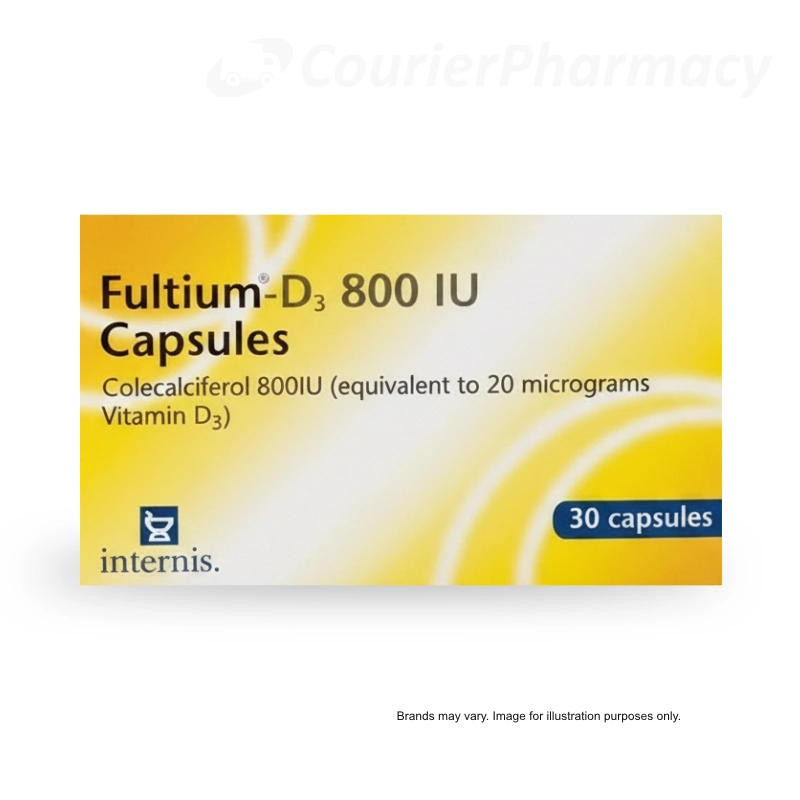
Fultium 800IU Capsules — Licensed Vitamin D3 for Deficiency Treatment and Prevention
This is a licensed medicine — Fultium 800IU capsules contain cholecalciferol (vitamin D3) at 800 international units per capsule, licensed for the prevention and treatment of vitamin D deficiency in adults and adolescents. So each capsule provides a defined therapeutic dose of the same vitamin D3 form the body produces from sunlight exposure, but in a standardised medicinal formulation rather than a food supplement.
Standard adult dosing is typically 1-2 capsules once daily, with the specific regimen determined by whether the goal is prevention, maintenance after deficiency correction, or ongoing supplementation for those at risk. As a licensed medicinal product from Internis Pharmaceuticals, Fultium sits distinct from OTC vitamin D supplements — it undergoes the same regulatory scrutiny as prescription medicines and is manufactured to medicinal quality standards. Available at Courier Pharmacy after clinical review.
At Courier Pharmacy, we believe in treatment that fits the person, but only where it’s honest, safe, and consented to.
This page covers what Fultium 800IU capsules are, how they differ from OTC vitamin D supplements, who they may suit, how the 800IU strength fits into vitamin D dosing, how they compare to other Fultium strengths and alternatives, and the practical points that matter — including realistic expectations, when higher-strength options might be needed, and how to interpret vitamin D testing.
Five key takeaways
- Fultium 800IU capsules contain cholecalciferol (vitamin D3) 800IU per capsule as a licensed medicinal product from Internis Pharmaceuticals, not a food supplement. This means they’re manufactured to medicinal quality standards and undergo the same regulatory scrutiny as prescription medicines
- Cholecalciferol (D3) is the same form of vitamin D the body produces from skin exposure to UVB sunlight. It’s the preferred form for supplementation over ergocalciferol (D2) because it raises serum 25-hydroxyvitamin D levels more effectively and sustainably
- Standard adult dosing is 1-2 capsules once daily depending on scenario. Take with food (containing some fat) for optimal absorption. The 800IU strength suits prevention and maintenance rather than significant deficiency correction, which typically requires higher-strength loading doses
- Suits adults at risk of vitamin D deficiency (limited sun exposure, darker skin, older age, obesity, malabsorption conditions, chronic kidney disease, certain medications) and those maintaining levels after higher-dose deficiency treatment
- Well-tolerated at standard doses. Excess vitamin D can cause hypercalcaemia with serious consequences, so following prescribed dose is important. Not for hypercalcaemia, severe renal impairment, active kidney stones, or vitamin D metabolism disorders. Prescriber assessment before supply is essential
Why choose Courier Pharmacy for vitamin D support
At Courier Pharmacy, our approach starts with a simple idea: treatment should fit the person, not force the person to fit the system.
Dr Ada Jex-Cori
Our service is shaped by the philosophy of Dr Ada Jex-Cori, our brand pharmacist.
Dr Ada represents the spirit of the pharmacy: evidence-led, community-rooted, and willing to challenge the one-size-fits-all approach to medicine. She is named in honour of three pioneering women in science: Ada Lovelace, the mathematician and visionary; Sophia Jex-Blake, the first female doctor in the UK who fought the medical establishment; and Gerty Cori, the biochemist and Nobel Prize winner.
In our fictional world of Etherwell, Dr Ada fights against pharma’s standardised approach to medicine. In the real world, she represents what we stand for. Her view is straightforward: you are not broken. The system is. And we are here to change that.

Vitamin D deserves proper clinical framing
Vitamin D sits between medicine and supplement in ways that create confusion. Courier Pharmacy is different. So we recognise that:
- Deficiency is genuinely common in UK adults and warrants attention
- But vitamin D isn’t a cure-all despite ongoing marketing claims
- Testing before supplementation gives more targeted treatment
- Different strengths suit different clinical scenarios
- Licensed medicines and OTC supplements have different quality standards
- Prescriber input helps identify who genuinely needs supplementation
- Getting the right dose for the right scenario matters
Honest framing about vitamin D benefits
The evidence picture:
- Clear benefits for bone health in deficient individuals
- Reduced fracture risk in older adults when combined with calcium
- Reduced falls risk in older adults with deficiency
- Support for muscle function
- However, cardiovascular benefits in replete individuals not consistently demonstrated
- Cancer prevention claims not supported by large trials
- Immune function support during infections more modest than initially hoped
- Depression treatment not a licensed indication
- Realistic expectations based on evidence, not marketing
Honest framing about licensed medicine vs OTC supplement
Different regulatory frameworks:
- Fultium 800IU is a licensed medicine with MHRA oversight
- OTC vitamin D supplements are food supplements with different regulation
- Both can be effective for vitamin D supplementation
- Licensed medicines have more rigorous quality control
- Both meet minimum content standards
- Choice between them is legitimate patient preference
- Fultium suits scenarios where medicinal-grade product is preferred
Honest framing about testing before supplementing
The rationale:
- Testing 25(OH)D shows individual baseline
- Enables targeted correction rather than blanket supplementation
- Distinguishes deficiency (needs loading) from insufficiency (needs maintenance) from adequate levels
- Post-treatment retesting confirms response
- Prevents both under-treatment and over-treatment
- Universal supplementation without testing works but is less targeted
- Prescriber can arrange testing if not already done
Vitamin D and the bigger picture
Vitamin D rarely sits in isolation. So our prescriber can discuss:
- Comprehensive bone health approach
- Calcium intake and requirements
- Weight-bearing exercise
- Fall risk assessment in older adults
- Osteoporosis screening and management
- Sun exposure balance (adequate for D3, safe from cancer risk)
- Dietary optimisation
- Other nutritional considerations (protein, magnesium, vitamin K)
- Age-appropriate screening and monitoring
- Menopause-related bone health
- Testosterone deficiency and bone health
Sometimes vitamin D is one part of a wider health picture worth talking through.
Prescriber support before and after supply
Our team is here to discuss:
- Whether Fultium 800IU fits your specific situation
- Whether testing before supplementing would help
- Whether higher-strength Fultium would suit better
- Whether combined calcium/vitamin D would suit better
- Alternative approaches
- Comprehensive bone health work alongside supplementation
- Correct use technique
- Realistic expectations
- Monitoring approach
- What to do if you develop side effects
- When to review or adjust approach
Trust earned, not claimed
We are GPhC-regulated, and our content is grounded in the licensed Fultium Summary of Product Characteristics, NICE clinical knowledge summaries on vitamin D deficiency, Royal Osteoporosis Society guidance on vitamin D supplementation, Public Health England guidance on vitamin D for the UK population, Endocrine Society clinical practice guidelines on vitamin D deficiency, MHRA guidance on medicine supply, and the real experience of patients managing vitamin D status.
If Fultium 800IU isn’t the right answer for your situation, we’ll tell you honestly. After all, getting the right approach matters more than fulfilling a request.
How supply works
Fultium 800IU is a licensed medicine, which means the supply process has proper clinical steps rather than a straight checkout. Here’s how it works from your first click to your capsules arriving.
Step 1: Eligibility check
Complete the vitamin D consultation on courierpharmacy.co.uk. This covers your reason for wanting supplementation, risk factors for deficiency, any previous vitamin D testing, sun exposure and dietary patterns, allergies (particularly peanut/soya as Fultium contains arachis oil), and any relevant medical conditions.
Step 2: Prescriber review
Your consultation goes to our UK-qualified prescriber, who reviews your clinical picture. This isn’t automatic approval. The prescriber assesses whether Fultium 800IU genuinely fits your situation, whether testing before supplementing would help, whether a different strength or formulation would suit better, or whether an alternative approach makes more sense.
Step 3: Prescription and dispensing
If the prescriber judges Fultium 800IU is appropriate, they issue a prescription. Your medication is dispensed from our GPhC-regulated pharmacy premises.
Step 4: Discreet delivery and ongoing support
Your order is dispatched in plain packaging, suitable for home or workplace delivery. Free prescriber support is available throughout your treatment, and we can arrange retesting when appropriate to confirm response.
When other options might suit better
If Fultium 800IU isn’t right, we’ll explain why. Other options may include:
- Fultium 3200IU capsules — for mild-to-moderate deficiency
- Fultium 20,000IU capsules — for loading in significant deficiency
- Fultium D3 drops — for those unable to swallow capsules
- Alternative D3 formulations without peanut oil — for peanut/soya allergy
- Vegetarian D3 alternatives — for those avoiding gelatin
- Ergocalciferol (D2) — for specific dietary preferences
- Combined calcium and vitamin D (Adcal-D3, Calceos, Calcichew D3) — when calcium also needed
- Calcitriol — for vitamin D metabolism disorders
- OTC vitamin D supplements — for general prevention where medicinal-grade isn’t essential
- Investigation for secondary causes if deficiency severe
- Specialist endocrinology referral for complex cases
- Lifestyle-only approach with sensible sun exposure and dietary sources
Our community service
Our free fortnightly drop-in clinics at Insomnia, Derby run every other week from 10am to 12pm.
Healthcare shouldn’t only happen when you’re paying for it. So we show up, even when it’s free.
We cover weight management, GLP-1 therapy, MCAS, menopause, women’s health, men’s health, chronic pain, digestive health, allergies, asthma, sleep, migraine, headache, skincare, acne, hair loss, and whatever else people bring through the door. No appointment needed, no charge, no pressure.
Active ingredient
Each Fultium 800IU capsule contains:
- Cholecalciferol (vitamin D3) 800 international units (equivalent to 20 micrograms)
- Refined arachis (peanut) oil as the oil base for the soft capsule
- Gelatin, glycerol, and purified water in the capsule shell
- Colouring agents (typically titanium dioxide, iron oxides)
Why cholecalciferol (D3) specifically
Cholecalciferol offers advantages over other forms:
- Same form the body produces from sunlight (UVB) exposure to skin
- More effectively raises serum 25(OH)D than ergocalciferol (D2)
- Longer-lasting effect on serum levels than D2
- Better bioavailability than plant-derived D2
- Preferred form in most current clinical guidelines
- Available in oil-based formulation to support absorption
In short, D3 is the more effective and physiologically appropriate form for supplementation. After all, the body produces D3 from sunlight, so supplementing with D3 mirrors what the body would naturally do.
Why the 800IU strength
The 800IU strength serves specific clinical scenarios:
- Standard preventive dose for at-risk adults
- Maintenance dose after deficiency correction with higher-strength loading
- Recommended daily intake for older adults per some guidelines
- Sufficient for mild insufficiency correction over time
- Below the level requiring more intensive monitoring for hypercalcaemia risk
- Suits daily long-term use
- Available as OTC in some markets, but as licensed medicinal product ensures quality
Different strengths of Fultium exist for different scenarios:
- Fultium-D3 800IU capsules: standard prevention and maintenance (this product)
- Fultium-D3 3200IU capsules: higher-dose prevention or moderate deficiency
- Fultium-D3 20,000IU capsules: loading dose for significant deficiency
- Fultium Drops: for infants, children, and those unable to swallow capsules
After all, one size doesn't fit all situations. So the 800IU strength fits daily prevention and maintenance while higher strengths address significant deficiency more efficiently.
Why the oil-based capsule format
The soft capsule with oil base offers specific advantages:
- Vitamin D is fat-soluble, so oil-based delivery enhances absorption
- Uniform dose per capsule
- Small, easy to swallow
- Stable at room temperature
- Long shelf life
- Suitable for daily long-term use
The peanut oil consideration
Important allergen point:
- Fultium 800IU contains refined arachis (peanut) oil
- Not suitable for people with peanut or soya allergy
- Refined oil has very low protein content but caution advised
- Alternative vitamin D3 formulations without peanut oil are available for those with allergy
- Prescriber checks allergen status before supply
Other ingredients
The capsule shell contains gelatin (of animal origin), glycerol, and colouring agents. So patients following strict vegetarian or vegan diets or with specific religious dietary restrictions should discuss alternatives.
Complete excipients list is provided with each supply. So mention any known allergies or sensitivities during your consultation.
Pack details
Fultium 800IU capsules come as:
- Small oval or round soft gelatin capsules
- Blister packs preserve stability
- Standard pack sizes: 30 or 90 capsules
- 30-capsule pack for monthly supply at once-daily dosing
- 90-capsule pack for longer-term supply at once-daily dosing
- Manufactured by Internis Pharmaceuticals

What is Fultium 800IU for?
Fultium 800IU capsules are licensed for the prevention and treatment of vitamin D deficiency in adults and adolescents. So they fit specific clinical scenarios — not general wellness supplementation without indication, but defined therapeutic use where vitamin D status genuinely warrants intervention. As a result, the 800IU strength positions itself for prevention in at-risk groups and maintenance after significant deficiency has been corrected.
What vitamin D does in the body
The clinical relevance of adequate vitamin D:
- Essential for calcium and phosphate absorption from the gut
- Required for normal bone mineralisation
- Affects muscle function and strength
- Involved in immune function regulation
- May influence cardiovascular health
- Role in glucose metabolism being characterised
- Deficiency causes rickets in children, osteomalacia in adults
- Insufficient levels may contribute to osteoporosis, muscle weakness, and increased fracture risk
What vitamin D deficiency looks like
Understanding the diagnostic framework:
- Serum 25-hydroxyvitamin D (25(OH)D) is the standard test
- Deficiency: below 25 nmol/L (below 10 ng/ml)
- Insufficiency: 25-50 nmol/L (10-20 ng/ml)
- Adequate: above 50 nmol/L (above 20 ng/ml)
- Optimal for bone health: 75-125 nmol/L (30-50 ng/ml) according to some guidelines
- Toxicity risk: above 220 nmol/L (above 88 ng/ml)
- Standard reference ranges vary between laboratories
Who might Fultium 800IU suit?
This medicine may suit:
- Adults with confirmed vitamin D insufficiency (25(OH)D 25-50 nmol/L)
- Adults maintaining vitamin D levels after higher-dose deficiency correction
- Adults at risk of vitamin D deficiency needing prevention
- Older adults with limited sun exposure
- Adults with darker skin who require more sun exposure for endogenous synthesis
- Adults who cover skin extensively for cultural or religious reasons
- Housebound or institutionalised adults
- Adults with obesity (vitamin D sequestered in adipose tissue reduces bioavailability)
- Adults on medications affecting vitamin D metabolism (some anticonvulsants, glucocorticoids)
- Adults with malabsorption conditions (coeliac, Crohn's, cystic fibrosis, bariatric surgery)
- Adults with chronic kidney disease at appropriate stages
- Pregnant and breastfeeding women (specific dosing guidance applies)
What Fultium 800IU may help with
Based on vitamin D pharmacology and clinical evidence:
- Prevention of vitamin D deficiency in at-risk adults
- Maintenance of adequate 25(OH)D levels after correction
- Support for calcium absorption and bone health
- Reduced fracture risk in older adults with vitamin D deficiency (when combined with calcium)
- Muscle function support in deficient individuals
- Reduced falls risk in older adults with deficiency
- Support during winter months when endogenous synthesis is limited
- Correction of mild vitamin D insufficiency over time
Important honesty point: vitamin D supplementation clearly benefits those who are deficient, but benefits in people with adequate levels are much less clear. Recent large clinical trials (VITAL, D2d, others) haven't consistently shown benefits for cardiovascular disease, cancer prevention, or diabetes prevention in generally replete populations. So Fultium 800IU works best where there's a genuine clinical rationale for its use rather than as a general wellness measure.
What Fultium 800IU doesn't claim to do
Honest framing matters:
- It doesn't prevent COVID-19 or improve outcomes despite ongoing research
- It doesn't prevent cardiovascular disease in replete individuals
- It doesn't prevent cancer despite historical interest
- It doesn't prevent or treat depression as licensed indications
- It doesn't rapidly correct significant deficiency — higher-strength options are needed for this
- It doesn't replace adequate calcium intake for bone health
- It doesn't replace lifestyle measures (sensible sun exposure, dietary sources)
- It doesn't work in vitamin D metabolism disorders where activated forms are needed
- It isn't for general wellness use without clinical indication

How to take Fultium 800IU
Correct use matters for effectiveness. So take a few minutes to understand the approach before starting.
Standard dosing
For adults and adolescents (from 12 years):
- 1-2 capsules once daily
- Total dose depends on clinical scenario (prevention vs mild insufficiency correction)
- Take with food for optimal absorption
- Swallow capsules whole with water
Typical dosing scenarios:
- Prevention in at-risk adults: 1 capsule (800IU) once daily
- Maintenance after deficiency correction: 1-2 capsules (800-1600IU) once daily
- Mild insufficiency correction: 1-2 capsules (800-1600IU) once daily for 8-12 weeks
- Pregnancy prevention: 1 capsule (800IU) once daily
- Higher doses may be prescribed for specific clinical situations
How to take the capsule
- Take at approximately the same time each day
- Take with a meal containing some fat for optimal absorption
- Swallow the capsule whole with a glass of water
- Don't chew or break the capsule
- Don't puncture the capsule to remove contents
- If you forget a dose, take when remembered unless close to the next dose
- Don't take a double dose to make up for a missed one
Practical tips
- Morning dosing with breakfast often works well
- Consistency around the same time each day supports routine
- Taking with the largest meal of the day supports absorption
- Fat-containing foods (dairy, eggs, oily fish, avocado, nuts) support absorption
- Don't rely on skipping doses then taking multiple to catch up
- Keep a supply visible near your usual morning routine to support adherence
- Continue lifestyle measures alongside — sensible sun exposure, dietary sources
Duration of treatment
The approach depends on scenario:
- Prevention in at-risk adults: often continued long-term with periodic review
- Maintenance after deficiency correction: continued to prevent recurrence
- Mild insufficiency correction: 8-12 weeks then retest
- Regular review with prescriber to assess ongoing need
- 25(OH)D retesting at 3-6 months confirms response
What to combine with
Comprehensive vitamin D optimisation often needs multiple elements:
- Sensible sun exposure (15-30 minutes to face and arms during summer months without sunburn)
- Dietary sources: oily fish (salmon, mackerel, sardines), egg yolks, fortified foods
- Adequate calcium intake for bone health
- Weight-bearing exercise for bone density
- Regular testing to monitor response
- Consideration of other bone health factors
What to avoid
- Combining with other high-dose vitamin D supplements without prescriber discussion
- Combining with high-dose calcium supplements without prescriber discussion
- Excess dosing believing more is better (hypercalcaemia risk)
- Using without prescriber review during treatment
- Chewing, crushing, or opening the capsules
- Doubling doses if one is missed
Storage
- Store below 25°C
- In original blister pack
- Away from direct light and moisture
- Keep out of sight and reach of children
- Use by expiry date on packaging

Frequently asked questions

How is Fultium 800IU different from OTC vitamin D?
Different regulatory frameworks:
- Fultium is a licensed medicine with MHRA oversight
- OTC vitamin D is a food supplement with different regulation
- Both can contain cholecalciferol at similar strengths
- Fultium meets medicinal quality standards
- Choice is legitimate patient preference
Should I take 800IU or a higher strength?
Depends on your situation:
- 800IU: prevention or maintenance after correction
- Higher strengths (3200IU or 20,000IU): active deficiency correction
- Testing helps determine appropriate starting dose
- Prescriber assesses individual factors
How long before I see benefit?
Gradual effect:
- 25(OH)D blood levels rise over 4-8 weeks
- Symptoms improve as levels normalise
- Testing at 3 months confirms response
- Not for acute symptom relief
- Individual variation is significant
Do I need testing before starting?
Depends on scenario:
- Testing recommended for suspected deficiency
- Testing recommended for symptoms suggestive of deficiency
- Testing helps target appropriate strength
- For general prevention in at-risk groups, testing not always essential
- Prescriber discusses whether testing helps in your case
Can I take Fultium during pregnancy?
Yes at recommended doses:
- 800IU daily during pregnancy is generally recommended
- Supports maternal and fetal bone health
- Higher doses only under prescriber direction
- Standard recommendation across UK pregnancy guidance
Can I take Fultium while breastfeeding?
Yes at recommended doses:
- 800IU daily during breastfeeding is generally safe
- Passes into breast milk in small amounts
- Some infants may also need direct supplementation
- Prescriber discusses individual situation
Can children take Fultium 800IU?
Depends on age:
- Licensed for adolescents from 12 years
- Younger children need Fultium Drops or paediatric formulations
- Paediatric dosing differs from adult
- Discuss children's supplementation with GP or paediatrician
What if I have peanut allergy?
Not for you:
- Fultium contains refined arachis (peanut) oil
- Not suitable for peanut allergy
- Alternative D3 formulations without peanut oil available
- Prescriber can recommend suitable alternatives
What if I'm vegetarian or vegan?
Consider alternatives:
- Fultium capsule shell contains gelatin (animal origin)
- Vegetarian D3 alternatives available (usually from lichen source)
- Ergocalciferol (D2) is plant-derived alternative
- Prescriber can recommend suitable options
Can I take too much vitamin D?
Yes, at high doses:
- Excessive vitamin D can cause hypercalcaemia
- At standard doses (800-1600IU daily), risk is very low
- Higher doses above 4000IU daily long-term increase risk
- Don't combine multiple vitamin D preparations
- Follow prescribed dose
What are signs of too much vitamin D?
Hypercalcaemia symptoms:
- Persistent nausea or vomiting
- Excessive thirst
- Frequent urination
- Constipation
- Muscle weakness
- Fatigue
- Confusion
- If these develop, stop and seek medical assessment
Should I also take calcium?
Depends on dietary intake:
- Adequate dietary calcium (dairy, leafy greens, fortified foods) may not require supplementation
- Poor dietary calcium intake may benefit from combined calcium/D3 supplement
- Osteoporosis prevention often uses combined calcium/D3
- Prescriber assesses individual calcium needs
Can I take Fultium with my other medications?
Some interactions to consider:
- Thiazide diuretics — combined use requires monitoring
- Digoxin — hypercalcaemia can affect arrhythmia risk
- Anticonvulsants — may reduce vitamin D effect
- Provide full medication list at consultation for comprehensive check
How should I store Fultium?
- Below 25°C
- In original blister pack
- Away from direct light and moisture
- Keep out of reach of children
- Use by expiry date
Is my packaging discreet?
- Plain packaging with no mention of contents
- Suitable for delivery to home or workplace
How do I order Fultium from Courier Pharmacy?
Complete the vitamin D consultation on courierpharmacy.co.uk. Our prescriber will review your risk factors, testing status, and current situation, then supply Fultium if clinically appropriate. Your order goes out in plain, discreet packaging with support available throughout your treatment.
More than a prescription: our community
Healthcare shouldn't only happen when you're paying for it.
Every fortnight we run free drop-in talks and clinics at Insomnia, Derby, from 10am to 12pm. So we show up, even when it's free.
Bring a question, bring a friend, bring a stack of bewildering letters from another clinic. We'll sit with you.
We cover weight management, GLP-1 therapy, MCAS, menopause, women's health, men's health, chronic pain, digestive health, allergies, asthma, sleep, migraine, skincare, acne, hair loss, and whatever else people bring through the door. No appointment. No cost. No pressure. Just real support and treatment that fits.
This page is for information only and isn't a substitute for personal medical advice. Fultium 800IU is a licensed medicine (cholecalciferol/vitamin D3) from Internis Pharmaceuticals for prevention and treatment of vitamin D deficiency in adults and adolescents. It's contraindicated in hypercalcaemia, hypercalciuria, hypervitaminosis D, severe renal impairment requiring specific treatment, active kidney stones, vitamin D metabolism disorders, and peanut/soya allergy (contains arachis oil). Prescriber assessment before supply is essential. Signs of hypercalcaemia (persistent nausea, vomiting, extreme thirst, frequent urination, confusion) need medical assessment. Signs of severe allergic reaction (facial swelling, breathing difficulty, widespread rash) need immediate medical attention (999). Excessive vitamin D dosing can be harmful — following prescribed dose is important. This medicine should be used alongside comprehensive lifestyle measures including sensible sun exposure and dietary vitamin D sources.
How this content was created
Written by the Courier Pharmacy editorial team and reviewed by a GPhC-registered prescribing pharmacist.
Disclaimer: This information is for education only and isn’t a substitute for personal medical advice. Always follow your prescriber’s instructions.
References
- Electronic Medicines Compendium (emc) (n.d.) [Summary of Product Characteristics for product 2813]. Available at: https://www.medicines.org.uk/emc/product/2813/smpc (Accessed: 10 July 2026).
- NICE Clinical Knowledge Summaries. Vitamin D deficiency in adults. Available at: https://cks.nice.org.uk/topics/vitamin-d-deficiency-in-adults/