

Is Quviviq available on the NHS? Yes, for some adults with long-term insomnia. This guide explains the NICE TA922 criteria, why CBT for insomnia comes first, what your GP will ask and how to prepare for that appointment.
Ever sat in a GP waiting room, rehearsing what you’ll say about your sleep, then forgotten half of it the moment you sit down? You’re not alone. If you’ve been wondering “is Quviviq available on the NHS”, you probably want to know whether it’s worth raising, and how.
The good news is that Quviviq (daridorexant) is available on the NHS. NICE has recommended it for routine use. However, it’s not a first step, and there are clear rules about who it’s for.
In this guide, the Courier Pharmacy clinical team explains the NHS criteria in plain English, what “CBTi first” really means and how to have a useful conversation with your GP.
Five key takeaways
- Quviviq is available on the NHS, following NICE guidance TA922.
- NICE recommends it for adults with insomnia on three or more nights a week for at least three months, with a considerable effect on daytime life.
- CBT for insomnia (CBTi) must usually be tried first, unless it isn’t available or isn’t suitable for you.
- Your GP should review treatment after three months and stop it if it hasn’t helped enough.
- Preparing a two-week sleep diary and a list of what you’ve tried can make your GP appointment far more productive.
Is Quviviq available on the NHS? The direct answer
Yes, Quviviq is available on the NHS. NICE guidance TA922 recommends daridorexant for adults with insomnia symptoms on at least three nights a week for three months or more, with daytime functioning considerably affected. It’s only recommended if CBT for insomnia has been tried and hasn’t worked, or isn’t available or suitable.
That’s the bit you could read out to your GP. Now let’s unpack what each part means for you.
What NICE TA922 says, in plain English
NICE (the National Institute for Health and Care Excellence) decides which treatments the NHS in England should fund, based on evidence and value for money. Its decisions are also widely followed elsewhere in the UK. In October 2023, it published TA922, “Daridorexant for treating long-term insomnia”.
This was a big moment. It was NICE’s first specific recommendation of a medicine for long-term insomnia. NICE also estimated that just over 20,000 people in England might receive it in the first year.
The NICE TA922 criteria, one by one
Think of the criteria as a set of boxes your situation needs to tick. NICE recommends daridorexant if:
- You’re an adult (18 or over).
- Your insomnia symptoms happen on three or more nights a week.
- They’ve been going on for at least three months.
- Your daytime functioning is considerably affected (for example, work, concentration, mood, relationships or driving).
- CBTi has been tried and hasn’t worked, or CBTi isn’t available or isn’t suitable for you.
If all five apply, your GP may consider it as one option. It’s still their clinical decision, based on your health and other medicines.
What happens after you start?
NICE says treatment should be assessed after three months. If your long-term insomnia hasn’t responded well enough, it should be stopped. If it continues, your prescriber should check regularly that it’s still working.
NICE noted that trial evidence shows benefit compared with placebo for up to 12 months. What happens beyond that isn’t yet known.
Why did NICE say yes?
NICE judged daridorexant to be cost-effective for the NHS. Long-term insomnia has real costs too, from lost work days to accidents and poorer mental health, so a treatment that helps the right people can be good value.

Figure 1. The NICE TA922 pathway: CBT for insomnia comes first, and daridorexant is reviewed within 3 months.
Why does CBTi come first?
CBT for insomnia (CBTi) is the first-line treatment for long-term insomnia in the UK. The NHS website, NICE’s Clinical Knowledge Summary and the 2023 European Insomnia Guideline all agree on this. It’s not a box-ticking exercise. It’s the treatment with the strongest long-lasting evidence.
Here’s a useful way to see it. If your sleep is a garden that’s become overgrown, a sleeping tablet is like a strimmer: fast, but the weeds grow back. CBTi is more like learning to garden. It takes longer, but you end up with skills you keep.
What does CBTi actually involve?
CBTi usually runs over several weeks. It might include:
- Keeping a sleep diary to spot patterns.
- Setting a fixed wake-up time, even at weekends (yes, really).
- Spending less time lying awake in bed, then building back up.
- Getting up if you can’t sleep after a while, and only returning when sleepy.
- Tackling the racing thoughts and “what if I never sleep again?” worries.
It can feel tough in the first couple of weeks. Many people tell us they felt more tired before they felt better. That’s normal, and it usually passes.
How to get CBTi on the NHS
Ask your GP about local options. In some areas, digital CBTi such as Sleepio is available free on the NHS. What’s on offer varies from place to place, so it’s fine to ask your GP or practice pharmacist what’s available nearby.
When might CBTi not be suitable or available?
NICE allows daridorexant when CBTi isn’t available or isn’t suitable. That could include long local waiting lists with no digital option, or situations where someone can’t take part in CBTi for health reasons. Your GP will judge this with you. It’s not about skipping the queue, but about making sure people aren’t left without help.
How to ask your GP about Quviviq
This is where a bit of preparation pays off. GP appointments are short, and sleep problems can be hard to describe when you’re running on empty. Here’s what we suggest at the counter.
Before the appointment
Keep a simple sleep diary for two weeks. Note roughly what time you went to bed, how long it took to fall asleep, how often you woke and when you got up. Add a quick score for how you felt the next day.
Also jot down:
- How long the problem has gone on (months or years).
- How many nights a week it happens.
- How it affects your day, with real examples (“I nearly fell asleep at the wheel last Tuesday”, “I’ve missed three shifts”).
- What you’ve already tried, including CBTi, apps, sleep hygiene, over-the-counter remedies or melatonin.
- Every medicine, supplement and herbal remedy you take, including St John’s wort.
- How much alcohol and caffeine you have, honestly.
What to say
You might try something like: “My sleep has been poor on most nights for about six months, and it’s affecting my work. I’ve tried a digital CBTi programme and it didn’t help enough. Would daridorexant be suitable for me, under the NICE guidance?”
That shows you’ve done your homework without sounding demanding. It also gives your GP the key facts they need for TA922.
What your GP may ask you
Expect questions about your mood, snoring or pauses in breathing at night, restless legs, pain, menopause symptoms, shift work and anything else that might be causing the insomnia. They’ll want to rule out narcolepsy and check for medicines that interact.

Figure 2. What happens at your Quviviq reviews.
Why your GP might say “not yet”
Sometimes the answer will be “let’s try something else first”. That can feel disheartening, but there’s usually a sound reason. Common ones include:
- You haven’t tried CBTi yet, and it’s available locally.
- Your symptoms haven’t lasted three months, or don’t happen three nights a week.
- Another condition, such as sleep apnoea, low mood or pain, needs treating first.
- You’re taking a strong CYP3A4 inhibitor, such as itraconazole, clarithromycin or ritonavir, which rules it out.
- You have narcolepsy, where daridorexant shouldn’t be used.
What is Quviviq, and how does it help?
Quviviq contains daridorexant, a dual orexin receptor antagonist (DORA). Orexin A and B are brain messengers that keep you awake. Daridorexant blocks both orexin receptors, lowering the brain’s wake drive so sleep can take over.
Imagine your brain has a doorbell that keeps ringing every time you start to drift off. Quviviq doesn’t knock you out. It just disconnects the doorbell for the night. It isn’t a benzodiazepine, a z-drug or melatonin.
What the trials found
In real-life terms, the trials found that the patients taking Quviviq 50mg achieved around 18 minutes less lying awake and about 20 minutes more sleep each night compared with placebo. It’s also worth knowing that sleep didn’t get worse than before when people stopped (no rebound insomnia), and an extension study followed people for up to 12 months in total without withdrawal symptoms or signs of misuse.

How to take Quviviq 50mg
The usual dose is Quviviq 50 mg once a night, within 30 minutes before bed. Some people are prescribed Quviviq 25 mg, including those taking moderate CYP3A4 inhibitors or with moderate liver problems. It can be stopped without tapering.
Side effects and safety on the NHS
Your GP or pharmacist should talk you through side effects. The most common are headache and sleepiness. Dizziness, tiredness and nausea affect up to 1 in 10 people. Less often, people notice vivid dreams, sleepwalking, sleep paralysis or brief hallucinations when falling asleep or waking.
Driving can be affected the morning after the very first dose, even nine hours later. Don’t drive unless you feel fully alert, especially in the first few days. Avoid alcohol, and skip grapefruit juice in the evening. If you notice side effects, tell your GP or pharmacist and consider reporting them through the MHRA Yellow Card scheme.
What will it cost me?
In England, you’ll pay the standard NHS prescription charge unless you’re exempt. If you need regular prescriptions, a prescription prepayment certificate may save you money. Prescriptions are free in Scotland, Wales and Northern Ireland.
If you choose the private route, then costs can vary.
How to get Quviviq online from Courier Pharmacy
If a prescriber agrees it’s right for you, you can get Quviviq online from Courier Pharmacy without leaving home. Because it’s a prescription-only medicine, the process starts with a short online health form rather than a “buy now” button. That form is how we make sure Quviviq is safe and suitable for you before anything is sent out.
How it works, step by step
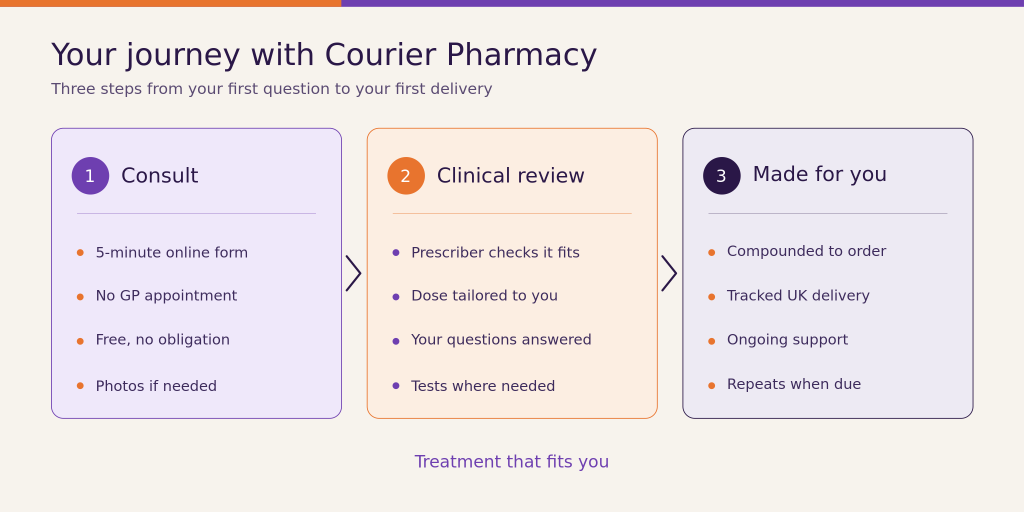
- Complete the online form. Start your online Quviviq consultation form. It asks about your sleep, how long you’ve had trouble, how it affects your days, your general health and the medicines you take. Most people finish it in a few minutes.
- A prescriber reviews your answers. One of our UK-registered prescribers checks your form. They look for anything that could make Quviviq unsuitable, such as narcolepsy, moderate or severe liver problems, pregnancy, or medicines that interact with it, like clarithromycin or itraconazole. If they need more information, they’ll contact you.
- Your prescription is issued, if it’s appropriate. If Quviviq suits you, the prescriber issues a prescription and tells you how to take it safely. If it isn’t the right fit, we’ll explain why and suggest other options, such as CBT for insomnia (CBTi), which NICE recommends as the first treatment to try.
- We dispense and deliver it. Our GPhC-registered pharmacy dispenses your medicine and sends it to you in discreet packaging, with the patient information leaflet included.
Before you fill in the form
Have a list of everything you take to hand, including over-the-counter remedies and herbal products such as St John’s wort. Be honest about alcohol, too. It all helps the prescriber make a safe decision, and none of it is there to judge you.
Frequently asked questions
Is Quviviq available on the NHS?
Yes. NICE recommended daridorexant for NHS use in TA922, published on 18 October 2023. It’s for adults with long-term insomnia who meet the criteria, usually after CBTi has been tried.
What are the NICE TA922 criteria for Quviviq?
NICE recommends it for adults with insomnia symptoms on three or more nights a week for at least three months, with daytime functioning considerably affected. CBTi must have been tried and not worked, or not be available or suitable. Treatment is reviewed after three months.
Can my GP prescribe Quviviq?
Yes. In practice, daridorexant is usually prescribed by GPs in primary care. Your GP will decide whether it’s suitable based on your history, other medicines and local guidance.
Do I have to try CBTi before getting Quviviq on the NHS?
Usually, yes. NICE recommends daridorexant only if CBTi has been tried and hasn’t worked, or isn’t available or suitable. CBTi is the first-line treatment for long-term insomnia.
How do I ask my GP for Quviviq?
Bring a two-week sleep diary, a list of what you’ve tried and examples of how poor sleep affects your day. Ask whether daridorexant would be suitable under the NICE guidance. Be open about your medicines, alcohol and mood.
Is Sleepio available on the NHS?
Digital CBTi such as Sleepio is available free on the NHS in some areas. Ask your GP or check what your local NHS offers. It can be a practical first step while you wait for other support.
How long can I take Quviviq on the NHS?
NICE says treatment should be reviewed after three months and stopped if it hasn’t helped enough. If it continues, it should be checked regularly. Some local guidelines, such as Derbyshire’s, say it shouldn’t go beyond 12 months.
Why won’t my GP prescribe Quviviq?
Common reasons include not having tried CBTi yet, symptoms not meeting the three-month or three-nights-a-week criteria, or another cause of poor sleep needing treatment first. Some medicines and conditions, such as narcolepsy, rule it out.
Is Quviviq free on the NHS?
It’s free in Scotland, Wales and Northern Ireland, where prescriptions don’t carry a charge. In England, you pay the standard prescription charge unless you’re exempt.
Is Quviviq available on the NHS in Scotland and Wales?
NICE guidance applies directly to England, and the other UK nations have their own processes for reviewing medicines. Availability can vary by area, so ask your GP or local pharmacist what applies where you live.

Disclaimer
Disclaimer: This information is for education only and isn’t a substitute for personal medical advice. Always follow your prescriber’s instructions.
References
- Ahsan, S. (2026) What is Quviviq and what is it used for? Courier Pharmacy, 14 November. Available at: https://courierpharmacy.co.uk/what-is-quviviq-and-what-is-it-used-for/ (Accessed: 15 November 2026).
- emc (2025a) QUVIVIQ 50 mg film-coated tablets: summary of product characteristics. Idorsia Pharmaceuticals UK Ltd. Available at: https://www.medicines.org.uk/emc/product/15360/smpc (Accessed: 28 October 2026).
- emc (2025b) QUVIVIQ 25 mg and 50 mg film-coated tablets: patient information leaflet. Idorsia Pharmaceuticals UK Ltd. Available at: https://www.medicines.org.uk/emc/product/15360/pil (Accessed: 28 October 2026).
- European Medicines Agency (2022) Quviviq (daridorexant): EPAR summary for the public. Available at: https://www.ema.europa.eu/en/medicines/human/EPAR/quviviq (Accessed: 28 October 2026).
- Markham, A. (2022) ‘Daridorexant: first approval’, Drugs, 82(5), pp. 601–607. doi: 10.1007/s40265-022-01699-y.
- Mignot, E., Mayleben, D., Fietze, I., Leger, D., Zammit, G., Bassetti, C.L.A., Pain, S., Kinter, D.S. and Roth, T. (2022) ‘Safety and efficacy of daridorexant in patients with insomnia disorder: results from two multicentre, randomised, double-blind, placebo-controlled, phase 3 trials’, The Lancet Neurology, 21(2), pp. 125–139. doi: 10.1016/S1474-4422(21)00436-1.
- NHS (no date) Insomnia. Available at: https://www.nhs.uk/conditions/insomnia/ (Accessed: 28 October 2026).
- NICE (2023) Daridorexant for treating long-term insomnia (TA922). Available at: https://www.nice.org.uk/guidance/ta922 (Accessed: 28 October 2026).
- Pharmaceutical Journal (2023) ‘NICE recommends drug treatment for long-term insomnia’. Available at: https://pharmaceutical-journal.com/article/news/nice-recommends-drug-treatment-for-long-term-insomnia (Accessed: 28 October 2026).
- Riemann, D., Espie, C.A., Altena, E. et al. (2023) ‘The European Insomnia Guideline: an update on the diagnosis and treatment of insomnia 2023’, Journal of Sleep Research, 32(6), e14035. doi: 10.1111/jsr.14035.