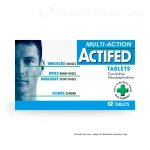
A dual-action tablet containing pseudoephedrine 60mg (decongestant) and triprolidine 2.5mg (sedating antihistamine)
For adults and children 12+ for cold, flu, hay fever, and allergy symptoms with both blocked nose and runny nose, sneezing, or watery eyes
Dose: 1 tablet every 4 to 6 hours; max 4 tablets in 24 hours; not more than 5 to 7 days without medical advice
Causes drowsiness, do not drive or use machinery. Not for use with alcohol, MAOI antidepressants, uncontrolled high blood pressure, or several other conditions
Available from Courier Pharmacy as a pharmacy medicine (P), subject to UK pack size restrictions with pharmacist support
Actifed Multi-Action Tablets are white oral tablets. Each pack contains 12 tablets.
Each tablet contains two active ingredients. Pseudoephedrine hydrochloride 60mg is a decongestant. Triprolidine hydrochloride 2.5mg is a sedating antihistamine.
Also, the 12-tablet pack is the maximum permitted under UK pseudoephedrine pack size limits. These limits sit under the Misuse of Drugs Regulations 2001.
How the two actives work together
Colds, flu, and allergies produce several symptoms at once. Blocked nose comes from swollen blood vessels in the nasal lining. Sneezing, runny nose, and watery eyes come from histamine released by immune cells.
Firstly, pseudoephedrine narrows the nasal blood vessels. This reduces swelling and opens the nasal passages.
Also, triprolidine blocks histamine H1 receptors. This reduces sneezing, runny nose, and watery or itchy eyes.
As a result, one tablet targets both the mechanical blockage and the immune-driven symptoms of a cold or allergy.
A pharmacy medicine with pack size restrictions
Actifed Multi-Action Tablets are a pharmacy medicine (P). They can only be supplied via pharmacies with pharmacist involvement.
Firstly, the pseudoephedrine content triggers UK Misuse of Drugs Regulations pack size limits. Pack size is capped at 720mg pseudoephedrine (12 x 60mg tablets).
Also, pharmacies usually limit purchases to one pack per transaction. This is to prevent bulk buying for illicit methamphetamine manufacture.
However, this restriction does not affect normal medical use. One pack provides about 3 days of standard adult dosing, close to the licensed duration limit anyway.
Furthermore, at Courier Pharmacy, our pharmacist may ask a few questions before supply. This check confirms the product is suitable for your situation.
Key features and specifications
Active ingredients per tablet: pseudoephedrine hydrochloride 60mg + triprolidine hydrochloride 2.5mg
Form: white oral tablets
Pack size: 12 tablets (the maximum permitted under UK pseudoephedrine pack size restrictions)
Class: combined antihistamine and decongestant (sympathomimetic + first-generation H1 antihistamine)
Legal status: Pharmacy medicine (P), subject to Misuse of Drugs Regulations pack size limits, generally one pack per transaction
Other ingredients: lactose, maize starch, povidone, magnesium stearate
Storage: store below 25°C, keep in original packaging
Distinctive features: dual-action for both congestion and allergy symptoms, causes drowsiness (unlike non-drowsy Sudafed), suitable for adults and children 12+
MOJO WISDOM
Take control of your health by understanding your condition and what this medication is doing for you.
READ:
More information about this treatment.
UK-based doctors and pharmacists
Discreet and Confidential
UK-based doctors and pharmacists
Free, Expert Advice
No video link provided.
No video link provided.
UK-based doctors and pharmacists
Free, expert advice
Discrete and confidential
Fast delivery
Giving you trusted clinical advice for over 40 conditions
A UK regulated pharmacy providing safe, effective treatments online since 2014
A dual-action tablet for blocked nose and allergy symptoms
Actifed Multi-Action Tablets are a well-known UK cold, flu and allergy remedy. Each tablet contains two active ingredients.
The first is pseudoephedrine hydrochloride 60mg. This is a decongestant that helps clear a blocked nose and sinuses.
The second is triprolidine hydrochloride 2.5mg. This is a first-generation antihistamine. It reduces sneezing, runny nose, and watery or itchy eyes.
Firstly, this combined targets both blockage and allergy symptoms in one tablet. It suits cold and flu with runny nose, or hay fever with congestion.
However, triprolidine is a sedating antihistamine. So Actifed Multi-Action Tablets can cause drowsiness, unlike the non-drowsy Sudafed Decongestant Tablets.
Also, Actifed Multi-Action Tablets are licensed for adults and children aged 12 and over. They are a pharmacy medicine (P) sold only via pharmacies.
Above all, the pseudoephedrine content means the same MHRA 2024 safety alert applies. There is a rare but serious risk of PRES and RCVS (brain-blood-vessel conditions).
At Courier Pharmacy, our team can help you decide whether Actifed Multi-Action Tablets fit your symptoms and situation.
When to see a doctor rather than self-treat
Actifed Multi-Action Tablets are for short-term symptom relief only. However, some symptoms need medical assessment instead of continued self-treatment.
Sudden severe headache, seizures, sudden confusion, or visual disturbance. Stop Actifed and call 999 (possible PRES or RCVS from the pseudoephedrine)
Chest pain, breathlessness, palpitations, or one-sided weakness. Call 999
Cold or flu symptoms lasting more than 7 to 10 days without improvement, or symptoms that improve and then worsen
Thick coloured nasal discharge with high fever, severe facial pain, or dental pain (possible bacterial sinusitis)
Severe or widespread skin rash with pustules, blistering, or peeling. Stop Actifed and seek urgent help (possible AGEP)
If you are pregnant, breastfeeding, over 60, or have any of the medical conditions in the warnings section below, don’t take Actifed without pharmacist or GP advice
Five key takeaways
Actifed Multi-Action Tablets combine pseudoephedrine 60mg (decongestant) and triprolidine 2.5mg (sedating antihistamine) in one tablet.
Licensed for adults and children 12+ for cold, flu, hay fever, and allergy symptoms that include both congestion and runny nose or sneezing.
Dose: 1 tablet every 4 to 6 hours, up to 4 tablets in 24 hours. Not for use for more than 5 to 7 days without medical advice.
Causes drowsiness. Do not drive or use machinery. Do not combine with alcohol or other sedating drugs.
Not for use with MAOI antidepressants (current or last 14 days), in uncontrolled high blood pressure, severe heart disease, or several other cardiovascular and metabolic conditions.
What are Actifed Multi-Action Tablets: overview
Where Actifed fits in cold, flu, and allergy treatment
Cold, flu, and allergies produce a mix of symptoms. Options include single-active products (paracetamol, ibuprofen, plain decongestant, plain antihistamine) and combined products like Actifed.
Firstly, Actifed’s specific niche is symptoms with both congestion and allergic features. Examples include hay fever with a blocked nose, or a cold with sneezing and runny nose.
Also, if pain and fever dominate, plain paracetamol or ibuprofen may fit better. If only congestion is present, plain Sudafed Decongestant Tablets or a nasal decongestant spray may fit.
However, if drowsiness is unacceptable (e.g. daytime driving), a non-sedating alternative is needed. Consider a non-sedating antihistamine (loratadine or cetirizine) plus a plain decongestant.
Actifed Multi-Action vs Sudafed Decongestant Tablets
Both products contain 60mg pseudoephedrine. Both come from McNeil Products Ltd. Both are pharmacy medicines with the same pack size restrictions.
Firstly, the key difference is the second ingredient. Actifed adds triprolidine (a sedating antihistamine). Sudafed Decongestant Tablets contain pseudoephedrine only.
However, this means Actifed is sedating, while Sudafed tablets are non-drowsy. Actifed also addresses allergy symptoms like sneezing and runny nose, which Sudafed alone does not.
As a result, choose based on symptoms and whether sedation is acceptable. Ask the pharmacist for guidance.
Actifed Multi-Action vs separate antihistamine plus decongestant
Some patients prefer taking separate products for antihistamine and decongestant effects. This allows more control over dosing and choice of antihistamine.
Firstly, a non-sedating antihistamine (loratadine, cetirizine, fexofenadine) plus plain Sudafed offers similar symptom coverage without daytime sedation.
However, the combined Actifed tablet is more convenient. It contains matched doses in one tablet, taken every 4 to 6 hours.
Also, some patients specifically want the sedating antihistamine (for nighttime relief or symptom-driven sleep). Actifed suits this use case.
Short-term use only
Actifed Multi-Action Tablets are licensed for short-term (up to 5 to 7 days) symptom relief. Symptoms that persist beyond this need medical assessment.
Firstly, prolonged decongestant use can cause tolerance to the decongestant effect. It can also raise cardiovascular strain.
Also, prolonged sedating antihistamine use can cause daytime cognitive slowing. In older adults, it can raise fall risk.
However, chronic congestion or persistent allergic symptoms have their own management (intranasal corticosteroids, non-sedating antihistamines, immunotherapy). Ask your GP if symptoms recur.
Self-medication with pharmacist support
Because Actifed is a pharmacy medicine, buying it at Courier Pharmacy comes with pharmacist support. Firstly, this is not optional but a mandated feature of the pharmacy classification.
Also, the pharmacist can check that Actifed fits your symptoms and situation. They will confirm you are not on MAOI antidepressants or other interacting medicines.
However, if Actifed is not right for you, we will explain why. We will then suggest safer options (single-active products, non-sedating options, or a GP appointment).
Why choose Courier Pharmacy for your Actifed Multi-Action Tablets
Registered, independent, and patient-led
Courier Pharmacy is a UK-registered independent pharmacy. The General Pharmaceutical Council regulates us.
Firstly, even for a well-known pharmacy medicine like Actifed, pharmacist support matters. A short conversation can prevent avoidable harm.
Also, we treat every request as a chance to check that the product fits your situation. This is not a simple retail transaction.
As a result, buying Actifed from us comes with reassurance that a UK-qualified pharmacist has thought about your specific case.
Dr Ada Jex-Cori, our brand pharmacist
Our brand pharmacist is Dr Ada Jex-Cori. She represents the spirit of what we do. Named for Ada Lovelace, Sophia Jex-Blake, and Gerty Cori, she stands for evidence-led, unafraid-of-questions medicine. Her message is straightforward. You’re not broken. The system is. We’re here to change that.
Care that keeps showing up
Pharmacy-medicine purchases are not one-off transactions when done properly. Firstly, we are here to answer follow-up questions if the product is not working as expected.
Also, if you notice unexpected side effects or your symptoms change, contact us. If symptoms persist beyond 5 to 7 days, we can help you think through the next step.
However, we will not sell repeated packs to someone who really needs medical assessment. That is not care, it is just retail.
Buy Actifed Multi-Action Tablets from Courier Pharmacy
Actifed Multi-Action Tablets are a pharmacy medicine (P). You can order at courierpharmacy.co.uk in the 12-tablet pack.
Add Actifed Multi-Action Tablets to your basket at courierpharmacy.co.uk
A brief pharmacist suitability check will be conducted before supply
Your order is dispensed and dispatched promptly
Follow the pack directions carefully. Contact us if you have questions
If Actifed is not right for your situation, we will explain why. Options include a non-sedating antihistamine, a plain decongestant, or a GP appointment.
Above all, we will not dispense a pack that is not suitable for you just because it was requested.
Summary
A pharmacy-sold combined tablet containing pseudoephedrine (decongestant) and triprolidine (sedating antihistamine).
Adult and 12+ dose: 1 tablet every 4 to 6 hours, max 4 tablets in 24 hours, not more than 5 to 7 days without medical advice.
Causes drowsiness. Not suitable when driving, using machinery, or needing to stay alert.
Contraindicated with MAOI antidepressants (current or last 14 days), and in uncontrolled high blood pressure, severe heart disease, hyperthyroidism, and several other conditions.
Subject to UK Misuse of Drugs Regulations pack size limits (720mg pseudoephedrine per pack, one pack per transaction).
Active ingredients in Actifed Multi-Action Tablets
Pseudoephedrine hydrochloride 60mg
Pseudoephedrine is a synthetic sympathomimetic drug. It acts primarily on alpha-adrenergic receptors on blood vessels.
Firstly, at the 60mg dose, it works as an oral decongestant by narrowing blood vessels in the nasal and sinus lining. This reduces mucosal swelling and opens the nasal passages.
However, this vasoconstricting effect is not confined to the nose. Some narrowing also occurs in blood vessels throughout the body.
Also, this can raise blood pressure and heart rate. This is why cardiovascular contraindications and cautions apply.
Additionally, pseudoephedrine has mild central nervous system stimulant effects. These include feeling more alert, difficulty sleeping, and occasional restlessness.
Triprolidine hydrochloride 2.5mg
Triprolidine is a first-generation H1 antihistamine of the propylamine class. It blocks histamine H1 receptors.
Firstly, this reduces the effects of histamine released during allergic or inflammatory responses. Symptoms like sneezing, runny nose, and itchy or watery eyes improve.
However, unlike newer non-sedating antihistamines, triprolidine crosses the blood-brain barrier readily. It causes noticeable sedation.
Also, triprolidine has anticholinergic effects. These include dry mouth, blurred vision, urinary retention, and (in older adults) confusion or falls.
As a result, triprolidine gives the sedating and anticholinergic profile that separates Actifed from non-drowsy options.
Why pseudoephedrine is a controlled precursor
Pseudoephedrine has been controlled in the UK under the Misuse of Drugs Regulations 2001 since 2007. This is because it can be chemically converted to methamphetamine, a Class A controlled drug.
However, the UK response has been to restrict pack sizes rather than require prescriptions. The maximum pack size is 720mg pseudoephedrine, which is 12 tablets in Actifed.
Also, pharmacies usually sell one pack per transaction. Pharmacists are trained to recognise patterns that may indicate diversion for illicit manufacture.
As a result, the pack size restriction is a public safety measure. It does not affect appropriate self-care.
What are Actifed Multi-Action Tablets used for?
Cold and flu with allergic-type symptoms
Actifed is commonly used for the cluster of cold and flu symptoms that includes blocked nose, runny nose, and sneezing. This is where the two-active combined shines.
Firstly, pseudoephedrine addresses the mechanical blockage. Also, triprolidine reduces the runny nose and sneezing driven by histamine.
However, Actifed does not treat the underlying viral infection. Colds usually resolve on their own in 7 to 10 days.
Hay fever with congestion
Actifed is also used for hay fever (seasonal allergic rhinitis) when both congestion and typical hay fever symptoms are present. Triprolidine addresses the histamine-driven sneezing, runny nose, and itchy or watery eyes.
Also, pseudoephedrine relieves the blocked-nose component that some hay fever sufferers find most troublesome.
However, for regular or seasonal hay fever, a non-sedating antihistamine (loratadine, cetirizine, fexofenadine) is usually first-line. Adding a plain decongestant or an intranasal corticosteroid may be needed for congestion.
As a result, Actifed is best for short-term flare-ups rather than continuous seasonal use.
Sinus congestion
Sinus congestion often accompanies colds and allergies. Blocked sinuses cause facial pressure, headache, and (sometimes) pain over the cheeks or forehead.
Actifed can help by reducing swelling in the nasal lining that blocks sinus drainage. This can relieve pressure and improve airflow.
However, severe sinus symptoms need medical assessment. Warning signs include high fever, severe facial pain, thick coloured discharge, or symptoms lasting more than 10 days.
Eustachian tube congestion
The Eustachian tubes connect the middle ear to the back of the nose. When blocked during colds or flu, they cause muffled hearing and (during air travel) painful pressure changes.
Also, the pseudoephedrine in Actifed can reduce swelling around the Eustachian tube openings. However, the sedation from triprolidine makes this less ideal for flying alone.
If flying, a topical decongestant nasal spray or plain Sudafed Decongestant Tablets may fit better than Actifed.
What Actifed isn't for
Actifed is not for chronic congestion, chronic allergies, cold and flu prevention, cough, or sore throat as primary symptoms.
Also, it is not for children under 12. It is not for use during pregnancy or breastfeeding without medical advice.
However, if symptoms are severe, sudden, unusual, or accompanied by other concerning features (see When to see a doctor above), Actifed is not the right response.
Furthermore, some conditions that cause nasal blockage (nasal polyps, deviated septum, chronic rhinosinusitis) need specialist assessment.
How do Actifed Multi-Action Tablets work?
Pseudoephedrine's alpha-adrenergic action
Pseudoephedrine works by narrowing blood vessels in the nasal and sinus lining. Firstly, it binds to alpha-adrenergic receptors on the vessel walls.
However, this makes the vessels tighten (vasoconstriction). Tightening reduces the swelling that causes a blocked nose.
Also, the same effect helps drainage of the sinuses and Eustachian tubes.
However, pseudoephedrine acts throughout the body, not just in the nose. This is why cardiovascular contraindications and cautions apply.
Triprolidine's antihistamine action
Triprolidine blocks histamine H1 receptors. Firstly, this reduces the effects of histamine released during colds, flu, and allergies.
Also, sneezing, runny nose, itchy or watery eyes, and mild throat itch all improve. Triprolidine works within about 15 to 30 minutes.
However, first-generation antihistamines like triprolidine cross the blood-brain barrier readily. They block H1 receptors in the brain too, causing sedation.
Also, they have anticholinergic effects (dry mouth, blurred vision, urinary retention). Non-sedating antihistamines (loratadine, cetirizine, fexofenadine) do not cross the blood-brain barrier significantly.
Why the combined is used together
Cold and allergy symptoms come from two different processes. Blocked nose is a vascular problem. Sneezing, runny nose, and watery eyes are histamine-driven.
Firstly, a single-active decongestant relieves blockage but does not address the histamine symptoms. A single-active antihistamine addresses histamine symptoms but not the blockage.
However, the Actifed combined targets both mechanisms in one tablet. This suits patients whose symptoms include both.
As a result, one tablet every 4 to 6 hours covers a broader symptom range than either active alone.
Why Actifed causes drowsiness
The drowsiness comes entirely from the triprolidine. Pseudoephedrine on its own is a mild CNS stimulant, not a sedative.
Firstly, triprolidine crosses into the brain and blocks histamine H1 receptors there. Histamine in the brain helps maintain wakefulness.
Also, blocking these receptors reduces alertness and induces sedation. This is why first-generation antihistamines like triprolidine are sometimes used as sleep aids.
However, sedation from Actifed can persist into the following day. Do not drive or use machinery if drowsiness continues.
How to take Actifed Multi-Action Tablets
Adult and adolescent dose (12 years and over)
The standard dose is 1 tablet with water every 4 to 6 hours as needed. Do not take more than 4 tablets in any 24-hour period.
Also, leave at least 4 hours between doses. Do not use Actifed for more than 5 to 7 days without medical advice.
However, take the lowest dose that controls your symptoms for the shortest time needed. Persistent symptoms need medical assessment rather than continued self-treatment.
Above all, do not exceed the stated dose. Pseudoephedrine overdose can cause severe cardiovascular effects and CNS stimulation.
How quickly it works
Actifed usually starts to relieve congestion within about 30 minutes. Antihistamine effects on sneezing and runny nose often start within 15 to 30 minutes.
Also, peak effect is usually reached at about 1 to 2 hours. The effect usually lasts 4 to 6 hours per dose.
However, sedation from the triprolidine may be noticeable within 30 to 60 minutes and can last longer than the decongestant effect.
Timing across the day
Because Actifed causes drowsiness, timing matters. Firstly, avoid taking a dose before driving, cycling, or using machinery.
Also, avoid Actifed if you need to stay alert for work, study, or childcare. Consider a non-sedating alternative in those situations.
However, an evening dose taken well before bedtime can help you sleep through cold or allergy symptoms. But do not use Actifed as a general sleep aid.
Missed doses and stopping
Actifed is taken as needed, not on a fixed schedule. So there is no missed-dose concern in the usual sense.
Also, you can stop Actifed whenever your symptoms have resolved. There is no need to taper.
However, if you find yourself needing Actifed regularly for more than a week, medical assessment is warranted. The underlying cause of ongoing symptoms matters.
Do not take with other pseudoephedrine or antihistamine products
Above all, do not take Actifed alongside any other product containing pseudoephedrine, phenylephrine, or ephedrine. This includes Sudafed products, Day Nurse, Lemsip, Beechams, and Nurofen Cold and Flu variants.
Also, do not combine with other antihistamines. This includes non-sedating ones (loratadine, cetirizine, fexofenadine) and sedating ones (chlorphenamine, promethazine).
However, plain paracetamol or plain ibuprofen can be taken alongside Actifed for pain and fever, provided no other paracetamol- or ibuprofen-containing product is also being used.
If in doubt, ask the pharmacist before combining any cold, flu, or allergy medicines.
Warnings and precautions for Actifed Multi-Action Tablets
MHRA safety alert: PRES and RCVS (rare but serious)
Above all, the MHRA issued a safety alert in February 2024 for pseudoephedrine-containing medicines. Rare but serious cases of PRES and RCVS have been reported.
Firstly, PRES stands for posterior reversible encephalopathy syndrome. RCVS stands for reversible cerebral vasoconstriction syndrome.
Also, both conditions involve reduced blood supply to the brain. Symptoms include sudden severe headache, seizures, sudden confusion, visual disturbances, or slurred speech.
However, if any of these symptoms develop while taking Actifed, stop immediately. Seek urgent medical assessment (call 999 for severe symptoms).
Drowsiness, driving, and machinery
Actifed causes significant sedation from the triprolidine component. Firstly, do not drive, ride a bicycle, or use machinery after taking Actifed.
Also, sedation can persist into the following day for some patients. Caution with next-day driving is warranted especially if you notice residual drowsiness.
However, driving while impaired by prescription or OTC medicines is a criminal offence in the UK. This is under the Road Traffic Act 1988.
As a result, take Actifed only when you can commit to being off the road until you are fully alert.
Cardiovascular contraindications and cautions
Actifed is contraindicated in patients with severe or uncontrolled high blood pressure, severe coronary artery disease, and tachyarrhythmias. It is also contraindicated after a stroke or transient ischaemic attack.
Firstly, pseudoephedrine's vasoconstricting effect can worsen all of these conditions. Rarely, it can precipitate serious events like hypertensive crisis, myocardial infarction, or stroke.
Also, well-controlled mild hypertension may not be an absolute contraindication. However, it still needs pharmacist assessment before supply.
However, if you take any regular medicine for high blood pressure or heart conditions, disclose this when buying Actifed.
Diabetes mellitus
Actifed should be used with caution in diabetes. Pseudoephedrine can raise blood glucose levels through its sympathomimetic effects.
However, well-controlled diabetes may allow occasional use with medical supervision. Uncontrolled diabetes is a stronger caution.
As a result, disclose any diabetes diagnosis during pharmacist consultation.
Hyperthyroidism
Actifed should be used with caution in hyperthyroidism. Patients with an overactive thyroid are already in a hyper-sympathetic state (raised heart rate, blood pressure, and metabolism).
However, adding a sympathomimetic like pseudoephedrine can compound this. It can rarely trigger serious cardiovascular events.
Angle-closure glaucoma and prostatic hypertrophy
Actifed is contraindicated in narrow-angle glaucoma. Both pseudoephedrine and triprolidine can precipitate an acute glaucoma attack in susceptible patients.
Also, Actifed is contraindicated in prostatic hypertrophy with urinary retention. Both actives can worsen urinary retention through different mechanisms.
However, disclose any glaucoma diagnosis or prostate symptoms during pharmacist consultation.
MAOI antidepressants (contraindicated)
Above all, Actifed must not be taken if you are currently taking an MAOI antidepressant, or have taken one within the last 14 days.
Also, MAOIs include phenelzine (Nardil), isocarboxazid, tranylcypromine (Parnate), and moclobemide (Manerix).
However, combining pseudoephedrine with an MAOI can cause hypertensive crisis. Linezolid (an antibiotic) has MAOI-like activity and carries the same concern.
As a result, this is an absolute contraindication.
AGEP (rare severe skin reaction)
Acute generalised exanthematous pustulosis (AGEP) is a rare but serious skin reaction that has been reported with pseudoephedrine-containing products.
Also, AGEP usually appears within the first 2 days of treatment. Features include fever with numerous small pustules on widespread reddened skin.
However, if a severe rash appears while taking Actifed, stop the tablets and seek urgent medical assessment.
Pregnancy and breastfeeding (not recommended)
Actifed is not recommended during pregnancy. Pseudoephedrine has been linked in some studies to a small increased risk of certain birth defects in the first trimester.
Also, Actifed is not recommended during breastfeeding. Pseudoephedrine passes into breast milk and can reduce milk production. Triprolidine can also pass into milk and cause infant sedation.
However, if you need symptom relief in pregnancy or breastfeeding, ask your midwife, GP, or pharmacist about safer alternatives.
Children under 12 (not for use)
Actifed Multi-Action Tablets are not for children under 12 years of age. MHRA guidance restricts oral decongestants in children under 6 (never) and advises caution in ages 6 to 11 (only under medical guidance).
However, first-generation sedating antihistamines like triprolidine are also generally best avoided in children. Non-sedating options fit better where antihistamine is needed.
Elderly patients
Actifed should be used with caution in adults over 60. Firstly, older adults are more sensitive to pseudoephedrine's cardiovascular effects.
Also, they are more susceptible to triprolidine's sedative and anticholinergic effects. This includes falls, confusion, urinary retention, and constipation.
However, if Actifed is considered in older adults, discuss with the pharmacist. Safer options usually exist.
Alcohol (compounded sedation)
Avoid alcohol while taking Actifed. Firstly, alcohol compounds the sedating effect of triprolidine.
Also, the combined can cause much more sedation than either alone. Impaired coordination, judgement, and (rarely) breathing depression are risks.
However, alcohol also has its own cardiovascular effects that can add to pseudoephedrine's blood-pressure-raising effect.
As a result, plain water is the safe companion for Actifed.
Duration of use (short-term only)
Do not take Actifed for more than 5 to 7 days without medical advice. Ongoing symptoms beyond this need medical assessment.
Also, prolonged pseudoephedrine use can cause tolerance to the decongestant effect. Prolonged sedating antihistamine use can cause daytime cognitive slowing.
However, if you need symptom relief regularly, see your GP for underlying cause assessment.
Severe renal or hepatic impairment
Actifed should not be used in severe kidney or liver disease without medical advice. Pseudoephedrine is largely excreted unchanged by the kidneys, so accumulation can occur in severe renal impairment.
Also, triprolidine metabolism is affected by liver function. Disclose any kidney or liver conditions during pharmacist consultation.
Side effects of Actifed Multi-Action Tablets
Common side effects
Common side effects come from both actives. Firstly, drowsiness from triprolidine is very common.
Also, dry mouth, dry eyes, mild dizziness, and mild constipation are common anticholinergic effects from triprolidine.
However, insomnia (if taken close to bedtime), restlessness, mild headache, and mild anxiety can come from pseudoephedrine.
Furthermore, mild nausea or stomach upset can occur from either active.
Less common but significant side effects
Some side effects need attention. Firstly, palpitations, feeling your heart racing, or a noticeable rise in blood pressure warrant stopping Actifed.
Also, difficulty passing urine (particularly in men over 50) may indicate developing acute urinary retention.
However, next-day drowsiness or cognitive slowing that affects daily function warrants stopping Actifed.
Furthermore, paradoxical excitation (increased alertness or agitation rather than sedation) can occur, particularly in older adults.
Serious side effects requiring urgent help
Above all, seek urgent medical help for signs of PRES or RCVS. These include sudden severe headache, seizures, sudden confusion, visual disturbances, or slurred speech.
Also, seek help for signs of stroke: face drooping, arm weakness, speech difficulty (FAST). Call 999.
However, severe chest pain, breathlessness, or palpitations need urgent assessment. Signs of hypertensive crisis include very severe headache, chest pain, or trouble breathing.
Furthermore, signs of severe allergic reaction (facial or throat swelling, difficulty breathing, widespread rash) need 999.
Also, severe skin reactions with pustules, blistering, or peeling need urgent assessment (possible AGEP).
Drug interactions with Actifed Multi-Action Tablets
MAOI antidepressants (contraindicated)
Above all, do not take Actifed if you are on an MAOI antidepressant, or within 14 days of stopping one.
Also, MAOIs include phenelzine, isocarboxazid, tranylcypromine, and moclobemide. Linezolid (an antibiotic) carries the same concern.
However, combining pseudoephedrine with an MAOI can cause hypertensive crisis. This is a life-threatening rise in blood pressure.
As a result, this is an absolute contraindication.
Other pseudoephedrine, phenylephrine, or decongestant products
Do not take Actifed alongside any other product containing pseudoephedrine, phenylephrine, ephedrine, or another systemic decongestant.
Also, these are present in many combined cold and flu products (Sudafed products, Day Nurse, Lemsip, Beechams, Nurofen Cold and Flu).
However, this also includes topical decongestant nasal sprays (xylometazoline in Sudafed Blocked Nose Spray or Otrivine, oxymetazoline in some Vicks products).
Alcohol and CNS depressants
Avoid alcohol while taking Actifed. Firstly, alcohol compounds sedation from triprolidine.
Also, other CNS depressants add to sedation and breathing depression risk. Examples include benzodiazepines (diazepam, lorazepam), Z-drugs for sleep (zolpidem, zopiclone), and opioid painkillers (morphine, oxycodone, tramadol, codeine).
However, sedating antipsychotics, some antiepileptic medicines, and gabapentin or pregabalin also add to sedation.
Beta-blockers
Actifed should be used with caution with beta-blockers (propranolol, atenolol, bisoprolol, metoprolol, and others). Firstly, the combined can cause paradoxical high blood pressure.
However, this is because the beta-blocker leaves pseudoephedrine's alpha-adrenergic vasoconstricting effect unopposed. It is more marked with non-selective beta-blockers.
Also, if you take a beta-blocker for any reason, discuss with the pharmacist before taking Actifed.
Tricyclic antidepressants
Actifed should be used with caution with tricyclic antidepressants (amitriptyline, nortriptyline, imipramine, clomipramine, dosulepin).
Also, tricyclics have sympathomimetic effects of their own. Combining with pseudoephedrine can raise blood pressure and cause cardiac arrhythmias.
However, tricyclics also add to triprolidine's anticholinergic effects. Dry mouth, urinary retention, and confusion risks are compounded.
Other anticholinergic medicines
Other medicines with anticholinergic effects add to triprolidine's anticholinergic side effects. These include some antipsychotics, urinary antispasmodics (oxybutynin, tolterodine, solifenacin), and some Parkinson's medicines.
However, combining these compounds risks of dry mouth, constipation, urinary retention, blurred vision, and confusion (particularly in older adults).
Also, they can precipitate acute glaucoma in susceptible patients.
Other blood pressure medicines
Actifed can reduce the effect of certain blood pressure medicines. Firstly, it can antagonise the antihypertensive effect of guanethidine, reserpine, and methyldopa.
Also, in patients on treatment for high blood pressure, adding Actifed can lead to loss of blood pressure control.
However, if you take any blood pressure medicine, discuss with the pharmacist before taking Actifed.
Ergot alkaloids (migraine medicines)
Do not combine Actifed with ergot-derived migraine medicines (ergotamine tartrate, dihydroergotamine, methysergide).
Also, both classes cause vasoconstriction. The combined can cause severe peripheral vasoconstriction with ischaemic complications.
However, triptans (sumatriptan, rizatriptan, zolmitriptan) also have vasoconstrictive properties and should be used cautiously with Actifed.
Frequently asked questions about Actifed Multi-Action Tablets
How quickly does Actifed work?
Actifed usually starts to relieve congestion within about 30 minutes. Antihistamine effects on sneezing and runny nose often start within 15 to 30 minutes.
However, peak effect is reached at about 1 to 2 hours. The effect usually lasts 4 to 6 hours per dose.
Will Actifed make me drowsy?
Yes. The triprolidine in Actifed causes significant sedation. Do not drive, ride a bicycle, or use machinery after taking Actifed.
However, sedation can persist into the following day for some patients. Caution with next-day driving is warranted especially if you notice residual drowsiness.
Can I drive after taking Actifed?
No, not until you are fully alert. Firstly, driving while impaired by prescription or OTC medicines is a criminal offence in the UK under the Road Traffic Act 1988.
Also, if you need to drive during the day, consider a non-sedating alternative. Options include a non-sedating antihistamine (loratadine, cetirizine, fexofenadine) plus plain Sudafed Decongestant Tablets.
Can I take Actifed with alcohol?
No. Alcohol substantially compounds the sedating effect of triprolidine. This can cause impaired coordination, judgement, and (rarely) breathing depression.
Also, alcohol increases pseudoephedrine's blood-pressure-raising effect. Plain water is the safe companion for Actifed.
Can I take Actifed with other cold and flu products?
No, do not combine Actifed with other cold and flu remedies without pharmacist advice. Firstly, most contain pseudoephedrine, phenylephrine, or paracetamol. Combining these overloads the doses.
However, plain paracetamol or plain ibuprofen for pain and fever can be taken alongside Actifed. Always check that no other product also contains these.
Can I take Actifed if I take antidepressants?
Discuss with the pharmacist first. Firstly, if you take an MAOI antidepressant, Actifed is contraindicated (can cause hypertensive crisis).
Also, tricyclic antidepressants compound Actifed's anticholinergic and cardiovascular effects. Some SSRIs may add to CNS effects.
However, this doesn't mean Actifed is always contraindicated with these medicines. But the interaction check matters.
Can children take Actifed?
No. Actifed Multi-Action Tablets are for adults and children 12 years and over only.
However, for cold and flu symptoms in children under 12, plain paracetamol or ibuprofen for pain and fever, plus saline nasal drops for congestion, are the standard options.
Can I take Actifed during pregnancy or breastfeeding?
Not without medical advice. Actifed is not recommended in pregnancy or breastfeeding.
However, safer options include plain paracetamol for symptom relief, saline nasal spray for congestion, and non-sedating antihistamines (with GP advice) for allergy. Ask your midwife, GP, or pharmacist.
How long can I take Actifed for?
Do not take Actifed for more than 5 to 7 days without medical advice. Ongoing symptoms beyond this need medical assessment.
However, prolonged decongestant use can raise cardiovascular strain. Prolonged sedating antihistamine use can cause daytime cognitive slowing.
What are PRES and RCVS?
PRES stands for posterior reversible encephalopathy syndrome. RCVS stands for reversible cerebral vasoconstriction syndrome.
Also, both are rare brain-blood-vessel conditions highlighted by the MHRA in 2024 for pseudoephedrine-containing medicines.
However, symptoms include sudden severe headache, seizures, sudden confusion, visual disturbance, or slurred speech. If any develop, stop Actifed and seek urgent medical assessment.
What's the difference between Actifed Multi-Action and Sudafed Decongestant Tablets?
Both contain 60mg pseudoephedrine. Both are pharmacy medicines from McNeil Products Ltd.
However, Actifed adds triprolidine (a sedating antihistamine) to also address sneezing, runny nose, and watery eyes. Sudafed tablets contain pseudoephedrine only and are non-drowsy.
As a result, Actifed suits mixed cold and allergy symptoms but causes drowsiness. Sudafed suits pure congestion and does not sedate.
Can I take Actifed if I have high blood pressure?
Only if your blood pressure is well-controlled, and only with pharmacist advice. Uncontrolled or severe high blood pressure is a contraindication.
However, if your blood pressure rises during Actifed use, or if you develop palpitations, chest pain, or headache, stop and seek advice.
Can I take Actifed if I have glaucoma or prostate problems?
Actifed is contraindicated in narrow-angle glaucoma and in prostatic hypertrophy with urinary retention. Both actives contribute to these risks.
However, open-angle glaucoma (the more common type) usually allows Actifed use, but discuss with your ophthalmologist. If you have any prostate symptoms, discuss with the pharmacist first.
Is Actifed addictive?
Actifed is not addictive in the way opioid painkillers can be. Firstly, at therapeutic doses, neither active causes chemical dependence.
However, tolerance to the decongestant and sedative effects can develop with prolonged use. This is why short-term use only is important.
What if I've taken too many Actifed tablets?
Contact NHS 111 or A&E immediately. Firstly, pseudoephedrine overdose can cause severe cardiovascular effects (hypertensive crisis, arrhythmias) and CNS stimulation.
Also, triprolidine overdose can cause severe sedation, breathing depression, and (rarely) seizures. The combined is more risky than either alone.
However, take the packaging with you so medical staff can see exactly what and how much you have taken.
Do I need a prescription for Actifed from Courier Pharmacy?
No. Actifed Multi-Action Tablets are a pharmacy medicine (P), not prescription-only.
However, this means they can be supplied without a prescription but only via a pharmacy with pharmacist involvement. UK pack size limits also apply.
Disclaimer
Disclaimer: This information is for education only and isn't a substitute for personal medical advice. Always follow the packaging directions, and ask your pharmacist or GP if you're unsure whether Actifed Multi-Action Tablets are suitable for you.