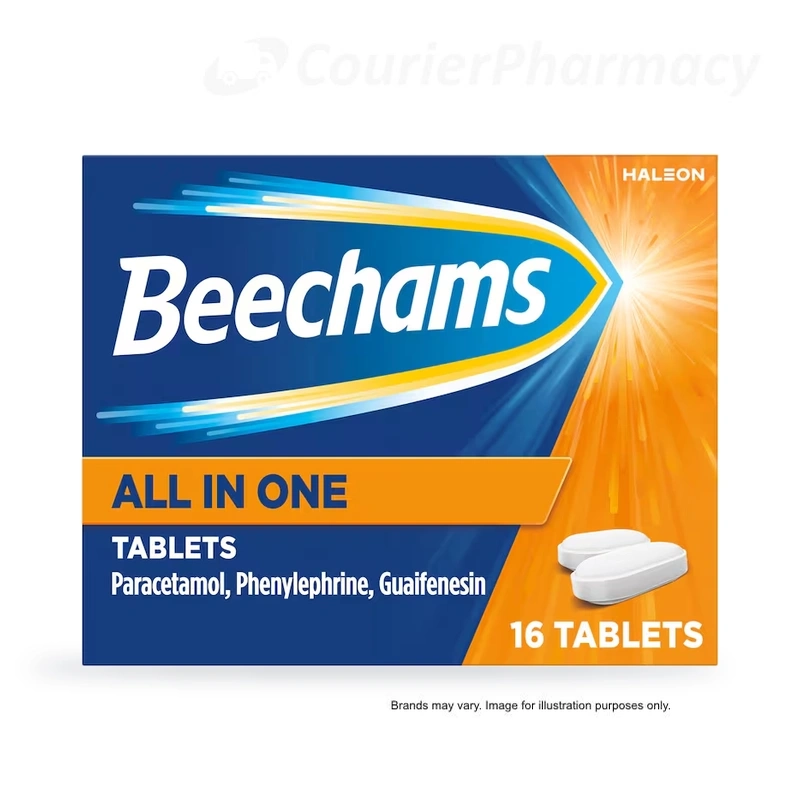
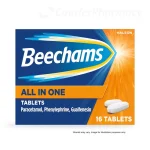
A three-active tablet containing paracetamol 250mg, guaifenesin 100mg (expectorant), and phenylephrine hydrochloride 5mg (decongestant) per tablet
For adults and children 12 and over with cold, flu, or sinusitis symptoms including chesty productive cough, congestion, headache, aches, and fever
Dose: 2 tablets every 4 hours as needed. Maximum 8 tablets in 24 hours. Maximum 5 days without medical advice
Contraindicated in hypertension, heart disease, diabetes, hyperthyroidism, phaeochromocytoma, closed-angle glaucoma, prostate enlargement, and with MAOIs, tricyclic antidepressants, beta-blockers, or other decongestants
Pharmacy medicine (P). Contains lactose. Available from Courier Pharmacy with pharmacist support
Beechams All in One Tablets are film-coated oral tablets supplied in packs of 8, 12, 16, or 24 tablets.
Firstly, each tablet contains three active ingredients. Paracetamol 250mg is an analgesic and antipyretic. Guaifenesin 100mg is an expectorant. Phenylephrine hydrochloride 5mg is a decongestant.
Also, adults and children aged 12 and over take 2 tablets per dose. Each dose delivers 500mg paracetamol, 200mg guaifenesin, and 10mg phenylephrine.
However, the tablets contain lactose as an inactive ingredient. This matters for the rare hereditary galactose disorders.
Furthermore, the manufacturer is Haleon UK Trading Limited (formerly GlaxoSmithKline Consumer Healthcare). Beechams is a long-established UK cold and flu brand.
The 12+ age option in the Beechams All in One range
The Beechams All in One family includes three products with the same three actives but different licences. Firstly, these Tablets are the only version licensed from age 12.
Also, the Beechams All in One Oral Solution is age 16+ due to its alcohol content.
Furthermore, the Beechams Max Strength All in One Capsules are age 16+ and deliver double the paracetamol per dose (1000mg vs 500mg).
As a result, these Tablets are the family-suitable option for households with adolescents aged 12-15 needing chesty cold and flu relief.
How three actives cover the main cold and flu symptoms
Cold and flu symptoms come from several different mechanisms. One tablet with three actives targets multiple symptoms at once.
Firstly, paracetamol addresses pain (headache, body aches, sore throat) and fever.
Also, phenylephrine addresses nasal and sinus congestion by narrowing blood vessels in the nose.
Furthermore, guaifenesin addresses a chesty productive cough by thinning mucus and making it easier to cough up.
However, this comes with a trade-off. You receive all three actives whether you need each one or not.
Non-drowsy formulation
Beechams All in One Tablets do not contain a sedating antihistamine or an opioid cough suppressant. Firstly, this means daytime use should not affect alertness.
Also, the tablets are suitable for use during working hours or before driving (subject to individual response).
However, some patients notice mild alertness or restlessness from phenylephrine. Avoid a dose too close to bedtime as this could disturb sleep.
Key features and specifications
Active ingredients per tablet: paracetamol 250mg + guaifenesin 100mg + phenylephrine hydrochloride 5mg
A triple-action pharmacy tablet for cold, flu, and chesty productive cough
Beechams All in One Tablets are a pharmacy medicine (P) from Haleon UK. They contain three active ingredients that target the main symptoms of cold and flu with a chesty productive cough.
Firstly, each tablet contains paracetamol 250mg (analgesic and antipyretic), guaifenesin 100mg (expectorant), and phenylephrine hydrochloride 5mg (decongestant).
Also, adults and children aged 12 and over take 2 tablets per dose. This delivers 500mg paracetamol, 200mg guaifenesin, and 10mg phenylephrine per intake.
However, Beechams All in One Tablets are designed for cold or flu accompanied by a chesty productive cough (one that brings up phlegm). A dry cough needs a different product.
Furthermore, the tablets are non-drowsy. They contain no antihistamine or opioid cough suppressant, so daytime use is fine.
Above all, do not combine with any other paracetamol-containing product. Firstly, this includes plain paracetamol, co-codamol, and many other cold and flu remedies (Lemsip, Day Nurse, Night Nurse, Nurofen Plus, and others).
Also, several medical conditions and other medicines are contraindications. The SmPC lists hypertension, heart disease, hyperthyroidism, diabetes, phaeochromocytoma, closed-angle glaucoma, and prostatic hypertrophy as contraindications, not just cautions.
However, unlike Beechams All in One Oral Solution (age 16+) and Beechams Max Strength All in One Capsules (age 16+), the Tablets are licensed from age 12. This makes them the family-suitable option for households with adolescents.
Furthermore, the Tablets contain no alcohol (unlike the Oral Solution) and no pseudoephedrine (so no Misuse of Drugs Regulations pack size limits).
Also, the tablets contain lactose. This matters for the rare hereditary galactose disorders.
At Courier Pharmacy, our team can help you decide whether Beechams All in One Tablets fit your symptoms, your medicines, and your medical history.
When to see a doctor rather than self-treat
Beechams All in One Tablets are for short-term self-care of cold and flu symptoms. However, some situations need medical assessment rather than continued over-the-counter treatment.
Sudden severe headache, seizures, sudden confusion, visual disturbance, or slurred speech. Stop and call 999 (rare risk of PRES or RCVS relevant to decongestants)
Chest pain, breathlessness, palpitations, or one-sided weakness. Call 999
Symptoms not improving after 5 days, or getting worse
Cough lasting more than 3 weeks, cough with blood, or thick coloured phlegm with high fever
Thick coloured nasal discharge with high fever, severe facial pain, or dental pain (possible bacterial sinusitis)
Signs of paracetamol overdose (nausea, vomiting, abdominal pain, drowsiness). Contact NHS 111 or A&E even if you feel well
Facial swelling, throat swelling, hives, or difficulty breathing. Call 999 (possible severe allergic reaction)
Severe or widespread skin rash with pustules, blistering, or peeling. Stop and seek urgent help
Difficulty passing urine, particularly in men over 50 (possible acute urinary retention from phenylephrine)
If you are pregnant, breastfeeding, over 60, take blood thinners, or have hypertension, heart disease, diabetes, hyperthyroidism, glaucoma, prostate enlargement, or kidney or liver disease, don’t take these without pharmacist or GP advice
If you take an MAOI antidepressant, tricyclic antidepressant, beta-blocker, or another decongestant, these tablets are contraindicated
Five key takeaways
Beechams All in One Tablets contain paracetamol 250mg, guaifenesin 100mg, and phenylephrine hydrochloride 5mg per tablet. Adults and 12+ take 2 tablets per dose.
Licensed for adults and children 12 and over for short-term relief of cold, flu, and sinusitis symptoms with chesty productive cough. Not for dry cough alone.
Dose: 2 tablets every 4 hours as needed. Maximum 8 tablets (4 doses) in 24 hours = 2g paracetamol. Maximum 5 days without medical advice.
Contraindicated in hypertension, heart disease, diabetes, hyperthyroidism, phaeochromocytoma, closed-angle glaucoma, prostatic hypertrophy, severe kidney or liver disease, and with MAOIs, tricyclic antidepressants, beta-blockers, or other decongestants.
Pharmacy medicine (P). Contains lactose. Do not combine with other paracetamol products, other decongestants, or cough suppressants.
What are Beechams All in One Tablets: overview
Where Beechams All in One Tablets fit
Cold and flu produce a mix of symptoms. Options include single-active products (paracetamol, ibuprofen, plain decongestant) and combined products like these tablets.
Firstly, these tablets’ specific niche is chesty cold and flu in adults and adolescents 12+. The guaifenesin sets them apart from most other combined products.
However, if you only have congestion, plain Sudafed or a nasal spray may fit better. If pain and fever dominate without congestion or cough, plain paracetamol may suffice.
Beechams All in One Tablets vs Beechams All in One Oral Solution
Both products contain the same three actives at equivalent per-dose amounts (500mg paracetamol + 200mg guaifenesin + 10mg phenylephrine per adult dose).
Firstly, the key differences are age and formulation. Tablets are licensed from age 12; Oral Solution is age 16+ due to its alcohol content (ethanol 96%).
However, the Oral Solution works slightly faster due to easier absorption. Tablets are convenient for on-the-go use and suitable for adolescents 12-15.
Beechams All in One Tablets vs Beechams Max Strength All in One Capsules
Tablets have 250mg paracetamol per tablet; adults take 2 tablets per dose (500mg). Max Strength Capsules have 500mg paracetamol per capsule; adults take 2 capsules per dose (1000mg).
Firstly, the Max Strength Capsules deliver double the paracetamol per dose.
However, the age licences differ. Tablets are licensed from age 12; Max Strength Capsules are age 16 and over.
As a result, families with adolescents aged 12-15 should use the Tablets, not the Max Strength Capsules.
Beechams All in One Tablets vs Lemsip Max Cold and Flu
Lemsip Max Cold and Flu Lemon sachets contain paracetamol 1000mg and phenylephrine 12.2mg per sachet. Firstly, Lemsip Max does not contain guaifenesin.
Also, Lemsip is a hot drink; Beechams All in One is a tablet.
However, Beechams All in One is a better choice if you have a chesty productive cough alongside cold or flu symptoms. Lemsip Max is better for head-cold symptoms without cough.
Beechams All in One Tablets vs Sudafed Sinus Pressure and Pain
Sudafed Sinus Pressure and Pain contains ibuprofen 200mg + pseudoephedrine 30mg per tablet. Firstly, it targets congestion with pain.
Also, Beechams All in One uses paracetamol (safer than ibuprofen in NSAID-sensitive patients) with phenylephrine (milder decongestant than pseudoephedrine).
However, Beechams All in One adds guaifenesin for chesty cough. Sudafed Sinus does not cover cough.
Furthermore, Sudafed Sinus Pressure and Pain is licensed from age 15; Beechams All in One Tablets from age 12.
When simpler options are better
If you only have one main symptom, a single-active product is often a better choice. Firstly, this avoids taking active ingredients you don’t need.
Also, plain paracetamol is enough for pain and fever alone. A simple linctus is enough for cough alone. Sudafed alone is enough for congestion alone.
However, combined products like Beechams All in One are convenient when you have multiple simultaneous symptoms.
Short-term use only
Beechams All in One Tablets are licensed for short-term (up to 5 days) symptom relief. Symptoms persisting beyond this need medical assessment.
Firstly, prolonged decongestant use raises cardiovascular strain. Prolonged paracetamol use raises liver strain, particularly with alcohol or existing liver problems.
Also, a productive cough lasting more than 3 weeks needs medical assessment. Chronic cough has many possible causes that need proper diagnosis.
Self-medication with pharmacist support
Because Beechams All in One Tablets are a pharmacy medicine, buying at Courier Pharmacy comes with pharmacist support. Firstly, this is a mandated feature of the pharmacy classification.
Also, the pharmacist can check that the product fits your symptoms and situation. They will confirm you are not on MAOI antidepressants, tricyclic antidepressants, beta-blockers, or other interacting medicines.
However, if this product is not right for you, we will explain why. We will then suggest safer options (single-active products, or a GP appointment).
Why choose Courier Pharmacy for your Beechams All in One Tablets
Registered, independent, and patient-led
Courier Pharmacy is a UK-registered independent pharmacy. The General Pharmaceutical Council regulates us.
Firstly, even for a well-known pharmacy medicine like Beechams, pharmacist support matters. A short conversation can prevent avoidable harm.
Also, we treat every request as a chance to check that the product fits your situation. This is not a simple retail transaction.
As a result, buying these tablets from us comes with the reassurance that a UK-qualified pharmacist has thought about your specific case.
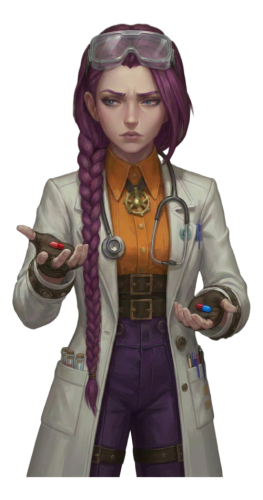
Dr Ada Jex-Cori, our brand pharmacist
Our brand pharmacist is Dr Ada Jex-Cori. She represents the spirit of what we do. Named for Ada Lovelace, Sophia Jex-Blake, and Gerty Cori, she stands for evidence-led, unafraid-of-questions medicine. Her message is straightforward. You’re not broken. The system is. We’re here to change that.
Care that keeps showing up
Pharmacy-medicine purchases are not one-off transactions when done properly. Firstly, we are here to answer follow-up questions if the product is not working as expected.
Also, if you notice unexpected side effects or your symptoms change, contact us. If symptoms persist beyond 5 days, we can help you think through the next step.
However, we will not sell repeated packs to someone who really needs medical assessment.
Buy Beechams All in One Tablets from Courier Pharmacy
Beechams All in One Tablets are a pharmacy medicine (P). You can order at courierpharmacy.co.uk in packs of 8, 12, 16, or 24 tablets.
Add Beechams All in One Tablets to your basket in your chosen pack size
A brief pharmacist suitability check will be conducted before supply
Your order is dispensed and dispatched promptly
Follow the pack directions carefully. Contact us if you have questions
If this product is not right for your situation, we will explain why. Options include Beechams All in One Oral Solution (age 16+), Beechams Max Strength All in One Capsules (age 16+, higher paracetamol dose), plain paracetamol with a separate decongestant, or a GP appointment.
Above all, we will not dispense a product that is not suitable for you just because it was requested.
Summary
A pharmacy-sold three-active tablet with paracetamol (pain and fever), guaifenesin (expectorant), and phenylephrine (decongestant).
Adult and 12+ dose: 2 tablets every 4 hours (max 8 in 24h = 2g paracetamol). Max 5 days without medical advice.
The only Beechams All in One product licensed from age 12 (Oral Solution and Max Strength Capsules are 16+).
Well-suited to chesty productive cough with cold and flu symptoms in adults and adolescents.
Contraindications include cardiovascular disease, diabetes, hyperthyroidism, glaucoma, phaeochromocytoma, prostate enlargement, and use with MAOIs, tricyclics, beta-blockers, or other decongestants.
Active ingredients in Beechams All in One Tablets
Paracetamol 250mg per tablet (500mg per adult dose)
Paracetamol is a widely-used analgesic (pain reliever) and antipyretic (fever reducer). It has been in clinical use since the 1950s.
Firstly, the exact mechanism is not fully understood. It is thought to act primarily on the central nervous system, reducing prostaglandin production in the brain and spinal cord.
Also, at the 500mg per adult dose (2 tablets), paracetamol provides moderate pain relief and reduces fever. Onset is usually within 30 to 60 minutes.
However, paracetamol has a narrow safety margin in overdose. Doses just above the maximum can cause serious liver damage.
Furthermore, total daily paracetamol from all sources must not exceed 4g (4000mg) in adults. Beechams All in One Tablets at maximum dose provide 2000mg per 24 hours.
Guaifenesin 100mg per tablet (200mg per adult dose)
Guaifenesin is a widely used expectorant. It is derived from guaiacol, a natural compound from the guaiac tree.
Firstly, guaifenesin works by thinning and loosening the mucus in the airways. This makes it easier to cough up and clear.
Also, at 200mg per adult dose, guaifenesin provides standard expectorant activity. It is not a cough suppressant.
However, guaifenesin needs adequate fluid intake to work well. Drink plenty of water while taking these tablets.
Furthermore, guaifenesin is generally well tolerated. Very large doses can cause nausea and vomiting.
Phenylephrine hydrochloride 5mg per tablet (10mg per adult dose)
Phenylephrine is a synthetic sympathomimetic decongestant. It acts as a selective alpha-1 adrenergic receptor agonist.
Firstly, at 10mg per adult dose, it narrows blood vessels in the nasal and sinus lining. This reduces swelling and improves airflow.
However, phenylephrine's effectiveness at oral doses has been debated. Some evidence suggests it is a weaker decongestant than pseudoephedrine, though it is widely used.
Also, phenylephrine is not controlled under the Misuse of Drugs Regulations. This is why phenylephrine-containing products have no pack size limits (unlike pseudoephedrine products).
Furthermore, phenylephrine has cardiovascular effects similar to pseudoephedrine. Contraindications and cautions for cardiovascular disease still apply.
Why the three-active combination is used
Cold and flu with chesty cough involve three main symptom groups. Firstly, pain and fever. Also, congestion. Furthermore, productive cough.
Also, paracetamol addresses pain and fever. Phenylephrine addresses congestion. Guaifenesin addresses the chesty cough.
As a result, one dose targets all three symptom groups. This is the appeal of a full-spectrum combined product.
What are Beechams All in One Tablets for?
Cold, flu, and sinusitis with chesty cough
Beechams All in One Tablets are licensed for the relief of cold and flu symptoms and the pain and congestion of sinusitis. This includes aches and pains, headache, blocked nose, sore throat, chills, and feverishness.
Firstly, the guaifenesin component also loosens stubborn mucus and provides relief from chesty coughs. This makes the tablets well-suited to full cold and flu symptom relief.
However, these tablets do not treat the underlying viral infection. Colds usually resolve on their own in 7-10 days.
Chesty productive cough with mucus
The guaifenesin component makes these tablets particularly suited to a chesty productive cough. Firstly, it loosens the mucus, making it easier to clear.
However, if the cough is dry (no phlegm), a cough suppressant fits better than an expectorant. These tablets are not appropriate for dry cough alone.
Also, if the cough has lasted more than 3 weeks, medical assessment is needed to identify the underlying cause.
For adolescents 12-15 with chesty cold and flu
These tablets are the only Beechams All in One product licensed for children as young as 12. Firstly, the Oral Solution and Max Strength Capsules are both age 16+.
Also, this makes these Tablets a useful option for households with adolescents needing cold and flu relief with chesty cough.
However, for children under 12, paediatric options (Calpol, ibuprofen, saline nasal drops) are the standard approach.
What Beechams All in One Tablets aren't for
These tablets are not for chronic cough, chronic congestion, isolated symptoms without cough, or dry (non-productive) cough.
Also, they are not for children under 12, or for use during pregnancy or breastfeeding without medical advice.
However, if symptoms are severe, sudden, unusual, or accompanied by other concerning features (see the red flags above), these tablets are not the right response.
Furthermore, if you have hypertension, heart disease, hyperthyroidism, diabetes, glaucoma, or take an MAOI antidepressant, tricyclic antidepressant, or beta-blocker, do not use these tablets.
How do Beechams All in One Tablets work?
Paracetamol's analgesic and antipyretic action
Paracetamol works mainly on the central nervous system. Firstly, it is thought to reduce prostaglandin production in the brain and spinal cord.
Also, this reduces pain perception and lowers the raised body temperature set-point during infection.
However, paracetamol has minimal anti-inflammatory effect in peripheral tissues. This is why it is a weaker anti-inflammatory than ibuprofen or aspirin.
Furthermore, paracetamol does not cause the stomach irritation, cardiovascular strain, or platelet effects associated with NSAIDs.
Guaifenesin's expectorant action
Guaifenesin thins and loosens mucus in the airways. Firstly, it does this by increasing the water content of respiratory secretions.
Also, thinner mucus is easier to cough up and clear. This helps a productive cough become more effective at clearing the airways.
However, guaifenesin needs adequate hydration to work well. Drink plenty of fluids while using it.
Furthermore, guaifenesin does not suppress the cough reflex. It does not reduce the urge to cough; it makes each cough more productive.
Phenylephrine's alpha-adrenergic action
Phenylephrine narrows blood vessels in the nasal and sinus lining. Firstly, it binds to alpha-1 adrenergic receptors on the vessel walls.
Also, this makes the vessels tighten (vasoconstriction), reducing the swelling that causes a blocked nose. Sinus drainage improves too.
However, phenylephrine acts throughout the body, not just in the nose. This is why cardiovascular contraindications and cautions apply.
Furthermore, phenylephrine is a weaker oral decongestant than pseudoephedrine but is widely used because it is not subject to Misuse of Drugs Regulations pack size limits.
Why the tablet format matters
The tablet format has specific properties. Firstly, tablets are convenient for on-the-go use, easier to carry than a bottle.
Also, tablets do not need to be measured out with a spoon or cup.
However, tablets take slightly longer to break down and absorb than a liquid. Onset is usually 30-60 minutes rather than 15-30 minutes for a liquid.
Furthermore, these tablets contain no alcohol (unlike the Oral Solution). This suits those avoiding alcohol.
How to take Beechams All in One Tablets
Adult and 12+ dose
Adults and children aged 12 and over take 2 tablets with water every 4 hours as needed. Firstly, this delivers 500mg paracetamol, 200mg guaifenesin, and 10mg phenylephrine per dose.
Also, do not exceed 4 doses (8 tablets) in any 24-hour period. This maximum daily dose delivers 2000mg paracetamol, well below the 4g paracetamol daily limit.
However, do not take more often than every 4 hours. Wait at least 4 hours between doses.
Furthermore, do not take these tablets for more than 5 days without medical advice.
Children under 12 (not for use)
Beechams All in One Tablets are not for children under 12 without medical advice. Firstly, alternative products designed for younger age groups should be used.
Also, for children under 12, paediatric paracetamol suspension (Calpol) or ibuprofen for pain and fever, plus saline nasal drops or spray for congestion, are the standard approach.
However, ask a pharmacist for advice on suitable options for a specific child.
How to swallow the tablets
Swallow each tablet whole with a full glass of water. Firstly, take with plenty of water. The guaifenesin works best with adequate hydration.
Also, tablets can be taken with or without food. Taking with food may reduce mild stomach upset.
How quickly they work
Paracetamol usually starts to reduce pain and fever within 30 to 60 minutes. Firstly, peak pain and fever relief is reached at 1-2 hours.
Also, phenylephrine's decongestant effect starts within about 30 minutes.
However, guaifenesin's expectorant effect builds up over the first few doses. Regular dosing throughout the day works better than single doses.
Furthermore, one dose usually lasts around 4 hours.
Timing during the day
Doses can be spaced evenly through waking hours. Firstly, morning, midday, and afternoon doses generally work well.
However, phenylephrine has mild central nervous system effects. Avoid a dose close to bedtime as this could disturb sleep.
Also, leave several hours between the last dose and bedtime.
Missed doses and stopping
These tablets are taken as needed, not on a fixed schedule. Firstly, there is no missed-dose concern in the usual sense.
Also, you can stop the tablets whenever your symptoms have resolved. There is no need to taper.
However, if you find yourself needing them for more than 5 days, medical assessment is warranted.
Do not combine with other paracetamol products
Above all, do not take Beechams All in One Tablets alongside any other product containing paracetamol. Firstly, this includes plain paracetamol, Panadol, Anadin Extra, Lemsip, Day Nurse, Night Nurse, Benylin Day and Night, Sinutab Non-Drowsy, Nurofen Plus, co-codamol, and co-dydramol.
Also, paracetamol overdose from combined products is a common cause of accidental liver damage. Always check the ingredient labels.
Do not combine with other decongestants or cough suppressants
Do not combine with any other decongestant. Firstly, this includes oral products (Sudafed tablets, Actifed, Nurofen Cold and Flu, other Beechams cold products) and nasal sprays (Sudafed Blocked Nose, Otrivine).
Also, do not combine with cough suppressants (dextromethorphan, pholcodine, codeine linctus). Guaifenesin loosens mucus for you to cough it up; suppressing the cough while thinning the mucus does not fit.
However, plain ibuprofen at recommended doses for extra pain relief can be taken alongside, following its own directions. Do not take a product that also contains ibuprofen (Nurofen Cold and Flu).
Overdose
Above all, if you take more than the maximum dose, seek medical advice immediately even if you feel well. Firstly, paracetamol overdose can cause serious liver damage that develops over 24-72 hours.
Also, symptoms of paracetamol overdose may be delayed. Do not wait for symptoms to appear.
However, phenylephrine overdose can cause severe hypertension, confusion, and (rarely) seizures or cardiac arrhythmias.
Furthermore, contact NHS 111 or attend A&E for urgent assessment. Take the packet with you.
Warnings and precautions for Beechams All in One Tablets
MHRA safety alert relevant to decongestants, PRES and RCVS
Above all, the MHRA issued a safety alert in February 2024 for pseudoephedrine-containing medicines. It highlighted rare but serious cases of PRES and RCVS.
Firstly, PRES stands for posterior reversible encephalopathy syndrome. RCVS stands for reversible cerebral vasoconstriction syndrome.
Also, although the specific alert focused on pseudoephedrine, phenylephrine has similar vasoconstricting properties. Symptoms to watch for include sudden severe headache, seizures, sudden confusion, visual disturbances, or slurred speech.
However, if any of these develop while taking these tablets, stop immediately. Seek urgent medical assessment (call 999 for severe symptoms).
Cardiovascular disease, contraindicated
These tablets are contraindicated in hypertension and heart disease. Firstly, phenylephrine's vasoconstricting effect can worsen these conditions.
However, if you take any regular medicine for high blood pressure or heart conditions, disclose this before buying.
Diabetes, contraindicated
These tablets are contraindicated in diabetes. Firstly, phenylephrine can raise blood glucose levels through its sympathomimetic effects.
However, if you have diabetes and need cold or flu symptom relief, ask the pharmacist for safer options.
Hyperthyroidism, contraindicated
Patients with an overactive thyroid should not use these tablets. Firstly, sympathomimetic drugs can compound the effects of excess thyroid hormone.
Phaeochromocytoma, contraindicated
Contraindicated in phaeochromocytoma (a rare tumour that affects heart rate and blood pressure). Firstly, phenylephrine can precipitate serious cardiovascular events in these patients.
Closed-angle glaucoma, contraindicated
These tablets are contraindicated in closed-angle glaucoma. Firstly, phenylephrine can precipitate an acute glaucoma attack in susceptible patients.
Prostatic hypertrophy, contraindicated
Contraindicated in enlargement of the prostate gland. Firstly, phenylephrine can worsen urinary retention.
Severe kidney or liver disease, contraindicated
Contraindicated in hepatic impairment (including alcoholic liver disease) or severe renal impairment. Firstly, paracetamol is metabolised by the liver, and severe impairment raises toxicity risk.
Also, phenylephrine is metabolised in the liver and excreted by the kidneys. Severe impairment of either affects clearance.
MAOI antidepressants, contraindicated
Above all, do not take these tablets if you are on an MAOI antidepressant, or within 14 days of stopping one.
Also, MAOIs include phenelzine, isocarboxazid, tranylcypromine, and moclobemide. Rasagiline and selegiline (Parkinson's medicines) carry the same concern.
However, the combination of an MAOI with phenylephrine can cause hypertensive crisis, a life-threatening rise in blood pressure.
Tricyclic antidepressants, contraindicated
Do not take with tricyclic antidepressants (amitriptyline, nortriptyline, imipramine, clomipramine).
Also, tricyclics can enhance the pressor effect of phenylephrine, raising blood pressure and cardiac arrhythmia risk.
Beta-blockers, contraindicated
Do not take with beta-blockers (propranolol, atenolol, bisoprolol, metoprolol). The combination with phenylephrine can cause paradoxical high blood pressure.
Other decongestants, contraindicated
Do not combine with any other sympathomimetic decongestant. Firstly, this includes pseudoephedrine, phenylephrine, ephedrine, oxymetazoline, or xylometazoline (both oral products and nasal sprays).
Also, combining these overloads the sympathomimetic dose. This raises the risk of cardiovascular events.
Paracetamol overdose and HAGMA with flucloxacillin
Paracetamol overdose can cause serious liver damage. Firstly, doses just above the maximum can be harmful.
Also, high anion gap metabolic acidosis (HAGMA) due to pyroglutamic acidosis has been reported when paracetamol is used with flucloxacillin (an antibiotic), especially in severe illness, severe renal impairment, sepsis, or malnutrition.
However, if you are taking flucloxacillin or have any of these conditions, discuss with the pharmacist or GP before use.
Lactose content
These tablets contain lactose. Firstly, patients with rare hereditary problems of galactose intolerance, Lapp lactase deficiency, or glucose-galactose malabsorption should not take these tablets.
However, common lactose intolerance is usually not an issue with the small amount in a normal dose.
Alcohol, caution
Avoid alcohol while taking these tablets. Firstly, alcohol raises the risk of paracetamol-related liver injury, particularly with regular use.
Also, alcohol has its own cardiovascular effects that can add to phenylephrine's blood-pressure-raising effect.
Pregnancy, not recommended
These tablets are not recommended during pregnancy without medical advice. Firstly, the safety of guaifenesin and phenylephrine during pregnancy has not been fully established.
However, paracetamol alone at the lowest effective dose is generally preferred for pain and fever in pregnancy. Ask your midwife, GP, or pharmacist.
Breastfeeding, not without medical advice
These tablets should not be used in breastfeeding without medical advice. Firstly, paracetamol and phenylephrine are excreted in breast milk, though not usually in clinically significant amounts.
However, the safety of guaifenesin during breastfeeding has not been fully established.
Elderly patients, caution
Use with caution in adults over 60. Firstly, older adults are more sensitive to phenylephrine's cardiovascular effects.
However, if these tablets are considered in older adults, discuss with the pharmacist. Safer options usually exist.
Duration of use, short-term only
Do not take these tablets for more than 5 days without medical advice. Firstly, ongoing symptoms need medical assessment.
Also, a productive cough lasting more than 3 weeks needs medical assessment.
Side effects of Beechams All in One Tablets
Common side effects
Common side effects come from the different actives. Firstly, from the phenylephrine: mild restlessness, mild palpitations, insomnia if taken too late, or mild headache.
Also, from the guaifenesin: mild nausea or stomach upset (rare at recommended doses).
However, paracetamol at recommended doses is generally well tolerated. Rarely, allergic skin reactions can occur.
Less common but significant side effects
Some side effects need attention. Firstly, palpitations or a noticeable rise in blood pressure warrant stopping the tablets.
Also, unusual bruising or bleeding may indicate a rare paracetamol-related blood disorder. Seek medical advice.
However, difficulty passing urine (particularly in men over 50) may indicate developing acute urinary retention from phenylephrine.
Serious side effects requiring urgent help
Above all, seek urgent medical help for signs of severe cardiovascular events. These include sudden severe headache, chest pain, one-sided weakness, or difficulty speaking. Call 999.
Also, signs of severe allergic reaction (facial or throat swelling, breathing difficulty, widespread rash) need 999.
Furthermore, signs of paracetamol overdose (nausea, vomiting, abdominal pain, drowsiness, confusion) need urgent assessment even if only slightly above the maximum dose.
However, severe skin reactions with pustules, blistering, or peeling need urgent assessment.
Drug interactions with Beechams All in One Tablets
MAOI antidepressants, contraindicated
Above all, do not take these tablets if you are on an MAOI antidepressant, or within 14 days of stopping one.
Also, MAOIs include phenelzine, isocarboxazid, tranylcypromine, and moclobemide. Rasagiline and selegiline (Parkinson's medicines) and linezolid (an antibiotic) carry the same concern.
Tricyclic antidepressants, contraindicated
Do not take with tricyclic antidepressants. Firstly, tricyclics can enhance the pressor effect of phenylephrine.
Also, this raises blood pressure and cardiac arrhythmia risk.
Beta-blockers, contraindicated
Do not combine with beta-blockers. Firstly, the combination with phenylephrine can cause paradoxical high blood pressure.
Other sympathomimetic decongestants, contraindicated
Do not combine with any other decongestant containing pseudoephedrine, phenylephrine, ephedrine, oxymetazoline, or xylometazoline.
Also, this includes both systemic products (Sudafed, Actifed, Sinutab, Nurofen Cold and Flu) and topical nasal sprays.
Other paracetamol products
Above all, do not combine with other paracetamol-containing products. Firstly, this includes plain paracetamol, Panadol, Anadin Extra, Lemsip Max, Day Nurse, Night Nurse, Benylin Day and Night, Sinutab Non-Drowsy, Nurofen Plus, co-codamol, and co-dydramol.
Also, paracetamol overdose from combined products is a common cause of accidental liver damage. Always check ingredient labels.
Cough suppressants
Do not combine with cough suppressants (dextromethorphan, pholcodine, codeine linctus). Firstly, guaifenesin loosens mucus to make it easier to cough up.
However, suppressing the cough while thinning the mucus does not fit. It could trap loosened mucus in the airways.
Flucloxacillin, HAGMA risk
Concurrent use with flucloxacillin has been linked to high anion gap metabolic acidosis (HAGMA) due to pyroglutamic acidosis.
However, this is particularly risky in patients with severe illness, severe renal impairment, sepsis, or malnutrition.
Warfarin, long-term paracetamol interaction
Regular paracetamol use can enhance the anticoagulant effect of warfarin. Firstly, this raises INR and bleeding risk.
However, occasional use is usually acceptable. Discuss with your anticoagulation clinic if you take warfarin regularly.
Metoclopramide, domperidone, and colestyramine
Metoclopramide and domperidone speed up paracetamol absorption. Colestyramine slows it down.
However, these interactions are usually clinically minor. Ask your pharmacist if you take any of these medicines regularly.
Digoxin
Use with caution with digoxin. Firstly, phenylephrine can potentially interact and raise the risk of cardiac arrhythmias.
Alcohol
Avoid alcohol while taking these tablets. Firstly, alcohol raises the risk of paracetamol-related liver injury.
Also, alcohol has its own cardiovascular effects that can add to phenylephrine's blood-pressure-raising effect.
Frequently asked questions about Beechams All in One Tablets
What's the difference between the Tablets and the Oral Solution?
Both products contain the same three actives at equivalent per-dose amounts. However, the Tablets are licensed from age 12; the Oral Solution is age 16+.
Also, the Oral Solution contains alcohol (ethanol 96%); the Tablets do not.
Furthermore, the Oral Solution works slightly faster (15-30 minutes) than the Tablets (30-60 minutes) due to easier absorption.
What's the difference between the Tablets and the Max Strength Capsules?
Tablets have 250mg paracetamol per tablet; adults take 2 tablets per dose (500mg). Max Strength Capsules have 500mg paracetamol per capsule; adults take 2 capsules per dose (1000mg).
Also, Tablets are licensed from age 12; Max Strength Capsules from age 16.
How quickly do the tablets work?
Paracetamol usually starts to reduce pain and fever within 30 to 60 minutes. Phenylephrine relieves congestion within about 30 minutes.
Also, peak effect for pain and fever relief is reached at about 1 to 2 hours. The effect usually lasts around 4 hours per dose.
Will these tablets make me drowsy?
No. These tablets do not contain a sedating antihistamine or opioid cough suppressant. Firstly, their actives are not known to cause sedation.
However, the phenylephrine has mild central effects. Some patients notice mild alertness rather than drowsiness.
Can I drive after taking these tablets?
Yes, generally. Firstly, the actives in these tablets are not sedating.
However, if you notice any unusual side effects (dizziness, palpitations), do not drive until they resolve.
Can I take these with paracetamol?
No. Firstly, these tablets already contain paracetamol 250mg per tablet (500mg per adult dose).
Also, adding more paracetamol from another product can lead to overdose and serious liver damage.
However, always check the ingredients of any other pain or cold medicine before combining.
Can I take these with ibuprofen?
Yes, generally. Firstly, ibuprofen and paracetamol work through different mechanisms and can be combined for extra pain relief.
However, always follow ibuprofen's own dose directions. Do not take another product that also contains ibuprofen or another NSAID.
Can I take these with other cold and flu products?
No. Firstly, do not combine with other cold and flu remedies without pharmacist advice. Most contain paracetamol or a decongestant. Combining overloads the doses.
Also, do not combine with cough suppressants (dextromethorphan, pholcodine). Guaifenesin and cough suppressants work against each other.
Can I take these if I take antidepressants?
Discuss with the pharmacist first. Firstly, if you take an MAOI antidepressant OR a tricyclic antidepressant, these tablets are contraindicated.
Also, some SSRIs may add to CNS effects. Ask the pharmacist for guidance based on your specific medicine.
Can 12-15 year olds take these tablets?
Yes. Firstly, these Tablets are licensed for adults and children aged 12 and over. They are the only Beechams All in One product suitable for this age group.
However, children under 12 should not take these tablets. Younger children need paediatric options like Calpol.
Can I take these during pregnancy or breastfeeding?
Not without medical advice. Firstly, these tablets are not recommended in pregnancy or breastfeeding.
However, paracetamol alone at the lowest effective dose is generally preferred for pain and fever in pregnancy. Ask your midwife, GP, or pharmacist.
How long can I take these tablets for?
Do not take these tablets for more than 5 days without medical advice. Firstly, ongoing symptoms need medical assessment.
Do the tablets contain lactose?
Yes. Firstly, this is important for patients with rare hereditary lactose or galactose disorders (galactose intolerance, Lapp lactase deficiency, glucose-galactose malabsorption).
However, common lactose intolerance is usually not an issue with the small amount in a normal dose.
What's the difference between phenylephrine and pseudoephedrine?
Both are sympathomimetic decongestants. Firstly, phenylephrine acts mainly on alpha-1 receptors; pseudoephedrine acts on both alpha and beta receptors.
Also, pseudoephedrine is generally stronger as an oral decongestant. However, pseudoephedrine is controlled under the Misuse of Drugs Regulations with pack size limits; phenylephrine is not.
Can I take these if I have high blood pressure or diabetes?
No. Firstly, both conditions are listed as contraindications in the SmPC for these tablets.
However, safer options exist. Ask the pharmacist for guidance. For pain relief in these patients, plain paracetamol is safer.
Are these tablets addictive?
No. Firstly, neither paracetamol, guaifenesin, nor phenylephrine cause chemical dependence at therapeutic doses.
However, prolonged use of any analgesic can lead to medication-overuse headache. Stick to short-term use.
What if I've taken too many?
Contact NHS 111 or A&E immediately. Firstly, paracetamol overdose can cause serious liver damage even at doses just above the maximum.
Also, phenylephrine overdose can cause severe hypertension, confusion, and (rarely) seizures or cardiac arrhythmias.
However, take the pack with you so medical staff can see exactly what and how much you have taken.
Do I need a prescription from Courier Pharmacy?
No. Firstly, Beechams All in One Tablets are a pharmacy medicine (P), not prescription-only.
However, this means they can be supplied without a prescription but only via a pharmacy with pharmacist involvement.
Disclaimer
Disclaimer: This information is for education only and isn't a substitute for personal medical advice. Always follow the packaging directions, and ask your pharmacist or GP if you're unsure whether Beechams All in One Tablets are suitable for you.