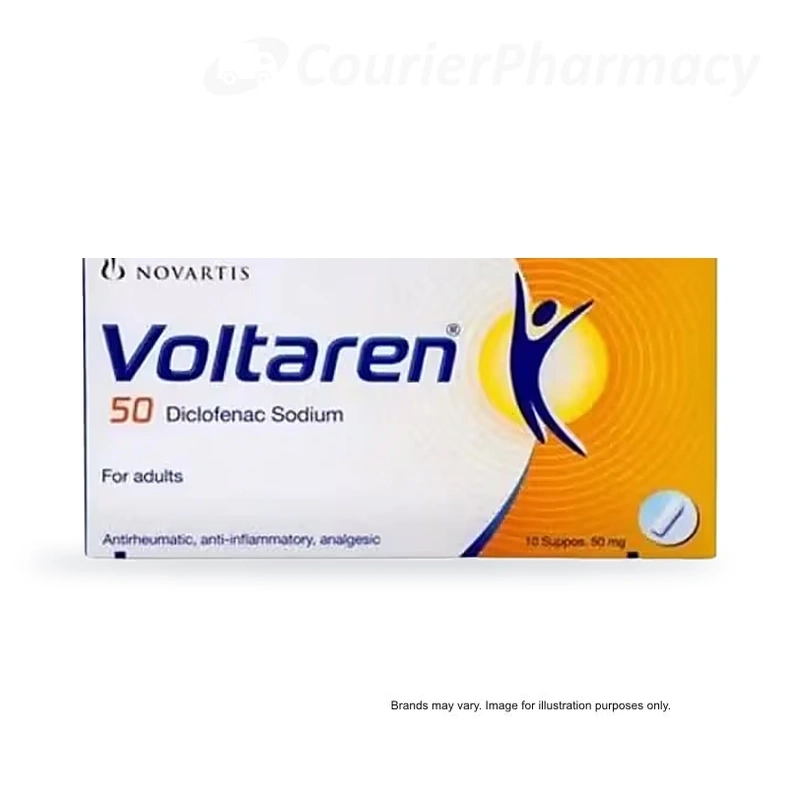
This is one of the most established NSAID rectal options used for short-term pain and inflammation. So the 50mg strength is the standard adult dose for most situations. In short, it’s prescribed when oral diclofenac isn’t a sensible option, or when faster, more reliable absorption is needed.
Where suppositories fit among NSAID options
First, diclofenac comes in many forms. So the choice depends on the clinical situation:
Oral tablets and capsules (diclofenac sodium 25mg, 50mg, 75mg, 100mg): standard option for most uses
Also, suppositories (this product): for when oral isn’t possible or sensible
Plus, injections (intramuscular Voltarol Ampoules): for acute hospital use
Likewise, topical gels (Voltarol gel, generic 1% gel): for local pain without systemic exposure
Equally, dispersible tablets: for people who can’t swallow whole tablets but can drink
Finally, modified-release tablets: for ongoing inflammatory conditions
So suppositories fit a specific clinical niche. In short, they’re not a first-choice option for most pain — they’re the right answer when other routes aren’t working.
What diclofenac suppositories are used for
Also, the licensed uses cover several common painful conditions:
Plus, trauma-related pain: fracture, low back pain, sprains, strains, dislocations
Likewise, post-surgical pain: orthopaedic, dental, and other minor surgery
Equally, renal colic (kidney stone pain — diclofenac is often first-line)
Also, acute gout flares
Plus, dysmenorrhoea (period pain)
Finally, migraine attacks
So suppositories are particularly useful in two situations. First, renal colic — where rapid, reliable pain relief is needed and the person may be vomiting. Plus, migraine — where nausea makes oral tablets unreliable.
Where Diclofenac 50mg Suppositories fit in UK pain care
First, UK pain care for inflammatory or musculoskeletal pain follows a stepped path:
Likewise, Step 4: topical NSAIDs (Voltarol gel, Ibuleve) for local pain
Equally, Step 5: suppositories (this product) when oral isn’t possible or has failed
Also, Step 6: combinations (NSAID plus weak opioid like codeine)
Plus, Step 7: stronger opioids for severe acute pain
Finally, Step 8: specialist referral for ongoing or complex pain
So Diclofenac 50mg Suppositories sit at Step 5. In short, they’re a route alternative rather than a different class of medicine.
Who Diclofenac 50mg Suppositories suit well
To start with, this product suits adults who:
Have moderate to severe pain or inflammation
Also, can’t easily take oral tablets (nausea, vomiting, post-surgery)
Plus, have migraine attacks where nausea makes tablets unreliable
Likewise, have renal colic and need fast, reliable relief
Equally, find oral NSAIDs upset their stomach significantly
Also, need anti-inflammatory pain relief around surgery
Plus, don’t have established heart disease
Likewise, don’t have a history of GI bleeding or active stomach ulcers
Equally, have good kidney function
Finally, have completed prescriber assessment
Who might suit other options better
On the other hand, other options may suit people who:
First, have established heart disease (heart failure NYHA II-IV, ischaemic heart disease, peripheral arterial disease, cerebrovascular disease): NSAIDs are contraindicated
Or have a history of GI bleeding or active stomach or duodenal ulcers: NSAIDs aren’t safe
Also have severe kidney problems: NSAIDs can make this worse
Plus have severe liver problems: care needed
Likewise are in the third trimester of pregnancy: NSAIDs are contraindicated
Equally have asthma triggered by NSAIDs: don’t use
Also have anal fissures or active haemorrhoids: rectal route isn’t ideal
Plus have recent rectal surgery: speak to your prescriber
Likewise have proctitis (inflammation of the rectum): rectal route may not suit
Equally need long-term anti-inflammatory treatment: a different approach may suit better
Also need pain relief that has lower cardiovascular risk: naproxen has the lowest cardiovascular risk among standard NSAIDs
Plus prefer not to use the rectal route: oral diclofenac, dispersible tablets, or other NSAIDs may suit
Finally need stronger pain relief: opioids may be needed alongside or instead
Courier Pharmacy supply
First, Diclofenac Sodium 50mg Suppositories are a UK Prescription-Only Medicine (POM). So supply only happens after a UK-qualified prescriber reviews your online consultation. In short, if the prescriber decides another approach would suit better, we’ll explain that clearly.
Key features and specs
First, active ingredient: diclofenac sodium 50mg per suppository
Also, form: rectal suppository on a hard fat base
Plus, route: rectal only — never to be taken by mouth
Likewise, timing: best inserted after passing stools
Equally, onset: pain relief starts within about 30 minutes to 1 hour
On top of that, peak effect: at around 1 to 2 hours after insertion
In addition, duration: typical effect 6 to 8 hours
As well as that, maximum daily dose: 150mg total diclofenac (any form combined)
Also, frequency: usually 1 to 3 times daily depending on indication
Plus, course length: as short as possible — usually a few days at most
Likewise, common pack sizes: 10 suppositories
Equally, legal status: Prescription-Only Medicine (POM)
Additional information
Quantity
1 x 10, 2 x10, 3 x 10
MOJO WISDOM
Take control of your health by understanding your condition and what this medication is doing for you.
READ:
More information about this treatment.
UK-based doctors and pharmacists
Discreet and Confidential
UK-based doctors and pharmacists
Free, Expert Advice
No video link provided.
No video link provided.
UK-based doctors and pharmacists
Free, expert advice
Discrete and confidential
Fast delivery
Giving you trusted clinical advice for over 40 conditions
A UK regulated pharmacy providing safe, effective treatments online since 2014
Diclofenac sodium 50mg suppositories are a rectal form of a well-known anti-inflammatory pain medicine (NSAID). So they’re useful when swallowing tablets isn’t possible or sensible — for example, with bad nausea or vomiting, around surgery, during a migraine attack, or with renal colic. Plus, the rectal route lets the medicine bypass the stomach, which some people find gentler on their gut. In short, this is a sensible POM option for short-term pain and inflammation when oral diclofenac isn’t a good fit.
At Courier Pharmacy, we believe in treatment that fits the person.
So that means honest framing of where diclofenac suppositories fit in the wider pain landscape. Also, it means knowing when this route makes sense and when oral tablets, topical gels, or other approaches would suit better. In short, this page covers what Diclofenac 50mg Suppositories are, how they work, who they suit, and the safety points that matter.
Five key takeaways
First, Diclofenac Sodium 50mg Suppositories are a UK Prescription-Only Medicine (POM). So they’re only supplied after a UK-qualified prescriber reviews your symptoms, history, and other medicines
Next, diclofenac is a non-steroidal anti-inflammatory drug (NSAID). Plus, it blocks the COX enzymes (mainly COX-2), which lowers prostaglandin production. So pain and inflammation both come down
Then, the rectal route is useful when oral isn’t a good option — for example, with bad nausea or vomiting, around surgery, during migraine attacks, or with renal colic. Also, onset is similar to or slightly faster than oral diclofenac in many situations
Also, used for short-term pain and inflammation. Specifically: arthritis flares, musculoskeletal pain (back pain, sprains, tendinitis), post-operative pain, renal colic, acute gout, dysmenorrhoea (period pain), and migraine attacks. Plus, used as a single dose or for a few days at most
Finally, important safety points apply. Specifically: don’t use with established heart disease (heart failure NYHA II-IV, ischaemic heart disease, peripheral arterial disease, cerebrovascular disease); GI bleeding risk; kidney effects with long use; and several drug interactions (warfarin, lithium, methotrexate, other NSAIDs, ACE inhibitors)
Why choose Courier Pharmacy for Diclofenac 50mg Suppositories
At Courier Pharmacy, our approach starts with a simple idea: treatment should fit the person, not force the person to fit the system.
Dr Ada Jex-Cori
First, our service is shaped by the philosophy of Dr Ada Jex-Cori, our brand pharmacist.
So Dr Ada represents the spirit of the pharmacy: evidence-led, community-rooted, and willing to challenge the one-size-fits-all approach to medicine.
Also, she is named in honour of three pioneering women in science: Ada Lovelace, the mathematician and visionary; Sophia Jex-Blake, the first female doctor in the UK who fought the medical establishment; and Gerty Cori, the biochemist and Nobel Prize winner.
In our fictional world of Ethrewell, Dr Ada fights against pharma’s standardised approach to medicine. In the real world, she represents what we stand for. So her view is straightforward: you are not broken. The system is. And we are here to change that.
Route matters as much as molecule
First, most online pharmacies just stock oral painkillers. Courier Pharmacy is different. So we recognise that the route matters as much as the molecule:
Some people can’t keep tablets down (severe nausea, vomiting, migraine)
Also, some people are post-surgery or NPO (nil by mouth)
Plus, some people find oral NSAIDs too hard on their stomach
Likewise, some situations (renal colic) need faster, more reliable absorption
Equally, some people find suppositories easier than swallowing large tablets
Finally, having the right route matters as much as having the right medicine
So treatment that fits means thinking about how someone takes their medicine, not just what they take. In short, diclofenac suppositories are one of several route options we can discuss.
Pain is more than a medicine problem
Also, our pharmacist will discuss:
First, what’s causing the pain
Also, lifestyle moves that often help (rest, ice, elevation, physiotherapy)
Plus, when NSAIDs aren’t the right answer
Likewise, gut-protective options (co-prescribing a PPI) if needed
Equally, when to step up to specialist care
Also, long-term safety considerations
Finally, alternative pain pathways (physio, CBT for pain, hydrotherapy)
So we’d rather help you understand your pain than just sell you suppositories. In short, treatment that fits, not just treatment.
MCAS and NSAIDs
Plus, some people with mast cell activation syndrome (MCAS) react badly to NSAIDs — diclofenac included. So our pharmacist can discuss whether further investigation might help. In short, sometimes pain that doesn’t fit usual patterns has an underlying cause that needs different treatment.
Pharmacist support before and after purchase
First, our pharmacist is here to discuss:
Whether diclofenac suppositories are right for your situation
Also, how to insert suppositories effectively
Plus, managing side effects
Likewise, drug interactions and what to watch for
Equally, when to see your GP or a specialist
Finally, lifestyle and pain-management approaches alongside
So this is free and on hand before and after purchase.
Trust earned, not claimed
First, we are GPhC-regulated. Also, our content is grounded in NHS, BNF, EMC, and NICE guidance.
Plus, we will tell you honestly if diclofenac suppositories aren’t the right answer for your situation. In short, we would rather give you the right advice than a quick sale.
How to buy Diclofenac 50mg Suppositories from Courier Pharmacy
First, Diclofenac 50mg Suppositories are a UK Prescription-Only Medicine (POM). So supply needs a prescription. Also, our prescriber issues this after a short online consultation.
How our service works
First, add Diclofenac 50mg Suppositories to your basket and complete a short online consultation. The consultation covers your symptoms, history, cardiovascular risk, GI risk, kidney function, current medicines, and other relevant conditions
Next, our UK-qualified prescriber reviews your answers to confirm diclofenac is suitable. So if extra information or alternative recommendations are needed, we will get in touch
Then, once approved, your prescription is dispensed and sent out in plain, unbranded packaging
Finally, free pharmacist and prescriber support is on hand before and after your purchase
When other options might suit better
So if diclofenac suppositories aren’t the right product for your situation, we will explain why. Other options may include:
First, oral diclofenac (25mg, 50mg, 75mg tablets): if you can swallow tablets comfortably
Also, diclofenac dispersible tablets: for swallowing problems where rectal isn’t preferred
Plus, ibuprofen or naproxen (oral or topical): may suit better for some people
Likewise, paracetamol or paracetamol+ibuprofen (Combogesic): for milder pain
Equally, codeine-containing options (Co-codamol, Solpadeine): for stronger pain when NSAIDs aren’t enough
Also, topical NSAIDs (Voltarol gel, Ibuleve, piroxicam gel): for local pain without systemic exposure
Plus, COX-2 selective NSAIDs (celecoxib, etoricoxib): lower GI risk but cardiovascular concerns
Likewise, paracetamol-containing options: for those who can’t take NSAIDs at all
Equally, GP referral for ongoing or specialist pain management
Finally, physiotherapy, exercise, ice, rest, or other non-medicine approaches
Our community service
First, our free fortnightly drop-in clinics at Insomnia, Derby run every other week from 10am to 12pm.
So healthcare shouldn’t only happen when you’re paying for it. In short, we show up, even when it’s free.
Also, we cover pain management, MCAS, CFS, fibromyalgia, allergies, asthma, hair loss, men’s and women’s health, digestive health, weight management, and whatever else people bring through the door. No appointment needed, no charge, no pressure.
Active ingredients
First, each suppository contains:
Diclofenac sodium 50mg (active ingredient): a non-steroidal anti-inflammatory drug (NSAID). So diclofenac blocks the cyclo-oxygenase (COX) enzymes. As a result, prostaglandin production drops, which lowers pain, inflammation, and fever
Why diclofenac
First, diclofenac is one of the most widely used NSAIDs in the world. Also, it's been available since the 1970s. Plus, it has a stronger COX-2 lean than older NSAIDs like ibuprofen — though not as much as COX-2 selective drugs (celecoxib, etoricoxib). So it's effective for inflammatory pain. In short, diclofenac sits between traditional NSAIDs and the COX-2 selective NSAIDs in terms of profile.
Why the suppository form
Also, the suppository form has specific advantages over tablets:
First, useful when swallowing isn't possible (nausea, vomiting, post-surgery, severe migraine)
Plus, useful when the gut isn't working well (post-surgery ileus)
Likewise, can bypass some first-pass liver metabolism
Equally, gives reliable absorption when oral might not
Also, often used for acute renal colic and migraine in A&E settings
Finally, can be used as a single dose or short course
So the suppository form is genuinely useful in specific situations. Specifically, it's not just a different way of taking diclofenac — it's an answer to a real clinical need.
Brand and generic options
Also, diclofenac 50mg suppositories are available as:
First, the brand Voltarol 50mg Suppositories (Novartis Pharmaceuticals UK Ltd)
Plus, generic diclofenac sodium 50mg suppositories from various UK makers
Likewise, both have the same active ingredient and equivalent strength
Finally, our prescriber may issue either brand or generic — both work the same
Suppository excipients
Plus, the suppository base contains:
Hard fat (the base that melts at body temperature)
Also, no major allergens
Finally, the full ingredient list is in the patient information leaflet supplied with the product
What is Diclofenac 50mg Suppositories for?
Diclofenac 50mg suppositories are for short-term relief of moderate to severe pain and inflammation in adults. So they're used for arthritis flares, musculoskeletal injuries, post-surgical pain, renal colic, acute gout, period pain, and migraines. In short, the suppository form is helpful when swallowing tablets isn't possible or sensible.
Who is it for?
First, it's made for adults who need diclofenac but can't or shouldn't take it by mouth. Also, it suits people with severe nausea or vomiting. Plus, it suits people around surgery (before or after). Equally, it suits people with migraine attacks where tablets get sicked up. Also, it suits people who find oral NSAIDs upset their stomach badly. Finally, it suits people whose prescriber has decided diclofenac is the right answer.
What does it do?
First, diclofenac blocks the COX enzymes (mainly COX-2). So less prostaglandin is made. Also, prostaglandins drive pain, inflammation, and fever. In short, diclofenac brings down pain and inflammation within about 30 minutes to an hour, with peak effect at around 1 to 2 hours.
What doesn't it do?
First, the rectal route doesn't make diclofenac "safe" for the stomach. So GI bleeding risk is still there — it's a systemic effect, not just local. Also, it doesn't cure the underlying cause of pain. Plus, it isn't for long-term use without GP review. Finally, it isn't safe for people with established heart disease, severe kidney problems, or active stomach ulcers.
How Diclofenac 50mg Suppositories work
First, diclofenac is a non-steroidal anti-inflammatory drug (NSAID). Also, it works by blocking the COX enzymes.
The COX inhibition mechanism
So in the body:
First, the body makes prostaglandins from arachidonic acid
Next, the COX enzymes (COX-1 and COX-2) drive this reaction
Then, prostaglandins trigger pain, inflammation, and fever
After that, diclofenac blocks the COX enzymes
Also, this stops prostaglandin production
Plus, pain and inflammation come down as a result
Likewise, diclofenac leans towards COX-2 inhibition more than COX-1
Finally, this gives strong anti-inflammatory effect
In short, diclofenac is a balanced COX-1/COX-2 inhibitor. So it has good pain and anti-inflammatory effect but still carries the standard NSAID risks.
Why the rectal route works
First, the rectum has a rich blood supply. Also, diclofenac absorbs well through the rectal lining. Plus, this means:
First, the suppository melts at body temperature (around 37°C)
Also, diclofenac is released gradually over several minutes
Plus, absorption happens through the lower rectal veins
Likewise, this partly bypasses first-pass liver metabolism
Equally, blood levels are similar to oral diclofenac at the same dose
Finally, onset is often faster than oral with food, since stomach emptying isn't a factor
Important point about GI safety
Also, a common misunderstanding: the rectal route doesn't make diclofenac safer for the stomach. So GI bleeding risk is still there. Specifically:
First, diclofenac works by blocking prostaglandins throughout the body
Also, prostaglandins protect the stomach lining
Plus, blocking them anywhere (oral or rectal) reduces this protection
Likewise, the route doesn't change this systemic effect
Equally, GI bleeding risk is similar with oral and rectal NSAIDs
Finally, the suppository form is gentler on the local stomach, not the broader gut
So choose the suppository form for the right reasons. In short, it's about delivery (when oral isn't possible) rather than safety from GI bleeding.
How diclofenac moves through the body
After rectal absorption:
First, peak plasma levels within around 1 hour
Also, plasma half-life around 1 to 2 hours
Plus, duration of clinical effect 6 to 8 hours
Likewise, metabolised in the liver (mainly by CYP2C9)
Equally, dose adjustment may be needed for liver problems
Also, broken down into inactive products
Finally, removed via urine (about 65%) and bile/stool (about 35%)
How to use Diclofenac 50mg Suppositories
First, this summary is for reference only. Also, the definitive guide is the patient information leaflet supplied with the product. So if you are unsure about any aspect of use, contact our pharmacist for support.
Standard adult dosing
Specifically:
First, usual dose: one 50mg suppository two or three times daily
Also, maximum daily dose: 150mg total diclofenac (any form combined)
Plus, can be combined with oral or other diclofenac forms — but total daily dose stays under 150mg
Likewise, for migraine: a single 100mg suppository (two 50mg suppositories) at the start of the attack may be advised
Equally, for dysmenorrhoea (period pain): 50mg up to three times daily, starting at the first sign of period
Also, for renal colic: usually 100mg initially (two 50mg suppositories), then 50mg up to three times daily as needed
Plus, for post-operative pain: as directed by the surgical team
Finally, use for the shortest time possible at the lowest effective dose
Step-by-step on how to insert a suppository
First, here's the practical guide:
Start by trying to pass stools first — the suppository is more effective in an empty rectum
Next, wash and dry your hands
Then, take the suppository out of its wrapper
After that, if the suppository is soft (warm room), pop it in the fridge for a few minutes first
Also, lie on your side with your knees drawn up — or stand with one foot on a chair
Plus, gently push the pointed end of the suppository into the rectum (around 2-3cm in for adults)
Likewise, hold the buttocks together gently for about 30 seconds to keep the suppository in place
Equally, stay lying down for about 5 to 10 minutes if you can
After that, wash your hands again
Finally, avoid passing stools for at least an hour if you can
Practical tips
Also, useful tips from people who use suppositories:
First, a tiny bit of water or water-based lubricant on the tip helps insertion
Plus, take a couple of slow breaths to help your muscles relax
Likewise, push the suppository past the muscle ring — otherwise it may slip out
Equally, if it slips out within a few minutes, it can be reinserted
Also, if it slips out later, don't reinsert — some of the medicine has been absorbed
Plus, soft suppositories can be firmed up in the fridge for a few minutes
Likewise, don't cut suppositories in half — the medicine isn't evenly spread
Finally, if you can't manage it, talk to our pharmacist about alternative forms
Common worries about suppositories
First, lots of people find suppositories awkward at first. So here are the common worries and what's actually true:
"Will it hurt?" — generally no. The suppository is small, smooth, and rounded at one end. Plus, with relaxation and a little lubricant, insertion is straightforward
"What if it falls out?" — pinch the buttocks together gently for 30 seconds after insertion. Plus, lying still for a few minutes helps it stay in place
"Will I feel it?" — most people don't notice the suppository within a few minutes of insertion
"What if I have a wee or poo?" — wee is fine. Plus, try to hold off passing stools for at least an hour after insertion
"Can I have it before bed?" — yes, and bedtime is often a good time as you're staying still anyway
"What if I'm anxious about the route?" — this is normal. Plus, our pharmacist can talk through what to expect and address specific worries
Food, drink, and timing
First, food: not directly relevant. Also, the suppository doesn't go through the stomach. Plus, you can use it before or after meals.
Next, alcohol: avoid heavy alcohol. So:
Alcohol and NSAIDs can both irritate the stomach lining
Also, combined, the risk of stomach bleeding goes up
Plus, moderate alcohol (1 unit occasionally) is unlikely to cause problems
Finally, heavy alcohol while using diclofenac is not safe
How long to use them
Also, this depends on what's being treated:
Acute pain (renal colic, post-op, migraine): a few doses or a few days
Plus, arthritis flares: a few days to a week
Likewise, dysmenorrhoea: for the duration of period pain (usually 1 to 3 days)
Finally, ongoing inflammatory conditions: review with prescriber regularly
So the principle is: lowest effective dose for the shortest time. In short, NSAID risks rise with longer use.
Storage
First, store below 25°C
Also, don't store in a damp bathroom
Plus, keep in the original packaging until ready to use
Likewise, keep out of sight and reach of children
Equally, the fridge can be used to firm up soft suppositories
Finally, don't use after the expiry date
Warnings and precautions
Absolute contraindications
First, Diclofenac 50mg Suppositories must NOT be used by people who:
Have established heart failure (NYHA II-IV)
Also, have ischaemic heart disease (angina, previous heart attack)
Plus, have peripheral arterial disease
Likewise, have cerebrovascular disease (previous stroke or TIA)
Equally, have active stomach or duodenal ulcers, or bleeding from the gut
Also, have had previous GI bleeding or perforation from NSAID use
Plus, have a history of recurrent stomach ulcers or bleeding (two or more episodes)
Likewise, have severe liver problems
Equally, have severe kidney problems
Also, have asthma, urticaria, or angioedema triggered by aspirin or other NSAIDs
Plus, are in the third trimester of pregnancy
Likewise, have a known allergy to diclofenac or any other ingredient
Finally, have proctitis (inflammation of the rectum) or recent rectal bleeding from haemorrhoids
The cardiovascular risk picture
First, all NSAIDs (except possibly low-dose naproxen) carry some cardiovascular risk. Also, diclofenac has slightly higher risk than ibuprofen or naproxen at standard doses. So:
Risk of heart attack and stroke goes up by about 1.4 to 1.5 times with high-dose long-term diclofenac
Plus, short courses at low doses (the usual situation for suppositories) have much lower risk
Likewise, the absolute risk depends on background cardiovascular risk
Equally, people with existing heart disease shouldn't use diclofenac at all
Finally, our prescriber will assess your cardiovascular risk
GI bleeding risk
Also, NSAIDs (oral or rectal) can cause:
Stomach or duodenal ulcers
Plus, GI bleeding (sometimes serious or fatal)
Likewise, perforation (a hole in the stomach or gut)
Equally, risk goes up with: older age, history of ulcers, longer use, higher dose, combined NSAID use, combined with steroids, anticoagulants, antiplatelets, or SSRIs
Also, our prescriber may co-prescribe a PPI (omeprazole, lansoprazole) to reduce risk in higher-risk people
Finally, stop and seek urgent medical advice if you have black tarry stools, vomiting blood or coffee-ground vomit, severe stomach pain, or unexpected anaemia
Kidney effects
Plus, NSAIDs can affect the kidneys, especially in:
Older adults
Also, people with existing kidney problems
Plus, dehydration
Likewise, people on ACE inhibitors, ARBs, or diuretics
Equally, people with heart failure (which is why these patients shouldn't use diclofenac at all)
Finally, kidney function should be monitored with longer use
Skin reactions
Also, serious skin reactions have been reported very rarely:
Stevens-Johnson syndrome
Plus, toxic epidermal necrolysis
Likewise, drug reaction with eosinophilia and systemic symptoms (DRESS)
Finally, stop diclofenac and seek urgent medical advice for severe rash, blistering, or peeling skin
Liver effects
Next, diclofenac can rarely cause liver problems:
Mild liver enzyme rises (common, usually reversible)
Also, rarely, more serious liver inflammation or jaundice
Plus, stop and seek advice if you develop yellowing of skin or eyes, dark urine, or pale stools
Finally, anyone with liver problems needs careful prescriber assessment
Asthma and respiratory considerations
Also, NSAIDs can trigger asthma in some people ("aspirin-induced asthma"). So:
First, if you've ever had asthma triggered by aspirin or another NSAID, don't use diclofenac
Plus, if you have known nasal polyps with asthma, NSAIDs may trigger bronchospasm
Likewise, talk to our prescriber if you have asthma — diclofenac may not be safe
Use in older adults
First, older adults are more at risk of NSAID side effects. Also, this includes:
GI bleeding (much higher risk)
Plus, kidney problems
Likewise, heart problems
Equally, drug interactions (because of multiple medicines)
Finally, the lowest effective dose for the shortest time matters even more
Use in pregnancy and breastfeeding
Also, diclofenac is contraindicated in the third trimester of pregnancy. So:
First trimester: avoid unless clearly needed
Plus, second trimester: avoid unless clearly needed
Likewise, third trimester: contraindicated (can affect the fetal heart and kidneys, and reduce contractions during labour)
Equally, breastfeeding: small amounts pass into breast milk; usually avoided
Finally, talk to your GP for personal advice
Use in children
Plus, Diclofenac 50mg Suppositories are not for children. Specifically:
First, the 50mg strength is not licensed for children under 18
Also, the 12.5mg and 25mg suppositories are licensed for children over 6 in specific situations
Finally, paediatric pain needs specialist input
Driving and machinery
Finally, diclofenac can rarely cause dizziness, drowsiness, blurred vision, or tiredness. So be careful until you know how the medicine affects you. Plus, if you have any of these effects, don't drive or operate machinery.
Side effects
First, like all NSAIDs, diclofenac can cause side effects. Also, most are mild and short-lived with short courses.
Common side effects (up to 1 in 10 people)
Stomach pain or upset
Also, nausea
Plus, diarrhoea or constipation
Likewise, indigestion or wind
Equally, headache or dizziness
Also, rash
Plus, raised liver enzymes (on blood tests)
Finally, local rectal irritation (with the suppository form specifically)
Less common side effects (up to 1 in 100 people)
Drowsiness
Also, tiredness
Plus, vomiting
Likewise, oedema (swelling of hands or feet)
Equally, high blood pressure
Also, blood disorders (low platelets, low white blood cells)
Plus, gastritis
Likewise, blood in the stool (sign of GI bleeding)
Equally, local rectal effects: tenesmus (feeling of needing to pass stools), discomfort, bleeding
Finally, palpitations or chest pain
Rare but more significant side effects
First, GI bleeding, perforation, or ulcer (medical emergency)
Also, heart attack or stroke (medical emergency)
Plus, severe skin reactions (Stevens-Johnson syndrome, TEN, DRESS) — medical emergency
Likewise, severe allergic reactions (anaphylaxis) — medical emergency
Likewise, fluid retention with worsening heart failure
Finally, aseptic meningitis (very rare)
Stop and seek urgent medical advice if
First, you have black tarry stools, vomiting blood, or coffee-ground vomit
Also, you have severe stomach pain
Plus, you have signs of severe allergic reaction (swelling of face, lips, tongue, or throat; trouble breathing)
Likewise, you develop a severe rash, blistering, or peeling skin
Equally, you have chest pain or signs of stroke (sudden numbness or weakness, especially on one side)
Also, you have yellowing of skin or eyes
Plus, you have signs of severe kidney problems (much less urine, swelling)
Finally, you have any severe or unusual reaction
Local rectal effects
Also, the suppository form specifically can cause local effects:
Mild rectal irritation (common, usually settles)
Plus, tenesmus (feeling of needing to pass stools)
Likewise, occasional rectal bleeding
Equally, mucous discharge
Finally, in people with haemorrhoids or anal fissures, the suppository may trigger discomfort
So if local irritation is significant or persistent, oral diclofenac may suit better. In short, talk to our pharmacist if this is bothering you.
Yellow Card reporting
You can report suspected adverse drug reactions to the MHRA via the Yellow Card scheme at yellowcard.mhra.gov.uk. Reporting helps build the safety picture for everyone.
Drug interactions
First, diclofenac has many significant drug interactions. Also, our prescriber checks the picture during your consultation.
Important interactions
So watch for:
Other NSAIDs (ibuprofen, naproxen, aspirin, etoricoxib, celecoxib, ketoprofen): don't combine — much higher GI bleeding risk
Also, low-dose aspirin for heart protection: combination may reduce aspirin's cardiovascular benefit; talk to your GP
Plus, warfarin and other anticoagulants (apixaban, dabigatran, edoxaban, rivaroxaban): higher bleeding risk
Likewise, cyclosporine and tacrolimus: higher risk of kidney toxicity
Equally, digoxin: diclofenac can raise digoxin levels
Also, ciprofloxacin and other quinolone antibiotics: small theoretical risk of seizures
Finally, sulfonylureas (gliclazide, glimepiride): may increase hypoglycaemia risk
Not significant interactions
Also, no major issues with:
Paracetamol
Plus, most asthma inhalers
Likewise, most allergy medicines
Equally, most PPIs and H2 antagonists
Also, statins
Finally, beta-blockers (apart from the blood pressure effect)
So always mention all your regular medicines to our prescriber. In short, NSAIDs interact with many common medicines.
Frequently asked questions
Why use a suppository instead of a tablet?
First, suppositories are useful when oral isn't a good option. So this includes:
Severe nausea or vomiting
Also, post-surgery when the gut isn't working well yet
Plus, migraine attacks where tablets get sicked up
Likewise, renal colic where fast, reliable absorption is needed
Finally, situations where someone can't swallow
So suppositories aren't a different medicine — they're a different way of giving the same medicine.
Is the rectal route safer for my stomach?
No. First, this is a common misunderstanding. Also, the GI bleeding risk with diclofenac comes from blocking prostaglandins throughout the body — not just where the medicine first hits. So the route doesn't change the systemic effect on stomach lining protection. In short, suppositories carry similar GI bleeding risk to oral diclofenac. Plus, the right reason to choose suppositories is delivery, not GI safety.
How quickly do they work?
First, pain relief usually starts within 30 minutes to 1 hour. Also, peak effect is around 1 to 2 hours after insertion. Plus, the effect typically lasts 6 to 8 hours. In short, this is similar to or slightly faster than oral diclofenac.
How do I insert a suppository?
Simple process:
First, try to pass stools first
Also, wash and dry your hands
Plus, lie on your side with knees drawn up
Likewise, gently push the pointed end into the rectum (around 2-3cm)
Equally, hold the buttocks together for 30 seconds
Also, stay lying down for 5 to 10 minutes if you can
Plus, avoid passing stools for at least an hour
Finally, wash your hands again
What if the suppository melts in my hand?
First, the suppository melts at body temperature (around 37°C). So if your hands are warm, it can soften quickly. Plus, popping it in the fridge for a few minutes firms it up. Likewise, run it under cool water briefly if you don't have time. Finally, work quickly and use minimal handling.
What if it slips out?
First, depends on the timing:
Within 1 to 2 minutes: reinsert
Also, after a few minutes: some of the medicine has already been absorbed
Plus, leave it and don't insert a new one
Likewise, wait for the next scheduled dose
Finally, if this happens repeatedly, talk to our pharmacist — there are inserting techniques that help
Can I cut a suppository in half?
No. First, the medicine isn't evenly spread through the suppository. Also, cutting it gives unpredictable dosing. Plus, lower-strength suppositories (12.5mg, 25mg) are available if a smaller dose is needed. Finally, talk to our prescriber if 50mg seems too high.
Can I have a wee or poo after inserting?
First, wee is fine. Also, try not to pass stools for at least an hour after insertion. Plus, if you need to go before then, the suppository may have absorbed enough by then. Finally, if it comes out with stools quickly, the dose has been lost.
Can I use them at the same time as other diclofenac?
First, only under prescriber guidance. Also, the maximum daily diclofenac dose is 150mg total across all forms. So if you're already taking oral diclofenac, the suppositories count towards your daily total. Plus, our prescriber will work out the right combination. In short, never combine without prescriber input.
Can I take other painkillers with diclofenac?
Depends on the painkiller:
Paracetamol: yes, can be combined for stronger pain relief
Plus, codeine: yes, can be combined
Likewise, opioids (morphine, oxycodone): yes, but only under prescriber guidance
Equally, other NSAIDs (ibuprofen, naproxen, aspirin): NO — don't combine
Finally, topical NSAIDs and oral NSAIDs: usually best to choose one or the other, but small overlap can be ok
Can I drink alcohol with diclofenac?
First, avoid heavy alcohol. Also, alcohol and NSAIDs can both irritate the stomach. Plus, combined, the risk of stomach bleeding goes up. So:
Moderate alcohol (1 unit occasionally): unlikely to cause problems
Plus, heavy alcohol: not safe while using diclofenac
Likewise, regular heavy drinking and NSAIDs is a known cause of GI bleeding
Finally, talk to our pharmacist if you're concerned
How long can I use them?
First, NSAIDs should be used for the shortest time at the lowest effective dose. Also, typical use:
Acute pain: a few doses or a few days
Plus, arthritis flares: a few days to a week
Likewise, ongoing inflammatory conditions: review with prescriber regularly
First, diclofenac should be avoided in pregnancy where possible. Also:
First and second trimesters: avoid unless clearly needed; talk to your GP
Plus, third trimester: contraindicated (can affect the fetal heart and kidneys)
Likewise, breastfeeding: small amounts pass into breast milk; usually avoided
Finally, paracetamol is generally preferred in pregnancy for pain
Can children use them?
First, the 50mg strength is not for children. Also, lower-strength diclofenac suppositories (12.5mg, 25mg) are licensed for children over 6 in specific situations (post-operative pain, juvenile arthritis). Plus, paediatric pain needs specialist input. Finally, paracetamol and ibuprofen are usually first-line for childhood pain.
Why is diclofenac restricted with heart disease?
First, all NSAIDs (except possibly low-dose naproxen) can slightly raise the risk of heart attack and stroke. Also, diclofenac has a higher risk than ibuprofen or naproxen at standard doses. So:
People with existing heart disease shouldn't use diclofenac at all
Plus, this includes heart failure, ischaemic heart disease, peripheral arterial disease, and cerebrovascular disease
Likewise, short courses at low doses have much lower risk
Finally, our prescriber will assess your cardiovascular risk before issuing diclofenac
How should I store the suppositories?
Storage:
First, store below 25°C
Also, don't store in a damp bathroom
Plus, keep in the original packaging until ready to use
Likewise, keep out of sight and reach of children
Equally, soft suppositories can be firmed up in the fridge
Finally, don't use after the expiry date
How do I order from Courier Pharmacy?
First, add Diclofenac 50mg Suppositories to your basket on courierpharmacy.co.uk. Also, complete the online consultation. Then, our prescriber will review and confirm suitability. Finally, your order goes out in plain, unbranded packaging.
More than a prescription: our community
First, healthcare shouldn't only happen when you're paying for it.
So every fortnight we run free drop-in talks and clinics at Insomnia, Derby, from 10am to 12pm. In short, we show up, even when it's free.
Also, bring a question, bring a friend, bring a stack of bewildering letters from another clinic. We'll sit with you.
Plus, we cover pain management, MCAS, CFS, fibromyalgia, allergies, asthma, hair loss, men's and women's health, digestive health, weight management, and whatever else people bring through the door. No appointment. No cost. No pressure. Just real support and treatment that fits.
Disclaimer: This article is for information only and isn't a substitute for personal medical advice. Always speak to a qualified prescriber before starting or changing treatment.
How this content was created
First, written by the Courier Pharmacy editorial team and reviewed by a GPhC-registered pharmacist.
Also, the content is grounded in the latest NHS, BNF, EMC, and NICE guidance. Plus, it draws on the real questions patients bring to our drop-in clinics in Derby.