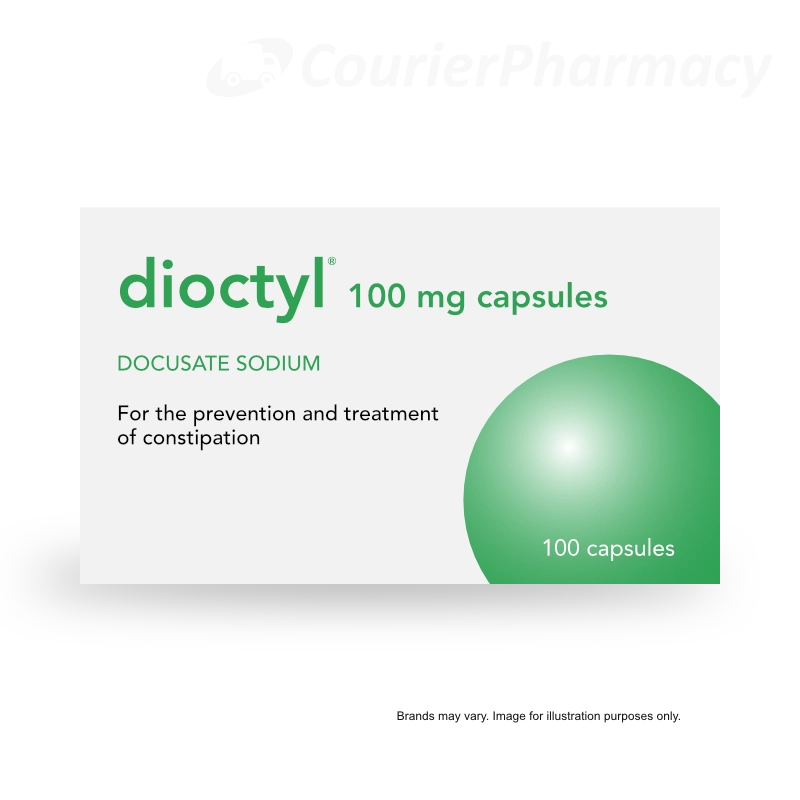
Dioctyl 100mg Capsules — Docusate Sodium Stool Softener for Constipation
This is a licensed medicine — Dioctyl capsules contain docusate sodium 100mg per capsule, a stool softener licensed for the short-term relief of constipation, particularly where hard, dry stools are the main problem.
It works through a genuinely different mechanism from bulk-forming, osmotic, or stimulant laxatives — docusate is a surfactant (a substance that reduces surface tension) that allows water and fats to penetrate hard stools, making them softer and easier to pass without necessarily accelerating gut motility.
Standard adult dosing is typically 1-5 capsules daily in divided doses, adjusted to response. Dioctyl sits at the early-to-mid tier of the constipation treatment ladder, particularly useful for patients where straining and hard stools are the main issue, and often used alongside other approaches for comprehensive management. Available at Courier Pharmacy after clinical review.
At Courier Pharmacy, we believe in treatment that fits the person, but only where it’s honest, safe, and consented to.
This page covers what Dioctyl (docusate sodium) is, how the stool softener mechanism differs from other laxative classes, who it may suit, how the standard dosing approach works, how it compares to alternatives in the constipation treatment ladder, and the practical points that matter — including realistic expectations, when other options might suit better, and the specific scenarios where docusate genuinely fits.
Five key takeaways
- Dioctyl 100mg capsules contain docusate sodium (a surfactant stool softener), licensed for short-term relief of constipation particularly where hard, dry stools are the main problem
- Genuinely different mechanism from other laxatives — docusate reduces surface tension of stools, allowing water and fats to penetrate and soften them rather than adding bulk, drawing water in osmotically, or stimulating gut motility
- Standard adult dosing is 1-5 capsules daily in divided doses (typically starting at 1 capsule twice daily), adjusted to response. Effect typically develops over 1-3 days rather than acutely, so patience during initial dosing is important
- Particularly suits scenarios where straining and hard stool consistency are the main issues — post-surgical constipation, painful defecation from anal fissures or haemorrhoids, situations where straining should be avoided (recent cardiac events, hernia risk), and older adults with hard-stool constipation
- Generally well-tolerated with modest side effect profile. Not for intestinal obstruction, appendicitis, undiagnosed abdominal pain, dehydration, or known allergy. Prescriber assessment before supply is essential
Why choose Courier Pharmacy for constipation support
At Courier Pharmacy, our approach starts with a simple idea: treatment should fit the person, not force the person to fit the system.
Dr Ada Jex-Cori
Our service is shaped by the philosophy of Dr Ada Jex-Cori, our brand pharmacist.
Dr Ada represents the spirit of the pharmacy: evidence-led, community-rooted, and willing to challenge the one-size-fits-all approach to medicine. She is named in honour of three pioneering women in science: Ada Lovelace, the mathematician and visionary; Sophia Jex-Blake, the first female doctor in the UK who fought the medical establishment; and Gerty Cori, the biochemist and Nobel Prize winner.
In our fictional world of Etherwell, Dr Ada fights against pharma’s standardised approach to medicine. In the real world, she represents what we stand for. Her view is straightforward: you are not broken. The system is. And we are here to change that.

Different constipations deserve different treatments
Constipation isn’t one condition. Courier Pharmacy is different. So we recognise that:
- Hard-stool constipation is genuinely different from slow-transit constipation
- Different patients need different mechanistic approaches
- Getting the right treatment for the right problem matters more than defaulting to familiar options
- Docusate specifically suits hard-stool scenarios rather than being a general laxative
- Comprehensive lifestyle work alongside medication improves outcomes
- Straining-avoidance scenarios (post-surgical, post-cardiac, fissures) benefit from softening specifically
Honest framing about docusate evidence
The evidence picture has evolved:
- Docusate was widely used historically based on early clinical experience
- Modern systematic reviews suggest more limited effectiveness than assumed for chronic constipation
- Evidence remains stronger for specific scenarios (hard stools, straining avoidance)
- Combination approaches often more effective than docusate alone
- Realistic expectations based on current evidence, not historical enthusiasm
Honest framing about docusate vs alternatives
Different mechanisms, different roles:
- Docusate suits stool consistency problems
- Osmotics (Cosmocol) suit chronic constipation with stronger evidence base
- Stimulants (senna, bisacodyl) suit acute relief or slow transit
- Prokinetics (prucalopride) suit chronic idiopathic constipation not responding to earlier stages
- Bulk-formers (Fybogel) suit dietary fibre deficiency
- Position in treatment ladder reflects appropriate role
Honest framing about short-term vs long-term use
Why duration matters:
- Docusate is licensed for short-term use
- Long-term daily use isn’t the ideal approach
- Chronic constipation deserves specific investigation and appropriate long-term management
- Persistent constipation needs review rather than indefinite laxative use
- Sometimes docusate is a bridge to lifestyle changes and other approaches
Constipation and the bigger picture
Constipation rarely sits in isolation. So our prescriber can discuss:
- Comprehensive management approach
- Dietary patterns that support gut health
- Fluid intake optimisation
- Physical activity and gut motility
- Stress and gut function
- Pelvic floor considerations if relevant
- Menstrual cycle and hormonal factors
- Menopause and gut function
- Medications that may contribute to constipation
- Investigations if red flag symptoms emerge
- When to consider specialist referral
- Long-term monitoring approach
Sometimes constipation is one part of a wider health picture worth talking through.
Prescriber support before and after supply
Our team is here to discuss:
- Whether Dioctyl fits your specific constipation type
- Whether other laxative classes would suit better
- Whether combination approaches would help
- Alternative approaches
- Comprehensive lifestyle work alongside medication
- Correct use approach
- Realistic expectations
- When to expect effect
- What to do if you don’t respond within 1-2 weeks
- What to do if side effects develop
- When to review or adjust approach
Trust earned, not claimed
We are GPhC-regulated, and our content is grounded in the licensed Dioctyl Summary of Product Characteristics, NICE clinical knowledge summaries on constipation, contemporary systematic reviews on docusate effectiveness including Cochrane reviews, BNF guidance on docusate sodium, MHRA guidance on medicine supply, and the real experience of patients managing constipation across the treatment ladder.
If Dioctyl isn’t the right answer for your situation, we’ll tell you honestly. After all, getting the right approach matters more than fulfilling a request.
How supply works
Dioctyl is a licensed medicine, which means the supply process has proper clinical steps rather than a straight checkout. Here’s how it works from your first click to your capsules arriving.
Step 1: Eligibility check
Complete the constipation consultation on courierpharmacy.co.uk. This covers your constipation history, stool characteristics, previous treatments tried, current lifestyle factors, and specific scenario (post-surgical, fissures, haemorrhoids, straining concerns). We ask specifically about stool consistency because docusate particularly suits hard-stool scenarios.
Step 2: Prescriber review
Your consultation goes to our UK-qualified prescriber, who reviews your clinical picture. This isn’t automatic approval. The prescriber assesses whether Dioctyl genuinely fits your specific constipation type, whether other laxative classes might suit better, whether combination approaches might help, or whether specialist referral would be more appropriate. If any of these fit better, we’ll say so.
Step 3: Prescription and dispensing
If the prescriber judges Dioctyl is appropriate, they issue a prescription. Your medication is dispensed from our GPhC-regulated pharmacy premises.
Step 4: Discreet delivery and ongoing support
Your order is dispatched in plain packaging, suitable for home or workplace delivery. Free prescriber support is available throughout your treatment.
When other options might suit better
If Dioctyl isn’t right, we’ll explain why. Other options may include:
- Fybogel (ispaghula husk) — bulk-forming for dietary fibre inadequacy
- Cosmocol or Movicol (macrogol) — osmotic with stronger chronic constipation evidence
- Lactulose — osmotic alternative
- Senna or bisacodyl — stimulant for acute or slow-transit constipation
- Dulcolax Pico (sodium picosulfate) — stimulant liquid
- Glycerol suppositories — local rectal stimulation
- Combination approaches (softener plus stimulant)
- Prucalopride (Resolor) — for chronic idiopathic constipation not responding to laxatives
- Linaclotide (Constella) — for IBS-C specifically
- Naldemedine or naloxegol — for opioid-induced constipation
- Specialist gastroenterology referral for complex cases
- Dietary review with a dietitian
Our community service
Our free fortnightly drop-in clinics at Insomnia, Derby run every other week from 10am to 12pm.
Healthcare shouldn’t only happen when you’re paying for it. So we show up, even when it’s free.
We cover weight management, GLP-1 therapy, MCAS, menopause, women’s health, men’s health, chronic pain, digestive health, allergies, asthma, sleep, migraine, headache, skincare, acne, hair loss, and whatever else people bring through the door. No appointment needed, no charge, no pressure.

Active ingredient
Each Dioctyl capsule contains:
- Docusate sodium 100mg (also known as dioctyl sodium sulfosuccinate)
- Excipients including gelatin, glycerol, and colouring agents in the soft capsule shell
- Standard excipients supporting stability and delivery
Why docusate sodium specifically
Docusate sodium offers specific pharmacological advantages:
- Anionic surfactant that reduces surface tension of stools
- Allows water and fats to penetrate hard stool matter
- Softens stools without stimulating peristalsis directly
- Doesn't cause the cramping associated with stimulant laxatives
- Doesn't cause the osmotic diarrhoea sometimes seen with macrogol or lactulose
- Well-tolerated over decades of clinical use
- Suitable for short-term use in specific scenarios
- Available as both licensed medicine and OTC formulations
In short, docusate provides stool softening without the motility effects of other laxative classes. This mechanism suits scenarios where the primary need is softer stools rather than accelerated transit.
Why the 100mg strength
The 100mg per capsule strength allows flexible dosing:
- Standard starting dose: 1 capsule twice daily (200mg total)
- Dose can be increased up to 500mg total daily in divided doses
- Individual titration based on response
- Same strength suits both initial and maintenance dosing scenarios
- Allows tailoring to individual response and tolerance
How the surfactant mechanism works
Understanding the pharmacology:
- Docusate is an anionic surfactant (surface-active agent)
- Reduces the surface tension between water and fats in the intestinal contents
- Allows water and lipids to penetrate hard, dry stool matter more easily
- Softer stool consistency emerges
- May also mildly stimulate secretion of water and electrolytes into the intestinal lumen
- Doesn't directly stimulate peristalsis like senna or bisacodyl
- Effect develops over 1-3 days as stools soften through the digestive tract
Other ingredients
The capsule shell contains gelatin (of animal origin), glycerol, and colouring agents. So patients following strict vegetarian or vegan diets or with specific religious dietary restrictions should discuss alternatives.
Complete excipients list is provided with each supply. So mention any known allergies or sensitivities during your consultation.
Pack details
Dioctyl 100mg capsules come as:
- Soft gelatin capsules
- Blister packs preserve stability
- Standard pack size: 30 capsules
- Larger pack sizes may be available depending on supply

What is Dioctyl for?
Dioctyl is licensed for the short-term treatment of constipation. So it fits a specific clinical scenario — not chronic idiopathic constipation as a first choice necessarily, but constipation where stool softening is the primary therapeutic need. As a result, docusate sits in the specific niche of hard-stool constipation rather than functioning as a general-purpose laxative for all constipation scenarios.
What docusate specifically addresses
The clinical scenarios where stool softening matters most:
- Hard, dry, pellet-like stools that are difficult to pass
- Constipation with painful defecation from anal fissures
- Constipation with haemorrhoids where straining worsens symptoms
- Post-surgical constipation where straining should be avoided
- Constipation after childbirth where perineal healing benefits from soft stools
- Situations where straining is medically inadvisable (recent cardiac events, hernia risk, glaucoma)
- Older adults with hard-stool constipation and reduced fluid intake
- Preparation for bowel procedures where softer stools are preferred
- Adjunct to other laxatives for comprehensive constipation management
Who might Dioctyl suit?
This medicine may suit:
- Adults with constipation characterised by hard, dry stools
- Adults with painful defecation from fissures or haemorrhoids
- Adults recovering from surgery where straining should be avoided
- Adults recovering from childbirth
- Adults with cardiac conditions where straining is inadvisable
- Adults with hernia risk where straining should be minimised
- Adults with glaucoma where straining can affect intraocular pressure
- Older adults with hard-stool constipation
- Adults preferring capsule format over liquid laxatives
- Adults preferring softener approach over motility stimulation
- Adults committed to lifestyle measures alongside medication
- Adults engaged with prescriber-led review
What Dioctyl may help with
Based on the surfactant mechanism and clinical use:
- Softening of hard, dry stools
- Reduced straining during defecation
- Easier stool passage
- Reduced pain from defecation with fissures or haemorrhoids
- Support during post-surgical recovery
- Support during post-partum recovery
- Prevention of straining-related complications
- More comfortable bowel movements
Important honesty point: docusate is a stool softener rather than a laxative in the traditional sense. It doesn't accelerate transit, add bulk, or stimulate the colon. So if constipation is primarily due to slow transit rather than hard stool consistency, other options often work better. Additionally, clinical evidence for docusate's effectiveness has become somewhat mixed in recent years — some systematic reviews suggest more limited benefit than historical use assumed, particularly for chronic constipation. So realistic expectations matter, and pairing docusate with other approaches often works better than docusate alone for complex situations.
What Dioctyl doesn't claim to do
Honest framing matters:
- It doesn't stimulate the colon like senna or bisacodyl
- It doesn't add bulk like Fybogel or methylcellulose
- It doesn't draw water into the bowel like macrogol (Cosmocol) or lactulose
- It doesn't restore gut motility like prucalopride (Resolor)
- It doesn't work overnight — effect typically develops over 1-3 days
- It doesn't address slow-transit constipation as effectively as motility-stimulating options
- It doesn't replace lifestyle measures (fluid, fibre, activity)
- It isn't licensed for long-term chronic constipation management
- It has more limited clinical evidence than initially assumed for chronic use
- It isn't a substitute for investigating underlying causes if constipation persists

Frequently asked questions

How is Dioctyl different from other laxatives?
Different mechanism:
- Dioctyl (docusate) softens stools through surfactant action
- Bulk-formers add fibre bulk
- Osmotics draw water into the bowel
- Stimulants accelerate transit through nerve stimulation
- Prokinetics restore gut motility
- Docusate addresses stool consistency specifically
When does docusate work best?
Specific scenarios:
- Hard, dry, difficult-to-pass stools
- Painful defecation from fissures or haemorrhoids
- Post-surgical scenarios where straining should be avoided
- Post-partum recovery
- Situations where straining is medically inadvisable
- Older adults with hard-stool constipation
How long before Dioctyl works?
Gradual effect:
- Not for acute overnight relief
- Effect typically develops over 1-3 days
- Full effect usually by 3-7 days
- Requires regular dosing during initial period
Is Dioctyl the same as docusate sodium?
Yes:
- Dioctyl is a brand name for docusate sodium
- Docusate sodium is also called dioctyl sodium sulfosuccinate
- Various brand names and generic versions exist
- Same active ingredient across formulations
Does docusate work for all constipation?
No — best for specific scenarios:
- Best for hard-stool consistency problems
- Less effective for slow-transit constipation
- Modern evidence suggests limited effectiveness for chronic constipation as monotherapy
- Other classes often work better for different constipation types
- Prescriber assessment identifies suitable candidates
Can I take Dioctyl long-term?
Generally not recommended:
- Licensed for short-term use
- Chronic constipation needs specific investigation and appropriate long-term management
- Prolonged laxative use of any kind isn't ideal
- Regular prescriber review essential for extended use
What if Dioctyl doesn't work?
Consider alternatives:
- Assess whether stool consistency is really the primary issue
- Consider other laxative classes
- Consider combination approaches
- Review lifestyle factors
- Investigation for underlying causes if constipation persists
- Discuss with prescriber
Can I take Dioctyl with other laxatives?
Yes, in many cases:
- Sometimes combined with stimulants for comprehensive approach
- Sometimes combined with osmotics
- Don't combine with mineral oil (liquid paraffin) — key interaction
- Discuss combined approach with prescriber
Can I take Dioctyl during pregnancy?
Generally considered safe:
- Docusate not systemically absorbed to significant degree
- Generally considered safe for short-term pregnancy use
- Particularly useful for post-partum straining avoidance
- Discuss with prescriber before use
Can I take Dioctyl while breastfeeding?
Generally compatible:
- Minimal systemic absorption
- Generally considered compatible with breastfeeding
- Useful for post-partum straining avoidance
- Discuss with prescriber before use
Can children take Dioctyl?
Adult formulation:
- Standard formulation for adults from 12 years
- Paediatric dosing exists for specific scenarios under specialist direction
- Discuss children's constipation with GP or paediatrician
What if I have appendicitis symptoms?
Don't take Dioctyl:
- Contraindicated in appendicitis or suspected appendicitis
- Contraindicated in undiagnosed severe abdominal pain
- Seek urgent medical assessment for severe abdominal pain
What if I get diarrhoea from Dioctyl?
Common if dose too high:
- Reduce dose
- Ensure adequate hydration
- Persistent diarrhoea beyond a few days — discuss with prescriber
- Sign that dose may need adjustment or alternative approach
How should I store Dioctyl?
- Below 25°C
- In original blister pack
- Away from direct heat and moisture
- Keep out of reach of children
- Use by expiry date
Is my packaging discreet?
- Plain packaging with no mention of contents
- Suitable for delivery to home or workplace
How do I order Dioctyl from Courier Pharmacy?
Complete the constipation consultation on courierpharmacy.co.uk. Our prescriber will review your constipation type, previous treatments, and current situation, then supply Dioctyl if clinically appropriate. Your order goes out in plain, discreet packaging with support available throughout your treatment.
More than a prescription: our community
Healthcare shouldn't only happen when you're paying for it.
Every fortnight we run free drop-in talks and clinics at Insomnia, Derby, from 10am to 12pm. So we show up, even when it's free.
Bring a question, bring a friend, bring a stack of bewildering letters from another clinic. We'll sit with you.
We cover weight management, GLP-1 therapy, MCAS, menopause, women's health, men's health, chronic pain, digestive health, allergies, asthma, sleep, migraine, skincare, acne, hair loss, and whatever else people bring through the door. No appointment. No cost. No pressure. Just real support and treatment that fits.
This page is for information only and isn't a substitute for personal medical advice. Dioctyl is a licensed medicine (docusate sodium) for short-term treatment of constipation. It's contraindicated in intestinal obstruction, appendicitis or suspected appendicitis, undiagnosed abdominal pain, and severe dehydration. Prescriber assessment before supply is essential. Signs of intestinal obstruction (severe abdominal pain with vomiting, fever, distention) need urgent medical assessment. Signs of severe allergic reaction (facial swelling, breathing difficulty, widespread rash) need immediate medical attention (999). Red flag symptoms (blood in stool, unexplained weight loss, family history of bowel cancer) need investigation before laxatives are prescribed. Don't combine with mineral oil (liquid paraffin) due to lipoid pneumonia risk. Constipation persisting beyond 1-2 weeks of treatment requires review rather than continued laxative use. This medicine should be used alongside comprehensive lifestyle measures for constipation.
How this content was created
Written by the Courier Pharmacy editorial team and reviewed by a GPhC-registered prescribing pharmacist.
The content is grounded in the licensed Dioctyl Summary of Product Characteristics, NICE Clinical Knowledge Summaries on constipation, Cochrane and other systematic reviews on docusate effectiveness in constipation, British National Formulary guidance on docusate sodium, MHRA guidance on medicine supply, and the real experience of patients managing constipation through our consultation pathway and drop-in clinics in Derby.
References
- electronic Medicines Compendium (emc). (n.d.) Summary of Product Characteristics (SmPC): Product 6218. Datapharm. Available at: https://www.medicines.org.uk/emc/product/6218/smpc (Accessed: 11 July 2026).
- NICE Clinical Knowledge Summary — Constipation. https://cks.nice.org.uk/topics/constipation/
- British National Formulary — Docusate sodium. https://bnf.nice.org.uk/drugs/docusate-sodium/