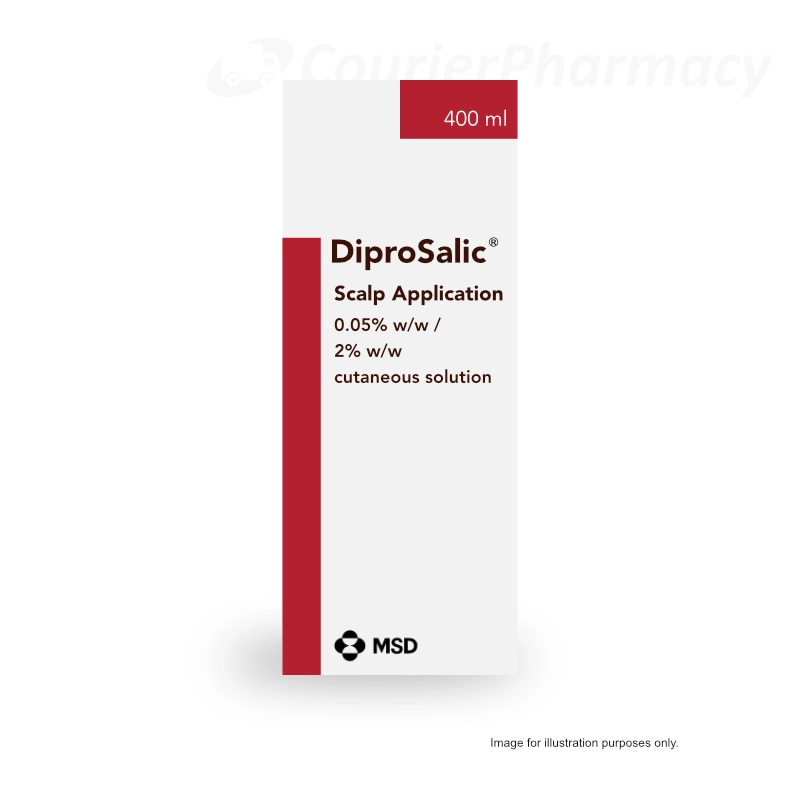
A colourless, slightly thick scalp solution combining a potent corticosteroid (betamethasone dipropionate 0.05%) with a keratolytic (salicylic acid 2%)
Licensed for scalp conditions with thick, resistant scale where a corticosteroid alone would struggle to penetrate
Applied thinly once or twice daily as a short course (long-term use should be avoided)
Not for use on the face; children’s use limited to 5 days
Prescription only, dispensed by Courier Pharmacy following full clinical consultation with a UK-qualified prescriber
Diprosalic Scalp Application is a colourless, slightly thick solution containing two active ingredients per gram: betamethasone dipropionate 0.64 mg (equivalent to 0.5 mg betamethasone) and salicylic acid 20 mg. In particular, betamethasone is classified as a potent (Class III) topical corticosteroid. Firstly, Diprosalic is manufactured by Organon Pharma (UK) Limited.
Meanwhile, the same active combination is available as Diprosalic Ointment for use on skin (body) rather than scalp. Additionally, other topical combination products for psoriasis (like Dovobet Gel or Enstilar Foam from LEO Pharma) combine a corticosteroid with a vitamin D analogue rather than a keratolytic, giving prescribers a choice based on which combination best suits the individual clinical picture.
How the combination works
Scalp psoriasis and some other scalp conditions produce thick, adherent scale that acts as a physical barrier to topical treatments. In particular, when a corticosteroid is applied to skin covered by thick scale, much of the active ingredient can’t reach the inflamed skin underneath. Meanwhile, salicylic acid is a keratolytic; it softens keratin, loosens the top layer of scale, and helps it shed.
Additionally, this lifts the scale barrier and allows the betamethasone dipropionate to reach and treat the inflamed skin beneath. Furthermore, betamethasone dipropionate then reduces the local inflammation, redness, and itching that drive the condition. As a result, the two ingredients work in complementary rather than competing ways, and the combination is often more effective than either component alone for hyperkeratotic scalp conditions.
Why short-course use only
Betamethasone dipropionate is a potent (Class III) topical corticosteroid with well-documented risks when used long-term, particularly skin thinning (atrophy), stretch marks (striae), telangiectasia, and rebound flares on stopping. In particular, these risks apply to scalp skin as well as body skin, though the thicker skin of the scalp is somewhat more resilient than facial or flexural skin.
Meanwhile, salicylic acid can also cause dermatitis with prolonged use. Additionally, current guidance recommends time-limited treatment courses with clear plans for stopping or stepping down. Furthermore, patients who need ongoing scalp psoriasis management often use non-steroidal alternatives (like calcipotriol-based scalp treatments) for maintenance, keeping Diprosalic for flares. As a result, Diprosalic Scalp Application is a short-course treatment rather than a long-term daily use product.
Key features and specifications
Active ingredients: betamethasone dipropionate 0.64 mg per gram (equivalent to 0.5 mg betamethasone) + salicylic acid 20 mg per gram
Form: colourless, slightly thick solution
Pack sizes: 30 ml or 100 ml bottles (not all pack sizes may be marketed at any given time)
Class: potent (Class III) topical corticosteroid combined with a keratolytic
Legal status: Prescription Only Medicine (POM)
Excipients: disodium edetate, hydroxypropyl methylcellulose, sodium hydroxide, isopropyl alcohol, and purified water
Contains isopropyl alcohol: may cause stinging on broken skin; also flammable
A potent scalp treatment combining a topical corticosteroid with a keratolytic
Diprosalic Scalp Application is a colourless, slightly thick solution licensed for scalp conditions where thick scale prevents topical corticosteroids from working well on their own. Firstly, it contains two active ingredients: betamethasone dipropionate (a potent Class III topical corticosteroid) and salicylic acid (a keratolytic that softens and lifts scale). Additionally, patients and prescribers sometimes refer to it colloquially as ‘Diprosalic Scalp Ointment’ although the formulation is technically a solution, not an ointment; the ointment form of Diprosalic is a separate product designed for skin (body) rather than scalp use. Meanwhile, Diprosalic Scalp Application is typically used for short-course treatment of scalp psoriasis and other hyperkeratotic scalp conditions. At Courier Pharmacy, Diprosalic is prescribed through a full clinical consultation with a UK-qualified prescriber.
Five key takeaways
Diprosalic Scalp Application is a two-in-one scalp solution containing betamethasone dipropionate 0.05% (a potent corticosteroid) and salicylic acid 2% (a keratolytic).
Licensed for scalp conditions with thick, resistant scale where a corticosteroid alone would struggle to penetrate.
Applied thinly once or twice daily as a short course; long-term continuous use should be avoided because of the potent steroid content.
Not for use on the face; use in children limited to 5 days.
Diprosalic Scalp Application is a Prescription Only Medicine. A UK-qualified prescriber reviews every request at courierpharmacy.co.uk.
What is Diprosalic Scalp Application: overview
Where Diprosalic sits in the NICE psoriasis pathway
NICE clinical guideline CG153 covers the assessment and management of psoriasis. In particular, for scalp psoriasis, NICE recommends starting with a potent topical corticosteroid once daily for up to 4 weeks. Meanwhile, if this doesn’t achieve control, options include adding a topical vitamin D analogue (like calcipotriol) at a different time of day, or moving to a combination product (like Dovobet Gel). Additionally, for hyperkeratotic scale, a salicylic acid preparation may be used first to lift the scale before applying a steroid; Diprosalic combines both steps in one product. Furthermore, prolonged continuous potent steroid use should be avoided, with breaks or step-down to non-steroidal maintenance. As a result, Diprosalic has a specific place for hyperkeratotic scalp flares.
Diprosalic vs steroid-alone scalp treatments
Several potent topical corticosteroid scalp treatments exist (Betnovate Scalp Application, Elocon Scalp Lotion, and others). In particular, these products work well for inflammatory scalp conditions without thick scale. Meanwhile, when scale is thick and adherent, a steroid alone may not penetrate effectively; the added salicylic acid in Diprosalic addresses this by lifting scale to let the steroid work. Additionally, for scalp psoriasis with prominent scaling, Diprosalic is often preferred over steroid-alone products. Furthermore, once thick scale has resolved, a steroid-alone maintenance approach (or a non-steroid alternative) may be more appropriate. As a result, Diprosalic fits a specific clinical picture rather than being interchangeable with all scalp steroids.
Diprosalic vs Dovonex Scalp Solution
Diprosalic Scalp Application and Dovonex Scalp Solution both treat scalp psoriasis but work differently. In particular, Diprosalic combines a potent steroid and a keratolytic; Dovonex contains calcipotriol (a vitamin D3 analogue) alone. Meanwhile, Diprosalic works faster and is used short-course; Dovonex works more slowly but can be used long-term without the steroid-related risks. Additionally, some patients use both (at different times of day) during flares, and then continue Dovonex alone for maintenance. However, above all, DO NOT apply Diprosalic and Dovonex at the same time on the same area; salicylic acid deactivates calcipotriol on contact. Furthermore, if using both, leave several hours between applications. As a result, coordination of these two products matters.
A treatment for defined courses, not indefinite use
Diprosalic is a course-based treatment rather than a long-term daily therapy. In particular, most patients use it for 2 to 4 weeks at a time. Meanwhile, if scalp symptoms return after a course, further short courses may be prescribed with breaks in between. Additionally, patients who need ongoing scalp treatment often use non-steroidal alternatives (like Dovonex Scalp Solution or coal tar shampoos) for maintenance, reserving Diprosalic for flares. Furthermore, discuss any pattern of recurrent use with your prescriber to build a coherent long-term plan. As a result, treatment planning matters as much as individual courses.
Why choose Courier Pharmacy for your Diprosalic Scalp Application
Registered, independent, and prescriber-led
Courier Pharmacy is a UK-registered independent pharmacy. The General Pharmaceutical Council regulates us. Firstly, scalp psoriasis and other hyperkeratotic scalp conditions vary substantially between patients. Additionally, the pattern of your symptoms, previous treatments, current medicines, and expectations for the coming months all matter. As a result, our prescribers ask about those things properly rather than treating scalp treatment prescribing as a tick-box exercise. Getting your scalp treatment right is about the fit, the course length, and the follow-up plan.
Dr Ada Jex-Cori, our brand pharmacist
Our brand pharmacist is Dr Ada Jex-Cori. She represents the spirit of what we do. Named for Ada Lovelace, Sophia Jex-Blake, and Gerty Cori, she stands for evidence-led, unafraid-of-questions medicine. Her message is straightforward. You’re not broken. The system is. We’re here to change that.
Care that keeps showing up
Scalp psoriasis treatment isn’t a one-off transaction. Furthermore, we build in ongoing review for chronic conditions. Additionally, if you need repeat short courses of Diprosalic, we’re here to help plan them with appropriate breaks and maintenance strategies. Meanwhile, for patients whose scalp psoriasis affects visible areas, quality of life, or self-confidence, that continuity matters. As a result, we treat scalp psoriasis as a long-term relationship, not a single dispense.
Free fortnightly drop-in clinics in Derby
Healthcare shouldn’t only happen when you’re paying for it. Every fortnight, we run free drop-in talks at Insomnia Coffee shop, Derby, from 10am to 12 pm. Anyone can come. No appointment. No cost. No pressure. We cover skincare, mental health, weight management, hormones, hair loss, digestive health, and more.
Buy Diprosalic Scalp Application (Prescription Only) from Courier Pharmacy
Diprosalic Scalp Application is a Prescription Only Medicine. You can request it at courierpharmacy.co.uk. Firstly, complete a full online consultation covering your scalp condition, previous treatments, and other medicines. Then, a UK-qualified prescriber reviews your answers carefully. If Diprosalic is appropriate for you, we dispense and deliver discreetly.
Complete a full online consultation covering your scalp condition, medical history, and current medicines
A UK prescriber reviews your consultation and may follow up with questions
If approved, a prescription is issued and dispensed
We deliver discreetly and set up follow-up if needed
If Diprosalic isn’t the right treatment for you (for example, if your scalp condition is very extensive, has unusual features, or would suit a non-steroidal alternative for long-term use), we’ll explain why and suggest better routes. Above all, we won’t dispense Diprosalic just because it was requested.
Summary
A combination scalp solution containing a potent corticosteroid (betamethasone dipropionate) and a keratolytic (salicylic acid).
Designed to treat scalp conditions with thick scale where a corticosteroid alone can’t penetrate effectively.
Applied thinly once or twice daily as a short course (typically 2 to 4 weeks).
Sits alongside other scalp psoriasis treatments including Dovonex Scalp Solution (calcipotriol, non-steroidal) and combination products like Dovobet Gel.
Long-term continuous use should be avoided because of the potent steroid content; different maintenance options exist.
Active ingredients in Diprosalic Scalp Application
Betamethasone dipropionate
Betamethasone dipropionate is a synthetic fluorinated corticosteroid. In particular, it's classified as a potent (Class III) topical corticosteroid in the UK. Meanwhile, it produces a rapid and sustained anti-inflammatory response in the skin, and is effective for inflammatory conditions that don't respond well to milder steroids, including scalp psoriasis. Additionally, the dipropionate ester (rather than the plain betamethasone or valerate ester) gives good skin penetration and duration of action. Furthermore, betamethasone dipropionate is the same active found in several other topical products including Diprosone Ointment/Cream and combination products like Dovobet.
Salicylic acid
Salicylic acid at 2% is a keratolytic agent. In particular, it softens keratin, loosens the top layer of scale (cornified epithelium), and helps it shed. Meanwhile, this is particularly useful in hyperkeratotic conditions like scalp psoriasis, where thick scale can prevent other treatments from reaching the affected skin. Additionally, salicylic acid on its own is used in scalp psoriasis (as coconut oil-based scalp preparations, or coal tar and salicylic acid combinations). Furthermore, the combination with a potent steroid in Diprosalic addresses both the scale barrier and the underlying inflammation in one product. Above all, salicylic acid deactivates calcipotriol on contact, which is why Diprosalic and Dovonex (or any calcipotriol product) should not be applied at the same time on the same area.
Solution formulation with isopropyl alcohol
Diprosalic Scalp Application is formulated as a solution rather than an ointment, cream, or gel. In particular, this formulation is designed for hair-bearing skin; it penetrates through hair to the scalp without leaving greasy residue that would make hair look oily or matted. Meanwhile, the solution contains isopropyl alcohol as one of the excipients. Additionally, this can cause stinging on broken or inflamed skin. Furthermore, isopropyl alcohol is flammable; keep the bottle away from open flames or heat sources. As a result, the solution format works well for scalp use but has its own handling considerations.
What is Diprosalic Scalp Application for?
Scalp psoriasis
Scalp psoriasis is one of the most common presentations of psoriasis, affecting a large proportion of psoriasis patients. In particular, it produces raised red patches with silvery-white scale on the scalp, sometimes extending beyond the hairline onto the forehead, ears, or back of the neck. Meanwhile, scalp psoriasis often becomes hyperkeratotic (very thick and scaly), which is exactly the scenario Diprosalic is designed for. Additionally, effective treatment often improves both physical symptoms (itching, flaking, hair concerns) and the psychological impact of visible flaking.
Other hyperkeratotic scalp conditions
Beyond scalp psoriasis, Diprosalic may be used for other corticosteroid-responsive scalp conditions with prominent scale. In particular, this can include seborrhoeic dermatitis with thick scale, and some cases of chronic scalp eczema where scale is a major feature. Meanwhile, treatment choice should be guided by accurate diagnosis; different scalp conditions can look similar but need different treatments. Additionally, if the diagnosis is uncertain, dermatology input may be helpful.
What Diprosalic isn't for
Above all, Diprosalic Scalp Application is a specific tool for scalp conditions with hyperkeratotic scale, not a general scalp treatment. In particular, it isn't first-line for acute scalp infections (bacterial, fungal, viral). Additionally, it isn't for widespread body psoriasis or non-scalp skin conditions (use Diprosalic Ointment for skin, if the same combination is needed). Meanwhile, it isn't licensed for cosmetic scalp treatment. Furthermore, it isn't appropriate for scalp conditions where the diagnosis is unclear; correct identification of the underlying condition matters. As a result, use is guided by clinical picture and prescriber judgement.
How to apply Diprosalic Scalp Application
Part hair to expose scalp
Part your hair to expose the affected scalp areas. In particular, this ensures the solution reaches the scalp rather than being absorbed into hair. Meanwhile, work through the affected areas systematically. Additionally, if scalp psoriasis affects multiple areas of the scalp, address each area in turn. Furthermore, the applicator on the bottle typically allows drop-by-drop or line application; use whichever gives you best control.
Apply a few drops and massage in
Apply a few drops of the solution directly to the exposed scalp area. In particular, use only enough to cover the affected skin with a thin film. Meanwhile, gently massage into the scalp with your fingertips until the solution is absorbed. Additionally, avoid applying to hair rather than scalp, and avoid excess that may run onto the forehead or face. As a result, targeted scalp application gives the best benefit with the least risk.
Wash hands afterwards
Wash your hands thoroughly with soap and water after applying Diprosalic. In particular, this prevents transferring the potent steroid and salicylic acid to your face, eyes, or other sensitive areas. Meanwhile, if you accidentally get Diprosalic in your eyes, mouth, or on your face, wash off promptly with plenty of water. Additionally, avoid touching your face until you've washed your hands after application.
Timing with other scalp products
If you use Diprosalic alongside other scalp treatments (like coal tar shampoo, ketoconazole shampoo, or Dovonex Scalp Solution), apply them at different times of day rather than layering them. In particular, allow at least several hours between different topicals to avoid dilution or interaction. Meanwhile, above all, do NOT apply Diprosalic and Dovonex (or any calcipotriol product) at the same time on the same area; salicylic acid deactivates calcipotriol. Additionally, if using both, use them on different days or at very different times of day. Furthermore, discuss your full scalp treatment routine with your prescriber to build a coherent plan.
Apply a few drops of Diprosalic Scalp Application to the affected areas of scalp once or twice daily. In particular, part the hair to expose the scalp and drip or apply the solution directly onto the scalp rather than the hair. Meanwhile, massage gently and thoroughly into the scalp. Additionally, use only enough to cover the affected areas with a thin film; more is not better. Furthermore, wash your hands thoroughly after application. As a result, careful scalp-targeted application gives the best balance of benefit and safety.
Course length
Diprosalic Scalp Application is a short-course treatment. In particular, courses are typically 2 to 4 weeks, with a clear plan for stopping or stepping down. Meanwhile, long-term continuous therapy should be avoided in all patients regardless of age. Additionally, use in children (or on the face if occasionally used there under specialist guidance) should be limited to 5 days. Furthermore, if scalp symptoms recur after a course, further short courses may be prescribed with breaks in between; discuss this pattern with your prescriber. As a result, most patients use Diprosalic in defined bursts rather than indefinitely.
How long until improvement
Diprosalic often works relatively quickly for hyperkeratotic scalp conditions. In particular, initial improvement in scaling, redness, and itching may be noticeable within a few days. Meanwhile, meaningful clearing of thick plaques usually takes 1 to 2 weeks of consistent use. Additionally, this faster onset (compared to non-steroidal treatments like calcipotriol) is one reason short-course potent steroid combinations are useful for flares. As a result, patients often notice improvement early but should complete the prescribed course rather than stopping as soon as symptoms ease.
Do NOT use occlusion
Occlusion (covering the treated area with plastic wrap, an air-tight dressing, or similar) must not be used with Diprosalic. In particular, occlusion dramatically increases both corticosteroid absorption and salicylic acid absorption, raising the risk of local skin damage and systemic toxicity. Meanwhile, this includes swimming caps, shower caps, or headwear worn shortly after application. Additionally, leave treated scalp uncovered for at least 30 minutes after application. As a result, hats, headscarves, or hair coverings should be avoided or delayed after applying Diprosalic.
Missed applications
If you forget to apply Diprosalic, apply it as soon as you remember unless it's nearly time for the next application. In particular, don't apply a double amount to make up. Meanwhile, occasional missed doses aren't dangerous but consistent use during a short course gives the best result. As a result, aim to fit application into a regular morning and evening routine.
Warnings and precautions for Diprosalic Scalp Application
Do not apply to the face
Diprosalic Scalp Application should not be applied to the face. In particular, facial skin is thinner and more sensitive, and potent corticosteroids commonly cause skin atrophy, perioral dermatitis, telangiectasia, and steroid rosacea when used on the face. Meanwhile, if course use on the face is judged necessary under prescriber guidance, it should be limited to no more than 5 days. Additionally, if you accidentally get Diprosalic on your face, wash off promptly with water.
Skin atrophy and other long-term steroid effects
Betamethasone dipropionate is a potent corticosteroid and can cause skin thinning (atrophy), stretch marks (striae), telangiectasia, and easy bruising with prolonged use. In particular, these effects can be permanent. Meanwhile, they're more likely with continuous long-term use, use under occlusion, or use on thin skin (face, flexures). Additionally, this is why Diprosalic is a short-course treatment rather than a long-term one. Furthermore, scalp skin is thicker and more resistant than facial or flexural skin, so the risk is lower on the scalp than other body areas but is not zero.
Rebound flares on stopping
Potent topical corticosteroids can cause rebound flares of psoriasis or other conditions when stopped after prolonged use. In particular, this is one of the reasons for time-limited courses with clear stopping plans. Meanwhile, if you notice worsening of scalp symptoms after a Diprosalic course ends, contact your prescriber; sometimes stepping down (rather than stopping abruptly) or transitioning to a non-steroidal maintenance treatment helps. Additionally, planned tapering under prescriber guidance can reduce rebound risk.
Generalised pustular psoriasis risk
Topical corticosteroids used in psoriasis can rarely trigger generalised pustular psoriasis, a severe form of psoriasis that requires urgent specialist management. In particular, this risk is higher with abrupt withdrawal after prolonged use, use on widespread areas, or use in unstable psoriasis. Meanwhile, if you notice widespread pustules developing during or after Diprosalic use, seek prompt medical assessment. Additionally, this risk is one reason for careful prescriber supervision and short courses.
Systemic corticosteroid absorption
With prolonged use, use on large areas, use in children, or use under occlusion, enough betamethasone can be absorbed systemically to cause corticosteroid effects on the body as a whole. In particular, this can include suppression of the hypothalamic-pituitary-adrenal (HPA) axis. Meanwhile, symptoms of systemic corticosteroid effects include weight gain (particularly around the face and abdomen), high blood pressure, high blood sugar, and mood changes. Additionally, if you develop these symptoms during Diprosalic use, contact your prescriber. Furthermore, this is why occlusive dressings, extensive use, and long courses should be avoided.
Salicylic acid effects
Prolonged use of salicylic acid preparations can cause irritant dermatitis. In particular, if you notice worsening scalp irritation during Diprosalic use, contact your prescriber. Meanwhile, extensive systemic absorption of salicylic acid (from very extensive use, use under occlusion, or use on damaged skin) can theoretically cause salicylate toxicity, though this is very rare with topical use at this concentration. Additionally, avoid using Diprosalic on large areas simultaneously.
Do not use occlusion
Occlusion (plastic wrap, air-tight dressings, tight hats, or shower caps) must not be used with Diprosalic. In particular, occlusion dramatically increases absorption of both the corticosteroid and salicylic acid, raising the risk of both local damage (skin atrophy, striae, irritation) and systemic effects (HPA axis suppression, salicylate absorption). Meanwhile, keep the treated scalp uncovered for at least 30 minutes after application. Additionally, avoid tight headwear or hair coverings shortly after application.
Children and face use limited to 5 days
If Diprosalic is used in children or on the face (which should be under specific prescriber guidance), the course should be limited to 5 days. In particular, children have thinner skin and a higher surface-area-to-body-weight ratio, so systemic absorption is proportionally greater. Meanwhile, facial skin is more prone to atrophy and other corticosteroid side effects. Additionally, for chronic paediatric scalp psoriasis, specialist dermatology input is generally preferred over general online prescribing.
Isopropyl alcohol content
Diprosalic contains isopropyl alcohol as one of the excipients. In particular, this may cause stinging on broken or inflamed skin. Meanwhile, isopropyl alcohol is flammable; keep the bottle away from naked flames or heat sources, and avoid smoking or using electric hair dryers on freshly-applied Diprosalic. Additionally, allow the solution to dry fully before styling or heat-treating hair.
Pregnancy and breastfeeding
Topical corticosteroids should be used in pregnancy only if the potential benefit justifies the potential risk to the fetus. In particular, extensive use of potent topical corticosteroids in late pregnancy has occasionally been associated with low birth weight. Meanwhile, in breastfeeding, potent topical corticosteroids can pass into breast milk in small amounts if extensively used. Additionally, discuss pregnancy, planning pregnancy, or breastfeeding with your prescriber; use should typically be short-course and localised.
Side effects of Diprosalic Scalp Application
Common local skin effects
The most common side effects of Diprosalic are local skin reactions at the application site. In particular, these include burning, itching, irritation, dryness, and folliculitis (inflammation of hair follicles). Meanwhile, some patients experience acneiform eruptions or hypertrichosis (increased hair growth). Additionally, these effects are usually mild and may settle within the first few days. Furthermore, if irritation is severe or persistent, contact your prescriber.
Longer-term skin effects (with continuous use)
With continuous or repeated long-term use, potent corticosteroids can cause skin atrophy, stretch marks (striae), superficial blood vessel dilation (telangiectasia), pigmentation changes, perioral dermatitis, and allergic contact dermatitis. In particular, these effects can be permanent. Meanwhile, they're the main reason for time-limited courses rather than indefinite daily use. Additionally, notice any thinning, marks, or changes in the treated scalp skin and discuss with your prescriber.
Serious side effects requiring urgent help
Seek urgent help for signs of severe allergic reaction (facial swelling, difficulty breathing, widespread rash). Similarly, seek help for widespread pustules or sudden severe psoriasis flare (possible generalised pustular psoriasis). Additionally, seek help for symptoms of systemic corticosteroid effects (unusual weight gain, high blood pressure symptoms, mood changes, particularly with prolonged use). Meanwhile, severe skin reactions (blistering, peeling, mucosal involvement) also warrant urgent assessment.
Drug interactions with Diprosalic Scalp Application
Calcipotriol (Dovonex) — deactivation
Above all, do not apply Diprosalic and calcipotriol (Dovonex or any calcipotriol product) at the same time on the same area. In particular, salicylic acid in Diprosalic deactivates calcipotriol on contact. Meanwhile, if both treatments are needed as part of a scalp psoriasis regimen, use them at very different times of day (for example, one in the morning and one at night). Additionally, some prescribers alternate the two on different days rather than combining them on the same day. As a result, coordination of these two products matters.
Other topical products
Diprosalic can be used alongside coal tar shampoos, ketoconazole shampoos, and other scalp treatments but should be applied at different times of day rather than layered. In particular, allow at least an hour between different topicals. Meanwhile, shampoos should be rinsed out fully before applying Diprosalic. Additionally, if using multiple scalp treatments, disclose this at consultation for a full compatibility check.
Interactions from potential systemic absorption
At recommended short-course topical doses, systemic absorption of betamethasone is generally low, so significant systemic drug interactions are uncommon. However, extensive use, prolonged use, or use under occlusion can raise systemic corticosteroid levels enough to interact with medicines that affect the hypothalamic-pituitary-adrenal axis, or with other drugs metabolised similarly. In particular, if you take other corticosteroid preparations (oral prednisolone, inhaled steroids for asthma), disclose this during consultation. Meanwhile, most patients using Diprosalic short-course don't need special interaction management.
Frequently asked questions about Diprosalic Scalp Application
How quickly does Diprosalic work?
Initial improvement in scaling, redness, and itching may be noticeable within a few days. In particular, meaningful clearing of thick scalp plaques usually takes 1 to 2 weeks of consistent use. Meanwhile, Diprosalic works faster than non-steroidal alternatives like calcipotriol because of the potent steroid component.
How long should I use Diprosalic?
Diprosalic is a short-course treatment, typically 2 to 4 weeks. In particular, long-term continuous therapy should be avoided because of the potent steroid content. Meanwhile, if symptoms recur, further short courses with breaks in between may be prescribed. Additionally, discuss any pattern of recurrent use with your prescriber.
Can I use Diprosalic on my body skin?
Diprosalic Scalp Application is formulated as a solution for scalp use. In particular, for body skin, Diprosalic Ointment (a separate product with the same active combination) is more appropriate. Meanwhile, don't use the scalp application on body skin extensively; the solution format isn't designed for that purpose.
Can I use Diprosalic on my face?
No, avoid facial application. In particular, facial skin is thinner and more prone to corticosteroid side effects including atrophy, perioral dermatitis, and steroid rosacea. Meanwhile, if a very short course on the face is judged necessary under prescriber guidance, it should be limited to no more than 5 days.
Can I combine Diprosalic with Dovonex Scalp Solution?
Not at the same time on the same area. In particular, salicylic acid in Diprosalic deactivates calcipotriol in Dovonex. Meanwhile, some regimens use Dovonex Scalp Solution during the day and Diprosalic at night (or vice versa), or alternate on different days. Additionally, discuss any combined use with your prescriber for a coordinated plan.
Will Diprosalic thin my scalp skin?
With short-course use as prescribed, skin thinning on the scalp is uncommon. In particular, scalp skin is thicker and more resilient than facial or flexural skin, so the risk is lower than in more sensitive areas. Meanwhile, with continuous long-term use, skin atrophy becomes more likely. Additionally, this is why Diprosalic should be used in defined courses rather than continuously.
Will I get hair loss from using Diprosalic?
Diprosalic doesn't typically cause hair loss. In fact, treating scalp psoriasis can improve hair-related concerns, since untreated scalp psoriasis can itself contribute to temporary hair shedding due to scalp inflammation. Meanwhile, if you notice unusual hair loss during Diprosalic treatment, discuss with your prescriber to rule out other causes.
Can I wash my hair while using Diprosalic?
Yes. In particular, most patients wash their hair as usual with a routine that fits Diprosalic application. Meanwhile, if using medicated shampoo (coal tar, ketoconazole), rinse fully before applying Diprosalic to a dry scalp. Additionally, apply Diprosalic to clean, dry scalp for best absorption.
How long after application can I cover my hair?
Allow at least 30 minutes after application before covering the scalp with hats, headscarves, or other hair coverings. In particular, occlusion increases absorption significantly and raises risks. Meanwhile, avoid tight or air-tight coverings altogether while on Diprosalic. Additionally, sleeping without a covering (or with loose covering) is fine.
Is Diprosalic safe in pregnancy?
Topical corticosteroids should be used in pregnancy only if the potential benefit justifies the potential risk. In particular, extensive use of potent topical corticosteroids in late pregnancy has occasionally been associated with low birth weight. Meanwhile, short-course localised use of Diprosalic is generally lower risk. Additionally, discuss pregnancy or planning pregnancy with your prescriber.
Can I breastfeed while using Diprosalic?
Topical potent corticosteroids can pass into breast milk in small amounts if extensively used. In particular, short-course localised scalp use is typically low-risk. Meanwhile, avoid applying to breast areas or in ways that a breastfeeding infant could contact. Additionally, discuss with your prescriber for individual guidance.
Does Diprosalic cure psoriasis?
No. Psoriasis is a chronic condition, and Diprosalic manages symptoms rather than curing the underlying tendency. In particular, plaques usually recur after treatment stops. Meanwhile, long-term management strategies (including maintenance treatments and lifestyle factors) matter for keeping psoriasis controlled between flares.
What if I miss a dose?
Apply as soon as you remember unless it's nearly time for the next dose. In particular, don't apply a double amount to make up. Meanwhile, occasional missed applications aren't dangerous but consistent use during a short course gives the best result.
Can I use Diprosalic with dandruff shampoo?
Yes, at different times of day. In particular, most dandruff shampoos (containing ingredients like ketoconazole, selenium sulphide, or zinc pyrithione) can be used alongside Diprosalic. Meanwhile, rinse the shampoo out fully before applying Diprosalic to a dry scalp. Additionally, if your dandruff is a symptom of a specific condition being treated with Diprosalic, discuss whether the dandruff shampoo remains needed.
Does Diprosalic sting on my scalp?
Some patients experience stinging or burning when applying Diprosalic, particularly on broken or inflamed skin. In particular, this is largely due to the isopropyl alcohol content of the solution. Meanwhile, this usually settles within a few minutes. Additionally, if stinging is severe or persistent, contact your prescriber.
What if my scalp psoriasis returns after treatment?
Recurrence after a Diprosalic course is common because psoriasis is a chronic condition. In particular, further short courses may be prescribed with breaks in between. Meanwhile, ongoing maintenance treatment (such as Dovonex Scalp Solution, coal tar shampoos, or other non-steroidal options) is often used between flares. Additionally, discuss a long-term plan with your prescriber.
Can I dye or style my hair while using Diprosalic?
Hair dyes and chemical hair treatments can be irritating to inflamed scalp skin; avoid them during active Diprosalic treatment courses. In particular, wait until the scalp condition is settled and the treatment course is complete before hair colouring. Meanwhile, gentle styling (combing, low-heat drying after Diprosalic has fully absorbed) is generally fine.
Is Diprosalic flammable?
Yes, because it contains isopropyl alcohol. In particular, keep the bottle away from open flames, heat sources, or lit cigarettes. Meanwhile, avoid using electric hair dryers on freshly-applied Diprosalic; allow it to dry fully first. Additionally, store the bottle in a cool place away from heat sources.
Do I need a prescription from Courier Pharmacy?
Yes. Diprosalic Scalp Application is a Prescription Only Medicine. A UK-qualified prescriber must review your consultation. You can complete this at courierpharmacy.co.uk.
Disclaimer
Disclaimer: This information is for education only and isn't a substitute for personal medical advice. Always follow your prescriber's instructions.