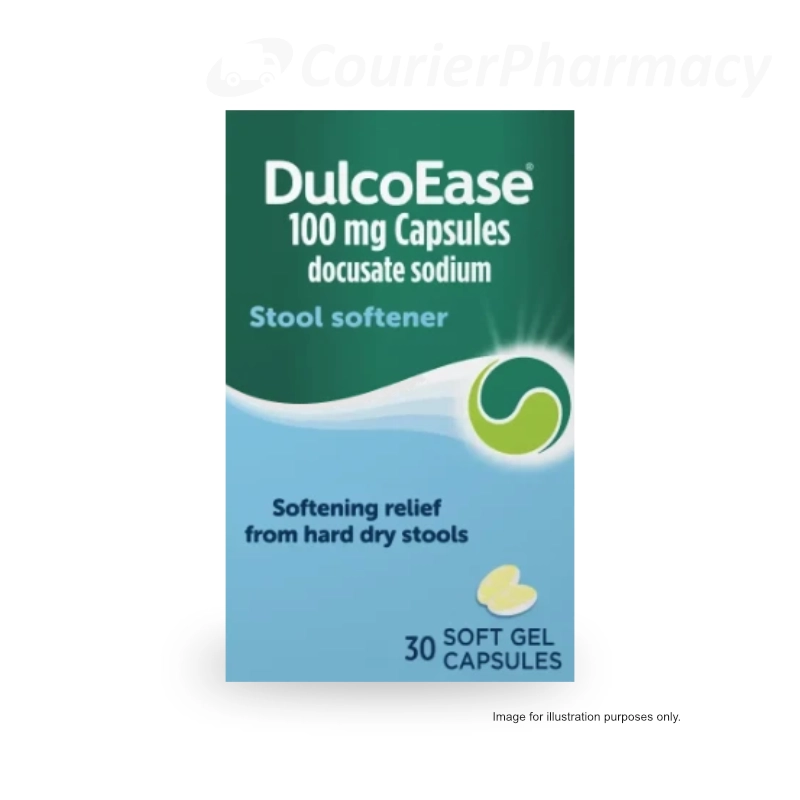
A docusate sodium surface-active stool softener in the Dulcolax brand family, for the treatment of constipation in adults and adolescents over 12 years where stool softening is the priority.
Onset 24-48 hours; well-tolerated; gentle action.
Supplied at Courier Pharmacy after a brief online consultation reviewed by a UK pharmacist, then delivered to your door.
Notably, dulcoease 100mg Capsules are a stool softener containing docusate sodium 100mg per capsule. Available as oblong gelatin capsules in standard packs. Furthermore, used for the treatment of constipation in adults and adolescents over 12 years, particularly where stool softening is the principal need.
Specifically, standard pack contains 30 or 60 capsules. Manufactured by Sanofi as part of the Dulcolax brand family (Dulco range).
Dulcoease
Meanwhile, what distinguishes Dulcoease in the Dulcolax range:
Stool softener — different mechanism from Dulcolax tablets (stimulant)
Same active as generic Docusate — interchangeable with generic versions
Brand-family consistency — fits with Dulcolax range for patients preferring branded products
Sanofi manufacturer — established pharmaceutical company
Standard 100mg dose — same as the most widely used docusate strength
In fact, what’s important to understand about the Dulcolax brand range:
The Dulcolax / Dulco range from Sanofi includes products with different active ingredients:
In particular, despite the similar branding, these are pharmacologically different. Choose by the action needed:
Stool softening: Dulcoease
Oral stimulant: Dulcolax tablets or Dulcolax Pico
Rapid rectal stimulant: Dulcolax suppositories
In short, what’s important to know about docusate and constipation (overview here; full mechanism in Active Ingredient section):
Docusate sodium is a surface-active agent (surfactant) that works by allowing water and fat to mix with hard, dry stool. Similarly, the stool softens from within rather than being shifted by stimulant action or osmotic pressure.
Gentle mechanism
The mechanism is gentle:
Doesn’t cause cramping (unlike stimulants)
Doesn’t draw water in osmotically (unlike macrogol or lactulose)
Doesn’t add bulk (unlike Fybogel)
Just softens existing stool through surface tension effects
Indeed, this makes docusate particularly suitable when:
Comfortable stool consistency is the priority
Straining must be avoided
Combined treatment is needed (e.g. with stimulant for opioid-induced constipation)
Key points to remember
For chronic adult constipation as monotherapy, NICE generally positions macrogol (Cosmocol, Movicol) first-line. As a result, docusate (Dulcoease) has its place in specific situations.
Who uses Dulcoease 100mg Capsules:
Patients recovering from surgery — particularly anal, rectal, prostate, abdominal procedures
Patients with painful piles or anal fissures — softer stool reduces pain and supports healing
Patients on opioid medication — opioid-induced constipation, often combined with stimulant
Patients with cardiovascular conditions where straining should be avoided
Patients in late pregnancy — reduces strain in third trimester and post-partum
Older adults — gentle, well-tolerated
Palliative care patients — combined with stimulants for opioid-related constipation
Generally, the relationship to other laxative options:
Vs generic Docusate Sodium Capsules — same active, same dose, same clinical effect; brand-name vs generic
Vs Dioctyl 100mg Capsules — same active; brand-name (Sanofi) vs another brand
Vs Docusol Capsules — same active; another brand option
Vs Dulcolax tablets (bisacodyl) — different mechanism (stimulant vs softener); same brand family
Vs Dulcolax Pico Liquid (sodium picosulfate) — different mechanism (stimulant vs softener); same brand family
Vs Cosmocol/Movicol (macrogol) — different mechanism (osmotic vs softener); macrogol generally preferred for chronic constipation
Vs senna — different mechanism (stimulant vs softener); often combined
Vs Fybogel — different mechanism (bulk-forming vs softener)
At Courier Pharmacy, every Dulcoease supply is reviewed by a UK pharmacist. In addition, we’ll discuss the indication, whether Dulcoease alone or in combination is appropriate, and the broader management plan.
Features and specifications:
Active ingredient: docusate sodium 100mg per capsule
Form: oral capsule
Pack sizes: 30 or 60 capsules
Manufacturer: Sanofi
Brand family: Dulcolax / Dulco
Class: surface-active agent / stool softener
Legal status: pharmacy (P) medicine in the UK
Age range: adults and adolescents over 12 years
Typical use: 1-2 capsules twice daily; up to 5 capsules total daily
Storage: room temperature
Additional information
Pack size
1 x 30, 1 x 60
MOJO WISDOM
Take control of your health by understanding your condition and what this medication is doing for you.
READ:
More information about this treatment.
UK-based doctors and pharmacists
Discreet and Confidential
UK-based doctors and pharmacists
Free, Expert Advice
No video link provided.
No video link provided.
UK-based doctors and pharmacists
Free, expert advice
Discrete and confidential
Fast delivery
Giving you trusted clinical advice for over 40 conditions
A UK regulated pharmacy providing safe, effective treatments online since 2014
A familiar brand name on the gentle end of the laxative spectrum, the Dulco-family option for stool softening without the cramping that can come with stimulants. Maybe you’ve been prescribed docusate after recent surgery, particularly anal, rectal, or abdominal operations, to keep stool soft during healing. Maybe you’re dealing with painful piles or anal fissures where straining must be avoided. Maybe you’ve used Dulcolax tablets (bisacodyl) before and want to stay within the same brand family for a softening option. Maybe you’re on opioid medication and your prescriber wants a stool softener alongside other measures.
Dulcoease 100mg Capsules contain docusate sodium 100mg, the same active as generic docusate capsules. A surface-active agent that softens stool from within by allowing water and fat to penetrate. At Courier Pharmacy we want to explain how docusate works as a softener, where Dulcoease fits in the Dulcolax range, and the specific situations where stool softening adds most value.
Five key takeaways
Dulcoease 100mg Capsules contain docusate sodium 100mg per capsule. A surface-active agent (surfactant / wetting agent) that softens stool by allowing water and fat to penetrate hard, dry stool.
The same active ingredient as generic Docusate Sodium Capsules and Dioctyl 100mg Capsules. Clinically interchangeable — the choice between Dulcoease and generic versions is typically brand-preference and cost. Both work identically.
Standard adult dose: 100-200mg up to five times daily; typical use 1-2 capsules twice daily. Maximum 500mg (5 capsules) in 24 hours. Onset 24-48 hours; full effect builds over 3-5 days of regular use. Better for sustained use than acute relief.
The clinical niche is stool softening where straining must be avoided. Post-surgery (especially anal/rectal procedures), painful piles or fissures, opioid use, cardiovascular conditions where Valsalva should be minimised, late pregnancy, and palliative care. As monotherapy for chronic constipation, macrogol (Cosmocol/Movicol) is usually more effective; docusate adds value as part of combination treatment or for specific softening indications.
Often used alongside Dulcolax tablets (bisacodyl) or Dulcolax Pico (sodium picosulfate) where both softening and stimulant effects are needed. Or combined with senna in established products (Manevac, various combinations). For maintaining soft stool over time, Dulcoease alone or alongside lifestyle measures can be effective.
Overview of Dulcoease 100mg Capsules
Five things worth knowing:
Dulcoease is the same as docusate. The active ingredient (docusate sodium 100mg) is identical to generic docusate capsules and to other brands like Dioctyl and Docusol. Choose Dulcoease if you prefer the brand-family consistency with other Dulcolax products; choose generic if cost matters more.
Docusate is a softener, not a stimulant. The Dulcolax brand family includes both — Dulcolax tablets and Dulcolax Pico are stimulants; Dulcoease is the softener option. Knowing which action you need helps you choose.
For chronic constipation in adults, macrogol (Cosmocol, Movicol) is often more effective as monotherapy. Docusate adds value in specific situations: post-surgery, with piles or fissures, with opioid use, in late pregnancy, or as part of combination treatment.
Onset is 24-48 hours, similar to other oral laxatives. Don’t expect immediate effect. For urgent constipation relief, rectal preparations (suppositories, microenemas) are faster.
Safe in pregnancy. Limited systemic absorption; long-established safe use. A reasonable choice for pregnancy-related constipation, particularly in third trimester where straining should be minimised.
Dulcoease’s role is targeted, for situations where stool consistency is the key issue, often as part of a combination regimen rather than monotherapy.
Why choose Courier Pharmacy for Dulcoease 100mg Capsules
In short, for patients who prefer brand-family consistency with the Dulcolax range, Dulcoease is the docusate option. Every Dulcoease supply at Courier Pharmacy is reviewed by a UK pharmacist who knows when softener fits and when something different would suit better.
Similarly, we’ll discuss whether docusate is the right choice. Indeed, for chronic constipation in adults, macrogol may be more effective. Docusate has its place when stool softening specifically matters — post-surgery, with piles, cardiovascular, opioid use.
We’ll consider combinations. As a result, within the Dulcolax range: Dulcoease + Dulcolax tablets or Dulcoease + Dulcolax Pico Liquid. Generally, or with macrogol from outside the brand. The combination approach is often more effective than docusate alone.
In addition, we’ll discuss the brand vs generic choice. Additionally, dulcoease and generic docusate are clinically identical. Brand preference is fine; cost-conscious patients can use generics with confidence.
What to know
For example, we’ll explain the slow onset. 24-48 hours for first effect; several days for full effect. Not an emergency laxative.
Importantly, we’ll cover lifestyle and red flags. Fluids, fibre, exercise work alongside any laxative. On the other hand, new constipation in older adults, bleeding, weight loss, change in bowel pattern need investigation.
Therefore, our brand guide, Dr Ada Jex-Cori, sums it up: you’re not broken. The system that’s failed you might be. Consequently, we want to do the part we can do, properly, and connect you with the rest. However, that includes our free fortnightly drop-in clinics and talks at Insomnia in Derby, where you can ask questions face-to-face without spending a penny.
Buy Dulcoease 100mg Capsules from Courier Pharmacy
Dulcoease 100mg Capsules are available as a pharmacy (P) medicine in the UK. Moreover, buying through Courier Pharmacy is straightforward and built around your time, not ours.
Here’s how it works:
Complete a quick online consultation about the constipation
A UK pharmacist reviews your information
If suitable, supply is approved
We dispense and deliver discreetly to your door
In summary, if it isn’t suitable for you, we’ll explain why and suggest the next best option.
Active Ingredients
On the other hand, the active ingredient is docusate sodium, also called dioctyl sodium sulfosuccinate (DSS).
Chemical and pharmacological class:
Docusate sodium: dioctyl sodium sulfosuccinate
Anionic surfactant
Surface-active agent (allows water and oils to mix)
Used as a stool softener since the 1950s
Same active in all docusate sodium products (Dulcoease, Dioctyl, Docusol, generics)
Mechanism of action:
Docusate works through surfactant properties:
Molecule has hydrophilic (water-loving) and lipophilic (fat-loving) ends
Dual nature allows it to bring water and fat together at interfaces
Applied to hard, dry stool, it allows water from the gut and fat from the diet to penetrate
Stool becomes softer and more pliable
Easier passage with less straining
Additional effects at higher doses:
Mild stimulation of intestinal secretion
Mild stimulation of intestinal motility
Contributes to laxative action at higher doses (4-5 capsules daily)
Pharmacokinetics:
Absorption: very limited (most acts locally in the gut)
Onset: 24-48 hours for first effect; full effect over several days
Duration: continues while regularly dosed
Metabolism: small amount absorbed; metabolised in liver
Excretion: mainly in stool
No significant systemic accumulation
Safety profile:
Long-established safe use across decades
Used in palliative care, post-surgery, pregnancy, paediatrics
Generally well-tolerated
Minimal systemic effects at standard doses
Therefore, other excipients in Dulcoease 100mg Capsules include gelatin capsule shell, glycerol, sorbitol, and small amounts of additional excipients. Specific excipients are on the patient information leaflet.
What is it for?
Consequently, dulcoease 100mg Capsules are used for:
Treatment of constipation in adults and adolescents over 12 years
Maintenance of soft stool in patients where straining must be avoided — post-surgery, with piles or fissures, with cardiovascular conditions
Component of combination treatment for opioid-induced constipation — often with stimulant
Pregnancy and postpartum constipation management
Palliative care bowel management
It's appropriate for:
Adults with constipation requiring stool softening
Post-surgical patients
Patients with painful piles or fissures
Pregnant women
Older adults requiring gentle laxative
Patients on opioid medication (often combined with stimulant)
However, dulcoease 100mg Capsules are not appropriate for:
Children under 12 (different formulations needed)
Bowel obstruction
Acute abdominal pain
Severe inflammatory bowel disease in flare
Severe acute illness
NICE Clinical Knowledge Summaries include docusate as one of the laxative options, with macrogol generally preferred for chronic constipation as monotherapy.
How does it work?
Moreover, the product acts through surfactant properties during transit through the gut:
During transit (0-24 hours):
Capsule dissolves in the stomach
Docusate enters the small bowel
Small fraction absorbed; most continues through gut
Mixes with intestinal contents
In the colon (24-48 hours):
Reaches the colon where stool is forming
Surface-active properties allow water and fat to penetrate stool
Hard, dry stool gradually softens
Stool becomes more pliable
Bowel transit may be slightly accelerated through mild stimulation
Stool passage:
Softer stool passes more easily
Less straining required
Reduced discomfort
Result: more comfortable bowel movement
Time course:
24-48 hours: first effect on stool
3-5 days: full effect builds with regular use
Steady state: maintained with ongoing dosing
Cessation: effect ends within a few days of stopping
What it doesn't do:
Doesn't provide rapid relief (use rectal preparations for that)
Doesn't substantially increase stool frequency on its own
Doesn't substitute for adequate fluid intake
Doesn't treat underlying causes
Doesn't address slow transit alone (needs combining with stimulant)
How to use it
The technique is straightforward.
Standard technique:
Take capsule(s) at the dose recommended
Swallow whole with water
Best with or after food
Continue regular fluid intake throughout day
Daily routine for chronic management
Frequency:
1-2 capsules twice daily standard
Up to 5 capsules in 24 hours
Adjust to effect over 1-2 weeks
Practical tips:
Establish a routine: morning and evening doses
Don't break capsules: swallow whole
Drink with capsule: water glass per capsule helps
Patience: 3-5 days for full effect
Combine with lifestyle: fluids, fibre, exercise
Combine with other Dulcolax products if needed: Dulcoease + Dulcolax tablets, or Dulcoease + Dulcolax Pico
Long-term use: safe for months/years if needed
Combining with other approaches:
Stimulant (Dulcolax tablets, Dulcolax Pico, or senna): common and effective combination
Macrogol (Cosmocol): can be combined; macrogol provides osmotic effect plus docusate softening
Lifestyle: continue regardless
Don't combine with mineral oil (liquid paraffin): theoretical concern about increased absorption
In summary, when to seek further medical advice:
Inadequate effect after 1 week at full dose
Significant abdominal pain
Rectal bleeding (always)
New constipation in older adult
Weight loss with bowel symptoms
Recurrent need
Diarrhoea or watery stools
Warnings and Precautions
Docusate is one of the gentler laxatives but has specific considerations.
Contraindicated in:
Children under 12 (without specific paediatric formulation)
Hypersensitivity to docusate sodium or excipients
Bowel obstruction or perforation
Severe abdominal pain (could mask serious pathology)
Acute appendicitis or other surgical abdomen
Severe active inflammatory bowel disease
Use with care in:
Patients on multiple medications (theoretical absorption effects)
Patients with liver disease (mild absorbed amount metabolised hepatically)
Patients with kidney impairment
Patients on warfarin (rare effect on absorption)
Pregnancy:
Generally considered safe
Long-established use including in late pregnancy
Useful where straining must be avoided post-delivery
Paediatric solution is available with appropriate lower doses
Use only under medical supervision in children
Drug interactions:
Few clinically important interactions
Mineral oil (liquid paraffin): theoretical concern about increased mineral oil absorption; avoid combining
Warfarin: rare reports of altered effect; monitor INR if significant change
Other oral medications: usually not affected
Allergic reactions:
True docusate allergy is very rare
Local reactions possible
Severe allergic reactions are very rare
Long-term use:
Generally safe long-term
No dependency in the traditional sense
Continue as needed for chronic constipation
Overall, if you experience signs of an allergic reaction or significant abdominal symptoms, stop using and seek medical advice.
Side Effects
Notably, docusate is well-tolerated by most patients.
Common side effects, between 1 in 100 and 1 in 10 people, include mild abdominal cramping (less than with stimulants), diarrhoea if dose too high, and nausea (especially if taken on empty stomach).
Furthermore, uncommon side effects, between 1 in 1,000 and 1 in 100 people, include bloating, rash (minor allergic), bitter taste, and dependency with prolonged misuse.
Specifically, rare side effects, fewer than 1 in 1,000 people, include severe allergic reactions, liver dysfunction (with high-dose chronic use), and rare cardiac arrhythmia.
Very rare and serious side effects include hepatotoxicity (with chronic high-dose use), severe allergic reactions, and severe gastrointestinal effects.
Meanwhile, if you experience any side effect that worries you, you can report it directly to the MHRA's Yellow Card scheme. In fact, this helps improve safety data for everyone who uses the product. Our pharmacy team are happy to help you submit a Yellow Card report if you'd like assistance.
Drug Interactions
Few clinically important drug interactions.
Considerations:
Mineral oil (liquid paraffin): avoid combining due to theoretical increased absorption
Warfarin: monitor INR with significant bowel function changes
Other oral medications: usually not significantly affected; separation by 1 hour reasonable
Other laxatives: can be combined cautiously; common with stimulants
In particular, tell your pharmacist about all medicines you take when starting any new treatment.
Frequently Asked Questions
What is Dulcoease 100mg Capsules used for?
For the treatment of constipation in adults and adolescents over 12 years. Particularly useful where stool softening is the key need — post-surgery, with piles or fissures, in late pregnancy, with opioid medication, or where straining must be avoided.
How does it work?
Overall, docusate sodium is a surface-active agent (surfactant). Notably, it allows water and fat to penetrate and mix with hard, dry stool, softening it from within.
How quickly does it work?
24-48 hours for first effect. Full effect builds over 3-5 days of regular use. Not for emergency use.
Is Dulcoease the same as generic docusate?
Furthermore, yes — same active ingredient (docusate sodium 100mg), same clinical effect. Specifically, dulcoease is the Sanofi-branded version; generic versions are equally effective and usually cheaper.
How is Dulcoease different from Dulcolax tablets?
Different actives within the same brand family. Dulcolax tablets contain bisacodyl (stimulant). Dulcoease contains docusate (softener). Different actions; sometimes combined.
How is Dulcoease different from Dulcolax Pico?
Meanwhile, dulcolax Pico contains sodium picosulfate (stimulant liquid). Dulcoease contains docusate (softener capsule). In fact, different mechanisms; both in the Dulcolax brand family.
What's the right dose?
Adults: 100-200mg (1-2 capsules) up to five times daily. In particular, typical use is 1-2 capsules twice daily. In short, adjust to produce comfortable formed stools.
Can I take it with a stimulant?
Yes — common and effective combination. Similarly, stimulant addresses motility; docusate addresses consistency. Often used together for opioid-induced constipation.
Can I use it in pregnancy?
Yes — long-established safe use. Indeed, useful in late pregnancy to avoid straining.
Can I use it while breastfeeding?
Considered acceptable for occasional use. For ongoing need, macrogol or lactulose may be preferred.
Can children use it?
Capsules: from 12 years. As a result, younger children: paediatric solution with appropriate lower doses, under medical supervision.
What if it doesn't work?
Generally, after 1-2 weeks at full dose, see your pharmacist. May need to switch to or add macrogol, lactulose, or stimulant.
What if I get diarrhoea?
Reduce the dose. In addition, loose stools mean dose too high.
What's the difference from a stool softener like Dulcolax tablets?
Additionally, dulcolax tablets contain bisacodyl, a stimulant — different from Dulcoease's docusate softener. Different mechanisms; sometimes combined.
Can I use it long-term?
Yes, generally safe long-term. No traditional dependency.
Can I use it after surgery?
Yes — often recommended for 1-2 weeks after operations where straining must be avoided (haemorrhoid surgery, fissurectomy, prostate surgery, hernia repair, abdominal surgery).
Should I take it with food?
For example, best taken with or after food (some find empty stomach causes mild nausea).
Can I open the capsule?
Best taken whole. Importantly, the capsule is a gelatin shell; opening doesn't change the active dose but may affect taste (docusate has a bitter taste).
What about palliative care?
Docusate, often combined with stimulants, is commonly used in palliative care for opioid-induced constipation.
Can I use it with my warfarin?
Generally yes, but monitor INR if significant change in bowel function. Discuss with your anticoagulation clinic.
What if I have piles?
On the other hand, docusate is useful for piles because softer stool reduces straining and pain. The softening effect supports healing.
How should I store it?
Room temperature in original packaging.
Disclaimer: This information is for education only and isn’t a substitute for personal medical advice. Always follow your prescriber’s instructions.