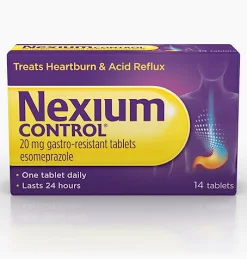
Product description: Nexium Control 20mg gastro-resistant tablets
Nexium Control 20mg gastro-resistant tablets are an over-the-counter Pharmacy (P) medicine for adults. They’re used for the short-term treatment of frequent heartburn and reflux symptoms such as acid regurgitation. “Frequent” usually means symptoms twice a week or more.
Each tablet contains esomeprazole 20mg in a gastro-resistant (enteric-coated) formulation. Nexium Control is supplied in packs of 7 or 14 tablets.
What Nexium Control 20mg is used for
Nexium Control is used to treat reflux symptoms such as:
Heartburn (burning feeling in the chest)
Acid coming up into the throat or mouth (regurgitation)
Reflux symptoms that happen regularly, not just once in a while
It’s designed as a short course for adults with frequent symptoms, not as a long-term “everyday forever” solution without review.
How Nexium Control works (and why it’s different from antacids)
Nexium Control contains esomeprazole, which is a proton pump inhibitor (PPI). PPIs reduce how much acid your stomach produces at the source.
That’s different from:
Antacids (like Rennie), which neutralise acid that’s already there
Alginate-antacids (like Peptac/Gaviscon), which neutralise acid and form a “raft” barrier to reduce reflux
Antacids and alginates can work quickly, but the effect is shorter. A PPI is a more “upstream” approach that can give longer-lasting control.
The key practical point: it takes a few days to reach full effect
Nexium Control doesn’t usually work instantly. It often takes 1–4 days of daily use to build up to its full effect.
So, during the first few days, it’s common to use an alginate-antacid alongside for breakthrough symptoms (as directed). In other words, Nexium Control is the “control” plan, and an alginate can be the “backup” while it kicks in.
Why the tablets are gastro-resistant (and why you shouldn’t crush them)
Esomeprazole is broken down by stomach acid. The enteric coating protects it so it can pass through the stomach and be absorbed properly in the small intestine.
That’s why you should:
Swallow the tablet whole with water
Not crush, chew, or break it
If you damage the coating, you can reduce how well it works.
Nexium Control vs Pyrocalm Control: is one better?
This is a common question, and the honest answer is: for most people, they’re broadly equivalent.
Nexium Control contains esomeprazole 20mg
Pyrocalm Control contains omeprazole 20mg
They work in the same way and are both OTC PPIs. Esomeprazole can be a bit more consistent in some people, but in day-to-day practice the difference is usually modest. What matters most is taking it correctly (daily, before food, for the full course).
Why there’s a 14-day limit (and when to get checked)
OTC PPIs are designed for short courses. If symptoms persist, keep returning, or you have red-flag symptoms, you should get assessed. Reflux can be simple, but it can also be a sign of something that needs proper medical review.
How we supply Nexium Control at Courier Pharmacy
At Courier Pharmacy, every Nexium Control supply is reviewed by a UK pharmacist. We’ll ask about your reflux pattern (including whether it’s truly frequent), what you’ve tried already, and any red-flag symptoms. We’ll also check other medicines you take, because PPIs can interact with some treatments (for example clopidogrel and methotrexate). Then we’ll explain how to use a 14-day course properly and when to follow up with your GP.
Key features and specifications
Active ingredient: Esomeprazole 20mg per tablet
Form: Gastro-resistant (enteric-coated) tablet
Pack sizes: 7 or 14 tablets
Class: Proton pump inhibitor (PPI)
Legal status (UK): Pharmacy (P) medicine for frequent heartburn in adults
Typical adult dose (as directed): 1 tablet once daily for up to 14 days
Storage: Store below 25°C, in original packaging, protected from moisture
MOJO WISDOM
Take control of your health by understanding your condition and what this medication is doing for you.
READ:
More information about this treatment.
UK-based doctors and pharmacists
Discreet and Confidential
UK-based doctors and pharmacists
Free, Expert Advice
No video link provided.
No video link provided.
UK-based doctors and pharmacists
Free, expert advice
Discrete and confidential
Fast delivery
Giving you trusted clinical advice for over 40 conditions
A UK regulated pharmacy providing safe, effective treatments online since 2014
Frequent heartburn that keeps coming back — twice a week or more, sometimes more often, sometimes worse at night. Maybe antacids help in the moment but the heartburn just returns. Maybe you’ve heard of Nexium as a well-known PPI brand and want to understand what it does and whether it’s the right step.
Nexium Control contains esomeprazole, a proton pump inhibitor that reduces stomach acid production for around 24 hours per tablet, available over the counter as a Pharmacy medicine for short courses. At Courier Pharmacy we want you to understand exactly how Nexium Control works, who it suits, how esomeprazole compares to omeprazole, the 14-day course pattern, and when to step up to GP review, so the choice feels properly yours.
Five key takeaways
Nexium Control 20mg gastro-resistant tablets contain esomeprazole 20mg, a proton pump inhibitor (PPI) available over the counter as a Pharmacy (P) medicine for frequent heartburn (twice a week or more) in adults. Esomeprazole is the S-isomer of omeprazole — same family, slightly different pharmacology, broadly equivalent in clinical effect.
It works by blocking the proton pumps in the stomach lining that produce stomach acid. Each dose reduces acid production for around 24 hours. The OTC course is up to 14 days, addressing the cause of acid reflux rather than just neutralising acid as antacids do.
Like all PPIs, it takes 1-4 days to reach full effect. For breakthrough symptoms during the first few days of a Nexium Control course, an alginate-antacid (Peptac, Gaviscon) or simple antacid can be used alongside.
The 14-day OTC course is a built-in safeguard: if symptoms haven’t settled by then, or recur frequently after stopping, see your GP. There may be an underlying cause (H. pylori, hiatus hernia, GORD requiring assessment) or red-flag symptoms needing investigation.
Generally well-tolerated. Esomeprazole has fewer drug interactions than omeprazole in some respects, though the difference is modest. Long-term safety considerations (bone density, magnesium, B12, kidney, C. difficile, rebound acid hypersecretion) are mostly relevant for prolonged supervised use, less so for a 14-day OTC course.
Treatment dosage Nexium Control 20mg
The standard adult dose is one tablet (20mg) once daily for up to 14 days.
How to take:
Take one tablet in the morning, ideally before breakfast (about 30 minutes to 1 hour before eating)
Swallow whole with a glass of water — don’t crush, chew, or break the tablet
If swallowing whole is difficult, the tablet can be dispersed in still water (about half a glass): drop it in, stir until disintegrated, drink immediately. Don’t dissolve in milk or fizzy water
Continue for up to 14 days; if symptoms are well controlled by the end, stop
If symptoms persist beyond 14 days or recur frequently after stopping, see your GP
Timing matters:
Morning before breakfast is the conventional time
Acid production rises in anticipation of and during meals; the PPI works best on actively secreting proton pumps
Taking 30-60 minutes before the meal gives the esomeprazole time to reach the parietal cells before meal-stimulated acid production starts
If you don’t eat breakfast, take it 30-60 minutes before the first meal of the day
During the first few days:
Symptom relief builds gradually over 1-4 days as more proton pumps are progressively disabled
For breakthrough symptoms in the run-in period, an alginate-antacid (Peptac, Gaviscon) or simple antacid can be used alongside
The two work through different mechanisms (PPI reduces acid production; antacid neutralises acid) so combining is fine
After 14 days:
If symptoms are well controlled, stop
Don’t continue beyond 14 days without GP advice
If symptoms recur within a short period after stopping, see your GP — frequent recurring heartburn often warrants further assessment
If symptoms haven’t improved at all, see your GP — there may be an underlying cause needing different treatment
Don’t use Nexium Control if:
You’re under 18
You have any of the red-flag symptoms below — see a GP urgently:
Difficulty or pain on swallowing
Unintentional weight loss
Persistent vomiting
Vomiting blood, or vomit looking like coffee grounds
Black tarry stools or blood in stools
Severe stomach pain
Jaundice (yellowing of skin or eyes)
Pain that radiates to the arm, jaw, or back, or pain with sweating or breathlessness (could be cardiac)
You’re pregnant or breastfeeding (without prescriber advice)
You take other PPIs or H2 blockers
You have severe liver disease
You’re allergic to esomeprazole, other PPIs, or any ingredient
Don’t combine with:
Other PPIs (omeprazole, lansoprazole, pantoprazole, esomeprazole, rabeprazole)
HIV antiretrovirals containing nelfinavir or rilpivirine (contraindicated)
Without prescriber advice: clopidogrel, methotrexate, digoxin, warfarin, tacrolimus, phenytoin
Stopping Nexium Control: when finishing a 14-day course, you can stop directly. For longer prescription courses, some clinicians recommend tapering to avoid rebound acid hypersecretion. For a 14-day OTC course, this is usually less of an issue, but if you notice a flare of symptoms after stopping, this could be temporary rebound rather than the original condition.
Overview of Nexium Control 20mg
Five things worth knowing:
Esomeprazole was developed as a successor to omeprazole. It’s the S-isomer of omeprazole — same chemistry family, isolated for slightly more consistent pharmacokinetics. In practice, the clinical difference between esomeprazole and omeprazole at the same dose is small for most patients.
Nexium is one of the most-prescribed branded PPIs worldwide, with strong brand recognition. The OTC availability (Nexium Control) brought esomeprazole to people who want a self-management option for frequent heartburn without needing a GP appointment.
The 1-4 day run-in to full effect is a defining practical feature of PPIs. Patients used to fast-acting antacids sometimes assume Nexium Control “isn’t working” after one or two days. Setting expectations matters — the first few days are a build-up phase, and breakthrough antacids can bridge this period.
The 14-day OTC limit isn’t arbitrary. It allows enough time for the PPI to work properly, but isn’t long enough to risk the longer-term concerns associated with prolonged PPI use. Anything beyond 14 days needs medical oversight.
For most patients, esomeprazole (Nexium Control) and omeprazole (Pyrocalm Control) are clinically equivalent. The choice usually comes down to cost, brand preference, or specific interaction considerations. Both work; consistent correct use matters more than which one.
Nexium Control sits within the broader heartburn and reflux treatment landscape:
Simple antacids (Rennie, Tums, Settlers) — neutralise acid; act in minutes, last about 30-60 minutes; for occasional immediate relief
Combination antacid + anti-foaming (Rennie Deflate, Maalox Plus) — antacid plus simeticone; for acid + gas symptoms
Alginate-antacid combinations (Peptac, Gaviscon, Acidex) — neutralise acid plus form a raft against reflux; act in minutes, last about 4 hours; for occasional reflux symptoms
H2 receptor antagonists (famotidine, Guardium Acid Reflux Control) — reduce acid production for several hours; faster onset than PPIs but less complete acid suppression; for ongoing mild-to-moderate acid problems
Proton pump inhibitors OTC (Nexium Control esomeprazole 20mg; Pyrocalm Control omeprazole 20mg) — substantially reduce acid production over 24 hours; take 1-4 days for full effect; for frequent heartburn
PPIs on prescription (omeprazole, lansoprazole, pantoprazole, esomeprazole/Nexium 20mg, rabeprazole) — for longer courses, ulcer treatment, H. pylori eradication, and other specific indications
The choice depends on the pattern:
Occasional immediate heartburn: antacids or alginate-antacids
Frequent heartburn (twice a week or more for several weeks): a PPI course (Nexium Control, Pyrocalm Control)
Chronic acid reflux disease (GORD): ongoing treatment under medical supervision
Reflux specifically (acid coming up): alginate-antacids work well; PPIs work too but more for the acid level than the mechanical reflux
The esomeprazole-vs-other-PPI question comes up occasionally. Esomeprazole has somewhat more consistent pharmacokinetics than omeprazole (less variation between patients). It also has somewhat fewer interactions through CYP2C19 in some respects. In practice, for most patients the choice between Nexium Control (esomeprazole) and Pyrocalm Control (omeprazole) is essentially equivalent. Where it matters more: patients with significant drug interaction concerns may benefit from pantoprazole (which has fewer interactions than either esomeprazole or omeprazole), and pantoprazole is available on prescription.
The rebound acid hypersecretion phenomenon is worth noting. After PPI use, the body upregulates its acid-producing machinery (a compensatory response). When the PPI is stopped, this upregulated machinery produces a temporary surge in acid — potentially worse than baseline — for a few days to a few weeks. This is more pronounced with long courses; for a 14-day OTC course, it’s usually mild or absent. Some patients stop and notice symptoms returning, which can be temporary rebound rather than the underlying condition needing more treatment.
For people living with complex conditions, PPI considerations include the interactions with clopidogrel (relevant for cardiovascular patients), methotrexate (relevant for autoimmune conditions), and the long-term considerations (bone density, magnesium, B12, kidney) that matter more for prolonged use than for OTC courses.
Why choose Courier Pharmacy for Nexium Control 20mg
Frequent heartburn is common and often poorly managed with repeated antacids that don’t address the underlying acid level. A PPI course can be transformative when matched to the right pattern, but it’s not the right choice for every situation. Every Nexium Control supply at Courier Pharmacy is reviewed by a UK pharmacist who reads your answers properly, asks about your reflux frequency and pattern, screens for red flags, and explains the decision either way.
We’ll discuss whether Nexium Control is the right choice. For frequent heartburn (twice a week or more) in adults without red flags, a 14-day OTC course often gives substantial relief. For occasional heartburn, an alginate-antacid (Peptac, Gaviscon) is usually a better match. For red-flag symptoms, an urgent GP/A&E referral is what’s needed. For frequent recurring heartburn that keeps coming back after PPI courses, GP review for proper assessment matters more than repeated self-treatment.
We’ll discuss the Nexium-vs-Pyrocalm question. For most patients, esomeprazole (Nexium Control) and omeprazole (Pyrocalm Control) at 20mg are clinically equivalent — both work, both have a 14-day OTC course, both take 1-4 days to build to full effect. The choice usually comes down to cost, brand preference, or specific drug interaction considerations.
We’ll explain the 1-4 day run-in (so the first day’s lack of dramatic effect doesn’t make you think it isn’t working), the option of using antacids alongside for breakthrough symptoms, and when to stop and step up to GP review.
We’ll also discuss lifestyle measures that genuinely help with reflux — smaller meals, posture after eating, raising the bed head, trigger foods, weight, smoking. These extend the benefit beyond the medicine course.
Our brand guide, Dr Ada Jex-Cori, sums it up: you’re not broken. The system that’s failed you might be. We want to do the part we can do, properly, and connect you with the rest. That includes our free fortnightly drop-in clinics and talks at Insomnia in Derby, where you can ask questions face-to-face without spending a penny.
Buy Nexium Control 20mg from Courier Pharmacy
Nexium Control 20mg is available as a Pharmacy (P) medicine in the UK for frequent heartburn in adults. Buying through Courier Pharmacy is straightforward and built around your time, not ours.
Here’s how it works:
Complete a quick online consultation about your reflux symptoms
A UK pharmacist reviews your answers
If suitable, supply is approved
We dispense and deliver discreetly to your door
If it isn’t suitable for you, we’ll explain why and suggest the next best option.
Active ingredient in Nexium Control 20mg
The active ingredient is esomeprazole 20mg, the S-isomer of omeprazole and a well-established proton pump inhibitor.
To explain the isomer point: omeprazole is a chiral molecule — it exists in two mirror-image forms (R-omeprazole and S-omeprazole), which are stereoisomers of each other. Standard omeprazole is a 50:50 mixture of both isomers (a “racemate”). Esomeprazole is just the S-isomer, isolated and produced on its own. The body metabolises the two isomers slightly differently — the S-isomer is metabolised more slowly than the R-isomer, which means esomeprazole produces somewhat more consistent and slightly higher blood levels than the same dose of omeprazole racemate. The clinical effect of this difference is modest but real for some patients.
Esomeprazole works by selectively and irreversibly inhibiting the H+/K+ ATPase enzyme (the “proton pump”) on the surface of the gastric parietal cells. This enzyme is the final common pathway for stomach acid production. By inhibiting it, esomeprazole substantially reduces acid output regardless of what’s stimulating the parietal cells.
The mechanism features that matter:
Activation in acidic conditions: like all PPIs, esomeprazole is a prodrug that needs an acidic environment to activate. It’s absorbed in the small intestine, reaches the parietal cells, and within their highly acidic secretory canaliculi converts to its active form, which then irreversibly binds to the proton pump.
Irreversible inhibition: the active form covalently bonds to the proton pump, permanently disabling it. Recovery requires the cell to synthesise new proton pumps, which takes time. This is why PPIs continue working for around 24 hours from a single dose even though their elimination half-life is short — the drug is long gone, but the pumps it disabled are still out of action.
Build-up over days: because not all proton pumps are actively secreting at any given moment, repeated daily doses progressively disable more pumps. Full effect typically builds over 1-4 days. After several days of consecutive dosing, the substantial acid reduction characteristic of PPI therapy is achieved.
Onset within hours, peak over days: acid suppression begins within hours of the first dose. The first day’s effect is partial; by day 4-5 the full effect is established and maintained throughout the course.
The gastro-resistant (enteric) coating is essential because esomeprazole, like omeprazole, is destroyed by stomach acid. The coating protects the drug through the stomach and dissolves in the more alkaline small intestine, where the esomeprazole is absorbed.
Metabolism: esomeprazole is metabolised in the liver, primarily by CYP2C19 and CYP3A4. CYP2C19 has genetic variants — different metaboliser statuses produce different rates of esomeprazole elimination. Esomeprazole’s pharmacokinetics are somewhat less affected by CYP2C19 polymorphism than omeprazole’s, which is one of the practical advantages.
Interactions: through CYP2C19 and CYP3A4, esomeprazole can affect the metabolism of other medicines. The interactions are similar to omeprazole’s, with clopidogrel being the most clinically discussed (esomeprazole can reduce clopidogrel’s conversion to its active form, potentially reducing antiplatelet effect). Pantoprazole has fewer of these interactions and is sometimes preferred when interactions matter.
After absorption, esomeprazole’s effect lasts about 24 hours from a single 20mg dose. After stopping a course, acid production gradually returns to baseline over 3-5 days as the parietal cells synthesise new proton pumps, sometimes with a temporary rebound increase above baseline (rebound acid hypersecretion).
What is Nexium Control 20mg for?
Nexium Control 20mg is licensed in the UK as a Pharmacy (P) medicine for:
Short-term treatment of reflux symptoms (heartburn, acid regurgitation) in adults experiencing frequent heartburn (defined as twice a week or more)
For OTC use, the indication is specifically frequent heartburn in adults, used as a course of up to 14 days. For other indications, esomeprazole is available on prescription (Nexium 20mg, 40mg):
Treatment of gastric and duodenal ulcers
Prevention and treatment of NSAID-associated ulcers
Eradication of H. pylori (in combination with antibiotics)
Treatment of Zollinger-Ellison syndrome
Long-term maintenance for GORD
For OTC use, Nexium Control is not appropriate for:
Children and adolescents under 18
Patients with any of the red-flag symptoms requiring urgent GP/A&E review
Patients already taking another PPI or H2 blocker
Pregnant or breastfeeding women (without prescriber advice)
Patients with severe liver disease
Patients with known allergy to esomeprazole or other PPIs
Patients taking nelfinavir or rilpivirine (contraindicated)
Patients with frequent heartburn lasting beyond 14 days of treatment — they need GP review
The 14-day course limit and the red-flag screening are essential safeguards. Frequent heartburn can sometimes be a symptom of underlying conditions warranting proper diagnosis (GORD with complications, Barrett’s oesophagus, peptic ulcer, H. pylori infection, hiatus hernia, occasionally cardiac symptoms mistaken for heartburn, very rarely oesophageal cancer). The OTC course allows a reasonable trial of treatment; beyond that, persistent or recurring symptoms should be assessed.
NICE clinical guidance on GORD recommends PPI treatment as effective for symptomatic reflux. The OTC route gives adults with frequent heartburn access to this treatment without needing a GP appointment, but with built-in checkpoints (red flags, 14-day limit) to catch situations needing more.
How Nexium Control 20mg works
First, esomeprazole is a proton pump inhibitor. Also, it blocks the final step in stomach acid production.
The proton pump inhibition mechanism
So inside the stomach:
First, special cells in the stomach lining (parietal cells) make acid
Next, these cells have a protein called the H+/K+-ATPase enzyme, also known as the proton pump
Then, this pump moves hydrogen ions (acid) out of the cells and into the stomach
After that, esomeprazole travels through the gut wall into the bloodstream
Also, it concentrates in the acidic spaces around the parietal cells
Plus, it changes into its active form and binds to the proton pump
Likewise, this stops the pump from working
Finally, less acid is pumped into the stomach
In short, esomeprazole blocks the last common pathway for acid production. So it doesn't matter what's stimulating acid release (food, stress, gastrin), the pump itself is blocked.
Why PPIs are slower than antacids
First, antacids work in minutes — they neutralise existing acid in the stomach. Also, PPIs work over hours and days — they stop new acid being made. So:
First, antacids: quick relief, short-lived
Also, alginates (Gaviscon): form a raft over stomach contents, quick relief
Plus, H2 antagonists (famotidine): work in about an hour, last several hours
Likewise, PPIs (esomeprazole, omeprazole): full effect after 2 to 3 days, longer-lasting
Finally, that's why PPIs aren't for instant relief — they're for ongoing protection
How esomeprazole moves through the body
After absorption:
First, peak plasma levels within around 1 to 2 hours
Also, bioavailability around 64% with single dosing, rising to about 89% with repeated daily dosing
Plus, plasma half-life around 1 to 1.5 hours (but biological effect lasts much longer)
Likewise, metabolised mainly by CYP2C19 and CYP3A4 enzymes in the liver
Equally, broken down more slowly than omeprazole, giving slightly more consistent acid suppression
Also, no major dose change needed for kidney problems
Finally, removed mainly via urine (80%) and stool
How to use Nexium Control 20mg
The dosing is simple but timing and the run-in period matter.
Step-by-step:
Take one tablet (20mg) once daily
Best timing: morning, 30-60 minutes before breakfast
Swallow whole with water — don’t crush, chew, or break
If swallowing whole is difficult, the tablet can be dispersed in still water: drop it in half a glass, stir until disintegrated, drink immediately
Continue for up to 14 days
If symptoms are well controlled at 14 days, stop
If symptoms persist or recur frequently, see your GP
Why before breakfast:
PPIs work best on actively secreting proton pumps
Eating stimulates acid production by activating proton pumps
Taking 30-60 minutes before eating gives the esomeprazole time to reach the parietal cells before meal-stimulated acid production starts
This maximises the proportion of proton pumps that are active and therefore vulnerable to esomeprazole’s inhibition
If you don’t eat breakfast:
Take it 30-60 minutes before the first meal of the day
The principle is the same — take before a meal so that meal-stimulated proton pumps are active when the esomeprazole reaches them
During the run-in period (days 1-4):
Don’t expect immediate dramatic relief — this is normal for any PPI
Symptoms improve gradually as proton pumps are progressively disabled
For breakthrough symptoms, antacids (Rennie, Tums) or alginate-antacids (Peptac, Gaviscon) can be used as needed
The two mechanisms (PPI and antacid) don’t conflict
Throughout the course:
Take consistently — daily, ideally at the same time
Symptoms should be well controlled by days 4-7
Don’t increase the dose; the OTC formulation is 20mg once daily
At the end of the 14-day course:
If symptoms are well controlled, stop
Be aware of possible rebound acid hypersecretion (temporary increase in acid for a few days to weeks after stopping); for a 14-day course, usually mild or absent
If symptoms recur within a short period of stopping, see your GP
If you miss a dose:
Take it as soon as you remember on the same day if possible
If it’s nearly time for the next day’s dose, skip the missed one and take the next normal dose
Don’t double up
Lifestyle measures alongside Nexium Control:
Smaller meals rather than large meals
Don’t lie down within 2-3 hours of eating
Raise the head of the bed if night-time reflux is a problem
These measures often make as much difference as the medicine for chronic reflux, and they extend the benefit beyond the 14-day course.
Red flags — see your GP urgently if any develop:
Difficulty or pain on swallowing
Unintentional weight loss
Persistent vomiting, particularly with blood or “coffee grounds”
Black tarry stools or blood in stool
Severe stomach pain
Yellowing of skin or eyes
Chest pain with sweating, breathlessness, or pain to arm/jaw (could be cardiac)
Warnings and precautions for Nexium Control 20mg
Nexium Control is contraindicated in:
Known hypersensitivity to esomeprazole, other PPIs, or any other ingredient
Concurrent use of nelfinavir (an HIV antiretroviral)
Concurrent use of rilpivirine (an HIV antiretroviral)
Children and adolescents under 18 (for OTC use)
Pregnancy and breastfeeding (for OTC use; prescription use may be appropriate)
Use with care in:
Patients with red-flag symptoms — these need urgent GP assessment
Patients with severe liver disease (esomeprazole is metabolised in the liver)
Patients with severe kidney disease
Patients on clopidogrel (PPIs can reduce clopidogrel’s antiplatelet effect — discuss with prescriber)
Patients on warfarin (PPIs can affect INR — monitor if combining)
Patients on methotrexate (PPIs can increase methotrexate levels — discuss for high-dose methotrexate)
Patients on digoxin, tacrolimus, phenytoin (potential level changes)
Patients on HIV antiretrovirals (some interact significantly with PPIs)
Patients with osteoporosis or fracture risk (long-term use has been associated with slightly increased fracture risk)
Older patients (more vulnerable to some long-term effects)
Long-term safety considerations are mostly relevant for prolonged PPI use rather than a 14-day OTC course, but worth understanding:
Bone density and fracture risk: long-term high-dose PPI use has been associated with a modest increase in hip, wrist, and spine fracture risk
Magnesium deficiency: rare hypomagnesaemia with long-term use, more likely with diuretics
Vitamin B12 deficiency: long-term use reduces B12 absorption from food
Acute interstitial nephritis: rare but recognised
difficile and other gut infections: slightly increased risk
Rebound acid hypersecretion: after prolonged use, stopping can cause temporary acid surge
For a 14-day OTC course, these long-term concerns are essentially not relevant. They matter for repeated courses, prolonged prescription use, or particularly vulnerable patients.
Hiding more serious conditions: PPIs effectively treat reflux symptoms regardless of cause. The red-flag list and the 14-day OTC limit are designed to catch situations where further investigation is needed — a serious underlying condition could be temporarily masked by symptomatic improvement.
Pregnancy: esomeprazole has been used in pregnancy when clinically necessary, with reassuring safety data. For OTC use in pregnancy, the standard guidance is to discuss with prescriber — alginate-antacids (Peptac, Gaviscon) are usually tried first as they’re not absorbed.
Breastfeeding: small amounts of esomeprazole pass into breast milk; adverse effects in infants haven’t been reported. For OTC use during breastfeeding, discuss with prescriber.
Older patients: generally tolerate PPIs well, but more vulnerable to some long-term effects (fracture risk, magnesium and B12 deficiency, C. difficile, interactions with multiple other medicines).
If you experience signs of an allergic reaction (rash, swelling, difficulty breathing), stop the medicine and seek immediate medical attention. Severe skin reactions (Stevens-Johnson syndrome, toxic epidermal necrolysis) are rare with PPIs but have been reported. Anaphylaxis is a medical emergency; call 999.
Side effects of Nexium Control 20mg
PPIs including esomeprazole are generally well-tolerated, particularly for short courses. Side effects are usually mild.
Common side effects, between 1 in 100 and 1 in 10 people, include headache, abdominal pain, constipation, diarrhoea, flatulence, nausea, vomiting, and benign fundic gland polyps (with long-term use).
Uncommon side effects, between 1 in 1,000 and 1 in 100 people, include insomnia, dizziness, paraesthesia, drowsiness, vertigo, raised liver enzymes on blood tests, rash, itching, urticaria, and fracture of hip, wrist or spine (associated with long-term use).
Rare side effects, fewer than 1 in 1,000 people, include hyponatraemia, agitation, confusion, depression, taste disturbance, blurred vision, bronchospasm, dry mouth, hepatitis with or without jaundice, hair loss, photosensitivity, joint pain, muscle pain, muscle weakness, malaise, peripheral oedema, and increased sweating.
Very rare and serious side effects include agranulocytosis, pancytopenia, severe hepatic dysfunction, severe skin reactions (Stevens-Johnson syndrome, toxic epidermal necrolysis), interstitial nephritis, severe muscle weakness, gynaecomastia, severe anaphylactic reactions, hypomagnesaemia (with prolonged use), low B12 (with prolonged use), subacute cutaneous lupus erythematosus, and C. difficile colitis.
For a 14-day OTC course, the most likely side effects (if any) are mild gastrointestinal effects or headache. Most people tolerate the course with no side effects.
For prolonged use (months to years), the relevant concerns shift to the longer-term issues — bone density, magnesium and B12 levels, kidney function, C. difficile risk. These warrant medical supervision rather than ongoing OTC use.
If you experience any side effect that worries you, you can report it directly to the MHRA’s Yellow Card scheme. This helps improve safety data for everyone who uses the product. Our pharmacy team are happy to help you submit a Yellow Card report if you’d like assistance.
Drug interactions with Nexium Control 20mg
Esomeprazole has clinically significant interactions similar to omeprazole, mainly through metabolism by CYP2C19 and CYP3A4 and through effects on stomach acidity.
Important interactions requiring care or alternatives:
Clopidogrel — esomeprazole reduces the conversion of clopidogrel to its active form, potentially reducing its antiplatelet effect. If a PPI is needed alongside clopidogrel, pantoprazole or H2 blockers are often preferred
Warfarin — PPIs can affect INR. Monitor INR more frequently when starting or stopping
Methotrexate — particularly high-dose; PPIs can increase methotrexate levels. For low-dose methotrexate (rheumatology), the interaction is usually clinically minor
Digoxin — PPIs can slightly raise digoxin levels through gastric pH effects
Tacrolimus, ciclosporin — PPIs can affect levels of these immunosuppressants
Phenytoin — esomeprazole can increase phenytoin levels
Citalopram, escitalopram — PPIs can increase exposure; relevant for QT prolongation considerations
Medicines whose absorption is affected by reduced stomach acid:
Diazepam and other benzodiazepines — slightly increased levels
St John’s wort — induces enzymes and may reduce esomeprazole effect
Tell your prescriber or pharmacist about all medicines you take, including OTC products and supplements, before starting Nexium Control.
Frequently asked questions about Nexium Control 20mg
What is Nexium Control used for?
Nexium Control 20mg is used for short-term treatment (up to 14 days) of frequent heartburn (twice a week or more) in adults. It contains esomeprazole, a proton pump inhibitor that reduces stomach acid production.
How does Nexium Control work?
The esomeprazole blocks the proton pumps in the stomach lining that produce stomach acid. With reduced acid production, reflux is less burning and the oesophagus can heal. Each dose lasts about 24 hours.
How quickly does Nexium Control work?
Full effect takes 1-4 days to build because not all proton pumps are actively secreting at any single moment — repeated daily doses progressively disable more pumps. Symptom improvement often starts within the first 1-3 days but maximum effect is at day 4 onwards.
Can I use Peptac or Gaviscon alongside Nexium Control?
Yes. They work through different mechanisms — Nexium Control reduces acid production, Peptac/Gaviscon neutralise acid and form a raft against reflux. Using an alginate-antacid for breakthrough symptoms during the first few days of a Nexium Control course is a sensible approach.
How long can I take Nexium Control?
Up to 14 days for OTC use. If symptoms haven’t settled by 14 days, or recur frequently after stopping, see your GP. Don’t continue beyond 14 days without medical advice.
When should I take Nexium Control?
Best taken in the morning, 30-60 minutes before breakfast. The PPI works best on actively secreting proton pumps, and meal-stimulated acid production starts soon after eating.
Is Nexium Control the same as Pyrocalm Control?
Both are OTC PPIs at 20mg. Nexium Control contains esomeprazole; Pyrocalm Control contains omeprazole. Esomeprazole is the S-isomer of omeprazole — same family, slightly different pharmacokinetics, broadly equivalent in clinical effect. For most patients the choice is essentially equivalent.
Is esomeprazole better than omeprazole?
In most clinical situations, they’re broadly equivalent. Esomeprazole has somewhat more consistent pharmacokinetics (less variation between patients with different CYP2C19 status) and somewhat fewer interactions through CYP2C19. The clinical difference is modest. Some patients respond slightly better to one than the other, but predicting which won’t help.
Can I crush or chew the tablets?
No. The tablets have a gastro-resistant coating that protects the esomeprazole from stomach acid. Crushing or chewing destroys the coating. If swallowing whole is difficult, the tablet can be dispersed in still water (stir until disintegrated, drink immediately).
What if I miss a dose?
Take it as soon as you remember on the same day. If it’s nearly time for the next day’s dose, skip the missed one. Don’t double up.
Can children take Nexium Control?
The OTC indication is adults only. For children with reflux, see a GP — appropriate treatment can be prescribed.
Can I take Nexium Control during pregnancy?
For OTC use, the standard advice is to discuss with prescriber. Alginate-antacids (Peptac, Gaviscon) are usually tried first in pregnancy as they’re not absorbed. PPIs including esomeprazole can be prescribed in pregnancy when clinically necessary, with reassuring safety data.
Is it safe while breastfeeding?
Small amounts of esomeprazole pass into breast milk but adverse effects in infants haven’t been reported. For OTC use during breastfeeding, discuss with prescriber.
Can I take Nexium Control with clopidogrel?
This is a recognised interaction — esomeprazole can reduce clopidogrel’s antiplatelet effect. If a PPI is needed alongside clopidogrel, pantoprazole or an H2 blocker (famotidine) are often preferred. Discuss with your prescriber.
Can I take Nexium Control with warfarin?
It can affect INR, occasionally raising it. If you’re on warfarin, your INR should be monitored more closely when starting or stopping. Discuss with your prescriber.
What about long-term concerns (bone, magnesium, B12, kidneys)?
These are mostly relevant for prolonged PPI use rather than a 14-day OTC course. Long-term PPI use has been associated with slightly increased fracture risk, magnesium deficiency, B12 deficiency, kidney problems, and C. difficile risk. For a 14-day OTC course, these concerns are essentially not relevant. For repeated or prolonged use, medical supervision is sensible.
What if I stop and my symptoms come back worse?
This could be rebound acid hypersecretion — a temporary surge in acid production after stopping the PPI. It’s more pronounced with longer courses; for a 14-day course it’s usually mild or absent. If symptoms return strongly, the underlying condition may need further assessment by your GP.
Can I drink alcohol while taking Nexium Control?
There’s no direct interaction. But alcohol itself can trigger or worsen reflux, so reducing alcohol while controlling reflux often helps.
What if Nexium Control doesn’t work for me?
If 14 days hasn’t given significant improvement, see your GP. The underlying condition may not be acid-related (some “heartburn” turns out to be cardiac, oesophageal motility disorders, or functional dyspepsia), or may need a different approach (H. pylori testing and eradication, longer PPI course, oesophageal investigation).
How is Nexium Control different from Nexium 20mg (prescription)?
The active ingredient and dose are identical — esomeprazole 20mg. The difference is the indication and legal status. Nexium Control is an OTC Pharmacy medicine for short-term treatment of frequent heartburn in adults, up to 14 days. Prescription Nexium 20mg is used for confirmed GORD, ulcer treatment, H. pylori eradication (with antibiotics), prevention of NSAID-induced ulcers, and other specific indications under medical supervision.
Disclaimer: This article is for information only and isn’t a substitute for personal medical advice. Always speak to a qualified prescriber before starting or changing treatment.
References:
[1] Electronic Medicines Compendium (emc) (n.d.) Nexium Control 20 mg gastro-resistant tablets – Summary of Product Characteristics (SmPC). Available at: https://www.medicines.org.uk/emc/product/3660/smpc (Accessed: 14 June 2026).











 First, esomeprazole is a proton pump inhibitor. Also, it blocks the final step in stomach acid production.