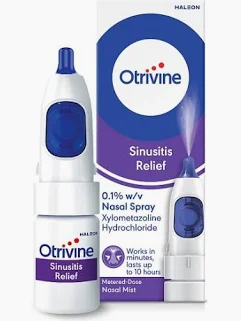
Otrivine Sinusitis Spray is a metered-dose nasal spray supplied in a 10ml bottle. The spray delivers a consistent dose with each application.
The active ingredient is xylometazoline hydrochloride 0.1% w/v. This is the standard adult concentration of a widely-used topical decongestant.
Firstly, the manufacturer is Haleon UK Trading Limited (formerly GlaxoSmithKline Consumer Healthcare). Otrivine is a long-established UK decongestant brand.
Also, the spray contains benzalkonium chloride as a preservative. This can cause mild nasal irritation in some patients.
How xylometazoline works locally in the nose
Xylometazoline is a sympathomimetic drug that binds to alpha-adrenergic receptors on the blood vessels lining the nose.
Firstly, this makes the vessels narrow (vasoconstriction), reducing the swelling that causes a blocked nose.
Also, less swelling means more space for air to flow through the nasal passages. Sinus drainage improves too.
However, because the spray acts locally in the nose, systemic side effects are usually mild. Some xylometazoline is absorbed into the bloodstream but at low levels.
Furthermore, effect starts within a few minutes and can last up to 10 hours per dose. This is longer than most oral decongestants.
MHRA 2026 five-day maximum
Above all, the MHRA issued a Drug Safety Update on 30 April 2026 for nasal decongestant sprays containing xylometazoline or oxymetazoline.
Firstly, the guidance is that these sprays should not be used for more than 5 consecutive days. This is shorter than the older 7-day maximum in the SmPC.
Also, this is because of concerns about rebound congestion, rhinitis medicamentosa, and tachyphylaxis (reduced effect from repeated use).
However, if symptoms persist or worsen beyond 5 days, seek pharmacist or GP advice rather than continuing the spray. A different approach may be needed.
Key features and specifications
Active ingredient: xylometazoline hydrochloride 0.1% w/v (1mg/ml)
Age: adults and children 12 years and over (contraindicated under 12)
Other ingredients: benzalkonium chloride, sodium phosphate, disodium edetate, sodium acid phosphate, sodium chloride, sorbitol, hypromellose, water
Storage: store below 25°C, use within 6 months of first opening
Distinctive features: topical action (fewer systemic effects than oral decongestants), fast onset (minutes), long duration (up to 10 hours), 5-day maximum use per MHRA 2026 update
MOJO WISDOM
Take control of your health by understanding your condition and what this medication is doing for you.
READ:
More information about this treatment.
UK-based doctors and pharmacists
Discreet and Confidential
UK-based doctors and pharmacists
Free, Expert Advice
No video link provided.
No video link provided.
UK-based doctors and pharmacists
Free, expert advice
Discrete and confidential
Fast delivery
Giving you trusted clinical advice for over 40 conditions
A UK regulated pharmacy providing safe, effective treatments online since 2014
A topical xylometazoline nasal spray for cold, sinusitis, and rhinitis
Otrivine Sinusitis Spray (Otrivine Sinusitis Relief 0.1% w/v Nasal Spray) is a well-known UK topical decongestant. Each spray contains xylometazoline hydrochloride 0.1% w/v as the single active ingredient.
Firstly, xylometazoline is a sympathomimetic decongestant. It works by narrowing blood vessels in the nasal lining.
Also, this reduces swelling and opens blocked nasal passages. Airflow improves within a few minutes and lasts up to 10 hours per dose.
However, unlike oral decongestants like Sudafed tablets, Otrivine acts locally in the nose. This means fewer systemic side effects but the risk of rebound congestion if used for too long.
Also, Otrivine Sinusitis Spray is for adults and children aged 12 years and over. It is a General Sales List (GSL) medicine, so it does not require pharmacist involvement to buy.
Above all, an MHRA April 2026 safety update now limits use to a maximum of 5 consecutive days. This is shorter than the older 7-day limit and reflects concerns about rebound congestion and rhinitis medicamentosa.
Firstly, rebound congestion means the nose becomes more blocked as the medicine wears off. This can lead to a cycle of overuse.
Also, rhinitis medicamentosa is a longer-lasting change to the nasal lining from prolonged spray use. Both can be avoided by keeping to the 5-day maximum.
Furthermore, Otrivine has cardiovascular contraindications despite being a topical medicine. Some systemic absorption still occurs.
At Courier Pharmacy, our team can help you decide whether Otrivine Sinusitis Spray fits your symptoms and situation.
When to see a doctor rather than self-treat
Otrivine Sinusitis Spray is for short-term symptom relief only. However, some symptoms need medical assessment instead of continued self-treatment.
Nasal congestion persisting or worsening beyond 5 days of Otrivine use, or symptoms returning as soon as the spray wears off (possible rebound congestion)
Thick coloured nasal discharge with high fever, severe facial pain, or dental pain (possible bacterial sinusitis)
Symptoms lasting more than 10 days without improvement, or symptoms that improve and then worsen
Severe headache, seizures, sudden confusion, chest pain, or one-sided weakness. Call 999
Nose bleeds that are frequent, heavy, or don’t stop within 10-15 minutes
Facial swelling, throat swelling, hives, or difficulty breathing. Call 999 (possible severe allergic reaction)
Visible changes to the inside of your nose, or persistent nasal dryness, crusting, or damage
If you have found yourself using the spray for weeks or months, seek medical advice about stopping it safely
If you are pregnant, breastfeeding, over 60, or have any of the medical conditions in the warnings section below, don’t use this without pharmacist or GP advice
Five key takeaways
Otrivine Sinusitis Spray contains xylometazoline hydrochloride 0.1% w/v as its single active ingredient. It works as a topical decongestant.
Licensed for adults and children 12+ for the symptomatic relief of nasal congestion associated with colds, sinusitis, allergic rhinitis, and hay fever.
Dose: 1 spray in each nostril, up to 3 times daily. Maximum 5 consecutive days (per MHRA April 2026 update, reduced from 7 days).
Contraindicated in narrow-angle glaucoma, phaeochromocytoma, prostatic hypertrophy, MAOI use (current or last 14 days), children under 12, and after certain nasal surgery.
Overuse causes rebound congestion (worse blockage as spray wears off) and rhinitis medicamentosa (lasting nasal lining damage). Available from Courier Pharmacy without prescription.
What is Otrivine Sinusitis Spray: overview
Where Otrivine Sinusitis Spray fits in nasal congestion treatment
Nasal congestion can be treated with several options. Saline nasal spray is the gentlest and safest first choice.
Firstly, if saline alone is not enough, a topical decongestant like Otrivine offers fast and effective relief. This suits short-term use for cold and sinus congestion.
However, for longer-term congestion (like allergic rhinitis), a steroid nasal spray (fluticasone, beclometasone, mometasone) or antihistamine may fit better than a topical decongestant.
Also, oral decongestants like Sudafed can help too, but with different side effect profiles.
Otrivine vs Sudafed Blocked Nose Spray
Both products contain the same active (xylometazoline 0.1% w/v). Firstly, they are functionally equivalent as medicines.
Also, both are 12+, both are GSL, and both should be used for no more than 5 days per current MHRA guidance.
However, they differ in brand (Otrivine is Haleon; Sudafed is Kenvue/McNeil) and pack presentation. Choose based on availability, price, or preference.
Otrivine vs Vicks Sinex range
Vicks Sinex uses oxymetazoline hydrochloride 0.05% as its active. Otrivine uses xylometazoline hydrochloride 0.1%.
Firstly, both are topical alpha-adrenergic decongestants. Both act locally in the nose with similar profiles.
Also, the MHRA April 2026 update applies to both classes (5-day maximum). Both have similar contraindications.
However, some patients find one better than the other, or prefer the different scents (Vicks Sinex Micromist adds menthol, eucalyptus, and camphor aromatics).
Otrivine vs oral decongestants (Sudafed tablets, Sinutab, Nurofen Cold and Flu)
Oral decongestants like pseudoephedrine or phenylephrine act throughout the body. Otrivine acts only in the nose.
Firstly, oral products have broader effects and more systemic side effects (cardiovascular, CNS, urinary). Otrivine has fewer systemic effects but the risk of rebound congestion.
However, oral decongestants have no rebound issue but can affect blood pressure, heart rate, and sleep. Choose based on which side effect profile fits you better.
Also, combined oral products cover multiple symptoms in one product. Otrivine covers only congestion.
Otrivine vs Otrivine Extra Dual Relief
The Otrivine range includes several products. Firstly, plain Sinusitis Relief contains xylometazoline alone.
Also, Otrivine Extra Dual Relief adds ipratropium bromide. This anticholinergic helps with runny nose as well as congestion.
However, if you only have congestion, the plain Sinusitis Relief fits well. If you also have significant runny nose, Dual Relief may suit better.
Rebound congestion and rhinitis medicamentosa
Firstly, rebound congestion is when the nose becomes more blocked as the spray wears off. This can occur after just a few days of use.
Also, rhinitis medicamentosa is a longer-lasting change to the nasal lining from prolonged spray use. It causes chronic congestion that only gets worse with more spray.
However, both can be avoided by keeping to the MHRA 5-day maximum. If you notice congestion returning quickly as each dose wears off, stop and speak to your pharmacist.
Furthermore, if you have been using the spray for weeks or months and cannot stop without severe congestion returning, seek GP advice on gradual withdrawal. A steroid nasal spray may help ease the transition.
Self-medication with pharmacist support
Although Otrivine is a General Sales List medicine (no pharmacist involvement required), buying at Courier Pharmacy comes with pharmacist support.
Also, the pharmacist can check that the spray fits your symptoms and situation. They will confirm you are not on MAOI antidepressants or have contraindications.
However, if this product is not right for you, we will explain why. We will then suggest safer options (saline nasal spray, steroid nasal spray, or a GP appointment).
Why choose Courier Pharmacy for your Otrivine Sinusitis Spray
Registered, independent, and patient-led
Courier Pharmacy is a UK-registered independent pharmacy. The General Pharmaceutical Council regulates us.
Firstly, even for a General Sales List medicine like Otrivine, pharmacist support matters. A short conversation can prevent avoidable harm.
Also, we treat every request as a chance to check that the product fits your situation. This is not a simple retail transaction.
As a result, buying this spray from us comes with the reassurance that a UK-qualified pharmacist has thought about your specific case.
Dr Ada Jex-Cori, our brand pharmacist
Our brand pharmacist is Dr Ada Jex-Cori. She represents the spirit of what we do. Named for Ada Lovelace, Sophia Jex-Blake, and Gerty Cori, she stands for evidence-led, unafraid-of-questions medicine. Her message is straightforward. You’re not broken. The system is. We’re here to change that.
Care that keeps showing up
Pharmacy purchases are not one-off transactions when done properly. Firstly, we are here to answer follow-up questions if the product is not working as expected.
Also, if you notice unexpected side effects or your symptoms change, contact us. If symptoms persist beyond 5 days, we can help you think through the next step.
However, we will not sell repeated bottles to someone showing signs of rebound congestion. That is not care, it is enabling overuse.
Buy Otrivine Sinusitis Spray from Courier Pharmacy
Otrivine Sinusitis Spray is a General Sales List (GSL) medicine. You can order at courierpharmacy.co.uk in the 10ml bottle.
Add Otrivine Sinusitis Spray to your basket at courierpharmacy.co.uk
Your order is dispensed and dispatched promptly
Follow the pack directions carefully. Do not use for more than 5 consecutive days
Contact us if you have questions or if symptoms persist
If this product is not right for your situation, we will explain why. Options include saline nasal spray, a steroid nasal spray (for allergic rhinitis), plain paracetamol for pain, or a GP appointment.
Above all, we will not dispense a product that is not suitable for you just because it was requested.
Summary
A topical xylometazoline nasal spray for local decongestant action in the nose.
Adult and 12+ dose: 1 spray in each nostril, up to 3 times daily. Maximum 5 consecutive days (MHRA April 2026 guidance).
Fast onset (minutes) and long duration (up to 10 hours per dose). Well-suited to short-term congestion relief.
Contraindicated in narrow-angle glaucoma, phaeochromocytoma, prostate enlargement, MAOI antidepressants, and children under 12.
General Sales List (GSL), no prescription needed. Overuse causes rebound congestion and rhinitis medicamentosa.
Active ingredient in Otrivine Sinusitis Spray
Xylometazoline hydrochloride 0.1% w/v
Xylometazoline is a synthetic sympathomimetic drug. It is a member of the imidazoline class of alpha-adrenergic agonists.
Firstly, at 0.1% w/v (1mg/ml), it is the standard adult concentration for topical nasal use. There is also a 0.05% paediatric strength for children 6-12.
Also, xylometazoline binds to alpha-adrenergic receptors on nasal blood vessels. It causes vasoconstriction (narrowing), which reduces the swelling that causes a blocked nose.
However, xylometazoline has moderate systemic absorption. This is why cardiovascular contraindications and some interactions apply.
Furthermore, unlike pseudoephedrine, xylometazoline is not controlled under the Misuse of Drugs Regulations. So no pack size limits apply.
Why topical decongestants act quickly
The spray delivers the active ingredient directly to the nasal lining. Firstly, this bypasses the digestive system and liver metabolism.
Also, the effect starts within a few minutes as the vessels begin to narrow.
However, this direct action also means the effect is concentrated at the nasal receptors. Repeated use can desensitise these receptors, leading to reduced effectiveness and rebound congestion.
Why xylometazoline has such long duration
Xylometazoline is a long-acting imidazoline. Firstly, its effect on nasal vessels can last 8-10 hours per dose.
Also, this is much longer than older topical decongestants (like ephedrine, which lasts 2-3 hours).
However, the long duration means fewer applications per day. But it also means the risk of accumulation with repeated use.
What is Otrivine Sinusitis Spray for?
Nasal congestion associated with the common cold
Otrivine Sinusitis Spray is licensed for the symptomatic relief of nasal congestion. Firstly, this is often the most common use, a blocked nose from a cold.
Also, the fast onset (minutes) makes it particularly useful when you need immediate relief.
However, colds usually resolve on their own in 7-10 days. Do not use the spray for the entire cold duration.
Sinusitis with congestion and pressure
Blocked sinuses cause facial pressure, headache, and (sometimes) pain. Xylometazoline reduces swelling in the nasal lining that also blocks sinus drainage.
Firstly, opening up the sinus drainage can ease pressure and pain.
However, severe sinus symptoms need medical assessment. Warning signs include high fever, severe facial pain, thick coloured discharge, or symptoms lasting more than 10 days.
Allergic rhinitis and hay fever
Otrivine can also help with the nasal congestion of allergic rhinitis and hay fever. However, this is often a longer-term condition.
Firstly, the 5-day maximum use makes Otrivine unsuitable for ongoing allergic rhinitis management.
Also, first-line options for allergic rhinitis are non-sedating antihistamines (loratadine, cetirizine, fexofenadine) or steroid nasal sprays (fluticasone, beclometasone, mometasone).
However, Otrivine may help for the first few days of a severe hay fever episode alongside long-term treatment.
What Otrivine Sinusitis Spray isn't for
This spray is not for chronic congestion, ongoing allergy management, cough, sore throat, or fever. It is also not for children under 12.
Also, it is not for use during pregnancy or breastfeeding without medical advice.
However, if symptoms are severe, sudden, unusual, or accompanied by other concerning features (see the red flags above), this spray is not the right response.
Furthermore, if you have narrow-angle glaucoma, phaeochromocytoma, prostate enlargement, or take MAOI antidepressants, do not use this spray.
Xylometazoline binds to alpha-1 and alpha-2 adrenergic receptors on the blood vessels in the nasal lining.
Firstly, activation of these receptors causes the smooth muscle in the vessel walls to contract. This narrows the vessels (vasoconstriction).
Also, less blood in the swollen nasal lining means less swelling. Air can flow through the passages more freely.
However, if the receptors are overstimulated by prolonged use, they downregulate. This is the mechanism behind rebound congestion.
Why the effect is fast
The nasal lining is highly vascular. Firstly, this means xylometazoline can act quickly at the receptors.
Also, the spray delivers the medicine directly to the target tissue. No absorption or metabolism steps delay the effect.
However, some xylometazoline is also absorbed into the bloodstream. This is why systemic contraindications still apply.
Why the effect is long-lasting
Xylometazoline binds tightly to its receptors. Firstly, this means the effect persists for many hours after each application.
Also, the imidazoline structure of xylometazoline gives it a longer duration than older decongestants like ephedrine.
However, this long duration means the vessels stay narrowed for extended periods. Repeated exposure can lead to receptor desensitisation.
How rebound congestion develops
With prolonged spray use, the alpha-adrenergic receptors become less responsive to xylometazoline. This is called tachyphylaxis.
Firstly, the spray becomes less effective at reducing swelling. The nose feels blocked again sooner after each dose.
Also, when the spray wears off, the vessels dilate more than before treatment. This is rebound congestion.
However, patients often respond by using the spray more often. This creates a cycle of overuse that leads to rhinitis medicamentosa.
How to use Otrivine Sinusitis Spray
Adult and 12+ dose
Apply 1 spray into each nostril, up to 3 times daily. Do not exceed 3 applications in each nostril per 24 hours.
Also, leave at least 4 to 6 hours between applications. The effect lasts up to 10 hours per dose, so 2 doses per day is often enough.
However, do not use for more than 5 consecutive days (per MHRA April 2026 guidance).
Children under 12 (not for use)
Otrivine Sinusitis Spray at 0.1% strength is contraindicated in children under 12 years old.
However, for congestion in younger children, saline nasal drops or spray are the standard first-line option. Otrivine also makes a paediatric formulation for children 6-12.
How to use the spray properly
Blow your nose gently to clear it before use. Firstly, remove the cap and hold the bottle upright.
Also, tilt your head slightly forward. Insert the nozzle into one nostril and close the other nostril with your finger.
However, breathe in gently through the nose while squeezing the bottle once. Repeat for the other nostril.
Furthermore, replace the cap after use. Wipe the nozzle clean if needed to prevent contamination.
How quickly it works
The effect starts within a few minutes of the first spray. Firstly, this makes topical decongestants much faster than oral products.
Also, peak effect is reached within about 15-30 minutes. Duration per dose is up to 10 hours.
However, this fast onset and long duration make Otrivine convenient. But the same properties mean rebound congestion can develop quickly with overuse.
Timing during the day
Otrivine can be used at any time. Firstly, morning and evening applications often work well given the 10-hour duration per dose.
Also, an evening dose can help you sleep through cold or sinus congestion at night.
However, do not apply more than 3 times per day, and keep to the 5-day maximum overall.
Stopping the spray
Stop the spray when your symptoms have resolved, or after 5 days at the latest.
Also, if you have used the spray for close to 5 days and want to reduce further, consider stopping abruptly if congestion is well controlled.
However, if you have used the spray for weeks or months and cannot stop without severe congestion returning, this is rhinitis medicamentosa. Seek pharmacist or GP advice on gradual withdrawal.
Do not combine with other decongestant sprays
Above all, do not use Otrivine alongside any other decongestant nasal spray. This includes Sudafed Blocked Nose Spray, Vicks Sinex, Sudafed Sinus-Ease, or any other xylometazoline or oxymetazoline product.
Also, do not use alongside oral decongestants like Sudafed tablets, Sinutab, Nurofen Cold and Flu, or Beechams All-in-One. Combining oral and topical decongestants overloads the sympathomimetic dose.
However, plain paracetamol or plain ibuprofen for pain or fever can be used alongside, following each medicine's own directions.
Warnings and precautions for Otrivine Sinusitis Spray
MHRA April 2026 safety update: 5-day maximum
Above all, the MHRA issued a Drug Safety Update on 30 April 2026. It advises that xylometazoline and oxymetazoline nasal sprays should not be used for more than 5 consecutive days.
Firstly, this is a change from the older SmPC 7-day maximum. It reflects concerns about rebound congestion, rhinitis medicamentosa, and tachyphylaxis.
Also, patients may mistake rebound congestion for continuation of the original problem, leading to further overuse.
However, if symptoms of congestion persist, worsen, or do not improve after 5 days, alternative treatment may be required. Do not continue using the spray.
Rebound congestion and rhinitis medicamentosa
Rebound congestion is worsening of nasal congestion as the spray wears off. Firstly, it can develop after just a few days of overuse.
Also, rhinitis medicamentosa is a chronic condition of persistent congestion caused by prolonged spray use. It includes visible damage to the nasal lining.
However, both are avoided by keeping to the 5-day maximum. If you have already developed rebound congestion, seek pharmacist or GP advice on gradual withdrawal.
Narrow-angle glaucoma (contraindicated)
Otrivine Sinusitis Spray is contraindicated in narrow-angle glaucoma. Xylometazoline can precipitate an acute glaucoma attack in susceptible patients.
Phaeochromocytoma (contraindicated)
Contraindicated in phaeochromocytoma (a rare tumour that affects heart rate and blood pressure). Sympathomimetic drugs can precipitate serious cardiovascular events in these patients.
Prostatic hypertrophy (contraindicated)
Contraindicated in prostatic hypertrophy. Sympathomimetic action can worsen urinary retention in patients with prostate enlargement.
MAOI antidepressants (contraindicated)
Above all, do not use this spray if you are on an MAOI antidepressant, or within 14 days of stopping one.
Also, MAOIs include phenelzine, isocarboxazid, tranylcypromine, and moclobemide. Rasagiline and selegiline (Parkinson's medicines) carry the same concern.
However, the combination of an MAOI with xylometazoline can cause hypertensive crisis, a life-threatening rise in blood pressure.
Certain nasal surgery (contraindicated)
Contraindicated in patients who have had trans-sphenoidal hypophysectomy or other surgery exposing the dura mater. Also contraindicated in rhinitis sicca (dry nose) or atrophic rhinitis.
Children under 12 (contraindicated)
Otrivine at 0.1% is contraindicated in children under 12 years old.
However, for congestion in younger children, saline nasal drops or spray are safer options. A 0.05% paediatric xylometazoline formulation exists for children 6-12.
Cardiovascular caution
Use with caution in patients with cardiovascular disease, hypertension, or heart rhythm disturbances. Firstly, even topical xylometazoline can cause some systemic vasoconstriction.
Also, patients with long QT syndrome may be at increased risk of serious ventricular arrhythmias.
However, if you take any regular medicine for high blood pressure or heart conditions, discuss with the pharmacist before use.
Hyperthyroidism and diabetes (caution)
Use with caution in overactive thyroid and diabetes. Sympathomimetic drugs can compound the effects of excess thyroid hormone and can affect blood glucose.
Benzalkonium chloride content
The spray contains benzalkonium chloride as a preservative. This can cause nasal irritation, especially with prolonged use.
However, patients with sensitive nasal mucosa may notice more irritation. Discontinue if this becomes bothersome.
Pregnancy (not recommended)
Otrivine is not recommended during pregnancy without medical advice. Firstly, systemic vasoconstriction could theoretically affect placental blood flow.
However, saline nasal spray is a safe alternative for congestion in pregnancy. Ask your midwife, GP, or pharmacist.
Breastfeeding (not without medical advice)
Otrivine should not be used in breastfeeding without medical advice. Systemic absorption can occur.
However, saline nasal spray is a safe alternative for congestion while breastfeeding.
Elderly patients (caution)
Use with caution in adults over 60. Firstly, older adults are more sensitive to sympathomimetic cardiovascular effects.
However, if this spray is considered in older adults, keep to the minimum effective dose and short duration.
Duration of use (5 days maximum)
Do not use this spray for more than 5 consecutive days (per MHRA April 2026 guidance). Ongoing symptoms need medical assessment.
Side effects of Otrivine Sinusitis Spray
Common side effects
Common local side effects include application site burning, nasal dryness, and nasal discomfort. Firstly, these usually reflect the concentrated action at the nasal lining.
Also, headache, nausea, and mild sneezing can occur.
However, most side effects are mild and settle without action.
Less common but significant side effects
Some side effects need attention. Firstly, palpitations or a noticeable rise in blood pressure warrant stopping the spray.
Also, insomnia if the spray is used late at night, or persistent tremor or restlessness, may reflect systemic absorption.
However, nose bleeds can occur, particularly with prolonged use or in patients with fragile nasal mucosa.
Rebound congestion and rhinitis medicamentosa
These are the most important side effects of overuse. Firstly, rebound congestion is worsening blockage as each dose wears off.
Also, rhinitis medicamentosa is longer-lasting nasal lining changes. Both are common with use beyond the 5-day MHRA limit.
Serious side effects requiring urgent help
Above all, seek urgent medical help for signs of severe cardiovascular events. These include severe headache, chest pain, one-sided weakness, or difficulty speaking. Call 999.
Also, signs of severe allergic reaction (facial or throat swelling, breathing difficulty, widespread rash) need 999.
However, severe or persistent nose bleeds need medical assessment.
Above all, do not use this spray if you are on an MAOI antidepressant, or within 14 days of stopping one.
Also, MAOIs include phenelzine, isocarboxazid, tranylcypromine, and moclobemide. Rasagiline and selegiline (Parkinson's medicines) and linezolid (an antibiotic) carry the same concern.
However, the combination can cause hypertensive crisis, a life-threatening rise in blood pressure.
Tricyclic and tetracyclic antidepressants (caution)
Use with caution with tricyclic antidepressants (amitriptyline, nortriptyline, imipramine, clomipramine) and tetracyclic antidepressants (mirtazapine, mianserin).
Also, these can enhance the pressor effect of xylometazoline, raising blood pressure and cardiac arrhythmia risk.
Other sympathomimetics (caution)
Do not combine with other topical or oral sympathomimetic decongestants. This includes other xylometazoline products, oxymetazoline (Vicks Sinex), pseudoephedrine (Sudafed tablets, Sinutab), phenylephrine (Beechams All-in-One), and ephedrine.
Firstly, combining these overloads the sympathomimetic exposure. This raises the risk of cardiovascular events.
Beta-blockers (caution)
Use with caution with beta-blockers (propranolol, atenolol, bisoprolol, metoprolol). Firstly, unopposed alpha stimulation can cause paradoxical high blood pressure.
Frequently asked questions about Otrivine Sinusitis Spray
How quickly does Otrivine work?
The effect starts within a few minutes of the first spray. Firstly, this makes topical decongestants much faster than oral products.
Also, peak effect is reached within about 15-30 minutes. Duration per dose is up to 10 hours.
How long can I use Otrivine for?
The MHRA now advises a maximum of 5 consecutive days (April 2026 update). This is shorter than the older 7-day SmPC limit.
However, if your symptoms persist beyond 5 days, seek pharmacist or GP advice rather than continuing the spray.
What is rebound congestion?
Rebound congestion is when your nose becomes more blocked as each dose of Otrivine wears off. Firstly, it can start after just a few days of use.
Also, this can trap you in a cycle of using the spray more often to relieve congestion that the spray itself is causing.
However, keeping to the 5-day maximum prevents most cases.
What is rhinitis medicamentosa?
Rhinitis medicamentosa is chronic nasal congestion caused by prolonged use of decongestant sprays. Firstly, it can develop after weeks or months of overuse.
Also, the nasal lining can develop visible changes (dryness, crusting, damage).
However, treatment usually involves stopping the spray (gradually if severe) and using saline plus a steroid nasal spray to help the nose recover.
How do I stop using Otrivine safely?
For short-term use (up to 5 days), you can simply stop when your symptoms resolve or reach the 5-day limit.
However, if you have used the spray for weeks or months, gradual withdrawal is often needed. Try stopping in one nostril at a time, or reducing the frequency gradually.
Also, a steroid nasal spray or saline nasal spray can help ease withdrawal. Ask your pharmacist or GP for advice.
Will Otrivine make me drowsy?
No. Xylometazoline is not sedating. However, it can occasionally cause mild insomnia if used late in the day.
Can I drive after using Otrivine?
Yes, generally. Xylometazoline does not impair driving at recommended doses.
However, if you notice any unusual side effects (dizziness, palpitations), do not drive until they resolve.
Can I use Otrivine with oral cold medicines?
Not with oral decongestants (Sudafed, Sinutab, Nurofen Cold and Flu, Beechams All-in-One). Combining topical and oral decongestants overloads the sympathomimetic dose.
However, plain paracetamol or plain ibuprofen for pain or fever can be used alongside, following each medicine's own directions.
Can I use Otrivine with other nasal sprays?
Do not combine with any other decongestant nasal spray (Sudafed Blocked Nose, Vicks Sinex, Sudafed Sinus-Ease, other xylometazoline or oxymetazoline products).
However, saline nasal spray can be used alongside. Steroid nasal sprays (like fluticasone) can also be used alongside for different conditions.
Can I use Otrivine if I take antidepressants?
If you take an MAOI antidepressant, Otrivine is contraindicated. Also, use caution if you take tricyclic or tetracyclic antidepressants (amitriptyline, mirtazapine).
However, SSRIs and SNRIs are generally safer alongside Otrivine, but ask the pharmacist to confirm.
Can children use Otrivine?
The 0.1% Otrivine Sinusitis Spray is for children 12+ and adults. Children under 12 must not use it.
However, a paediatric 0.05% xylometazoline formulation exists for children 6-12. Saline nasal drops are the standard first-line option for younger children.
Can I use Otrivine during pregnancy or breastfeeding?
Not without medical advice. Otrivine is not recommended in pregnancy or breastfeeding.
However, saline nasal spray or drops are safe alternatives. Ask your midwife, GP, or pharmacist for guidance.
What's the difference between Otrivine and Sudafed Blocked Nose Spray?
Both contain the same active (xylometazoline 0.1% w/v). Firstly, they are functionally equivalent as medicines.
However, they differ in brand (Otrivine is Haleon; Sudafed is Kenvue). Both are 12+, both are GSL, both follow the 5-day MHRA maximum.
What's the difference between Otrivine and Vicks Sinex?
Otrivine contains xylometazoline 0.1%; Vicks Sinex contains oxymetazoline 0.05%. Both are topical alpha-adrenergic decongestants with similar effects.
Also, both fall under the MHRA April 2026 5-day maximum guidance.
What's the difference between Otrivine and oral Sudafed?
Otrivine acts locally in the nose (topical). Sudafed tablets act throughout the body (oral).
Firstly, Otrivine has fewer systemic side effects but a rebound congestion risk. Sudafed has broader effects but no rebound issue.
However, choose based on symptoms, other conditions you have, and which side effect profile fits you better.
Can I use Otrivine if I have high blood pressure?
Use with caution and discuss with the pharmacist first. Even topical xylometazoline can affect blood pressure through some systemic absorption.
However, saline nasal spray or a steroid nasal spray may be safer options if you have significant hypertension.
Is Otrivine addictive?
Not in the sense of chemical dependence. However, rhinitis medicamentosa creates a functional dependence, meaning you cannot breathe through your nose without more spray.
Also, this is why the 5-day maximum matters. Prolonged use leads to a cycle of overuse.
What if I've used too much Otrivine?
Contact NHS 111 or A&E immediately for significant overuse. Firstly, xylometazoline overdose can cause severe dizziness, sweating, low body temperature, headache, slow heart rate, high blood pressure, breathing depression, or convulsions.
Also, small children are more sensitive to toxicity. Keep out of children's reach.
However, take the bottle with you so medical staff can see exactly what and how much you have used.
Do I need a prescription from Courier Pharmacy?
No. Otrivine Sinusitis Spray is a General Sales List (GSL) medicine. It can be sold without prescription or pharmacist supervision.
However, buying from a pharmacy like Courier gives you access to pharmacist advice about safe use.
Disclaimer
Disclaimer: This information is for education only and isn't a substitute for personal medical advice. Always follow the packaging directions, and ask your pharmacist or GP if you're unsure whether Otrivine Sinusitis Spray is suitable for you.
References
Electronic Medicines Compendium (2024) Otrivine Sinusitis Relief, 0.1% w/v Nasal Spray, Solution with Khone Spray: Patient Information Leaflet. Available at: https://www.medicines.org.uk/emc/product/6334/pil
Electronic Medicines Compendium (2024) Otrivine Sinusitis Relief, 0.1% w/v Nasal Spray, Solution with Khone Spray: Summary of Product Characteristics. Available at: https://www.medicines.org.uk/emc/product/6334/smpc