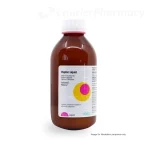
Peptac Aniseed Liquid is a pink oral suspension with an aniseed flavour. Firstly, it contains three active ingredients per 5ml: sodium alginate 250mg, sodium bicarbonate 133.5mg, and calcium carbonate 80mg.
Also, the 500ml pack is one of the largest bottle sizes available. Firstly, this makes it cost-effective for regular users.
However, Peptac is described as an antacid with reflux suppressant action. Firstly, it combines both acid-neutralising and raft-forming mechanisms.
Furthermore, the manufacturer is Pinewood Healthcare (part of Teva). Firstly, Pinewood produces a range of similar generic alginate suspensions under different brand names.
Aniseed flavour vs peppermint
Peptac is available in both aniseed and peppermint flavours. Firstly, both contain the same active ingredients at the same concentrations.
Also, choice between flavours is usually personal preference. Firstly, some people find aniseed more soothing or prefer its licorice-like taste.
However, some patients find that peppermint can occasionally worsen reflux symptoms. Firstly, peppermint essential oils can relax the lower oesophageal sphincter.
Furthermore, if you have found peppermint aggravates your symptoms, aniseed may be a better choice. Firstly, this is worth trying if peppermint hasn’t worked for you.
Peptac vs Gaviscon Original (essentially equivalent)
Peptac Aniseed and Gaviscon Original Aniseed share the same three active ingredients at very similar concentrations. Firstly, both are triple-action alginate raft-formers with acid neutralisation.
Also, both have the same clinical effect, same age suitability, and same warnings.
However, Peptac is usually offered at a lower price than the branded Gaviscon Original Aniseed. Firstly, this makes it a value option for the same clinical benefit.
The triple-action mechanism
Peptac works through three complementary mechanisms. Firstly, sodium alginate reacts with stomach acid to form alginic acid gel.
Also, sodium bicarbonate reacts with stomach acid to release carbon dioxide bubbles (which get trapped in the gel and make it float) and to neutralise some acid.
However, calcium carbonate provides additional acid neutralisation on contact with stomach acid. Firstly, this gives immediate acid-neutralising effect alongside the raft formation.
Furthermore, the alginate raft floats on top of the stomach contents. Firstly, this physical barrier blocks stomach acid and contents from refluxing up into the oesophagus for up to 4 hours.
Key features and specifications
Active ingredients per 5ml: sodium alginate 250mg + sodium bicarbonate 133.5mg + calcium carbonate 80mg
Active ingredients per 10ml: sodium alginate 500mg + sodium bicarbonate 267mg + calcium carbonate 160mg
Adult dose per intake: 10-20ml (2-4 x 5ml spoonfuls)
Sodium content: approximately 6 mmol per 10ml (max daily dose = 57.2% WHO recommended daily max)
Sugar-free and gluten-free
Distinctive features: aniseed flavour (Star Anise Oil), pink colour (Erythrosine E127), generic equivalent of Gaviscon Original Aniseed at usually lower price, suitable from age 6, up to 4-hour raft protection
MOJO WISDOM
Take control of your health by understanding your condition and what this medication is doing for you.
READ:
More information about this treatment.
UK-based doctors and pharmacists
Discreet and Confidential
UK-based doctors and pharmacists
Free, Expert Advice
No video link provided.
No video link provided.
UK-based doctors and pharmacists
Free, expert advice
Discrete and confidential
Fast delivery
Giving you trusted clinical advice for over 40 conditions
A UK regulated pharmacy providing safe, effective treatments online since 2014
Where Peptac Aniseed fits in acid-related self-care
Heartburn, indigestion, and acid reflux are common. Firstly, several over-the-counter options exist.
Also, antacids (Rennie, Tums) neutralise stomach acid for fast but short-lived relief.
However, alginate raft-formers (Peptac Aniseed, Peptac Peppermint, Gaviscon Original, Gaviscon Advance) form a physical barrier that reduces reflux for longer.
Furthermore, H2 antagonists (famotidine) and PPIs (omeprazole 10mg OTC as Zanprol) reduce acid production for hours to days.
Peptac Aniseed vs Peptac Peppermint
Both variants contain the same active ingredients at the same concentrations. Firstly, choice between them is primarily about flavour preference.
Also, some patients prefer aniseed because they find peppermint too strong or feel it worsens their reflux.
However, Peptac Aniseed contains Erythrosine (E127) food colouring, while Peptac Peppermint does not. Firstly, if you wish to avoid food dyes, choose the peppermint variant.
Peptac vs Gaviscon Original Aniseed
Peptac Aniseed and Gaviscon Original Aniseed contain essentially the same active ingredients at the same concentrations. Firstly, both are triple-action alginate raft-formers.
Also, the clinical effect is expected to be equivalent. Firstly, both are suitable from age 6.
However, Peptac is usually offered at a lower price than the branded Gaviscon Original Aniseed. Firstly, choice often depends on cost and personal brand preference.
Peptac vs Gaviscon Advance
Gaviscon Advance contains twice the sodium alginate concentration (1000mg vs 500mg per 10ml) and uses potassium bicarbonate instead of sodium bicarbonate. Firstly, Advance is stronger and lower in sodium.
Also, Gaviscon Advance is suitable from age 12, while Peptac is suitable from age 6.
However, Peptac is usually more economical. Firstly, choice depends on symptom severity, age, and budget considerations.
Peptac vs Acidex and supermarket own-brands
Peptac, Acidex, and various supermarket own-brands (Boots, Tesco, Well) are all made by Pinewood Healthcare with identical composition. Firstly, they share the same SmPC.
Also, choice between these usually comes down to pack size availability, price, and personal preference.
Peptac vs Rennie or Tums (simple antacids)
Rennie and Tums contain calcium carbonate (and magnesium in Rennie). Firstly, they neutralise stomach acid on contact.
Also, this gives fast but short-lived relief (usually 30-60 minutes).
However, Peptac’s raft-forming action gives longer protection (up to 4 hours). Firstly, this is more effective for regurgitation and reflux symptoms than simple antacids alone.
Peptac vs H2 antagonists (Pepcid AC)
Pepcid AC contains famotidine 10mg (OTC H2 antagonist). Firstly, it reduces acid production for 8-12 hours.
Also, Peptac works through a physical raft mechanism with faster onset but shorter duration.
However, the two can be combined for complementary effect.
Peptac vs OTC PPI (Zanprol)
Zanprol contains omeprazole 10mg (OTC PPI). Firstly, it reduces stomach acid production and needs 1-4 days to reach full effect.
Also, Zanprol is used for a 14-day course for frequent heartburn.
However, Peptac works immediately and can be used as needed. Firstly, it can be combined with PPI therapy for breakthrough symptoms.
Peptac vs prescription PPIs
Prescription PPIs (rabeprazole, lansoprazole, omeprazole higher doses) give stronger and longer-lasting acid suppression. Firstly, they are used for confirmed reflux disease and ulcer healing.
Also, Peptac is often used alongside prescription PPIs. Firstly, it provides fast relief for breakthrough reflux while PPIs reduce baseline acid production.
Complementary use with other acid-suppressing medicines
Peptac can be used alongside PPIs (omeprazole, lansoprazole, rabeprazole, esomeprazole) or H2 antagonists (famotidine). Firstly, they work through different mechanisms and complement each other.
However, remember to leave at least 2 hours between Peptac and other oral medicines. Firstly, the alginate can reduce absorption of some drugs.
Short-term use only
Peptac is for short-term (up to 7 days) symptom relief. Firstly, symptoms persisting beyond this need medical assessment.
Also, chronic or frequent reflux may need prescription treatment.
Why choose Courier Pharmacy for your Peptac Aniseed Liquid
Registered, independent, and patient-led
Courier Pharmacy is a UK-registered independent pharmacy regulated by the General Pharmaceutical Council. Firstly, even for a general sale product like Peptac, pharmacist support matters.
Also, a short conversation can help you choose the right reflux product for your specific symptoms and situation.
Dr Ada Jex-Cori, our brand pharmacist
Our brand pharmacist is Dr Ada Jex-Cori. She represents the spirit of what we do. Named for Ada Lovelace, Sophia Jex-Blake, and Gerty Cori, she stands for evidence-led, unafraid-of-questions medicine. Her message is straightforward. You’re not broken. The system is. We’re here to change that.
Care that keeps showing up
Purchases are not one-off transactions when done properly. Firstly, we are here to answer follow-up questions if the product is not working as expected.
Also, if your reflux persists beyond 7 days or worsens, contact us. We can help you think through the next step, including when a GP appointment or prescription treatment is needed.
Buy Peptac Aniseed Flavour Antacid 500ml from Courier Pharmacy
Peptac Aniseed Liquid 500ml is a general sale (GSL) medicine. You can order it at courierpharmacy.co.uk.
Add Peptac Aniseed Liquid 500ml to your basket
Our pharmacy team reviews the sale as part of our routine pharmacy check
Your order is dispatched promptly
Follow the pack directions carefully. Contact us if you have questions
If Peptac Aniseed is not the right product for your situation, we will explain why. Options include Peptac Peppermint (same composition, peppermint flavour, no Erythrosine dye), Gaviscon Advance Peppermint Suspension (stronger alginate concentration, lower sodium, age 12+), Gaviscon Original Aniseed or Peppermint (same composition as Peptac at higher price), Gaviscon Double Action (combines raft-former plus stronger antacid), Rennie (simple antacid for immediate relief), OTC PPI (Zanprol 10mg omeprazole for frequent heartburn), OTC H2 antagonist (Pepcid AC 10mg famotidine), or a prescription PPI (rabeprazole, lansoprazole for stronger or longer treatment).
Above all, we will not sell a product that is not right for your situation.
Active ingredients in Peptac Aniseed Liquid
Sodium alginate 250mg per 5ml
Sodium alginate is a naturally occurring polysaccharide derived from brown seaweed. Firstly, it has been used medicinally for its viscous, gel-forming properties for many decades.
Also, when sodium alginate contacts stomach acid, it forms alginic acid gel with near-neutral pH.
However, at 250mg per 5ml (500mg per 10ml), Peptac has the same alginate concentration as Gaviscon Original. Firstly, this gives a strong and durable raft.
Sodium bicarbonate 133.5mg per 5ml
Sodium bicarbonate has two roles in Peptac. Firstly, it reacts with stomach acid to release carbon dioxide bubbles that get trapped in the alginate gel, making it float.
Also, sodium bicarbonate provides direct acid neutralisation. Firstly, this adds an antacid component to the raft-forming action.
However, sodium bicarbonate contains sodium, which contributes to the total sodium load of the medicine.
Calcium carbonate 80mg per 5ml
Calcium carbonate provides additional acid neutralisation. Firstly, it also contributes calcium ions that support the raft-forming reaction.
However, patients with hypercalcaemia, nephrocalcinosis, or calcium-containing kidney stones should use with caution due to the calcium content.
Excipients in Peptac Aniseed Liquid
Star Anise Oil (natural aniseed flavour)
The aniseed flavour comes from Star Anise Oil, a natural essential oil extracted from star anise fruit. Firstly, this provides a distinctive licorice-like taste.
Also, aniseed has been traditionally used to aid digestion. Firstly, some patients find the flavour more soothing than peppermint.
Erythrosine Colour (E127), red food dye
Peptac Aniseed contains Erythrosine (E127), a red food colouring that gives the liquid its distinctive pink appearance. Firstly, this is not present in the peppermint variant.
However, some people are sensitive to Erythrosine or prefer to avoid artificial food colours. Firstly, if this concerns you, choose Peptac Peppermint instead, which is dye-free.
Also, Erythrosine is approved for use in food and medicines in the UK and EU. Firstly, it has been subject to safety reviews and remains authorised at controlled levels.
Parabens (E214, E216, and butyl parahydroxybenzoate)
Peptac Aniseed contains three parabens as preservatives: ethyl parahydroxybenzoate (E214), propyl parahydroxybenzoate (E216), and butyl parahydroxybenzoate. Firstly, these prevent bacterial and fungal growth in the suspension.
However, patients with paraben allergy must avoid this product. Firstly, butyl parahydroxybenzoate specifically is noted in the SmPC as potentially causing allergic reactions (sometimes delayed).
Other excipients
The suspension also contains carbomer (Carbopol 974P) as a viscosity agent, sodium hydroxide for pH adjustment, saccharin sodium as sweetener, isopropyl alcohol as a solvent for flavour compounds, and purified water. Firstly, these support the formulation.
What is Peptac Aniseed Liquid for?
Heartburn
Heartburn is the burning sensation in the chest caused by stomach acid refluxing up into the oesophagus. Firstly, Peptac's raft blocks this reflux physically while the bicarbonate and calcium carbonate neutralise acid.
Acid regurgitation
Acid regurgitation is when stomach contents come up into the throat or mouth, often causing a sour or bitter taste. Firstly, the alginate raft prevents this by acting as a physical barrier.
Indigestion (dyspepsia)
Dyspepsia can include a range of upper GI symptoms: stomach discomfort, bloating, nausea, early fullness. Firstly, Peptac can help when acid or reflux is a component.
Symptoms of gastro-oesophageal reflux
These include heartburn, acid regurgitation, chest discomfort, and sometimes cough (particularly at night). Firstly, Peptac addresses the physical process of reflux.
Post-meal symptoms
Symptoms occurring after meals (especially large meals, spicy foods, or lying down soon after eating). Firstly, Peptac taken after meals gives protection during the vulnerable post-meal period.
Night-time reflux
Reflux symptoms during sleep can wake you up or contribute to poor sleep. Firstly, a bedtime dose of Peptac provides overnight protection.
Pregnancy-related heartburn
Heartburn is very common in pregnancy, particularly in the third trimester. Firstly, Peptac can be used during pregnancy per SmPC.
Peppermint intolerance or aggravation
Some people find peppermint uncomfortable or find it worsens their reflux. Firstly, the aniseed variant offers the same clinical benefit without the peppermint flavour.
What Peptac isn't for
Peptac is not for chronic acid-related conditions needing PPI therapy. Firstly, prescription PPIs are usually more appropriate for confirmed GORD, oesophagitis, or ulcers.
Also, it is not for chest pain of cardiac origin. Firstly, if chest pain is severe, radiating, or with breathlessness, call 999.
However, it is not for children. Firstly, Infant Gaviscon is a separate product for very young children.
How does Peptac Aniseed Liquid work?
The alginate raft (main mechanism)
Sodium alginate is a viscous, gel-forming polymer. Firstly, when it contacts stomach acid, it precipitates into alginic acid gel.
Also, sodium bicarbonate reacts with stomach acid to release carbon dioxide. Firstly, these CO2 bubbles get trapped in the alginate gel, making it float.
However, this floating gel raft physically blocks stomach contents from refluxing up into the oesophagus. Firstly, the raft has near-neutral pH, so it does not itself irritate the oesophagus if refluxed.
The acid neutralisation (added benefit)
Sodium bicarbonate and calcium carbonate both neutralise stomach acid on contact. Firstly, this reduces acidity of the stomach contents.
Also, this is different from PPIs and H2 antagonists (which reduce acid production). Firstly, antacid neutralisation acts immediately but is short-lived.
Duration of raft protection
The raft can provide up to 4 hours of protection per dose. Firstly, this is longer than the immediate but short-lived neutralisation from simple antacids alone.
However, individual response varies. Firstly, factors like meal composition and gastric motility affect how long the raft lasts.
Not systemically absorbed
Alginic acid is not absorbed into the systemic circulation. Firstly, it acts locally in the stomach and passes through the digestive tract.
Also, small amounts of sodium bicarbonate and calcium carbonate may be absorbed. Firstly, however, this is minimal at recommended doses.
Treatment dosage for Peptac Aniseed Liquid
At a glance
Adult dose per intake: 10-20ml (2-4 x 5ml spoonfuls)
Frequency: after meals and at bedtime
Maximum: four doses in 24 hours
Duration: up to 7 days without medical advice
Administration: shake bottle well before use; measure with 5ml spoon or measuring cup provided
Adult and adolescent (12+) dose
Take 10-20ml (two to four 5ml spoonfuls) after meals and at bedtime, up to four times daily. Firstly, do not exceed four doses in any 24-hour period.
Also, most patients take Peptac after meals and at bedtime. Firstly, this covers the times when acid reflux is most common.
Elderly patients
No specific dose reduction is required in adults over 60. Firstly, however, be aware of the sodium content if you have heart failure or fluid retention.
Pregnancy
Peptac can be used in pregnancy. Firstly, clinical studies in over 500 pregnant women plus large postmarketing data show no malformative or feto-toxic effects.
However, if heartburn is severe or persistent in pregnancy, discuss with your midwife or GP.
Breastfeeding
Peptac can be used in breastfeeding. Firstly, the active ingredients are not significantly absorbed and no effects have been shown in breastfed babies of treated mothers.
Renal impairment or heart failure
Use with caution in significant renal impairment, congestive heart failure, or if on a low-salt diet. Firstly, the sodium content may be relevant.
Paraben allergy
Do not use Peptac if you have known paraben allergy. Firstly, it contains ethyl, propyl, and butyl parahydroxybenzoates as preservatives.
However, butyl parahydroxybenzoate specifically is noted in the SmPC as potentially causing allergic reactions (sometimes delayed).
Erythrosine (E127) allergy or avoidance
Peptac Aniseed contains Erythrosine, a red food colouring. Firstly, some people are sensitive to this dye or prefer to avoid food colours generally.
However, Peptac Peppermint does not contain Erythrosine. Firstly, this is a dye-free alternative from the same manufacturer.
Duration limits
Do not take Peptac for more than 7 days without medical advice. Firstly, persistent symptoms may indicate a more significant condition needing assessment or prescription treatment.
How to take Peptac Aniseed Liquid
Standard adult dose
Adults and children 12 and over: take 10-20ml (two to four 5ml spoonfuls) after meals and at bedtime. Firstly, use up to four times daily.
Shake before use
Shake the bottle well before each dose. Firstly, this ensures the suspension is properly mixed and any sedimentation is dispersed.
How to measure the dose
Use a 5ml medicine spoon or the measuring cup if one is provided. Firstly, do not use household teaspoons as they vary in size.
When to take
Take Peptac after meals and at bedtime. Firstly, this covers the times when acid reflux is most common.
Also, after meals: the raft forms in the presence of stomach acid released for digestion.
However, at bedtime: lying down makes reflux more likely, so a bedtime dose gives overnight protection.
How quickly it works
The alginate raft usually forms within minutes of swallowing the suspension. Firstly, symptom relief is often noticed rapidly.
Also, the raft can provide protection for up to 4 hours per dose.
Separating from other medicines
Above all, leave at least 2 hours between Peptac and other oral medicines. Firstly, the alginate raft can reduce the absorption of some medicines.
Also, particularly important with tetracycline and fluoroquinolone antibiotics, iron salts, thyroid hormones (levothyroxine), chloroquine, and bisphosphonates.
Missed doses
If you miss a dose, take it if symptoms are present or expected. Firstly, however, do not exceed the maximum daily dose.
Stopping treatment
Peptac can be stopped whenever symptoms have settled. Firstly, there is no need to taper.
However, if symptoms return quickly after stopping, consider whether prescription treatment (PPI or H2 antagonist) might be more appropriate.
Do not exceed the stated dose
Do not take more than 4 doses (up to 80ml maximum) in 24 hours. Firstly, exceeding the dose does not improve effect but adds unnecessary sodium load.
Warnings and precautions for Peptac Aniseed Liquid
Paraben allergy
Peptac contains ethyl, propyl, and butyl parahydroxybenzoates as preservatives. Firstly, patients with known paraben allergy should not take Peptac.
However, butyl parahydroxybenzoate specifically is noted in the SmPC as potentially causing allergic reactions (sometimes delayed).
Erythrosine (E127) sensitivity
Peptac Aniseed contains Erythrosine, a red food colouring. Firstly, some people are sensitive to this dye or prefer to avoid food colours generally.
However, Peptac Peppermint does not contain Erythrosine and is an alternative for those who wish to avoid this ingredient.
Symptoms lasting more than 7 days
If symptoms persist for more than 7 days, consult a doctor. Firstly, persistent reflux may indicate a more significant condition needing prescription treatment or investigation.
Alarm symptoms (see a doctor before using)
Certain symptoms need medical assessment before using self-care products. Firstly, these include difficulty or painful swallowing, unintended weight loss, persistent vomiting, or vomiting blood.
However, iron deficiency anaemia or new symptoms in someone over 55 also need medical assessment.
Sodium content
Peptac contains sodium from both sodium alginate and sodium bicarbonate. Firstly, approximately 6 mmol per 10ml dose. Maximum daily dose is 57.2% of WHO recommended daily sodium intake.
However, discuss with your GP or pharmacist if you are on a low salt diet, have congestive heart failure, or renal impairment.
Calcium content
Peptac contains calcium from calcium carbonate. Firstly, use with caution in patients with hypercalcaemia, nephrocalcinosis, or recurrent calcium-containing kidney stones.
Hypersensitivity
Do not use if allergic to any of the ingredients (sodium alginate, sodium bicarbonate, calcium carbonate, parabens, Erythrosine, Star Anise Oil, or other excipients).
Renal impairment
Use with caution in significant renal impairment. Firstly, the sodium and calcium content may be relevant.
Heart failure
Use with caution in congestive heart failure. Firstly, the sodium content may worsen fluid retention.
Pregnancy
Peptac can be used in pregnancy per SmPC. Firstly, clinical studies in over 500 pregnant women show no malformative or feto-toxic effects.
Breastfeeding
Peptac can be used in breastfeeding. Firstly, the active ingredients are not significantly absorbed and no effects have been shown in breastfed babies.
Driving and machinery
No effects on ability to drive or use machinery. Firstly, the medicine acts locally in the stomach.
Alcohol
No direct interaction with alcohol. However, alcohol can worsen acid-related symptoms and reflux.
Separation from other medicines
Above all, leave at least 2 hours between Peptac and other oral medicines. Firstly, the alginate raft can reduce absorption of some medicines.
Duration of use
Do not take Peptac for more than 7 days without medical advice. Firstly, ongoing symptoms need medical assessment.
Side effects of Peptac Aniseed Liquid
Occasional side effects
Peptac is generally well tolerated at recommended doses. Firstly, side effects are occasional.
Also, occasional side effects may include constipation, flatulence, stomach cramps, and belching.
Rare but significant side effects
Allergic reactions to the parabens, Erythrosine, or other ingredients are rare but possible. Firstly, symptoms include rash, itching, swelling of face, lips, tongue, or throat, and difficulty breathing.
However, butyl parahydroxybenzoate may cause delayed allergic reactions in susceptible patients.
Serious side effects requiring urgent help
Above all, seek urgent medical help for signs of severe allergic reaction (facial or throat swelling, breathing difficulty, widespread rash). Call 999.
Above all, leave at least 2 hours between Peptac and other oral medicines. Firstly, the alginate raft and antacid effect can reduce absorption of some medicines.
Also, particularly important with tetracycline and fluoroquinolone antibiotics, iron salts, thyroid hormones (levothyroxine), chloroquine, bisphosphonates, and phenothiazines.
Lithium and quinidine
Sodium bicarbonate can reduce plasma lithium levels and increase plasma quinidine levels through renal effects. Firstly, discuss with your GP or pharmacist if you take these medicines.
PPIs and H2 antagonists (compatible)
Peptac can be used alongside PPIs or H2 antagonists. Firstly, no direct interaction is expected.
However, if using both, some prescribers recommend taking Peptac for breakthrough symptoms rather than continuously.
Antacids (compatible)
Peptac already contains antacid components. Firstly, adding another antacid is usually unnecessary.
Anticoagulants and cardiac medicines
No direct interaction with warfarin, DOACs, or standard cardiac medicines. However, the sodium content should be considered in patients with heart failure or on low-sodium diets.
Alcohol
No direct interaction. However, alcohol worsens acid-related symptoms.
Other cold and flu medicines
Peptac can be used with paracetamol, ibuprofen, or cold and flu products. Firstly, no direct interaction is expected.
Frequently asked questions about Peptac Aniseed Flavour Antacid 500ml
What is the difference between Peptac Aniseed and Peptac Peppermint?
Both contain the same active ingredients at the same concentrations. Firstly, the difference is flavour: aniseed vs peppermint.
However, some patients prefer aniseed because they find peppermint too strong or feel it can worsen their reflux.
Is Peptac the same as Gaviscon?
Peptac is essentially the generic equivalent of Gaviscon Original. Firstly, they share the same active ingredients at the same concentrations.
However, Peptac is different from Gaviscon Advance, which has twice the alginate concentration and uses potassium bicarbonate instead of sodium bicarbonate.
Why is Peptac cheaper than Gaviscon Original Aniseed?
Peptac is a generic product without the branded product marketing costs. Firstly, this allows it to be offered at a lower price with equivalent clinical effect.
How quickly does Peptac work?
The raft forms within minutes of swallowing. Firstly, symptom relief is often noticed quickly, with the antacid effect providing immediate acid neutralisation.
How long does the effect last?
Up to 4 hours per dose. Firstly, this is longer than simple antacids.
How much should I take?
Adults and children 12+: 10-20ml (two to four 5ml spoonfuls) after meals and at bedtime, up to four times daily. Firstly, children 6-11 take 5-10ml.
Can Peptac be given to children?
Yes, from age 6 upwards. Firstly, this is a lower minimum age than Gaviscon Advance (12+).
However, Peptac is not suitable for children under 6. Firstly, use Infant Gaviscon or seek medical advice for very young children.
Is Peptac safe in pregnancy?
Yes. Firstly, clinical studies in over 500 pregnant women show no malformative or feto-toxic effects. Peptac can be used during pregnancy per SmPC.
Is Peptac safe while breastfeeding?
Yes. Firstly, the active ingredients are not significantly absorbed and no effects have been shown in breastfed babies of treated mothers.
Can I take Peptac with a PPI or H2 antagonist?
Yes. Firstly, they work through different mechanisms and complement each other well.
However, leave at least 2 hours between doses.
Does Peptac contain sugar?
No. Firstly, Peptac is sugar-free. It uses sodium saccharin as a sweetener.
Is Peptac gluten-free?
Yes. Firstly, Peptac is gluten-free.
Can I take Peptac if I have paraben allergy?
No. Firstly, Peptac contains ethyl, propyl, and butyl parahydroxybenzoates.
However, Gaviscon Advance Chewable Tablets are an alternative that does not contain parabens (although they contain aspartame which is contraindicated in PKU).
Can I take Peptac Aniseed if I want to avoid food colourings?
Peptac Aniseed contains Erythrosine (E127) red colouring. Firstly, if you wish to avoid food dyes, choose Peptac Peppermint, which is dye-free.
Can I take Peptac if I have high blood pressure?
Discuss with your pharmacist or GP. Firstly, Peptac contains sodium, which may be a concern for people with hypertension or fluid retention.
Can I take Peptac if I have heart failure?
Discuss with your GP. Firstly, the sodium content may worsen fluid retention in heart failure.
Can I take Peptac if I have kidney disease?
Discuss with your GP or pharmacist. Firstly, the sodium and calcium content may be significant in renal impairment.
Does Peptac interact with other medicines?
Leave at least 2 hours between Peptac and other oral medicines. Firstly, particularly important with tetracyclines, fluoroquinolones, iron salts, thyroid hormones, chloroquine, and bisphosphonates.
Also, sodium bicarbonate can affect lithium and quinidine levels.
How long can I take Peptac for?
Up to 7 days without medical advice. Firstly, persistent symptoms need medical assessment.
What if my symptoms don't improve?
If symptoms persist beyond 7 days, see your GP. Firstly, chronic or frequent reflux may need prescription PPI therapy.
Should I take Peptac before or after meals?
After meals, and at bedtime if needed. Firstly, this covers the times when acid reflux is most common.
Do I need a prescription for Peptac from Courier Pharmacy?
No. Firstly, Peptac is a general sale (GSL) medicine, available without a prescription.
Disclaimer
Disclaimer: This information is for education only and isn't a substitute for personal medical advice. Always follow the packaging directions, and ask your pharmacist or GP if you're unsure whether Peptac Aniseed Liquid is right for your situation.
Medicines and Healthcare products Regulatory Agency (2024) Yellow Card reporting. Available at: https://yellowcard.mhra.gov.uk/
National Institute for Health and Care Excellence (2024) Gastro-oesophageal reflux disease and dyspepsia in adults (CG184). Available at: https://www.nice.org.uk/guidance/cg184