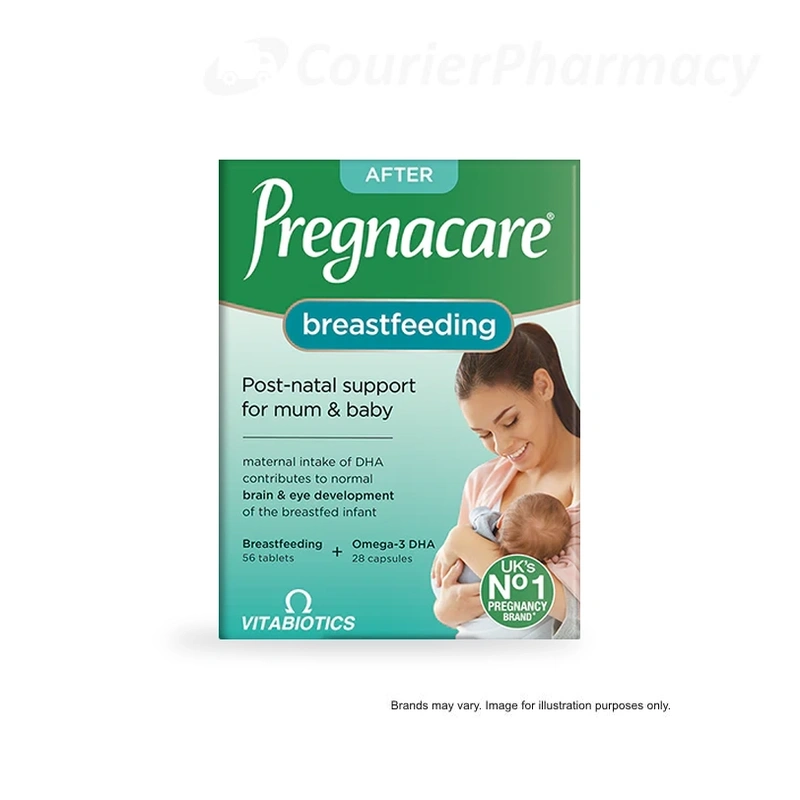
What Pregnacare Breastfeeding capsules/tablets are
Pregnacare Breastfeeding capsules/tablets are a daily two-part postnatal food supplement. The pack holds two blister strips: one with 56 Pregnacare Breast-feeding tablets, one with 28 Omega-3 Marine Oil capsules. You take two tablets and one capsule every day.
Vitabiotics makes the product. They are the UK’s leading pregnancy and postnatal supplement maker. Pregnacare is the UK’s No.1 pregnancy supplement brand.
The 84-pack (56 tablets + 28 capsules) gives you 4 weeks’ supply. The blister packs are marked to help you keep track.
Why the postnatal formula matters
Nutritional needs shift again after birth. Breastfeeding mothers transfer nutrients to their baby through breast milk daily. Non-breastfeeding mothers still need to recover from pregnancy and birth.
Pregnacare Breast-feeding covers these postnatal needs. The key additions over pregnancy versions are calcium (700mg per daily dose) and the continued Omega-3 support.
The calcium story
Calcium is the standout addition in Pregnacare Breast-feeding. The 700mg daily dose matches the UK Reference Nutrient Intake (RNI) for breastfeeding mothers, which is higher than for pregnancy.
Breastfeeding mothers transfer around 200-300mg of calcium into breast milk each day. Without adequate dietary intake, your body draws on your own bone stores to make up the difference. This can reduce bone density over time, particularly if you breastfeed for extended periods or have multiple pregnancies close together.
The 700mg calcium in Pregnacare Breast-feeding provides insurance against this bone loss. It works alongside dietary calcium from dairy, leafy greens, and calcium-fortified foods.
The DHA story continues after birth
If you took Pregnacare Plus during pregnancy for the Omega-3 DHA, Pregnacare Breast-feeding continues that support. The 300mg DHA per capsule matches the international expert recommendation for breastfeeding mothers.
DHA passes from mother to baby through breast milk. Breast-fed babies get their DHA from what mother eats or supplements. Formula-fed babies get DHA from fortified formula (so the DHA claim in Pregnacare Breast-feeding specifically references ‘breast-fed infants’).
The baby’s brain grows rapidly in the first two years of life. DHA is a structural fat in brain and eye tissue, so a steady supply through breast milk supports normal development during this critical window.
Vitamin D throughout breastfeeding
The UK Department of Health recommends 10 micrograms of vitamin D daily for all breastfeeding women. Pregnacare Breast-feeding provides exactly this amount.
Breast milk contains only small amounts of vitamin D, so the NHS also recommends breastfed babies (from birth to age 1) take a daily vitamin D supplement of 8.5 to 10 micrograms. This is separate from mother’s supplement.
Food supplement status
Pregnacare Breast-feeding sits in the food supplement category, not the licensed medicine one. This means it doesn’t carry MHRA approval and can’t make medical claims.
We can only use the approved EU/UK health claims for its nutrients. So we can’t say the product ‘boosts milk supply’ or ‘guarantees’ anything. We can say the nutrients support normal body functions in postnatal and breastfeeding women.
Key features and details
Main features: 20-nutrient postnatal multivitamin tablets + separate Omega-3 capsule (300mg DHA + 60mg EPA)
Standout nutrient: 700mg calcium per daily dose (UK RNI for breastfeeding)
Also provides: 10 micrograms vitamin D (UK DoH recommendation), 400 micrograms folic acid, iron 16mg, iodine 140 micrograms, full B-complex
Vitamin A source: beta-carotene (safe form)
Form: film-coated tablet plus soft gelatin capsule
A daily two-in-one postnatal supplement with 700mg calcium and 300mg DHA to support breastfeeding mums and baby’s brain development
Pregnacare Breast-feeding is a daily food supplement from Vitabiotics, made for new mothers throughout the postnatal period. Each daily serving gives you two things: two Pregnacare Breast-feeding tablets (with 20 vitamins and minerals) plus one Omega-3 capsule (with 300mg DHA and 60mg EPA).
The product is designed as the natural next step after Pregnacare Original or Pregnacare Plus. As pregnancy ends and breastfeeding begins, your nutritional needs shift again. Pregnacare Breast-feeding addresses these postnatal shifts.
The most important difference from the pregnancy versions is calcium. Pregnacare Breast-feeding contains 700mg calcium per daily dose. This matches the UK Reference Nutrient Intake (RNI) for breastfeeding mothers, which is higher than for pregnancy.
Breastfeeding places a heavy demand on the mother’s calcium stores. Every day, your body transfers calcium into breast milk to build your baby’s growing bones. Without adequate calcium intake, your body draws on your own bone reserves, which can affect bone density over time.
The Omega-3 capsule delivers 300mg DHA per day. DHA passes from mother to baby through breast milk, supporting the baby’s brain and eye development. The approved health claim is: maternal intake of DHA contributes to the normal brain and eye development of breast-fed infants.
The tablet component also includes 10 micrograms of vitamin D, matching the UK Department of Health recommendation for all breastfeeding women. Plus iron, iodine, zinc, magnesium, and the full B-complex to support your energy and recovery after birth.
The dose is different from Pregnacare Original or Plus. Take 2 tablets + 1 capsule daily, all with your main meal. The 84-pack (56 tablets + 28 capsules) lasts 4 weeks (28 days).
Pregnacare Breast-feeding suits mothers for the first 6-9 months after birth, though many continue longer if still breastfeeding. Non-breastfeeding mothers can also use it postnatally, as the calcium, iron, and other nutrients support recovery from pregnancy regardless of feeding choice.
An important note: Pregnacare Breast-feeding contains fish (in the Omega-3 capsule). It’s not suitable if you have a fish allergy, and it’s not suitable for vegetarians or vegans. It also contains soya (in the vitamin E).
After the immediate postnatal period, Vitabiotics makes Pregnacare New Mum as the next stage. This is designed for mothers wanting continued vitamin support after breastfeeding, with a focus on energy, hair, and skin.
Pregnacare Breast-feeding is a food supplement, not a licensed medicine. It works alongside a healthy postnatal diet and any medical care from your midwife, health visitor, or GP.
At Courier Pharmacy, we stock Pregnacare Breast-feeding as part of our women’s health range. Our pharmacy team can help you decide if it suits your needs, or whether Pregnacare New Mum, another postnatal option, or a targeted single-nutrient supplement would fit better.
When to see a doctor about postnatal nutrition or breastfeeding
Pregnacare Breast-feeding is a food supplement for daily postnatal support. However, some situations need medical review.
Fish allergy: don’t use Pregnacare Breast-feeding. Ask us about fish-free postnatal multivitamin options
Breastfeeding difficulties (pain, low supply, latch problems, mastitis): see your health visitor, breastfeeding counsellor, or GP
Baby feeding or weight concerns: see your health visitor or GP promptly
Signs of postnatal depression or anxiety: low mood persisting past the first two weeks, tearfulness, difficulty bonding, hopelessness. See your GP or health visitor
Persistent fatigue that doesn’t improve with the supplements and adequate rest
Suspected vitamin D or B12 deficiency (bone pain, muscle weakness, tingling in hands or feet). Blood tests confirm and prescription treatment may be needed
Suspected iron deficiency anaemia (pale, breathless, dizzy, hair loss). Multivitamin iron isn’t enough to treat established deficiency
Unusual heavy bleeding or ongoing pain from birth
You take warfarin: both vitamin K in the tablets AND fish oil in the capsules affect warfarin. Discuss with your GP or anticoagulation clinic first
You take other blood-thinning medicines: fish oil may add to bleeding risk
You have haemochromatosis or another iron-loading condition: the iron content may not be suitable
You have thyroid disease: the iodine content may affect thyroid function
You have kidney disease or kidney stones: the high calcium content needs medical review
You already take calcium or vitamin D supplements: combining products can push intake above safe levels
You already take other multivitamins or fish oil supplements: same combining risk
Soya allergy: the tablet contains soya
Signs of allergic reaction in you or your baby: rash, facial swelling, breathing difficulty. Call 999
Five key takeaways
Pregnacare Breast-feeding is a daily two-in-one postnatal supplement: 2 tablets (20 nutrients including 700mg calcium) plus 1 Omega-3 capsule (300mg DHA + 60mg EPA).
The 700mg calcium is the key addition over pregnancy versions, matching the UK RNI for breastfeeding mothers to help protect maternal bone density.
The DHA in the capsule passes into breast milk, supporting baby’s brain and eye development. Delivers 10 micrograms vitamin D as advised by UK Department of Health.
Dose: 2 tablets + 1 capsule daily with main meal. Different from Original/Plus (which are 1 tablet daily). 84-pack lasts 4 weeks.
Contains fish (Omega-3). NOT suitable for vegetarians, vegans, or fish allergy. Extra warfarin care needed. Food supplement, not a licensed medicine. Available from Courier Pharmacy.
What is Pregnacare Breast-feeding: overview
Where Pregnacare Breast-feeding fits in postnatal care
The postnatal period brings a lot of change. Your body recovers from pregnancy and birth. If you’re breastfeeding, you’re transferring nutrients to your baby daily. Sleep is often disrupted. Meal times can be chaotic.
Good postnatal nutrition rests on the same foundations as any healthy eating: variety, adequate calories, plenty of fluids. A daily multivitamin fills gaps that a chaotic early-parenting schedule can create.
Pregnacare Breast-feeding is specifically designed for this period. It’s the natural next step after your pregnancy multivitamin.
Pregnacare Breast-feeding vs Pregnacare Original or Plus
Pregnacare Original and Plus are for pregnancy. Pregnacare Breast-feeding is for after birth. The main differences are the added calcium (700mg per daily dose) and the different tablet composition.
Don’t continue using Original or Plus after delivery if you’re breastfeeding. Switch to Breast-feeding for the postnatal-specific formula.
Pregnacare Breast-feeding vs Pregnacare New Mum
Pregnacare Breast-feeding is for the immediate postnatal breastfeeding period, with high calcium and Omega-3. Pregnacare New Mum is for continued postnatal support after breastfeeding ends, with a different focus (energy, iron, biotin for hair and skin).
Many mothers use Pregnacare Breast-feeding for 6-12 months (while breastfeeding), then switch to Pregnacare New Mum for continued support. Or move to a general adult multivitamin once you’ve fully recovered.
Pregnacare Breast-feeding vs standalone calcium supplements
Standalone calcium supplements (Calcichew, Adcal, Caltrate, and similar) give higher-dose calcium for specific bone health needs. These are usually 500-1000mg per tablet, sometimes twice daily.
Pregnacare Breast-feeding gives 700mg calcium as part of a broader multivitamin. This works well for general postnatal support. For established osteoporosis or high fracture risk, standalone bone-focused calcium plus vitamin D from your GP is more appropriate.
Pregnacare Breast-feeding vs eating for calcium
Dietary calcium comes from dairy (milk, yogurt, cheese), calcium-fortified plant milks, leafy greens (kale, broccoli, pak choi), tinned fish with bones (sardines, salmon), tofu (calcium-set), and calcium-fortified foods.
Aim for around 1000mg daily during breastfeeding from all sources. Pregnacare Breast-feeding contributes 700mg, dietary calcium makes up the rest. If your diet is very dairy-rich, you may not need the full Pregnacare dose. If dairy-free, the supplement becomes more important.
Pregnacare Breast-feeding vs standalone DHA products
Standalone DHA supplements for breastfeeding are available. These give DHA without the multivitamin.
Choose Pregnacare Breast-feeding for a combined multivitamin plus DHA in one convenient pack. Choose standalone DHA if you’re already taking a separate multivitamin you’re happy with.
Pregnacare Breast-feeding vs standard adult multivitamins
Standard adult multivitamins may contain retinol (the form of vitamin A that’s less safe during breastfeeding). Standard multivitamins also don’t have the higher calcium and vitamin D matched to breastfeeding needs.
Postnatal-specific formulas like Pregnacare Breast-feeding are a better fit for the breastfeeding period.
Where to spend your money
Own-brand postnatal or breastfeeding multivitamins may cost less than Pregnacare. Check labels for calcium content (aim for 700mg or more), vitamin D (10 micrograms), and DHA if the Omega-3 element matters to you. Pregnacare’s advantage is the extensive research background and brand consistency.
Why choose Courier Pharmacy for your Pregnacare Breast-feeding
Registered, independent, and patient-led
Courier Pharmacy is a UK-registered independent pharmacy regulated by the General Pharmaceutical Council. The postnatal period is a full-on time, and getting the right nutritional support matters.
Our team can help you decide if Pregnacare Breast-feeding is the right choice for your situation, or whether Pregnacare New Mum, a standalone supplement, or a completely different approach would fit better.
Dr Ada Jex-Cori, our brand pharmacist
Our brand pharmacist is Dr Ada Jex-Cori. She represents the spirit of what we do. Named for Ada Lovelace, Sophia Jex-Blake, and Gerty Cori, she stands for evidence-led, unafraid-of-questions medicine. Her message is straightforward. You’re not broken. The system is. We’re here to change that.
Care that keeps showing up
We’re here for the questions that come up throughout the postnatal period: switching to Pregnacare New Mum later on, dealing with breastfeeding difficulties, checking interactions with any prescribed medicines. If you’d rather speak to your midwife or health visitor for breastfeeding-specific issues, we can point you to the right people.
Pregnacare Breast-feeding 84 Pack is a food supplement available at courierpharmacy.co.uk.
Add Pregnacare Breast-feeding 84 Pack to your basket
Our pharmacy team reviews the sale as part of our routine check
Your order dispatches promptly
Follow the pack directions. Contact us if you have questions
If Pregnacare Breast-feeding isn’t right for your situation, we’ll explain why. Options include Pregnacare New Mum (postnatal support after breastfeeding, or as an alternative to Breast-feeding), standalone calcium plus vitamin D (Adcal-D3 or Calcichew D3) for targeted bone support, standalone Omega-3 or DHA if you already take a separate multivitamin, standalone folic acid, iron, or B vitamins for specific deficiencies, own-brand postnatal multivitamins, NHS Healthy Start vitamins if you qualify, or a discussion with your GP about tailored postnatal supplementation for specific health conditions.
Above all, we won’t sell you a product that isn’t right for your postnatal needs.
Summary
A daily two-in-one postnatal food supplement: multivitamin tablets (with 700mg calcium plus 19 other nutrients) + separate Omega-3 capsule.
Standout addition over pregnancy versions: 700mg calcium (matching UK RNI for breastfeeding mothers) to help protect maternal bone density.
Continues DHA support (300mg per capsule) which passes into breast milk to support baby’s brain and eye development.
For breastfeeding mothers and postnatal recovery (breastfeeding or not) up to 6-9 months or throughout breastfeeding.
Food supplement, not a licensed medicine. Not for vegetarians, vegans, or those with fish allergy.
Main nutrients in Pregnacare Breast-feeding
Calcium 700mg (in the tablets)
The standout nutrient in Pregnacare Breast-feeding. The 700mg dose per daily intake matches the UK Reference Nutrient Intake for breastfeeding mothers.
Approved health claims: calcium is needed for the maintenance of normal bones and teeth, normal muscle function, and normal blood clotting.
Vitamin D 10 micrograms (in the tablets)
Vitamin D works alongside calcium for bone health. It also supports normal immune function for both mother and (via breast milk) baby. The 10 microgram dose matches UK Department of Health guidance for breastfeeding.
Omega-3 DHA 300mg (in the capsule)
DHA passes from mother to baby through breast milk. It supports the baby's brain and eye development in the first months and years of life, when brain growth is fastest.
Approved health claim: maternal intake of DHA contributes to the normal brain and eye development of breast-fed infants. This claim requires at least 200mg DHA daily on top of the adult recommendation. Pregnacare Breast-feeding provides 300mg.
Omega-3 EPA 60mg (in the capsule)
EPA supports normal heart function and has anti-inflammatory effects. It works alongside DHA in the overall omega-3 support.
Vitamin K 70 micrograms (in the tablets)
Vitamin K works with calcium in normal blood clotting. It also contributes to the maintenance of normal bones.
Iron 16mg (in the tablets)
Iron supports normal red blood cell formation, particularly important after any blood loss during birth. The 16mg dose provides postnatal-appropriate levels.
Iodine 140 micrograms (in the tablets)
Iodine passes into breast milk and supports the baby's thyroid function. Iodine deficiency in breastfeeding mothers can affect the baby's development.
B vitamins for energy
Vitamins B1 (5mg), B2 (2mg), B3 (20mg), B6 (10mg), B12 (6?g), biotin (150?g), and pantothenic acid (6mg) all contribute to normal energy-yielding metabolism and reduction of tiredness.
Folic acid 400 micrograms (in the tablets)
Folic acid continues to support normal blood formation and amino acid synthesis after pregnancy. Useful if you're planning further pregnancies too.
Other nutrients (in the tablets)
Vitamin C (70mg), vitamin E (20mg), magnesium (150mg), zinc (15mg), copper (1000?g), selenium (30?g), and beta-carotene (2mg) round out the 20-nutrient tablet formula.
Other ingredients in Pregnacare Breast-feeding
Contains fish (Omega-3 capsule)
The Omega-3 capsule contains purified fish oil. Don't use Pregnacare Breast-feeding if you have a fish allergy. Ask us about fish-free postnatal alternatives.
Contains soya (tablets)
The vitamin E in the tablets comes from soya. If you have a soya allergy, don't use Pregnacare Breast-feeding.
Halal-certified
The gelatin in the Omega-3 capsule shell is from bovine (beef) source and is Halal-certified. All Pregnacare products are suitable for a Halal diet.
NOT suitable for vegetarians or vegans
The fish oil in the Omega-3 capsule makes Pregnacare Breast-feeding unsuitable for vegetarians and vegans. Ask us about vegetarian-friendly postnatal alternatives.
What Pregnacare Breast-feeding doesn't contain
Gluten-free, lactose-free, yeast-free. No preservatives. No artificial colours. Not tested on animals.
Tablet excipients
Standard multivitamin excipients including calcium carbonate, magnesium oxide, microcrystalline cellulose, and film coating materials. Check the current pack label for the full ingredient list.
Capsule shell
Pharmaceutical-grade gelatin (Halal bovine source), glycerin, and natural lemon oil flavour (to reduce fish taste).
What is Pregnacare Breast-feeding for?
Supporting the mother's bone health during breastfeeding
Breastfeeding transfers calcium into breast milk daily. The 700mg calcium in Pregnacare Breast-feeding helps meet the increased calcium demand and protects the mother's bone density.
Supporting the baby's brain and eye development via breast milk
The 300mg DHA passes through breast milk to the baby. This supports the baby's brain and eye development in the first months and years, when brain growth is fastest.
Supporting maternal energy and recovery
B vitamins, iron, magnesium, and other nutrients support energy metabolism and recovery from pregnancy and birth. New parenthood is exhausting, and adequate nutrient intake helps.
Supporting maternal immune function
Vitamin C, vitamin D, zinc, and selenium all contribute to normal immune function. Postnatal mothers benefit from maintained immune support during a physically and emotionally demanding time.
Supporting the mother's iodine status
Iodine passes into breast milk. Adequate maternal iodine intake supports both mother's thyroid function and baby's development.
Filling common postnatal nutritional gaps
New parenthood often means chaotic eating patterns. Meals get skipped or become simplified. Pregnacare Breast-feeding fills the gaps that a chaotic early-parenting schedule can create.
Also suitable for non-breastfeeding postnatal mothers
Even without the breastfeeding-specific DHA benefit for baby, non-breastfeeding mothers benefit from the calcium, iron, and other nutrients for postnatal recovery. The DHA still has benefits for mother's brain and heart health.
What Pregnacare Breast-feeding isn't for
Not for people with fish allergy. Ask about fish-free alternatives.
Not for vegetarians or vegans. Ask about plant-based alternatives.
Not for pregnancy. Use Pregnacare Original or Plus during pregnancy instead.
Not for children or adult men. This is designed for postnatal mothers.
Not for treating established deficiencies. Significant deficiencies of calcium, vitamin D, B12, or iron need prescription-strength treatment.
Not for boosting milk supply. Milk supply depends on effective breastfeeding, hydration, and rest, not on multivitamins.
Not a substitute for postnatal care, a healthy diet, or medical advice. Attend all postnatal appointments as advised by your health visitor or GP.
Not to combine with other multivitamins, cod liver oil, standalone calcium, standalone vitamin D, or standalone fish oil supplements.
How does Pregnacare Breast-feeding work?
Nutrient replacement and gap-filling for mother
Pregnacare Breast-feeding delivers postnatal-appropriate levels of essential vitamins, minerals, and Omega-3 fatty acids daily. Each nutrient supports specific body functions in the postnatal period.
How the calcium works
Calcium from Pregnacare Breast-feeding absorbs in your small intestine (helped by vitamin D). Some enters your general calcium pool, replacing what's transferred into breast milk daily. Some contributes to maintaining your bone density during the demands of breastfeeding.
How the DHA reaches the baby
DHA from the Omega-3 capsule absorbs through your gut into your bloodstream. Some circulates for your own use (brain, heart, eyes). Some is transferred into breast milk for your baby. This gives your baby a steady DHA supply for their developing brain and eyes.
Why timing matters
The first 6-12 months post-birth are when the baby's brain grows fastest. Consistent daily maternal DHA intake during this time gives the baby the most benefit through breast milk.
Steady-state nutrient levels
Daily consistent dosing builds and maintains steady nutrient levels in the mother. This gives more predictable transfer into breast milk than sporadic higher doses.
Treatment dosage for Pregnacare Breast-feeding
At a glance
For: breastfeeding mothers and postnatal mothers (up to 6-9 months post-birth)
Duration: throughout breastfeeding, or first 6-9 months post-birth for non-breastfeeding
Next stage: switch to Pregnacare New Mum after breastfeeding ends, or for continued postnatal support
Do not exceed the recommended daily dose
Do not use as a substitute for a varied diet and healthy lifestyle
Standard adult dose
Take two Pregnacare Breast-feeding tablets and one Omega-3 capsule together, once daily, with your main meal. Swallow whole with water or a cold drink. Do not chew any of the tablets or the capsule.
Any main meal works (breakfast, lunch, or dinner). Choose a time that fits your routine. Taking with food helps absorption of the fat-soluble vitamins (A, D, E, K) and fish oil, and reduces the chance of stomach upset.
The 2-tablet dose is different from Original or Plus
If you're switching from Pregnacare Original or Plus (which are 1 tablet daily), the Breast-feeding version is 2 tablets daily. This is important to note. Each tablet holds a lower amount of some nutrients, so 2 tablets gives you the full daily dose.
Don't take 4 tablets thinking you'll get more benefit. Higher doses push some nutrients above safe levels.
Take all three together or split them
You can take the two tablets and one capsule all together at one meal, or split them. Some mothers find taking all three at breakfast simplest. Others prefer splitting them across two meals to reduce any stomach discomfort.
When to start
Switch from your pregnancy supplement (Pregnacare Original, Plus, Max, or similar) to Pregnacare Breast-feeding after delivery. Some mothers switch straight away, others finish their pregnancy pack first. Either approach works.
How long to take Pregnacare Breast-feeding
Take throughout breastfeeding, or for the first 6-9 months post-birth if not breastfeeding. Some mothers continue longer, particularly if breastfeeding continues beyond a year.
For continued vitamin support after breastfeeding ends, Vitabiotics makes Pregnacare New Mum as the next stage product.
For non-breastfeeding mothers
Pregnacare Breast-feeding also suits non-breastfeeding mothers in the postnatal period. The calcium, iron, and other nutrients support recovery from pregnancy regardless of feeding choice.
Non-breastfeeding mothers may not need the DHA capsule as strictly (since it primarily benefits the baby through breast milk). However, the DHA also has benefits for mother's brain and heart health, so continuing the full dose is reasonable.
Missed doses
If you miss a day, take your usual dose as soon as you remember. If you don't remember until the next day, just carry on with your normal dose. Don't take extras to catch up.
Next stage: Pregnacare New Mum
After breastfeeding ends (or after the first 6-9 months if not breastfeeding), consider switching to Pregnacare New Mum. It has different nutrient levels focused on continued postnatal recovery, energy, and skin/hair health rather than calcium and DHA.
How to take Pregnacare Breast-feeding
Standard use
Take 2 Pregnacare Breast-feeding tablets and 1 Omega-3 capsule daily with your main meal. Swallow all whole with water or a cold drink.
Swallow whole
Swallow both tablets and the capsule whole. Don't chew or crush any of them. The capsule contains fish oil, which will leak if the capsule is broken and can leave an unpleasant fishy taste.
If you have trouble swallowing tablets, ask us about other Pregnacare formats or spacing the tablets across the day.
Take with your main meal
Food helps absorption of fat-soluble vitamins (A, D, E, K), calcium, and fish oil. Taking on an empty stomach reduces absorption and may cause stomach upset.
Calcium absorbs best in doses of 500mg or less at a time, so if you're keen to maximise absorption, split the two tablets across two meals (one tablet each) rather than taking both together. Take the Omega-3 capsule with either meal.
Not with tea or coffee
Avoid taking Pregnacare with tea or coffee. Tannins in tea and compounds in coffee can reduce iron absorption. Leave at least an hour between your dose and these drinks.
Fish burps and how to reduce them
Some people notice a fishy aftertaste or 'fish burps' after taking fish oil capsules. Taking the capsule mid-meal (rather than before or after) usually helps. Storing the capsules in the fridge may also help. Freezing them is fine too.
Consistency matters
Try to take Pregnacare at the same time each day. New parenthood is a whirlwind, so linking your supplement to a fixed daily event (like your baby's morning feed or bath time) can help you remember.
Don't take more than the daily dose
The 2-tablet-plus-1-capsule daily dose is designed to give safe postnatal levels of each nutrient. Taking more can push calcium, vitamin A, iron, or Omega-3 above safe levels.
Don't combine with other calcium, vitamin D, or fish oil supplements
Avoid taking Pregnacare Breast-feeding alongside separate calcium supplements, vitamin D supplements, cod liver oil, or standalone fish oil. Combined intake can push some nutrients above safe levels.
Cod liver oil in particular contains retinol (vitamin A in a form that's less safe at high doses during breastfeeding) and adds to the Omega-3 intake. Avoid it while using Pregnacare Breast-feeding.
Space away from certain medicines
Leave at least 4 hours between Pregnacare Breast-feeding and levothyroxine. Calcium and iron both reduce levothyroxine absorption. Also space by 2 hours from quinolone antibiotics (ciprofloxacin, ofloxacin), tetracycline antibiotics, or bisphosphonates.
Storage
Store the pack in a cool dry place, out of direct sunlight. Keep the container sealed. Keep well out of reach of children.
How quickly you'll notice a difference
Most mothers don't notice a direct 'feeling different' from Pregnacare Breast-feeding. The benefits build over weeks and months, supporting both your recovery and your baby's development through breast milk.
Warnings and precautions for Pregnacare Breast-feeding
Fish allergy
Above all, don't use Pregnacare Breast-feeding if you have a fish allergy. The Omega-3 capsule contains purified fish oil. Reactions can range from mild rash to severe anaphylaxis.
Warfarin and blood thinners
Both the vitamin K in the tablets AND the fish oil in the capsule can affect blood clotting. If you take warfarin, other anticoagulants (apixaban, rivaroxaban, edoxaban, dabigatran), or antiplatelets (clopidogrel, aspirin), discuss with your GP or anticoagulation clinic before starting.
Before surgery
Fish oil may need stopping 1-2 weeks before scheduled surgery due to mild anticoagulant effects. Tell your surgical team about all supplements you take.
Don't combine with cod liver oil or vitamin A supplements
Don't take Pregnacare Breast-feeding alongside cod liver oil, standalone vitamin A supplements, or other multivitamins. Cod liver oil contains retinol, which is less safe at high doses during breastfeeding.
Don't combine with separate calcium or vitamin D supplements
Pregnacare Breast-feeding already provides 700mg calcium and 10 micrograms vitamin D. Adding separate calcium (Adcal-D3, Calcichew, Caltrate) or vitamin D supplements pushes intake above recommended levels.
Don't combine with other multivitamins or fish oil products
Combining products can push some nutrients above safe levels.
Not for pregnancy
Pregnacare Breast-feeding is for the postnatal period. Use Pregnacare Original, Plus, or Max during pregnancy instead. The nutrient levels differ between pregnancy and breastfeeding versions.
Not for children
Not suitable for children. Keep the pack sealed and well out of reach of children. The iron content in adult multivitamins can be harmful to children if taken by mistake.
Iron-loading conditions
The iron content isn't suitable if you have haemochromatosis or other iron-loading conditions. Ask about iron-free postnatal alternatives.
Thyroid conditions
The iodine content can affect thyroid function. If you have thyroid disease, discuss with your GP before starting. Untreated thyroid problems can also affect breast milk supply, so this is worth addressing anyway.
Kidney disease or kidney stones
The high calcium content needs medical review if you have severe kidney disease, kidney stones (particularly calcium-containing stones), or hypercalcaemia.
Soya allergy
The tablet contains soya (in the vitamin E). Don't use if you have a soya allergy.
Interactions with certain medicines
Discuss with your GP before starting if you take:
Warfarin (both vitamin K and fish oil affect anticoagulation)
Other anticoagulants or antiplatelets (fish oil may add to bleeding risk)
Levothyroxine (calcium and iron both reduce absorption, space by 4 hours)
Quinolone antibiotics like ciprofloxacin (calcium and iron reduce absorption)
Tetracycline antibiotics (calcium and iron reduce absorption)
Bisphosphonates like alendronic acid (calcium reduces absorption)
Digoxin (high calcium affects digoxin safety)
Thiazide diuretics like bendroflumethiazide (raise calcium levels)
Any prescribed medicines for long-term conditions
Signs of allergic reaction in you or your baby
Rare allergic reactions to fish oil or other ingredients are possible. Symptoms in you: rash, itching, facial swelling, or breathing difficulty. Symptoms in your baby: unusual rash, colic symptoms, breathing issues. If severe, call 999.
Overdose
Don't take more than 2 tablets plus 1 capsule daily. Accidental overdose can push calcium, vitamin A, iron, and Omega-3 above safe levels. Seek medical advice immediately if a child accidentally takes multiple doses.
Driving and machinery
No expected effects on driving or using machinery.
Alcohol
Alcohol during breastfeeding should be limited (up to 14 units per week, spread across the week, ideally after breastfeeding rather than before). There's no direct interaction with Pregnacare Breast-feeding, but general breastfeeding alcohol guidance applies.
Side effects of Pregnacare Breast-feeding
Common side effects
Pregnacare Breast-feeding is generally well tolerated. Mild stomach upset, nausea, constipation, or fishy aftertaste can happen. Taking with food usually helps.
Fishy aftertaste or fish burps
The Omega-3 capsule can cause a fishy aftertaste. Taking the capsule mid-meal or storing in the fridge helps.
Dark stools
The iron content in the tablets can cause dark or black stools. This is normal and doesn't indicate bleeding.
Constipation
Iron can cause constipation. Postnatal hormones and reduced activity can also worsen constipation. Adequate fibre, fluids, and gentle exercise (as soon as safe) help.
Bloating or heartburn
Calcium and iron together can cause bloating or heartburn in some people. Splitting the two tablets across two meals may help.
Loose stools
High doses of fish oil or magnesium can occasionally cause loose stools. The doses in Pregnacare Breast-feeding are modest and unlikely to cause this in most people.
Allergic reactions (rare)
Rare allergic reactions to fish oil, soya, or other ingredients are possible. Symptoms include rash, itching, facial swelling, or breathing difficulty.
Baby symptoms
Very rarely, a breastfed baby may react to something transferred through breast milk. Watch for unusual rash, colic, or feeding difficulties in your baby. If concerned, contact your health visitor or GP.
Serious side effects requiring urgent help
Above all, seek urgent medical help for signs of severe allergic reaction (facial or throat swelling, breathing difficulty, widespread rash). Call 999.
Drug interactions with Pregnacare Breast-feeding
Warfarin (particular care needed)
Both the vitamin K in the tablets AND the fish oil in the capsule can affect warfarin. The combined impact needs review by your GP or anticoagulation clinic before you start.
Other anticoagulants
Apixaban, rivaroxaban, edoxaban, dabigatran, and heparin may have increased bleeding risk when combined with fish oil. Discuss with your GP.
Antiplatelets
Clopidogrel, aspirin, and other antiplatelets may add to fish oil's mild anticoagulant effect.
Levothyroxine
Both calcium and iron in the tablets reduce levothyroxine absorption. Take levothyroxine first thing in the morning on an empty stomach, and Pregnacare Breast-feeding at least 4 hours later.
Quinolone antibiotics
Ciprofloxacin, ofloxacin, and other quinolones bind with calcium and iron. Leave at least 2 hours between doses.
Tetracycline antibiotics
Doxycycline and other tetracyclines also bind with calcium and iron. Space by 2 hours.
Bisphosphonates
Alendronic acid, risedronate, and other bisphosphonates need an empty stomach with just water. Calcium and iron in Pregnacare Breast-feeding reduce their absorption. Space by at least 2 hours.
Digoxin
High calcium levels can affect digoxin safety. If you take digoxin, discuss with your GP first.
Thiazide diuretics
Bendroflumethiazide reduces calcium excretion. Combined with the 700mg calcium in Pregnacare Breast-feeding, this can raise blood calcium too high.
Other multivitamins, calcium, vitamin D, or fish oil
Don't combine Pregnacare Breast-feeding with other multivitamins, cod liver oil, separate calcium supplements, separate vitamin D supplements, or standalone fish oil.
Alcohol
No direct interaction. Follow standard breastfeeding alcohol guidance (up to 14 units per week, ideally after feeding).
Frequently asked questions about Pregnacare Breast-feeding
What is Pregnacare Breast-feeding?
A daily two-in-one postnatal food supplement: 2 Pregnacare Breast-feeding tablets (20 nutrients including 700mg calcium) plus 1 Omega-3 capsule (300mg DHA + 60mg EPA). For breastfeeding mothers and postnatal recovery.
How is Pregnacare Breast-feeding different from Pregnacare Original or Plus?
The main differences are the added calcium (700mg per daily dose) and the different dosing (2 tablets + 1 capsule daily, versus 1 tablet daily for Original or 1 tablet + 1 capsule for Plus). The tablet formula is also adjusted for postnatal rather than pregnancy needs.
Why is calcium so important during breastfeeding?
Breastfeeding transfers 200-300mg of calcium into breast milk daily to build your baby's bones. Without adequate dietary calcium, your body draws on your own bone stores, which can reduce bone density over time.
How much should I take?
Two Pregnacare Breast-feeding tablets and one Omega-3 capsule daily, with your main meal. This is different from Pregnacare Original or Plus.
Can I take Pregnacare Breast-feeding during pregnancy?
No. Use Pregnacare Original, Plus, or Max during pregnancy. Switch to Breast-feeding after delivery.
When should I start taking Pregnacare Breast-feeding?
Start after delivery. Some mothers switch straight away, others finish their pregnancy pack first. Either works.
How long should I take it for?
Throughout breastfeeding, or the first 6-9 months post-birth for non-breastfeeding recovery. Some mothers continue longer, particularly if breastfeeding continues beyond a year.
What should I take after Pregnacare Breast-feeding?
Pregnacare New Mum is designed as the next stage, focused on continued postnatal recovery, energy, and skin/hair support. Or switch to a general adult multivitamin once you've fully recovered.
Can I take Pregnacare Breast-feeding if I'm not breastfeeding?
Yes. The calcium, iron, and other nutrients support postnatal recovery regardless of feeding choice. The DHA still benefits your own health even if not passed to a breastfed baby.
Does Pregnacare Breast-feeding boost milk supply?
No. Milk supply depends on effective breastfeeding, hydration, and rest, not on multivitamins. If you have supply concerns, see your health visitor or a breastfeeding counsellor.
Is Pregnacare Breast-feeding safe for my baby?
Yes. The nutrients transferred through breast milk (like DHA) are beneficial for your baby. Very rarely, a baby may react to something in breast milk, so watch for unusual symptoms.
Should I take with food?
Yes. Food helps absorption of fat-soluble vitamins, calcium, and fish oil, and reduces stomach upset.
How long does the 84-pack last?
Four weeks (28 days) at 2 tablets + 1 capsule per day.
Is Pregnacare Breast-feeding suitable for vegetarians?
No. The Omega-3 capsule contains fish oil. Vegetarians should ask about vegetarian postnatal multivitamin options.
Is Pregnacare Breast-feeding suitable for vegans?
No. Vegans need a different postnatal supplement.
Is Pregnacare Breast-feeding Halal?
Yes. The gelatin in the Omega-3 capsule is from Halal-certified bovine source.
Is Pregnacare Breast-feeding gluten-free?
Yes. Gluten-free, lactose-free, yeast-free, no preservatives, no artificial colours.
What if I have a fish allergy?
Don't use Pregnacare Breast-feeding. Ask us about fish-free postnatal alternatives.
Can I take Pregnacare Breast-feeding with a calcium supplement?
No. It already provides 700mg calcium. Adding more can push intake too high.
Should I still give my baby vitamin D drops if I take Pregnacare Breast-feeding?
Yes. The NHS recommends all breastfed babies (from birth to age 1) take 8.5 to 10 micrograms of vitamin D daily as drops. This is separate from your supplement. Your Pregnacare Breast-feeding covers your own vitamin D needs but doesn't fully supply your baby's.
What if I take warfarin?
Discuss with your GP or anticoagulation clinic first. Both the vitamin K in the tablets and the fish oil in the capsule affect warfarin.
What if I'm on thyroid medication?
Yes, but timing matters. Take levothyroxine first thing in the morning on an empty stomach, and Pregnacare Breast-feeding at least 4 hours later.
What if I miss a day?
Take your usual dose as soon as you remember. If you don't remember until the next day, just carry on. Don't double up.
Do I need a prescription?
No. It's a food supplement, available without prescription.
Disclaimer
Disclaimer: This information is for education only and isn't a substitute for personal medical advice. Pregnacare Breast-feeding is a food supplement, not a licensed medicine. It's not intended to diagnose, treat, cure, or prevent any postnatal condition. Always follow the pack directions. For breastfeeding difficulties, see your health visitor, GP, or a breastfeeding counsellor. For any concerns about your baby, contact your health visitor or GP promptly. Attend all postnatal appointments as advised by your care team.