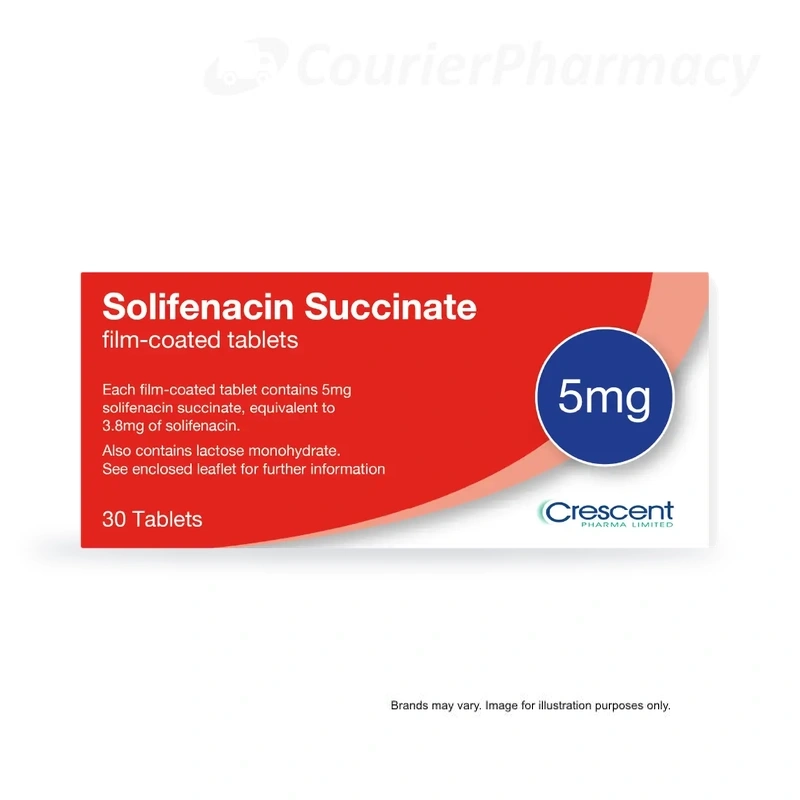
Solifenacin 5mg tablets are film-coated oral tablets. Each tablet contains 5mg of solifenacin succinate (equivalent to 3.8mg of solifenacin base).
Firstly, solifenacin succinate is the active salt form. It is well-absorbed after oral administration.
Also, various generic manufacturers make solifenacin 5mg tablets in the UK. Vesicare is the original brand, made by Astellas Pharma.
However, generic solifenacin has the same active ingredient at the same dose. It works in the same way.
The role of 5mg as the starting dose
The standard adult starting dose is 5mg once daily. Firstly, most patients begin here regardless of severity.
Also, efficacy is usually seen within the first week of treatment. Full effect stabilises over 12 weeks.
However, if 5mg provides adequate control of urgency, frequency, and incontinence, patients stay on 5mg long-term.
Furthermore, if 5mg is not enough after 4-8 weeks, the prescriber may increase to 10mg once daily.
Who must stay on 5mg (not increase to 10mg)
Some patients must not have their dose increased beyond 5mg. Firstly, this includes patients with severe kidney impairment (creatinine clearance ?30 mL/min).
Also, patients with moderate hepatic impairment (Child-Pugh score 7-9) should stay on 5mg only.
Furthermore, patients taking potent CYP3A4 inhibitors (like ketoconazole) may need to stay on 5mg or lower.
However, severe hepatic impairment is a contraindication for solifenacin altogether.
A once-daily prescription-only medicine
Solifenacin 5mg is a prescription-only medicine (POM). It cannot be sold over the counter.
Firstly, a UK-registered prescriber (GP, specialist, or independent pharmacist prescriber) must issue a prescription.
Also, at Courier Pharmacy, our independent prescriber can review your case, assess suitability, and issue a prescription online.
However, this is only appropriate for patients with an established overactive bladder diagnosis, or who fit clear clinical criteria for a first-time trial.
Key features and specifications
Active ingredient: solifenacin succinate 5mg per tablet (equivalent to 3.8mg solifenacin base)
Form: film-coated oral tablets, usually light yellow, round, biconvex
Pack: usually 30 tablets (one month’s supply at once-daily dosing)
Marketing Authorisation Holders: various (Astellas for brand Vesicare; multiple generic manufacturers)
A selective M3 antimuscarinic for overactive bladder, the starting dose
Solifenacin 5mg is a prescription-only medicine (POM) for overactive bladder syndrome. It is used to reduce urinary urgency, frequency, and urge incontinence.
Firstly, solifenacin is a selective muscarinic M3 receptor antagonist. It blocks the receptors that cause the bladder muscle (detrusor) to contract.
Also, this reduces unwanted bladder contractions, allowing better bladder control and fewer urgency episodes.
However, the 5mg strength is the standard adult starting dose. Most patients begin here and stay on 5mg if it controls symptoms well.
Furthermore, if 5mg does not provide enough relief after several weeks, the prescriber may increase the dose to 10mg once daily.
Also, some patients must stay on 5mg only. This includes those with severe kidney impairment (creatinine clearance ?30 mL/min) or moderate hepatic impairment.
Solifenacin’s brand name is Vesicare. Generic solifenacin succinate tablets contain the same active ingredient at the same dose.
Above all, solifenacin has typical antimuscarinic side effects. These include dry mouth, constipation, and blurred vision. Some patients notice these more than others.
Also, solifenacin is generally better tolerated than older antimuscarinics like oxybutynin. This is because of its M3 selectivity and reduced brain penetration.
At Courier Pharmacy, we can supply solifenacin 5mg through our online prescriber service. This allows convenient repeat supply and dose reviews.
When to seek medical advice while on solifenacin
Solifenacin is generally well tolerated when prescribed appropriately. However, some symptoms need urgent medical attention.
Sudden swelling of the face, lips, tongue, or throat, or difficulty breathing. Call 999 (possible angioedema)
Widespread rash, blistering, or peeling skin. Stop the tablets and seek urgent help
Sudden inability to pass urine, or a significantly reduced urine output. Contact your GP or A&E (possible urinary retention)
Severe abdominal pain, no bowel movement for several days, or vomiting (possible severe constipation or bowel obstruction)
Palpitations, feeling your heart racing, or fainting (possible QT prolongation, rare)
Sudden confusion, hallucinations, or unusual drowsiness, particularly in older adults
Signs of dehydration in hot weather (dry mouth reduces the usual thirst signal)
Symptoms of overactive bladder that don’t improve after several weeks of treatment, or worsen
If you are pregnant, breastfeeding, or planning pregnancy, discuss with your GP or prescriber before continuing
Five key takeaways
Solifenacin 5mg is a selective M3 muscarinic receptor antagonist for overactive bladder syndrome. It reduces urinary urgency, frequency, and urge incontinence.
Dose: 5mg once daily, swallowed whole with water. Can be taken with or without food. Prescriber may increase to 10mg once daily if 5mg is insufficient.
Contraindicated in urinary retention, severe gastrointestinal conditions (including toxic megacolon), myasthenia gravis, narrow-angle glaucoma, severe liver disease, and patients on haemodialysis.
Common side effects: dry mouth (very common), constipation, blurred vision, nausea, dyspepsia. Less common: confusion, urinary retention, palpitations.
Prescription-only medicine (POM). Available from Courier Pharmacy through our online prescriber service.
What are Solifenacin 5mg Tablets: overview
Where solifenacin fits in overactive bladder treatment
Overactive bladder (OAB) is a common condition affecting around 11-16% of adults. It includes urinary urgency, frequency, and (sometimes) urge incontinence.
Firstly, first-line treatment is behavioural: bladder training, fluid management, reducing caffeine and alcohol, weight loss if relevant.
Also, medication is considered when behavioural measures alone are not enough. Options include antimuscarinics (like solifenacin) and beta-3 agonists (like mirabegron).
However, solifenacin is one of the newer, more M3-selective antimuscarinics. It generally has a better side-effect profile than older options like oxybutynin.
Solifenacin vs oxybutynin
Oxybutynin is an older antimuscarinic. It is effective but has a less favourable side-effect profile.
Firstly, oxybutynin is less M3-selective. This means more side effects at other muscarinic receptors (dry mouth, constipation, cognitive effects).
Also, oxybutynin crosses the blood-brain barrier more readily. This raises the risk of confusion, especially in older adults.
However, oxybutynin has the longest track record and is less expensive. Some patients still do well on it.
Furthermore, solifenacin’s once-daily dosing and better tolerability make it a common first-line antimuscarinic choice.
Solifenacin vs tolterodine
Tolterodine is another antimuscarinic in the same treatment class as solifenacin. Both are commonly prescribed.
Firstly, tolterodine has similar M3 selectivity to solifenacin. Efficacy is broadly similar in clinical trials.
Also, side-effect profiles overlap. Individual response varies, so switching between them can help some patients.
However, tolterodine is available as immediate-release (twice daily) and extended-release (once daily) formulations. Solifenacin is always once daily.
Solifenacin vs mirabegron
Mirabegron is a beta-3 adrenergic agonist. It works through a different mechanism than antimuscarinics.
Firstly, mirabegron relaxes the bladder muscle by activating beta-3 receptors, rather than blocking muscarinic receptors.
Also, mirabegron has fewer typical antimuscarinic side effects (less dry mouth and constipation). However, it can raise blood pressure.
However, solifenacin and mirabegron can sometimes be combined for patients who don’t respond to either alone.
Long-term treatment
Overactive bladder is usually a chronic condition. Firstly, most patients need long-term treatment.
Also, solifenacin has been shown to maintain efficacy for at least 12 months in long-term studies.
However, periodic review with your prescriber is important. This checks that the medicine is still needed, still effective, and still tolerated.
Furthermore, the prescriber may recommend trying to stop the medicine periodically. This checks whether the condition has changed.
Prescriber support at Courier Pharmacy
Because solifenacin is prescription-only, buying at Courier Pharmacy involves prescriber assessment. Firstly, this ensures the medicine is suitable and safe for you.
Also, our independent prescriber can review your case, discuss options, and issue a prescription online.
However, we may need to see recent test results (kidney function, liver function), or refer back to your GP for shared care arrangements.
Why choose Courier Pharmacy for your Solifenacin 5mg Tablets
Registered, independent, and patient-led
Courier Pharmacy is a UK-registered independent pharmacy with independent prescribers. The General Pharmaceutical Council regulates us.
Firstly, prescription-only medicines require prescriber involvement. Our online service makes this convenient.
Also, we treat every prescription request as a chance to review your care fully. This is not a simple retail transaction.
As a result, buying solifenacin from us comes with the reassurance of UK-qualified prescriber oversight.
Dr Ada Jex-Cori, our brand pharmacist
Our brand pharmacist is Dr Ada Jex-Cori. She represents the spirit of what we do. Named for Ada Lovelace, Sophia Jex-Blake, and Gerty Cori, she stands for evidence-led, unafraid-of-questions medicine. Her message is straightforward. You’re not broken. The system is. We’re here to change that.
Care that keeps showing up
Prescription medicines need ongoing review, not one-off dispensing. Firstly, we are here to answer follow-up questions if the medicine is not working as expected.
Also, if you notice side effects or your circumstances change, contact us. We can review your prescription, adjust the dose, or discuss alternatives.
However, we will not dispense repeated prescriptions to someone whose condition has not been reviewed. Overactive bladder benefits from periodic reassessment.
Buy Solifenacin 5mg Tablets from Courier Pharmacy
Solifenacin 5mg is a prescription-only medicine. You can request supply through courierpharmacy.co.uk with our online prescriber service.
Complete our online consultation for overactive bladder or add solifenacin to your basket if you have an existing diagnosis
Our independent prescriber reviews your case and may issue a prescription if suitable
Your prescription is dispensed and dispatched promptly
Follow the pack directions carefully. Contact us for follow-up questions or dose reviews
If solifenacin is not right for your situation, we will explain why. Options include a different antimuscarinic, mirabegron, or referral back to your GP for further assessment.
Above all, we will not issue a prescription that is not clinically appropriate.
Summary
A prescription-only selective M3 antimuscarinic for adult overactive bladder syndrome.
Starting dose: 5mg once daily. Prescriber may increase to 10mg once daily if 5mg is insufficient.
Reduces urinary urgency, frequency, and urge incontinence within a few weeks. Full effect over 12 weeks.
Contraindicated in urinary retention, severe GI conditions, myasthenia gravis, narrow-angle glaucoma, severe liver disease, and haemodialysis.
Not suitable for children. Not recommended in pregnancy or breastfeeding without prescriber advice.
Active ingredient in Solifenacin 5mg Tablets
Solifenacin succinate 5mg per tablet
Solifenacin succinate is a synthetic muscarinic receptor antagonist. It was first approved in the UK in 2004.
Firstly, the 5mg dose contains solifenacin succinate 5mg (equivalent to 3.8mg solifenacin base). The succinate salt form has good oral absorption.
Also, oral bioavailability is approximately 88%. Peak plasma levels occur 3-8 hours after dosing. The elimination half-life is about 45-68 hours.
However, this long half-life supports once-daily dosing. It also means the drug takes time to reach steady state (up to 10 days).
Furthermore, solifenacin is metabolised primarily by CYP3A4 in the liver. Interactions with CYP3A4 inhibitors and inducers are clinically relevant.
M3 receptor selectivity
Solifenacin is a competitive antagonist at muscarinic receptors, with selectivity for the M3 subtype. Firstly, M3 receptors are the main muscarinic receptors on bladder smooth muscle.
Also, blocking M3 receptors reduces detrusor muscle contractions triggered by acetylcholine. This reduces urgency and involuntary bladder emptying.
However, M3 receptors are also found in salivary glands (causing dry mouth), the eye (blurred vision, mydriasis), and the gut (constipation). This explains the typical antimuscarinic side effects.
Furthermore, solifenacin has relatively low affinity for M1 receptors (in the brain), which reduces the risk of confusion compared with less selective antimuscarinics.
Why once-daily dosing works
Solifenacin's long elimination half-life (45-68 hours) allows once-daily dosing. Firstly, this simplifies the regimen for patients.
However, the long half-life means dose adjustments take time to show full effect. Wait at least a week (ideally longer) before deciding a dose is inadequate.
What are Solifenacin 5mg Tablets for?
Overactive bladder syndrome
Solifenacin is licensed for the symptomatic treatment of urge incontinence and/or increased urinary frequency and urgency in patients with overactive bladder syndrome (OAB).
Firstly, OAB is defined by urinary urgency, with or without urge incontinence, usually with increased frequency and nocturia.
Also, this is a common condition, affecting around 11-16% of adults. It has significant impact on quality of life.
However, OAB is often underreported. Many patients live with the symptoms without seeking treatment.
Urinary urgency
Urgency is the sudden, strong need to urinate that is difficult to defer. Firstly, this is often the most bothersome symptom of OAB.
Also, solifenacin reduces the frequency and intensity of urgency episodes by blocking bladder contractions.
Urinary frequency
Frequency means passing urine more often than expected (usually more than 8 times per day). Firstly, solifenacin can reduce daytime frequency by allowing better bladder capacity.
Also, this can improve quality of life significantly by allowing patients to leave the house without constant toilet planning.
Urge incontinence
Urge incontinence is involuntary leakage of urine preceded by urgency. Firstly, this is often the most distressing symptom.
Also, after 12 weeks of solifenacin, approximately 50% of patients suffering from incontinence become free of incontinence episodes.
However, complete resolution is not guaranteed. Some patients need additional strategies (bladder training, pelvic floor exercises).
What solifenacin isn't for
Solifenacin is not for stress incontinence (leakage on coughing, sneezing, or exertion). Stress incontinence responds to pelvic floor exercises, physiotherapy, or (sometimes) surgery.
Also, it is not for urinary retention or bladder outflow obstruction. Solifenacin can worsen these conditions.
However, it is not for children. It is also not for cystitis, kidney infection, or bladder stones. These are different conditions with different treatments.
How do Solifenacin 5mg Tablets work?
Muscarinic M3 receptor blockade
The bladder muscle (detrusor) is controlled by parasympathetic cholinergic nerves. Firstly, these release acetylcholine, which binds to muscarinic M3 receptors on the detrusor.
Also, acetylcholine binding causes the detrusor to contract. This normally happens during voluntary voiding.
However, in overactive bladder, the detrusor contracts unexpectedly (overactively). This creates the urgent need to urinate.
Furthermore, solifenacin blocks M3 receptors, preventing acetylcholine from triggering unwanted contractions. This reduces urgency, frequency, and urge incontinence.
Why M3 selectivity matters
There are five muscarinic receptor subtypes (M1 to M5). Firstly, they are found in different tissues throughout the body.
Also, older antimuscarinics like oxybutynin block all muscarinic receptors non-selectively. This causes side effects at every location.
However, solifenacin has higher selectivity for M3 (bladder) than M1 (brain). This reduces cognitive side effects while maintaining bladder effect.
Why some side effects still occur
Selectivity is relative, not absolute. Firstly, solifenacin still blocks some M1, M2, M4, and M5 receptors.
Also, M3 receptors themselves are present in salivary glands, eye, and gut. Blocking M3 in the bladder inevitably affects these too.
However, this is why dry mouth, blurred vision, and constipation are the most common side effects of solifenacin.
Long half-life for once-daily dosing
Solifenacin has an elimination half-life of 45-68 hours. Firstly, this is long enough to maintain effective blood levels with once-daily dosing.
Also, steady state is reached after about 10 days of continuous dosing.
However, this long half-life also means that if you stop the medicine, it takes several days to clear from your system.
How to take Solifenacin 5mg Tablets
Standard adult dose
Take 1 tablet (5mg) once daily. This is the starting dose for most adults.
Also, swallow the tablet whole with water. Take with or without food.
However, take at approximately the same time each day. This helps you remember and maintains steady blood levels.
When your prescriber may increase to 10mg
If 5mg does not provide enough symptom control after several weeks, your prescriber may increase to 10mg once daily.
Also, this is a shared decision. It weighs the extra symptom relief against the higher chance of side effects.
However, some patients must stay on 5mg. These include patients with severe kidney impairment, moderate hepatic impairment, or those on potent CYP3A4 inhibitors.
How quickly it works
Symptom improvement is usually seen within the first week of treatment.
Also, the full effect stabilises over 12 weeks. Patients often continue to see gradual improvement during this time.
However, if there is no improvement at all after 8 weeks at the correct dose, discuss with your prescriber. A different medicine may fit better.
Missed doses
If you miss a dose, take it as soon as you remember on the same day. However, if it is nearly time for your next dose, skip the missed one.
Also, do not take a double dose to make up for a forgotten one.
Stopping treatment
Solifenacin can be stopped without a taper. Firstly, there is no withdrawal syndrome.
However, symptoms of overactive bladder are likely to return if you stop treatment. Discuss with your prescriber before stopping.
Also, if side effects are the reason for stopping, tell your prescriber. There may be alternative options (mirabegron, other antimuscarinics).
Do not take with other antimuscarinic medicines
Above all, do not take other antimuscarinic (anticholinergic) medicines alongside solifenacin without prescriber advice. This includes other bladder antimuscarinics (oxybutynin, tolterodine, trospium, darifenacin, fesoterodine) and some antihistamines, tricyclic antidepressants, and Parkinson's medicines.
However, mirabegron (a different type of bladder medicine) can sometimes be combined with solifenacin under prescriber supervision.
Warnings and precautions for Solifenacin 5mg Tablets
Urinary retention (contraindicated)
Solifenacin is contraindicated in urinary retention. Firstly, blocking M3 receptors can further reduce the bladder's ability to empty.
However, if you cannot pass urine while on solifenacin, stop and seek medical help. Urinary retention is a medical emergency.
Severe gastrointestinal conditions (contraindicated)
Contraindicated in severe gastrointestinal conditions, including toxic megacolon. Firstly, antimuscarinics reduce gut motility.
Also, this can worsen or precipitate severe GI complications in vulnerable patients.
Myasthenia gravis (contraindicated)
Solifenacin is contraindicated in myasthenia gravis. Firstly, antimuscarinics can worsen the muscle weakness of this condition.
Narrow-angle glaucoma (contraindicated)
Contraindicated in narrow-angle glaucoma. Firstly, muscarinic blockade can dilate the pupil (mydriasis), which can precipitate an acute glaucoma attack.
However, if you have any type of glaucoma, discuss with your prescriber and ophthalmologist before starting.
Severe hepatic impairment (contraindicated)
Contraindicated in severe liver disease. Firstly, solifenacin is metabolised in the liver. Severe impairment raises toxicity risk.
Also, moderate hepatic impairment (Child-Pugh score 7-9) is not a contraindication but limits dose to 5mg only.
Haemodialysis (contraindicated)
Contraindicated in patients undergoing haemodialysis. Firstly, drug handling in dialysis patients is complex.
Severe renal impairment (caution, max 5mg)
In severe renal impairment (creatinine clearance ?30 mL/min), the maximum dose is 5mg once daily.
Also, solifenacin is partly excreted by the kidneys, so accumulation can occur in severe renal impairment.
Bladder outflow obstruction (caution)
Use with caution in patients with clinically significant bladder outflow obstruction (e.g. large prostate). Firstly, solifenacin can raise the risk of urinary retention.
However, the prescriber will assess this before starting treatment.
QT prolongation (caution)
Rare cases of QT prolongation and Torsades de Pointes have been reported. Firstly, this is more likely in patients with existing risk factors.
Also, risk factors include existing QT prolongation, low potassium, or use of other QT-prolonging medicines.
However, discuss with the prescriber if you have any history of heart rhythm problems.
Angioedema and anaphylaxis
Above all, angioedema (swelling of face, lips, tongue, or larynx) has been reported. It can occur after the first dose.
Also, anaphylactic reactions have been reported. These are serious and can be life-threatening.
However, if you develop these symptoms, stop the tablets immediately and seek urgent medical help. Call 999 for severe symptoms.
Central nervous system effects
Solifenacin has less CNS penetration than older antimuscarinics. However, CNS effects can still occur.
Firstly, these include headache, dizziness, drowsiness, and (particularly in older adults) confusion or hallucinations.
Also, if CNS effects appear, reassess with your prescriber. Reducing the dose or switching medicine may help.
Elderly patients (caution)
Older adults may be more sensitive to solifenacin's anticholinergic effects. Firstly, this includes higher risk of confusion, cognitive slowing, and falls.
Also, cumulative anticholinergic burden across multiple medicines can be significant in older patients.
However, solifenacin generally has a better profile than oxybutynin in this population.
Pregnancy (not recommended)
Solifenacin is not recommended during pregnancy. Firstly, there is limited human safety data.
However, if you become pregnant or plan pregnancy while on solifenacin, discuss with your prescriber promptly.
Breastfeeding (not recommended)
Solifenacin should not be used while breastfeeding. Firstly, it is present in animal milk, and human data is limited.
However, discuss with your prescriber about whether to stop breastfeeding or stop solifenacin.
Driving and machinery
Solifenacin can cause blurred vision, dizziness, and drowsiness in some patients. Firstly, do not drive or use machinery until you know how it affects you.
However, most patients can drive normally on solifenacin after the first few days.
Alcohol
Alcohol is not directly contraindicated, but limit consumption. Firstly, alcohol can worsen dry mouth and central effects.
Also, alcohol can also worsen bladder symptoms independently.
Lactose content
Solifenacin tablets contain lactose. Firstly, patients with rare hereditary problems of galactose intolerance, Lapp lactase deficiency, or glucose-galactose malabsorption should not take these tablets.
Side effects of Solifenacin 5mg Tablets
Very common (more than 1 in 10)
Dry mouth is very common. Firstly, this reflects M3 receptor blockade in salivary glands.
Also, this is often the first noticeable side effect. It may improve over time or with strategies (sugar-free chewing gum, sipping water).
Common (up to 1 in 10)
Constipation, nausea, indigestion (dyspepsia), and abdominal pain are common. Firstly, these reflect reduced gut motility.
Also, blurred vision is common. This is usually mild and improves with time.
However, urinary tract infection can also occur. This is because reduced bladder emptying can allow bacterial growth.
Uncommon and rare
Uncommon side effects include reflux, dry throat, dry skin, urinary retention, fatigue, and swelling of the ankles.
Also, rare side effects include confusion, hallucinations (particularly in older adults), dizziness, and headache.
However, very rare side effects include QT prolongation, Torsades de Pointes, angioedema, and severe skin reactions like erythema multiforme.
Serious side effects requiring urgent help
Above all, seek urgent medical help for angioedema (swelling of face, lips, tongue, throat) or difficulty breathing. Call 999.
Also, seek urgent help for signs of anaphylaxis, severe skin reactions with blistering or peeling, or complete inability to pass urine.
However, palpitations or fainting also need medical assessment.
Solifenacin is metabolised by CYP3A4. Firstly, potent CYP3A4 inhibitors can raise solifenacin blood levels significantly.
Also, examples include ketoconazole, itraconazole, ritonavir, nelfinavir, and clarithromycin.
However, when combined with ketoconazole, the maximum solifenacin dose is 5mg once daily. Combined use is contraindicated in patients with severe renal or moderate hepatic impairment.
CYP3A4 inducers
CYP3A4 inducers can lower solifenacin blood levels, reducing effectiveness. Firstly, examples include rifampicin, phenytoin, and carbamazepine.
However, no specific dose adjustment is required, but efficacy may be reduced. Discuss with your prescriber if you take any of these.
Other antimuscarinic medicines
Do not combine with other antimuscarinic (anticholinergic) medicines without prescriber advice. Firstly, this multiplies side effects.
Also, examples include other bladder antimuscarinics (oxybutynin, tolterodine, trospium, darifenacin, fesoterodine), some antihistamines (chlorphenamine, hydroxyzine), tricyclic antidepressants (amitriptyline, nortriptyline), and some Parkinson's medicines (procyclidine, trihexyphenidyl).
However, mirabegron can sometimes be combined with solifenacin under prescriber supervision.
Medicines that affect gut motility
Solifenacin reduces gut motility. Firstly, this can affect the absorption of other oral medicines.
Also, medicines that require normal transit time may be absorbed differently. Discuss with your pharmacist.
QT-prolonging medicines
Use caution with medicines known to prolong the QT interval. Firstly, examples include some antibiotics (macrolides, fluoroquinolones), antiarrhythmics (amiodarone, sotalol), and some antipsychotics.
However, discuss with your prescriber if you take any of these.
Alcohol
Alcohol is not directly contraindicated. However, alcohol can worsen dry mouth and central effects, and can worsen bladder symptoms independently.
Frequently asked questions about Solifenacin 5mg Tablets
How quickly does solifenacin work?
Symptom improvement is usually seen within the first week of treatment. Also, the full effect stabilises over 12 weeks.
However, if there is no improvement at all after 8 weeks, discuss with your prescriber.
What if 5mg isn't enough?
If 5mg does not provide enough symptom control after several weeks, your prescriber may increase to 10mg once daily.
However, some patients must stay on 5mg only (severe renal impairment, moderate hepatic impairment, or on potent CYP3A4 inhibitors).
Can I take solifenacin with food?
Yes. Solifenacin can be taken with or without food.
However, take at approximately the same time each day for consistency.
Will solifenacin cause weight gain?
Weight gain is not a recognised common side effect of solifenacin.
However, some patients notice mild fluid retention (ankle swelling). This is uncommon.
Can I drink alcohol on solifenacin?
Alcohol is not directly contraindicated. However, alcohol can worsen dry mouth and central effects. Alcohol also can worsen bladder symptoms independently.
Can I drive on solifenacin?
Most patients can drive normally on solifenacin. However, do not drive until you know how it affects you.
Also, solifenacin can cause blurred vision, dizziness, or drowsiness in some patients.
How do I manage dry mouth from solifenacin?
Dry mouth is very common. Firstly, sip water regularly throughout the day. Sugar-free chewing gum or sweets can stimulate saliva.
Also, avoid excessive caffeine and alcohol, which worsen dry mouth. Good oral hygiene is important as dry mouth increases dental decay risk.
However, if dry mouth is severe, discuss with your prescriber. There are prescription saliva substitutes available.
How do I manage constipation from solifenacin?
Constipation is common with antimuscarinics. Firstly, drink plenty of fluid, eat a high-fibre diet, and stay physically active.
Also, if constipation persists, discuss with your prescriber. A gentle laxative may be added.
Can I stop solifenacin suddenly?
Yes. Solifenacin can be stopped without a taper. Firstly, there is no withdrawal syndrome.
However, overactive bladder symptoms are likely to return once the drug clears from your system (over several days).
What if I forget a dose?
Take it as soon as you remember on the same day. However, if it's nearly time for your next dose, skip the missed one.
Also, do not take a double dose to make up for a forgotten one.
Can I take solifenacin if I'm pregnant or breastfeeding?
Solifenacin is not recommended during pregnancy or breastfeeding. However, discuss with your prescriber if you become pregnant or plan pregnancy.
Is solifenacin the same as Vesicare?
Vesicare is the original brand name for solifenacin succinate, made by Astellas Pharma.
However, generic solifenacin succinate tablets contain the same active ingredient at the same dose. They work in the same way.
Can I take solifenacin with other bladder medicines?
Discuss with your prescriber first. Firstly, do not combine with other antimuscarinics (oxybutynin, tolterodine, trospium, darifenacin, fesoterodine).
However, mirabegron (a beta-3 agonist, different mechanism) can sometimes be combined with solifenacin under prescriber supervision.
Can solifenacin cause confusion?
Rarely. Solifenacin has less brain penetration than older antimuscarinics like oxybutynin. However, confusion, drowsiness, or hallucinations can still occur, particularly in older adults.
However, if you notice cognitive changes, discuss with your prescriber promptly.
How long can I take solifenacin for?
Solifenacin can be taken long-term for ongoing overactive bladder symptoms. Firstly, clinical studies show maintained efficacy for at least 12 months.
However, periodic review with your prescriber is important. This checks that the medicine is still needed and still tolerated.
Do I need a prescription for solifenacin from Courier Pharmacy?
Yes. Solifenacin is a prescription-only medicine (POM). Firstly, our independent prescriber can review your case and issue a prescription online if appropriate.
However, we may need to see recent kidney and liver function tests, or arrange shared care with your GP.
Disclaimer
Disclaimer: This information is for education only and isn't a substitute for personal medical advice. Always follow the packaging directions and your prescriber's guidance, and ask your pharmacist or GP if you're unsure about your solifenacin treatment.
Medicines and Healthcare products Regulatory Agency (2024) Yellow Card reporting. Available at: https://yellowcard.mhra.gov.uk/
National Institute for Health and Care Excellence (2024) Urinary incontinence and pelvic organ prolapse in women: management (NG123). Available at: https://www.nice.org.uk/guidance/ng123
National Institute for Health and Care Excellence (2023) Lower urinary tract symptoms in men: management (CG97). Available at: https://www.nice.org.uk/guidance/cg97