

Testosterone replacement therapy (TRT) can transform how a man with low testosterone feels, but it comes with a trade-off that is often under-discussed: exogenous testosterone switches off the pituitary signals (LH and FSH) that keep the testes making sperm. For men who want children now, or who want to keep that option open, this raises an obvious question. Can adding hCG, commonly supplied as a 5000 IU vial, protect fertility while on TRT?
Introduction
Human chorionic gonadotropin or hCG acts like luteinising hormone, so it can keep testosterone production going inside the testes even while the rest of the system is suppressed. That mechanism is well supported [1]. However, a plausible mechanism is not the same as a guaranteed outcome. The clinical studies are small, the doses studied are far lower than the contents of a 5000 IU vial, and hCG does not replace FSH, which the testes also need for normal sperm production [2], [3], [4]. This article looks at what the biology and the evidence show, and why semen analysis, not testosterone levels, is the real test of whether fertility is being preserved.
Key takeaways
- TRT can suppress sperm production because it reduces pituitary LH and FSH. In a three-week randomised study, intratesticular testosterone fell by 94% on testosterone alone [1].
- hCG can keep intratesticular testosterone up. In the same study, 250 IU every other day brought levels close to baseline, and 500 IU every other day took them above baseline [1]. This is a short-term hormonal effect, not a fertility outcome.
- hCG alone does not replace FSH. An older human study found that prolonged hCG with suppressed FSH was linked to sperm concentrations below baseline, which improved when FSH was added [2].
- The best clinical data on add-on hCG are encouraging but limited. In a retrospective cohort of 26 men on TRT plus 500 IU of hCG every other day, semen parameters did not significantly decline, no man became azoospermic, and nine partner pregnancies were reported. There was no control group, so the study cannot prove that hCG protected fertility [3].
- Recovery after TRT-related suppression has been studied with hCG plus FSH, not hCG alone. Sperm concentration improved in 74% of 77 men, including 74% of those who continued TRT [4]. Men who want to conceive should have baseline and follow-up semen analyses, specialist review, and a discussion of sperm banking.
The role of hCG in TRT
TRT can relieve symptoms of testosterone deficiency, but it may also reduce sperm production. This creates a treatment dilemma for men who want to conceive or preserve the possibility of future biological parenthood. One proposed strategy is to add hCG to TRT: hCG stimulates testicular testosterone production and may counter one part of testosterone-induced suppression.
How hCG may support sperm production
Spermatogenesis depends on testosterone concentrations inside the testes that are much higher than those measured in blood. Exogenous testosterone can suppress pituitary luteinizing hormone (LH) and FSH, reducing the testicular signals that support sperm production. hCG acts mainly at the LH receptor on Leydig cells, stimulating them to make testosterone within the testes. In a randomised, three-week study of healthy men receiving testosterone, intratesticular testosterone fell by 94% with placebo; hCG maintained it in a dose-related fashion, with 250 IU every other day bringing the measured level close to baseline and 500 IU every other day above baseline [1]. The study demonstrates a short-term biological effect, not long-term fertility or pregnancy outcomes.
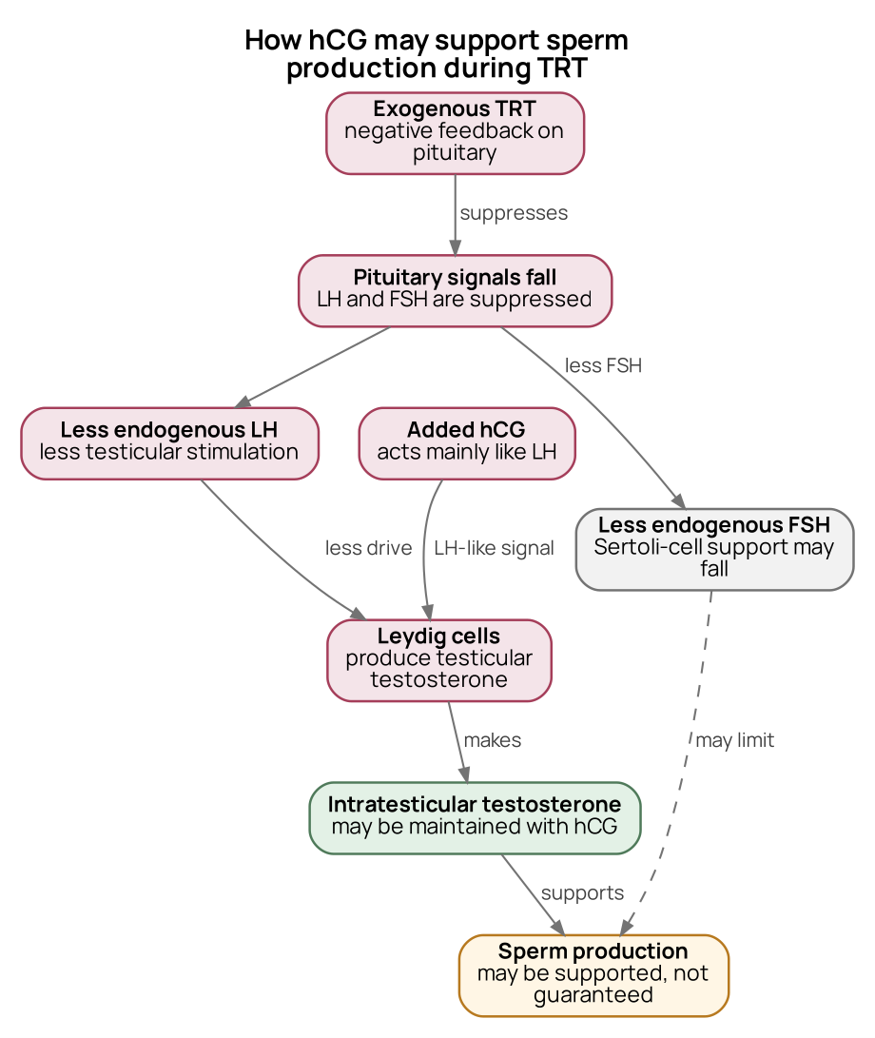
Figure 1. Proposed hormonal pathway. hCG can provide an LH-like signal and support intratesticular testosterone, but does not directly replace FSH; sperm production may therefore be supported without being assured [1], [2].
The distinction between LH and FSH matters. hCG does not directly replace FSH’s action on Sertoli cells. In an older human study, prolonged hCG treatment with suppressed FSH was associated with sperm concentrations below participants’ baseline; adding FSH subsequently increased sperm counts [2]. Although the study is small and not a modern clinical trial of fertility preservation, it cautions against assuming that maintaining testicular testosterone alone is sufficient for normal sperm production.
What the clinical evidence shows
The most direct clinical report of hCG added to TRT followed 26 men treated with 500 IU of hCG intramuscularly every other day alongside testosterone injections or gel. Semen parameters did not significantly decline during follow-up, no participant became azoospermic, and nine men had a partner pregnancy [3]. These findings are encouraging, but the retrospective study had no untreated comparison group and was too small to establish that hCG caused the pregnancies or reliably protects fertility across different patients.
A 2025 single-centre retrospective study examined recovery after testosterone-associated sperm suppression, rather than routine prevention. All 77 men received hCG plus FSH; sperm concentration improved in 74% overall. Improvement was reported in 74% of the 27 men who continued TRT during treatment, the same proportion as among those who stopped it [4]. This suggests that sperm recovery may be possible with combined gonadotropin treatment while continuing TRT in some patients. It does not show that hCG alone has the same effect, nor does it establish the best regimen or predict an individual’s chance of conception.
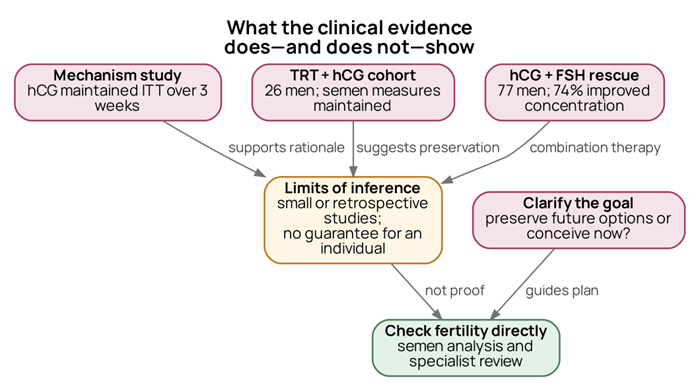
Figure 2. How to interpret the evidence: mechanistic, small-cohort and combination-treatment findings answer different questions, and none guarantees an individual fertility outcome [1], [3], [4].
Clinical implications
The right discussion depends on whether the goal is to preserve future options or to conceive soon. Although the evidence is promising and results have been borne out in practice, a man who is actively trying to conceive should not assume that add-on hCG makes TRT reliably fertility-safe. When sperm counts are already low or absent, treatment may require more than hCG alone; the recent recovery study used FSH as well.
For men who plan to continue TRT, baseline and follow-up semen analyses can show whether sperm production is actually being maintained. Serum testosterone alone cannot answer that question. Sperm banking can also be discussed when future biological parenthood is important.
Conclusion
Adding hCG to TRT may support intratesticular testosterone and may help preserve sperm production in some men, but current evidence is based on smaller studies and as such fertility cannot be guaranted. hCG does not replace FSH, and studies of sperm recovery often use additional fertility-directed treatment. Men who wish to conceive or protect future fertility should obtain individualised specialist advice and monitor semen—not rely on testosterone levels or hCG use alone.
Disclaimer
Disclaimer: This information is for education only and isn’t a substitute for personal medical advice. Always follow your prescriber’s instructions.
References
[1] A. D. Coviello et al., “Low-dose human chorionic gonadotropin maintains intratesticular testosterone in normal men with testosterone-induced gonadotropin suppression,” The Journal of clinical endocrinology and metabolism, May 2005, doi: 10.1210/jc.2004-0802.
[2] A. M. Matsumoto, A. E. Karpas, and W. J. Bremner, “Chronic human chorionic gonadotropin administration in normal men: Evidence that follicle-stimulating hormone is necessary for the maintenance of quantitatively normal spermatogenesis in man,” The Journal of clinical endocrinology and metabolism, June 1986, doi: 10.1210/jcem-62-6-1184.
[3] T.-C. Hsieh, A. W. Pastuszak, K. Hwang, and L. I. Lipshultz, “Concomitant intramuscular human chorionic gonadotropin preserves spermatogenesis in men undergoing testosterone replacement therapy,” The Journal of Urology, Feb. 2013, doi: 10.1016/j.juro.2012.09.043.
[4] B. T. Stocks et al., “Optimal restoration of spermatogenesis after testosterone therapy using human chorionic gonadotropin and follicle-stimulating hormone,” Fertility and Sterility, Apr. 2025, doi: 10.1016/j.fertnstert.2024.10.019.