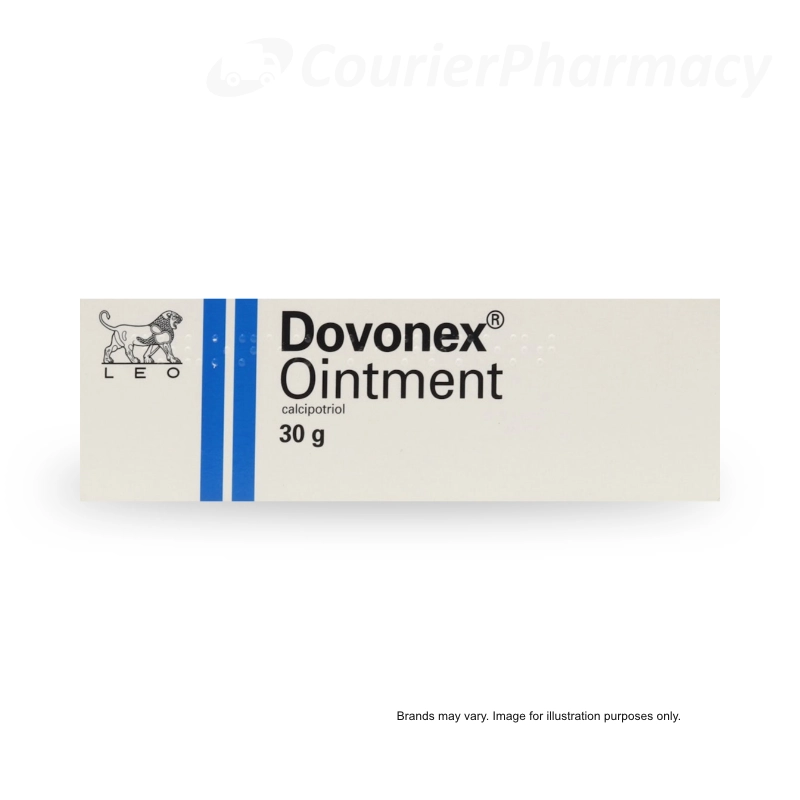
Dovonex Ointment is an off-white to yellowish-white translucent ointment containing 50 micrograms of calcipotriol per gram (0.005%). In particular, it belongs to the vitamin D analogue class of topical antipsoriatic medicines. Firstly, Dovonex is the originator brand of calcipotriol in the UK.
Additionally, the same active ingredient is also available in Dovonex Cream (for a less greasy alternative on the same body areas) and Dovonex Scalp Solution (for scalp psoriasis). Furthermore, calcipotriol is combined with the topical corticosteroid betamethasone in branded products like Dovobet Ointment/Gel and Enstilar Foam, for patients who need combination therapy. As a result, Dovonex Ointment sits within a wider LEO family of calcipotriol-based psoriasis treatments.
How vitamin D3 analogues work in psoriasis
Psoriasis is a chronic condition where skin cells (keratinocytes) grow and turn over much faster than normal, producing raised red plaques with silvery-white scales. In particular, natural vitamin D helps regulate keratinocyte growth and differentiation. Meanwhile, calcipotriol is a synthetic vitamin D3 analogue designed to bind vitamin D receptors on skin cells without causing the calcium metabolism effects that would come from systemic vitamin D at similar doses.
Additionally, when applied topically, it slows down excessive keratinocyte proliferation, promotes normal differentiation, and reduces the inflammation associated with psoriasis. As a result, plaques gradually flatten, scale less, and become less inflamed over weeks of treatment. Furthermore, this mechanism is distinct from topical corticosteroids, which work by suppressing skin inflammation and immune activity.
Why non-steroidal matters for long-term use
Topical corticosteroids (like betamethasone or clobetasol) work quickly for psoriasis but have side effects that limit long-term use, particularly skin thinning (atrophy), stretch marks (striae), telangiectasia (visible blood vessels), and rebound flares on stopping. In particular, this is why potent topical corticosteroids should not be used continuously for extended periods.
Meanwhile, calcipotriol (Dovonex) doesn’t cause skin thinning, so it can be used long-term for chronic plaque psoriasis. Additionally, it’s often used alongside a topical corticosteroid during flares, then continued alone during maintenance. Furthermore, calcipotriol works more slowly than potent corticosteroids (weeks rather than days) but the benefit is more sustainable. As a result, Dovonex has become a first-line option for mild-to-moderate plaque psoriasis in UK practice.
Key features and specifications
Active ingredient: calcipotriol 50 micrograms per gram (0.005%)
Form: off-white to yellowish-white translucent ointment
Pack sizes: aluminium tubes of 30g or 60g most commonly (smaller and larger sizes also produced)
A non-steroidal vitamin D3 topical for plaque psoriasis
Dovonex is the originator brand of calcipotriol, a synthetic vitamin D3 analogue used topically for plaque psoriasis. Firstly, it belongs to a family of medicines that work by binding to vitamin D receptors on skin cells (keratinocytes) to help normalise the excessive skin cell turnover that causes psoriasis plaques. Additionally, unlike topical corticosteroids, Dovonex doesn’t cause skin thinning (atrophy) with long-term use, which makes it particularly suitable for ongoing management. Meanwhile, Dovonex Ointment is indicated for the topical treatment of plaque psoriasis (psoriasis vulgaris) amenable to topical therapy. At Courier Pharmacy, Dovonex is prescribed through a full clinical consultation with a UK-qualified prescriber.
Five key takeaways
Dovonex Ointment contains calcipotriol 50 micrograms per gram, a synthetic vitamin D3 analogue for plaque psoriasis.
Applied thinly twice daily to psoriatic plaques, with a maximum weekly dose of 100g in adults.
Non-steroidal, so it doesn’t cause skin thinning and can be used long-term, unlike potent topical corticosteroids.
Not for application to the face, scalp (use Dovonex Scalp Solution instead), genital area, or skin folds.
Dovonex Ointment is a Prescription Only Medicine. A UK-qualified prescriber reviews every request at courierpharmacy.co.uk.
Treatment application Dovonex Ointment
How to apply
Apply a thin layer of Dovonex Ointment to the affected areas of skin twice daily (morning and evening). In particular, use only enough to cover the plaques with a thin film; more is not better and increases the risk of side effects. Meanwhile, gently rub in until absorbed. Additionally, wash your hands thoroughly after application (unless your hands are the area being treated). Furthermore, apply to psoriatic plaques only, not to surrounding normal skin. As a result, careful spot application gives the best balance of benefit and safety.
Maximum weekly dose (hypercalcaemia risk)
Above all, do not exceed the maximum weekly dose of 100g of Dovonex Ointment in adults. In particular, exceeding this can cause hypercalcaemia (raised blood calcium), because a small proportion of the calcipotriol is absorbed systemically. Meanwhile, for adults with extensive psoriasis needing more than 100g/week, alternative treatments should be considered. Additionally, for children (from age 6), the maximum weekly dose is lower and depends on age; a prescriber will guide this. Furthermore, patients using both Dovonex Ointment and Dovonex Scalp Solution should stay within a combined limit. As a result, tracking weekly usage matters, particularly for patients with widespread plaques.
How long until improvement
Dovonex is not a fast-acting medicine. In particular, initial improvement in redness or itching may be noticeable within 1 to 2 weeks. Meanwhile, meaningful plaque flattening and scale reduction usually builds over 4 to 8 weeks of consistent twice-daily use. Additionally, maximum benefit may take up to 8 weeks or longer. As a result, don’t judge whether Dovonex is working in the first 2 weeks; consistent application over at least a month is needed to assess response.
Where NOT to apply
Dovonex Ointment should NOT be applied to certain areas of the body. Firstly, do not apply to the face (can cause facial irritation or dermatitis). Additionally, do not apply to the scalp; use Dovonex Scalp Solution instead, which is formulated specifically for hair-bearing skin. Meanwhile, do not apply to the genital area or skin folds (armpits, groin, under breasts), where irritation risk is higher and other treatments are usually preferred. Furthermore, do not apply to broken or infected skin. As a result, Dovonex Ointment is for well-defined plaques on the trunk, arms, legs, and non-flexural skin only.
Missed applications
If you forget to apply Dovonex, apply it as soon as you remember unless it’s nearly time for the next dose. In particular, don’t apply a double amount to make up for a missed application. Meanwhile, occasional missed doses aren’t dangerous but consistent twice-daily use gives the best benefit. As a result, if you’re frequently missing doses, discuss with your prescriber about strategies to fit the routine into your day.
What is Dovonex Ointment: overview
Where calcipotriol sits in the NICE psoriasis pathway
NICE clinical guideline CG153 covers the assessment and management of psoriasis. In particular, for mild-to-moderate chronic plaque psoriasis on the trunk and limbs, NICE recommends a potent topical corticosteroid applied once daily and a vitamin D analogue applied once daily (at different times of day) for up to 8 weeks. Meanwhile, if this doesn’t achieve adequate control, options include stepping up to a combination product like Dovobet, adding phototherapy, or moving to systemic treatment. Additionally, for patients continuing on maintenance, a vitamin D analogue alone (like Dovonex) is often preferred over long-term potent topical corticosteroids because of the skin-thinning risk. As a result, calcipotriol is a well-established backbone of first-line topical psoriasis treatment.
Dovonex vs topical corticosteroids
Topical corticosteroids (like betamethasone valerate, mometasone, or clobetasol) and vitamin D analogues (like calcipotriol) both effectively treat plaque psoriasis but work differently and have different long-term profiles. In particular, corticosteroids act faster and work by suppressing skin inflammation, while calcipotriol acts more slowly by normalising keratinocyte turnover. Meanwhile, corticosteroids can cause skin thinning, stretch marks, and rebound flares if used long-term, so their use is time-limited. Additionally, calcipotriol doesn’t cause skin thinning and can be used long-term for maintenance. Furthermore, many patients benefit from combining both (either as separate products applied at different times, or as combination products like Dovobet). As a result, the two classes are complementary rather than competing.
Dovonex Ointment vs Cream vs Scalp Solution
Dovonex is available in three formulations with different characteristics. In particular, Dovonex Ointment is greasier and more occlusive, which suits thick, dry, well-defined plaques on the trunk and limbs. Meanwhile, Dovonex Cream is less greasy and cosmetically more acceptable to some patients for the same body areas. Additionally, Dovonex Scalp Solution is a specific formulation for scalp psoriasis, designed not to make hair excessively greasy or stiff. Furthermore, some patients use different formulations on different areas of the body simultaneously. As a result, formulation choice matches skin type, plaque characteristics, and personal preference.
Combination products (Dovobet, Enstilar)
For patients whose psoriasis needs both a vitamin D analogue and a topical corticosteroid, combination products may be more convenient than applying two separate treatments. In particular, Dovobet Ointment and Dovobet Gel combine calcipotriol 50 micrograms/g with betamethasone 0.5 mg/g (as dipropionate). Meanwhile, Enstilar Foam contains the same combination in a foam formulation that many patients find cosmetically preferable. Additionally, combination products are typically used once daily for a defined treatment course (usually up to 4 to 8 weeks) with a plan for maintenance. Furthermore, after a course of a combination product, some patients continue on Dovonex alone for maintenance. As a result, the LEO calcipotriol family gives flexible options for different treatment phases.
Why choose Courier Pharmacy for your Dovonex Ointment
Registered, independent, and prescriber-led
Courier Pharmacy is a UK-registered independent pharmacy. The General Pharmaceutical Council regulates us. Firstly, psoriasis treatment done well takes time. Additionally, the type and distribution of your psoriasis, previous treatments tried, current medicines, and impact on your life all matter. As a result, our prescribers ask about those things properly rather than treating psoriasis prescribing as a tick-box exercise. Getting your topical treatment right is about the fit, the application technique, and the follow-up.
Dr Ada Jex-Cori, our brand pharmacist
Our brand pharmacist is Dr Ada Jex-Cori. She represents the spirit of what we do. Named for Ada Lovelace, Sophia Jex-Blake, and Gerty Cori, she stands for evidence-led, unafraid-of-questions medicine. Her message is straightforward. You’re not broken. The system is. We’re here to change that.
Care that keeps showing up
Psoriasis treatment isn’t a one-off transaction. Furthermore, we build in ongoing review for chronic conditions. Additionally, if plaques improve slowly, or you need to combine treatments during a flare, or you’re wondering whether to step up to systemic therapy, we’re here to help. Meanwhile, for patients whose psoriasis affects visible areas, quality of life, or mental health, that continuity matters. As a result, we treat psoriasis as a long-term relationship, not a single dispense.
Free fortnightly drop-in clinics in Derby
Healthcare shouldn’t only happen when you’re paying for it. Every fortnight, we run free drop-in talks at Insomnia, Derby, from 12 to 1pm. Anyone can come. No appointment. No cost. No pressure. We cover skincare, mental health, weight management, hormones, hair loss, digestive health, and more.
Buy Dovonex Ointment (Prescription Only) from Courier Pharmacy
Dovonex Ointment is a Prescription Only Medicine. You can request it at courierpharmacy.co.uk. Firstly, complete a full online consultation covering your psoriasis history, current symptoms, and other medicines. Then, a UK-qualified prescriber reviews your answers carefully. If Dovonex is appropriate for you, we dispense and deliver discreetly.
Complete a full online consultation covering your psoriasis, medical history, and current medicines
A UK prescriber reviews your consultation and may follow up with questions
If approved, a prescription is issued and dispensed
We deliver discreetly and set up follow-up if needed
If Dovonex isn’t the right treatment for you (for example, if your psoriasis is severe enough to need systemic treatment, or if you have unusual features that need dermatology assessment), we’ll explain why and suggest better routes. Above all, we won’t dispense Dovonex just because it was requested.
Summary
A topical vitamin D3 analogue (calcipotriol) for plaque psoriasis on the body.
Non-steroidal, so it doesn’t cause skin thinning and can be used long-term.
Applied thinly twice daily; maximum 100g per week in adults.
First-line topical option for mild-to-moderate plaque psoriasis per NICE guidance, alongside topical corticosteroids or in combination products.
Not for face, scalp, genitals, or skin folds; different Dovonex formulations exist for scalp psoriasis.
Active ingredient in Dovonex Ointment
Calcipotriol
The active ingredient is calcipotriol, a synthetic vitamin D3 analogue. In particular, each gram of ointment contains 50 micrograms of calcipotriol. Meanwhile, calcipotriol was developed to have the beneficial vitamin D effects on skin cells (normalising keratinocyte growth and differentiation) while having minimal effect on systemic calcium metabolism at topical doses. Additionally, it binds to vitamin D receptors in keratinocytes, activating gene expression that normalises abnormal skin cell turnover. Furthermore, it's rapidly metabolised in the body if systemically absorbed, which reduces the risk of persistent hypercalcaemia. As a result, at recommended topical doses, calcipotriol is safe for long-term use.
Ointment formulation
The ointment base includes liquid paraffin, macrogol stearyl ether, and propylene glycol, giving a greasy, occlusive texture that helps the calcipotriol penetrate thick psoriatic plaques and provides moisturisation. In particular, ointments are generally more effective than creams for very dry, scaly plaques because the greasy base traps moisture. Meanwhile, some patients find ointments cosmetically less acceptable; for these, the cream formulation may be preferred. Additionally, the ointment contains no fragrances or common sensitisers, reducing the risk of contact reactions. As a result, the ointment formulation suits patients whose plaques are thick, dry, or scaly.
What is Dovonex Ointment for?
Plaque psoriasis (psoriasis vulgaris)
Dovonex Ointment is licensed for the topical treatment of plaque psoriasis (psoriasis vulgaris) amenable to topical therapy. In particular, this is the most common form of psoriasis, causing raised red patches covered with silvery-white scales, typically on the elbows, knees, lower back, and other extensor surfaces. Meanwhile, plaque psoriasis is a chronic condition; topical treatments manage symptoms rather than curing the underlying tendency. Additionally, mild-to-moderate plaque psoriasis is often well-controlled with topical treatment alone, while more severe cases may need phototherapy or systemic treatment alongside or instead of topicals.
What Dovonex Ointment isn't for
Above all, Dovonex is not appropriate for all types of psoriasis. In particular, it should not be used for generalised pustular psoriasis or erythrodermic exfoliative psoriasis, because these severe forms carry a higher risk of hypercalcaemia and need specialist management. Additionally, it's not licensed for guttate psoriasis (small drop-shaped lesions) or nail psoriasis. Meanwhile, it's not suitable for the face, scalp, genital area, or skin folds. Furthermore, it's not for other skin conditions such as eczema, contact dermatitis, or seborrhoeic dermatitis. As a result, correct diagnosis and appropriate treatment selection matter.
How does Dovonex Ointment work?
Vitamin D receptor binding in keratinocytes
Skin cells (keratinocytes) have vitamin D receptors that, when activated, regulate cell growth and maturation. In particular, in psoriasis, keratinocytes grow and turn over about 7 times faster than normal, without maturing properly. Meanwhile, calcipotriol binds to vitamin D receptors in keratinocytes and activates gene expression that slows this excessive proliferation and promotes normal maturation. Additionally, calcipotriol also has anti-inflammatory effects on the skin, reducing the immune activity that drives psoriatic plaques. As a result, over weeks of treatment, plaques become thinner, less scaly, and less inflamed.
Why psoriasis improvement is gradual
Skin cells take about 4 weeks to mature and be shed in normal skin. In particular, changes in skin cell behaviour due to treatment take similar time to become visible. Meanwhile, plaque psoriasis improvement with Dovonex builds gradually over weeks rather than days, as new normal-cycling keratinocytes replace the abnormal fast-cycling ones. Additionally, this is why consistent twice-daily application over at least 4 weeks is needed to assess response. Above all, don't judge whether Dovonex is working in the first week or two; the mechanism doesn't allow for that kind of rapid change.
How to apply Dovonex Ointment
Preparing the skin
Dovonex can be applied to clean, dry skin. In particular, there's no specific requirement to bathe or exfoliate before application; consistent twice-daily use is what matters. Meanwhile, some patients find that a warm bath or shower to soften scales followed by gentle towelling and then Dovonex application improves absorption into thick plaques. Additionally, if you use emollients or moisturisers, apply them at a different time from Dovonex (either well before or after) so they don't dilute the active.
Application technique
Squeeze a small amount of Dovonex onto your finger. In particular, a thin layer is all that's needed; excess doesn't improve results and increases side-effect risk. Meanwhile, apply directly to the plaques and gently rub in until absorbed. Additionally, avoid applying to normal skin around plaques where possible. Furthermore, cover the entire plaque area but no more. As a result, this spot-application approach maximises benefit while minimising both drug use and side-effect risk.
Wash hands afterwards
Wash your hands thoroughly with soap and water after applying Dovonex, unless your hands are one of the treatment areas. In particular, this prevents accidentally transferring calcipotriol to your face, eyes, or other sensitive areas. Meanwhile, if you accidentally get Dovonex in your eyes, mouth, or on your face, wash off with plenty of water. Additionally, avoid touching your face until you've washed your hands after application.
Timing with other treatments
If you use Dovonex alongside a topical corticosteroid for psoriasis, apply them at different times of day (for example, corticosteroid in the morning and Dovonex in the evening, or vice versa). In particular, this reduces the risk of one deactivating the other and allows both to work optimally. Meanwhile, do not mix Dovonex with salicylic acid preparations; salicylic acid deactivates calcipotriol. Additionally, if you use emollients, apply them at a different time from Dovonex. Furthermore, discuss the timing of all your topical treatments with your prescriber to build a coherent routine.
Treatment application Dovonex Ointment
How to apply
Apply a thin layer of Dovonex Ointment to the affected areas of skin twice daily (morning and evening). In particular, use only enough to cover the plaques with a thin film; more is not better and increases the risk of side effects. Meanwhile, gently rub in until absorbed. Additionally, wash your hands thoroughly after application (unless your hands are the area being treated). Furthermore, apply to psoriatic plaques only, not to surrounding normal skin. As a result, careful spot application gives the best balance of benefit and safety.
Maximum weekly dose (hypercalcaemia risk)
Above all, do not exceed the maximum weekly dose of 100g of Dovonex Ointment in adults. In particular, exceeding this can cause hypercalcaemia (raised blood calcium), because a small proportion of the calcipotriol is absorbed systemically. Meanwhile, for adults with extensive psoriasis needing more than 100g/week, alternative treatments should be considered. Additionally, for children (from age 6), the maximum weekly dose is lower and depends on age; a prescriber will guide this. Furthermore, patients using both Dovonex Ointment and Dovonex Scalp Solution should stay within a combined limit. As a result, tracking weekly usage matters, particularly for patients with widespread plaques.
How long until improvement
Dovonex is not a fast-acting medicine. In particular, initial improvement in redness or itching may be noticeable within 1 to 2 weeks. Meanwhile, meaningful plaque flattening and scale reduction usually builds over 4 to 8 weeks of consistent twice-daily use. Additionally, maximum benefit may take up to 8 weeks or longer. As a result, don't judge whether Dovonex is working in the first 2 weeks; consistent application over at least a month is needed to assess response.
Where NOT to apply
Dovonex Ointment should NOT be applied to certain areas of the body. Firstly, do not apply to the face (can cause facial irritation or dermatitis). Additionally, do not apply to the scalp; use Dovonex Scalp Solution instead, which is formulated specifically for hair-bearing skin. Meanwhile, do not apply to the genital area or skin folds (armpits, groin, under breasts), where irritation risk is higher and other treatments are usually preferred. Furthermore, do not apply to broken or infected skin. As a result, Dovonex Ointment is for well-defined plaques on the trunk, arms, legs, and non-flexural skin only.
Missed applications
If you forget to apply Dovonex, apply it as soon as you remember unless it's nearly time for the next dose. In particular, don't apply a double amount to make up for a missed application. Meanwhile, occasional missed doses aren't dangerous but consistent twice-daily use gives the best benefit. As a result, if you're frequently missing doses, discuss with your prescriber about strategies to fit the routine into your day.
Warnings and precautions for Dovonex Ointment
Do not apply to the face
Dovonex Ointment should not be applied to the face. In particular, facial skin is thinner and more sensitive, and calcipotriol commonly causes facial irritation or contact dermatitis. Meanwhile, if you have facial psoriasis, discuss alternative treatments with your prescriber; different formulations or classes (such as low-potency topical corticosteroids or calcineurin inhibitors) are usually preferred. Additionally, if you accidentally get Dovonex on your face, wash off with plenty of water.
Do not apply to the scalp
Dovonex Ointment is not designed for scalp use. In particular, ointments are difficult to apply to hair-bearing skin and become uncomfortable in hair. Meanwhile, Dovonex Scalp Solution is a specific formulation designed for scalp psoriasis, using a solution base that penetrates through hair to the scalp without leaving greasy residue. Additionally, if you have scalp involvement, discuss the appropriate formulation with your prescriber.
Do not apply to genital area or skin folds
Dovonex should not be applied to the genital area, armpits, groin, under breasts, or other skin folds. In particular, these areas have thinner skin and higher absorption, which increases both irritation risk and systemic exposure. Meanwhile, treatment of psoriasis in these areas usually requires different approaches under specialist guidance. Additionally, if you have psoriasis in flexural areas, discuss with your prescriber; alternative treatments may be appropriate.
Not for generalised pustular or erythrodermic psoriasis
Dovonex should not be used for generalised pustular psoriasis or erythrodermic exfoliative psoriasis. In particular, these severe forms of psoriasis have been reported to cause hypercalcaemia with calcipotriol use. Meanwhile, these conditions require specialist dermatology management, often with systemic treatment. Additionally, if your psoriasis suddenly changes character (becomes widespread, develops pustules, or covers most of your body), seek prompt medical assessment.
Calcium metabolism disorders (contraindication)
Dovonex is contraindicated in patients with known disorders of calcium metabolism. In particular, this includes hypercalcaemia, hyperparathyroidism, or other conditions affecting calcium balance. Meanwhile, this is because even topical calcipotriol can have some effect on calcium levels, especially with extensive use. Additionally, disclose any known calcium metabolism issues during your consultation.
Hypercalcaemia risk with excessive use
Exceeding the maximum weekly dose of 100g in adults can cause hypercalcaemia (raised blood calcium). In particular, symptoms include nausea, vomiting, constipation, muscle weakness, confusion, and excessive thirst. Meanwhile, if you notice these symptoms during treatment, stop Dovonex and seek medical assessment. Additionally, serum calcium returns to normal after treatment is stopped. Furthermore, the risk is minimal when the dosage recommendations are followed. As a result, tracking weekly usage matters, particularly for patients with widespread plaques.
UV exposure caution
Some patients use Dovonex alongside phototherapy (UVB or PUVA) under specialist supervision. In particular, this combination can enhance efficacy but also increases the risk of skin irritation. Meanwhile, don't apply Dovonex immediately before UV exposure (from phototherapy or sunbeds) unless directed by a specialist. Additionally, when spending time in strong sunshine, sun protection measures apply as normal. As a result, discuss any planned UV exposure or phototherapy with your prescriber.
Pregnancy and breastfeeding
Data on Dovonex in pregnancy are limited. In particular, at recommended doses, systemic absorption is minimal, but manufacturer advice is that use in pregnancy should be avoided unless clearly needed. Meanwhile, in breastfeeding, it's not known whether calcipotriol passes into breast milk in clinically significant amounts. Additionally, if breastfeeding, do not apply Dovonex to the breast area. Furthermore, discuss pregnancy, planning pregnancy, or breastfeeding with your prescriber before starting or continuing Dovonex.
Side effects of Dovonex Ointment
Common local skin effects
The most common side effects of Dovonex are local skin reactions at the application sites. In particular, these include skin irritation, redness, burning or stinging sensation, itching, and rash. Meanwhile, these effects are often mild and settle within the first 1 to 2 weeks of treatment as your skin adapts. Additionally, if irritation is severe or persistent, contact your prescriber. Furthermore, using less ointment per application (a thinner layer) may reduce irritation while still allowing treatment to work.
Less common local effects
Less commonly, patients may experience contact dermatitis, skin dryness, worsening of psoriasis (paradoxical), or photosensitivity. In particular, worsening psoriasis is usually temporary but should be discussed with your prescriber; sometimes it reflects irritation rather than true worsening. Meanwhile, facial rash may occur if calcipotriol is accidentally transferred from hands to face. Additionally, hyperpigmentation or hypopigmentation of treated areas is uncommon but possible.
Rare systemic effects (hypercalcaemia)
Rarely, if the maximum weekly dose is exceeded or if calcipotriol is used on very extensive or thin/inflamed skin, systemic absorption may raise blood calcium levels. In particular, symptoms of hypercalcaemia include nausea, vomiting, constipation, muscle weakness, confusion, excessive thirst, and increased urination. Meanwhile, if you develop these symptoms during treatment, stop Dovonex and seek medical assessment. Additionally, blood calcium normalises after stopping treatment.
Serious side effects requiring urgent help
Seek urgent help for signs of severe allergic reaction (facial swelling, difficulty breathing, widespread rash). Similarly, seek help for symptoms of hypercalcaemia (severe nausea, vomiting, confusion, muscle weakness, excessive thirst). Additionally, seek help for severe skin reactions (widespread blistering, peeling, or mucosal involvement). As a result, most Dovonex side effects are local and mild, but rare serious reactions warrant prompt attention.
Yellow Card reporting
Report any suspected side effects to the MHRA Yellow Card scheme at yellowcard.mhra.gov.uk or via the Yellow Card app.
Drug interactions with Dovonex Ointment
Salicylic acid deactivation
Above all, do not use Dovonex at the same time as topical salicylic acid preparations. In particular, salicylic acid (found in some psoriasis descaling products and coal tar shampoos) deactivates calcipotriol on the skin. Meanwhile, if you use both, apply them at different times of day with at least a few hours in between (for example, salicylic acid in the morning and Dovonex in the evening after washing). Additionally, some combination products intentionally avoid this interaction; discuss with your prescriber if you use multiple topical treatments.
Topical corticosteroids (planned combination)
Combining Dovonex with a topical corticosteroid is common and effective for plaque psoriasis, but the two should be applied at different times of day rather than mixed together. In particular, apply one in the morning and the other in the evening (order doesn't matter greatly). Meanwhile, combination products like Dovobet Ointment/Gel and Enstilar Foam contain both actives in a single formulation designed for combined use. Additionally, discuss with your prescriber whether separate application or a combination product suits you better.
UVB phototherapy
Some patients use Dovonex alongside narrowband UVB phototherapy under specialist supervision. In particular, this combination can be more effective than either alone. Meanwhile, timing matters; Dovonex is usually applied after phototherapy sessions rather than before, because vitamin D analogues can be degraded by UV light. Additionally, this combination is managed by dermatology teams. As a result, if you're receiving phototherapy, discuss Dovonex timing with the phototherapy team.
Other topical products
Emollients, coal tar preparations, and other topical psoriasis treatments can be used alongside Dovonex but should be applied at different times of day. In particular, allow at least an hour between different topicals to avoid dilution or interaction. Meanwhile, cosmetic products (moisturisers, sunscreens, makeup) can generally be used on non-treated areas without issue. Additionally, disclose all topical products you use during consultation for a full compatibility check.
Frequently asked questions about Dovonex Ointment
How quickly does Dovonex work?
Some improvement in redness or itching may be noticeable within 1 to 2 weeks. However, meaningful plaque flattening and scale reduction usually builds over 4 to 8 weeks of consistent twice-daily use. In particular, don't judge whether Dovonex is working in the first 2 weeks; the mechanism doesn't allow for rapid change.
Can I use Dovonex on my face?
No. Dovonex should not be applied to the face because it commonly causes irritation and dermatitis on facial skin. In particular, if you have facial psoriasis, discuss alternative treatments with your prescriber. Meanwhile, if you accidentally get Dovonex on your face, wash off with plenty of water.
Can I use Dovonex on my scalp?
Dovonex Ointment is not designed for scalp use. In particular, Dovonex Scalp Solution is a specific formulation for scalp psoriasis. Meanwhile, if you have scalp involvement, discuss the appropriate formulation with your prescriber. Additionally, combination products like Dovobet Gel are also available for scalp psoriasis.
Can I combine Dovonex with a steroid cream?
Yes, and this combination is commonly used and effective. In particular, apply the two treatments at different times of day (one in the morning, the other in the evening) rather than mixing them together. Meanwhile, combination products like Dovobet Ointment/Gel and Enstilar Foam contain both actives in one formulation for convenience. Additionally, discuss with your prescriber whether separate application or a combination product suits you.
Is Dovonex safe for long-term use?
Yes. Unlike potent topical corticosteroids, Dovonex doesn't cause skin thinning and can be used long-term for chronic plaque psoriasis. In particular, this is one of its main advantages. Meanwhile, do continue to observe the maximum weekly dose (100g in adults) to avoid hypercalcaemia risk.
How much Dovonex should I use?
A thin layer covering just the plaques, applied twice daily. In particular, more isn't better; excess ointment doesn't improve results and increases side-effect risk. Meanwhile, the maximum weekly dose for adults is 100g. Additionally, a rough guide is that a fingertip unit (about 0.5g) covers an area roughly the size of two adult palms.
Can I use Dovonex while pregnant?
Data on Dovonex in pregnancy are limited. In particular, systemic absorption at recommended doses is minimal, but manufacturer advice is to avoid use in pregnancy unless clearly needed. Meanwhile, discuss pregnancy or planning pregnancy with your prescriber to weigh the individual situation.
Can I use Dovonex while breastfeeding?
It's not known whether calcipotriol passes into breast milk in clinically significant amounts. In particular, if breastfeeding, do not apply Dovonex to the breast area. Meanwhile, discuss with your prescriber; alternative approaches may be appropriate for extensive treatment during breastfeeding.
What happens if I exceed the weekly maximum?
Exceeding the 100g/week maximum can cause hypercalcaemia (raised blood calcium). In particular, symptoms include nausea, vomiting, constipation, muscle weakness, confusion, and excessive thirst. Meanwhile, if you notice these symptoms, stop Dovonex and seek medical assessment. Additionally, blood calcium normalises after stopping.
Will Dovonex cure my psoriasis?
No. Psoriasis is a chronic condition, and Dovonex manages symptoms rather than curing the underlying tendency. In particular, plaques usually recur after treatment stops. Meanwhile, long-term maintenance with Dovonex or other treatments is often needed to keep psoriasis controlled. Additionally, some patients experience remissions; others need continuous treatment.
Can I use makeup or moisturiser over Dovonex?
Yes, but leave at least an hour between applying Dovonex and applying other products to the same area. In particular, this allows the Dovonex to absorb before being covered. Meanwhile, avoid applying other topicals to the same area at the same time. Additionally, cosmetic products on non-treated skin are generally fine without special timing.
Can I go in the sun while using Dovonex?
Moderate sun exposure is generally fine, but avoid excessive UV exposure or sunbeds. In particular, some patients use Dovonex alongside prescribed phototherapy under specialist supervision. Meanwhile, if using phototherapy, apply Dovonex after (not before) sessions, because vitamin D analogues can be degraded by UV light. Additionally, use sunscreen and sun protection measures as normal.
Can I use coal tar shampoo while using Dovonex?
Yes, but not at the same time. In particular, coal tar and salicylic acid preparations can deactivate calcipotriol. Meanwhile, use them at different times of day (for example, coal tar shampoo in the morning, Dovonex in the evening after washing off any residue). Additionally, discuss your full topical routine with your prescriber.
What if my psoriasis gets worse on Dovonex?
Worsening in the first 1 to 2 weeks may reflect skin irritation rather than true worsening; this usually settles. In particular, if worsening persists or is severe, contact your prescriber. Meanwhile, sometimes stepping up to a combination product or adjusting the treatment approach is appropriate. Additionally, if psoriasis suddenly changes character (widespread, pustular, or covers most of your body), seek prompt medical assessment.
Can I use Dovonex if I have kidney problems?
Dovonex is generally used cautiously in patients with kidney problems because impaired calcium handling can increase hypercalcaemia risk. In particular, disclose any kidney disease during your consultation. Meanwhile, most patients with mild kidney impairment can use Dovonex at standard doses under prescriber guidance.
Is Dovonex safe for children?
Dovonex has been used in children with plaque psoriasis, with reduced maximum weekly doses depending on age. In particular, paediatric psoriasis treatment is generally managed under specialist guidance rather than through general online prescribing. Meanwhile, discuss any paediatric psoriasis concerns with a dermatology-experienced prescriber.
Do I need blood tests while using Dovonex?
Routine blood monitoring isn't required for most patients using Dovonex at recommended doses. However, patients using extensive amounts, those with kidney impairment, or those with signs of hypercalcaemia may benefit from calcium monitoring. In particular, discuss any monitoring needs at your consultation.
What if I stop Dovonex - will my psoriasis rebound?
Unlike potent topical corticosteroids, Dovonex doesn't typically cause a rapid rebound flare on stopping. In particular, plaques may gradually reappear over weeks to months as the medicine's effect wears off, but not the sudden rebound seen with abrupt corticosteroid withdrawal. Meanwhile, long-term management usually involves either continued Dovonex use or a planned step-down strategy.
How is Dovonex different from Dovobet?
Dovonex Ointment contains calcipotriol alone (vitamin D analogue). Dovobet Ointment (and Dovobet Gel) contains calcipotriol combined with betamethasone (a potent topical corticosteroid). In particular, Dovobet is more potent and acts faster but shouldn't be used long-term because of the corticosteroid component. Meanwhile, a common treatment pattern is Dovobet for an initial course during flares, then Dovonex alone for maintenance. Additionally, Enstilar Foam is the same combination in a foam formulation.
Do I need a prescription from Courier Pharmacy?
Yes. Dovonex Ointment is a Prescription Only Medicine. A UK-qualified prescriber must review your consultation. You can complete this at courierpharmacy.co.uk. Meanwhile, a pharmacy-availability version was licensed in 2017 but never marketed by LEO Pharma, so all Dovonex Ointment currently sold in the UK remains prescription only.
Disclaimer
Disclaimer: This information is for education only and isn't a substitute for personal medical advice. Always follow your prescriber's instructions.