
Tretinoin (all-trans retinoic acid, or vitamin A acid) was not a single sudden discovery: clinicians first explored topical retinoic acid for abnormal skin thickening, then established its acne use, and later recognised benefits for sun-damaged skin and pigmentation. It is a topical retinoid, not the same medicine as oral isotretinoin, although both are vitamin-A derivatives. [1], [2]
Mechanism of action
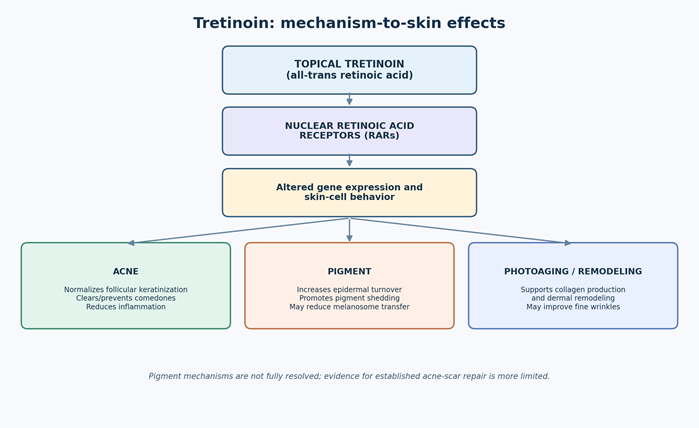
Tretinoin acts through nuclear retinoic acid receptors (RARs), which regulate the expression of cellular proteins and pathways. In skin, its downstream effects include changes to epidermal differentiation, follicular keratinisation, and collagen production; the mechanisms vary by condition and are not fully resolved. [2], [3], [4]
In acne-prone follicles, it normalises abnormal keratinisation and cell shedding, helping clear existing comedones and prevent the microcomedones that seed new lesions. It also has anti-inflammatory effects. [5], [6]
For uneven pigmentation, faster epidermal turnover helps shed melanin-containing cells; retinoids may also reduce transfer of melanosomes (pigment packages) to epidermal cells. The precise pigment-related mechanisms are not fully settled. [4]
In sun-damaged skin, tretinoin promotes collagen production and remodelling in the dermis, which can improve fine wrinkling and texture over time. Human trials report increased procollagen markers, but these effects should not be interpreted as proof that tretinoin can restore every kind of acne scar. [7], [8]
Figure 1. Conceptual summary of proposed skin effects; pigmentation mechanisms are not fully resolved, and scar repair evidence is more limited. [3], [4], [5], [8], [9]
Timeline
| Period | What happened |
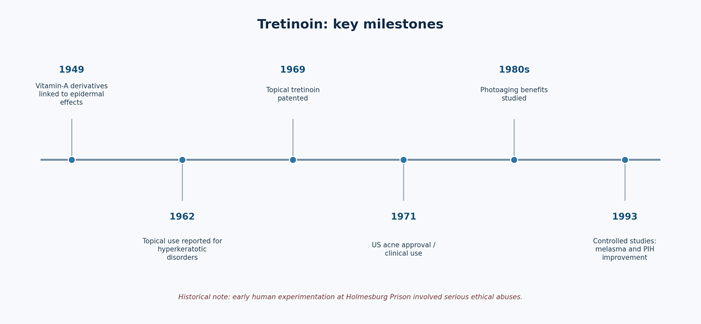
| 1949 | Research on vitamin-A derivatives helped establish that they can affect epidermal growth; this became part of the scientific background for later retinoid treatments. [10] |
| 1962 | Clinical reports described benefits from topical tretinoin for ichthyosis and other hyperkeratotic skin conditions. Acne was not yet the main success: early investigators found its benefit there less compelling. [1], [11] |
| 1960s | Albert Kligman and colleagues investigated tretinoin for acne. A recent historical account connects some early work on tretinoin’s pigment and anti-ageing effects with experiments on incarcerated people at Holmesburg Prison, conducted without ethical protections; the history is therefore also a reminder of serious research abuses. [12] |
| 1969 | A historical review reports that Kligman and colleagues patented topical tretinoin; reports from the period described its acne benefit as coming chiefly from preventing and dislodging comedones (blocked pores). [1], [12] |
| 1971 | Topical tretinoin was licensed/approved in the United States for acne, and became an established comedone-targeting treatment. [2], [12] |
| 1970s–1980s | Patients using tretinoin for acne were observed to have improved sun-damaged skin. This led to controlled studies of photodamage; a 1988 vehicle-controlled trial reported improvement in photoaging in tretinoin-treated skin, with local irritation as the main adverse effect. [13], [14] |
| 1993 | Controlled studies reported benefit for both melasma and post-inflammatory hyperpigmentation (PIH), including dark marks left after inflammation such as acne. These benefits required prolonged treatment in the studies. [15], [16] |
| Since then | Tretinoin has remained a well-established acne and photoaging treatment. Other uses, including melasma, PIH and acne scarring, have evidence of varying strength and are not interchangeable with its core acne indication. [3], [17] |
Figure 2. Selected dates for vitamin-A derivative research, early topical use, acne approval, photoaging studies, and controlled pigmentation trials. [1], [2], [10], [12], [13], [15], [16]
Acne scars: what “scars” means
Tretinoin normalises the shedding and turnover of cells lining hair follicles, helping prevent and clear comedones; it also has anti-inflammatory effects. Treating acne early and controlling inflammation can reduce the formation of new scars. [5], [6], [18]
People often call two different things “acne scars”: flat brown or dark marks (PIH) and textural depressions or raised scars. Tretinoin has controlled-trial evidence for lightening PIH: in a 40-week randomised trial of Black participants, treated lesions were 40% lighter toward normal skin colour versus 18% with vehicle, and improvement was first noted after four weeks. This helps discoloration; it does not mean a pitted scar has been erased. [16]
For established indented/atrophic scars, some small studies report improvement with tretinoin delivered by iontophoresis (an electrical delivery method), and reviews describe topical retinoids as potentially useful for scar remodelling. But those findings do not establish that ordinary tretinoin cream reliably removes established scars: the studies are limited, methods differ, and better comparative trials are needed. [9], [19], [20]
Other skin concerns
- Melasma: In a randomised, vehicle-controlled study, 13 of 19 people using 0.1% tretinoin were rated improved or much improved after 40 weeks, versus 1 of 19 using vehicle; significant improvement appeared after 24 weeks. The study attributed the benefit mainly to reduced epidermal pigment. Erythema and peeling were common, so this is a slow treatment that can irritate skin. [15]
- Sun damage / photoaging: Trials and a systematic review report improvement in fine wrinkles and mottled pigmentation, among other signs of photoaging; results generally develop over time and local irritation can occur. [7], [8]
- Acne prevention and ongoing acne treatment: Tretinoin’s best-established role is active acne, especially clogged pores. By helping control acne lesions, it can help prevent additional scarring, but it is not a stand-alone fix for every scar type. [3], [18]
Bottom line: tretinoin’s strongest, longest-established uses are acne and photoaging. It can also improve some pigmentary problems, including acne-related dark marks and melasma, while the evidence for repairing established acne scars is more limited and depends on scar type and treatment method. Irritation, redness and peeling are relevant trade-offs; the melasma trials in particular show that improvement may take months. [3], [15], [16]
References
[1] G. Stüttgen, “Historical perspectives of tretinoin,” Journal of the American Academy of Dermatology, 1986, doi: 10.1016/s0190-9622(86)70228-4.
[2] H. Baldwin, G. Webster, L. S. S. Gold, V. Callender, F. Cook-Bolden, and E. Guenin, “50 years of topical retinoids for acne: Evolution of treatment,” American Journal of Clinical Dermatology, 2021, doi: 10.1007/s40257-021-00594-8.
[3] H. E. Baldwin, M. Nighland, C. Kendall, D. A. Mays, R. Grossman, and J. Newburger, “40 years of topical tretinoin use in review,” Journal of Drugs in Dermatology, 2013. Available: https://pubmed.ncbi.nlm.nih.gov/23839179
[4] J. Ortonne, “Retinoid therapy of pigmentary disorders,” Dermatologic Therapy, 2006, doi: 10.1111/j.1529-8019.2006.00085.x.
[5] A. Thielitz and H. Gollnick, “Topical retinoids in acne vulgaris: Update on efficacy and safety,” American Journal of Clinical Dermatology, 2008, doi: 10.2165/0128071-200809060-00003.
[6] N. Schmidt and E. H. Gans, “Tretinoin: A review of its anti-inflammatory properties in the treatment of acne,” The Journal of Clinical and Aesthetic Dermatology, 2011. Available: https://pubmed.ncbi.nlm.nih.gov/22125655
[7] I. B. S. Sitohang, W. I. Makes, N. Sandora, and J. Suryanegara, “Topical tretinoin for treating photoaging: A systematic review of randomized controlled trials,” International Journal of Women’s Dermatology, 2022, doi: 10.1097/jw9.0000000000000003.
[8] S. Kang et al., “Long-term efficacy and safety of tretinoin emollient cream 0.05% in the treatment of photodamaged facial skin: A two-year, randomized, placebo-controlled trial,” American Journal of Clinical Dermatology, 2005, doi: 10.2165/00128071-200506040-00005.
[9] A. Tobiasz, A. Jankowska-Konsur, and D. Nowicka, “Topical retinoids in acne vulgaris and acne scars, from monotherapy to combining regimens,” Pharmaceuticals, 2026, doi: 10.3390/ph19040620.
[10] F. Ghali, S. Kang, J. Leyden, A. R. Shalita, and D. M. Thiboutot, “Changing the face of acne therapy,” Cutis, 2009. Available: https://pubmed.ncbi.nlm.nih.gov/19363873
[11] G. Plewig and A. M. Kligman, “Tretinoin (all-trans-retinoic acid, vitamin A acid),” Acne and Rosacea, 1993, doi: 10.1007/978-3-642-97234-8_74.
[12] M. Crous, N. Stefanovic, and L. Griffin, “HX21 Scars of confinement: The dark history of tretinoin,” British Journal of Dermatology, 2025, doi: 10.1093/bjd/ljaf085.484.
[13] E. G. Thorne, “Topical tretinoin research: An historical perspective,” The Journal of International Medical Research, 1990. Available: https://pubmed.ncbi.nlm.nih.gov/2227083
[14] J. S. Weiss, C. N. Ellis, J. T. Headington, T. Tincoff, T. A. Hamilton, and J. J. Voorhees, “Topical tretinoin improves photoaged skin. A double-blind vehicle-controlled study,” JAMA, 1988, doi: 10.1001/jama.1988.03720040019020.
[15] C. E. Griffiths, L. Finkel, C. M. Ditre, T. Hamilton, C. N. Ellis, and J. J. Voorhees, “Topical tretinoin (retinoic acid) improves melasma. A vehicle-controlled, clinical trial,” British Journal of Dermatology, 1993, doi: 10.1111/j.1365-2133.1993.tb03169.x.
[16] S. M. Bulengo-Ransby et al., “Topical tretinoin (retinoic acid) therapy for hyperpigmented lesions caused by inflammation of the skin in black patients,” The New England Journal of Medicine, 1993, doi: 10.1056/nejm199305203282002.
[17] P. Balado-Simó et al., “An updated review of topical tretinoin in dermatology: From acne and photoaging to skin cancer,” Journal of Clinical Medicine, 2025, doi: 10.3390/jcm14227958.
[18] J. Tan, E. Tanghetti, H. Baldwin, L. S. Gold, and E. Lain, “The role of topical retinoids in prevention and treatment of atrophic acne scarring: Understanding the importance of early effective treatment,” Journal of Drugs in Dermatology, 2019. Available: https://pubmed.ncbi.nlm.nih.gov/30909329
[19] J. B. Schmidt, P. Donath, J. Hannes, S. Perl, R. Neumayer, and A. Reiner, “Tretinoin-iontophoresis in atrophic acne scars,” International Journal of Dermatology, 1999, doi: 10.1046/j.1365-4362.1999.00586.x.
[20] T. Knor, “Flattening of atrophic acne scars by using tretinoin by iontophoresis,” Acta Dermatovenerologica Croatica, 2004. Available: https://pubmed.ncbi.nlm.nih.gov/15075042
Figure 1. Conceptual summary of proposed skin effects; pigmentation mechanisms are not fully resolved, and scar repair evidence is more limited. [3], [4], [5], [8], [9]