
If you have started taking minoxidil, you be shocked to find more hair in the sink than before. This is the dreaded minoxidil shed.
This guide explains what the minoxidil dread shed is, when it starts, how long it lasts, and whether it even occurs after a dose increase. Should you panic? Only if you don’t read this article!
Five key takeaways
- Minoxidil dread shed is a temporary rise in hair loss that usually starts two to four weeks after you begin treatment and settles within a few weeks to around three months.
- It happens because minoxidil shortens the resting phase of the hair cycle, so tired old hairs leave to make room for new ones.
- Both oral and topical minoxidil can cause it, because they work in the same way.
- There are no good trials on shedding after a minoxidil dose increase. A smaller, milder shed is plausible and often reported, but it isn’t proven.
- Keep taking minoxidil as prescribed, and speak to a clinician if heavy shedding carries on beyond about four months, or comes with bald patches, scalp pain or other symptoms.
What is minoxidil dread shed?
You start minoxidil to keep your hair. A few weeks later, your brush looks like it has lost a fight. Understandably, that feels like the treatment is making things worse.
This is minoxidil dread shed. It’s the name people use for a temporary increase in hair shedding after starting minoxidil. The term began on hair loss forums, but it’s now used in dermatology journals too. Researchers describe it as a paradoxical rise in shedding after starting low-dose oral minoxidil and note that it can be very distressing for people already worried about their hair (Nohria et al., 2024).
Here’s a way to picture it. Think of your scalp as a block of flats. Some residents have overstayed their tenancy. They’re resting hairs that were already on their way out. Minoxidil knocks on the door and says, “Time to go, new tenants are ready.” For a few weeks, the corridor is full of suitcases. Once the old residents have moved out, the new ones settle in.

The hair cycle in sixty seconds
Every hair on your head sits in one of four stages:
- Anagen is the growing phase. It can last years.
- Catagen is a short transition phase.
- Telogen is the resting phase.
- Exogen is when the resting hair finally falls out.
At any moment, most of your hairs are growing, and a smaller share are resting. Losing 50 to 100 hairs a day is normal. In pattern hair loss, the growing phase gets shorter with each cycle, and the hairs get finer.
Why minoxidil triggers a shed
Minoxidil is thought to shorten the telogen phase. It nudges resting follicles back into the growing phase sooner than they would on their own. It also helps the growing phase last longer (Nohria et al., 2024).
The catch is that a resting hair has to leave before a new one can take its place. So the old hairs come out, often all at about the same time. The shed hairs are thought to be ones that would probably have fallen within the next few weeks or months anyway, so you’re not losing hair you’d otherwise have kept (Nohria et al., 2024).

Is it minoxidil dread shed or just more hair loss?
This is the bit that keeps people up at night. How do you know the shed is a temporary reset, and not your pattern hair loss marching on?
There are a few clues. Timing is the biggest one. Minoxidil dread shed starts soon after you begin treatment, usually within the first month. It also looks different. The hair that falls out tends to be spread across the scalp, rather than concentrated in one new bald area. Many of the hairs are short, fine and wispy, because they were already shrinking.
The pattern over time matters too. A true shed rises, peaks and then falls back towards normal within a few weeks to a few months. Ongoing pattern hair loss doesn’t do that. It continues slowly, which is why treatment aims to slow it down and thicken what’s left.
Here are some signs that point towards a shed rather than something new:
- It began within a month or two of starting or changing minoxidil
- Hair loss feels diffuse, not patchy
- The scalp looks healthy, without redness, scaling or pain
- You feel well in yourself
- It slowly eases over the following weeks
If your picture doesn’t fit, don’t just wait it out. A quick conversation with a clinician is far better than months of guessing.

When does minoxidil dread shed start, and how long does it last?
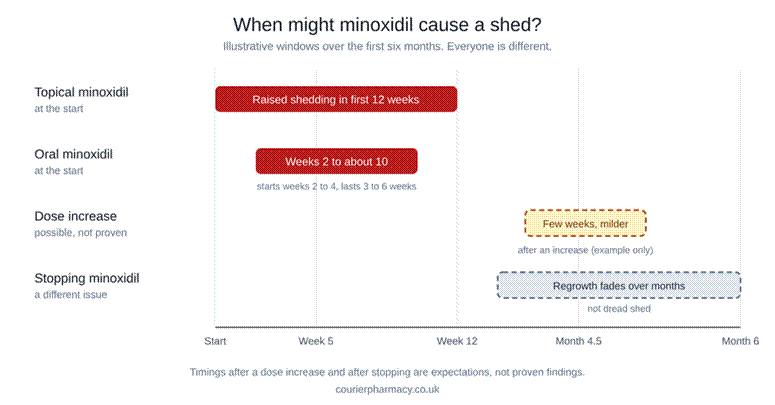
Most people notice minoxidil dread shed between two and four weeks after starting. In a review of low-dose oral minoxidil, it typically lasted three to six weeks (Nohria et al., 2024). An NHS patient leaflet from Royal Berkshire NHS Foundation Trust says the extra shedding usually settles within the first six weeks (Royal Berkshire NHS Foundation Trust, 2025).
Topical minoxidil follows a similar pattern. In a 2025 study of 49 people using 2% or 5% minoxidil on the scalp, hair shedding rose temporarily during the first 12 weeks. The shedding lasted longer in the 2% group than in the 5% group (Bi et al., 2025).
So the honest answer to “minoxidil shedding how long?” is this: a few weeks for many people, and up to around three months for some.
A rough timeline
- Weeks 1 to 2: Often nothing obvious. Some people notice a little extra hair fall straight away.
- Weeks 2 to 4: The shed typically starts.
- Weeks 4 to 12: The shed peaks and then settles. Hair loss should return towards your usual level.
- Months 3 to 6: Early signs of new, finer hairs may appear. Thicker, more noticeable hair takes longer.
You can read more about the full results timeline in our guide on how long minoxidil takes to work.

How common is it?
This depends on who you ask, and how they count. A study of 435 people on low-dose oral minoxidil found that 32% reported more hair fall than usual (Sanabria et al., 2021). A later chart review of 115 patients at one US clinic found that only 5.2% had dread shed (Nohria et al., 2024).
Why the gap? The first study relied on people reporting side effects themselves. The second relied on what was written in clinic notes. Mild shedding is easy to miss, or to forget to mention. The truth is probably somewhere in between, and not everyone sheds.
Oral versus topical minoxidil
Both forms can cause a shed, because the drug works in the same way. Oral minoxidil for hair loss is prescribed off-label, which means it’s not licensed for this use but is supported by growing clinical evidence. For safety information on both forms, see our minoxidil side effects guide.
There’s one practical difference. With a liquid or foam, you can see exactly where you’ve applied it, and the effects stay mostly on the scalp. With tablets, the medicine travels around the whole body, so oral minoxidil shedding sits alongside other possible effects, such as light-headedness, fluid retention and extra body hair. That’s one reason oral minoxidil needs a proper prescriber check first, including your blood pressure and any heart history.
Does it differ for men and women?
The mechanism is the same, so both can get a shed. Women are often more alarmed by it, simply because thinning hair is spoken about so little, and a bigger plughole can feel isolating. Neither experience is a sign that something is going wrong.
What does a shed feel like day to day?
Most people describe the same few things: more hair on the pillow, more in the shower, and a sudden awareness of every strand on the bathroom floor. Some notice that their parting looks a little wider for a few weeks. It can be unsettling, especially in bright light.
It helps to remember that a shed is a snapshot of a process, not the finished picture. The hair you can’t see yet, the new growth under the surface, is exactly what you’re waiting for. Think of it like a garden in early spring. It looks messy while the old growth is cleared, long before the new shoots show.
Is a bigger shed a good sign?
Possibly, but don’t read too much into it. In the 2025 topical study, people who shed more early on tended to see greater improvement by week 24 (Bi et al., 2025). That’s a small, retrospective study, though. Shedding doesn’t guarantee that minoxidil will work, and plenty of people respond well without a noticeable shed. Think of it as a sign that the hair cycle is moving, not a prediction of your final result.
Does minoxidil dread shed happen again when you increase the dose?
This is the question we hear a lot, and it deserves a straight answer: we don’t know for certain.
What the research says
Studies of minoxidil dread shed look at what happens when someone starts treatment. In the New York study, dread shed was defined as new shedding that began after starting low-dose oral minoxidil (Nohria et al., 2024). We couldn’t find a trial that tracks shedding after a minoxidil dose increase. A 2025 review of transient shedding across hair loss treatments also found that few studies clearly defined when shedding started or how long it lasted (Journal of Clinical and Aesthetic Dermatology, 2025).
What’s plausible
Here’s the logic. A higher dose may recruit more resting follicles into the growing phase. If that happens, a fresh batch of old hairs could be pushed out. So a second, milder shed after an increase is biologically reasonable. Clinicians and patients do report it. But it’s an observation, not a proven effect, and we shouldn’t present it as settled.
What to expect if it happens
If you do see more hair fall after your minoxidil dose goes up, it’s usually:
- Milder than the first shed
- Short, often a few weeks
- Not a reason to stop or to take extra tablets
How we reduce the risk
Prescribers often start oral minoxidil at a low dose and increase it gradually. This gives your scalp smaller steps to adjust to. It also gives us a chance to check your blood pressure, pulse and any swelling at each stage. Never change your dose yourself. Your prescriber chooses each step based on your response and your health.
There’s a trade-off here. Slower increases may make any extra shedding gentler, but they also mean it can take longer to reach the dose that suits you. Neither approach is right for everyone. What matters is that the plan is agreed with your prescriber, reviewed regularly and based on how your hair and your body respond.
One tip that doesn’t work: continuing topical minoxidil while starting the oral form. The NYU study found that overlapping the two didn’t significantly reduce dread shed (Nohria et al., 2024).

A real-world way to think about it
Imagine two people. The first starts oral minoxidil at a low dose, sheds a bit in week three, and the shed fades by week eight. The second does the same, but when their dose is increased at month four, they notice a few extra weeks of hair fall. Both are plausible. Both are usually temporary. The difference is simply how each person’s follicles respond to each step.
The useful question isn’t “Why is this happening to me?” It’s “Does this fit a pattern that settles, or does it look different?” Keeping a simple note of your dose changes and the dates when your shedding rises will help your prescriber answer that quickly.
When it might not be dread shed
If shedding is heavy, lasts well beyond three or four months, or starts long after a dose change, other causes are worth checking. Common ones include a recent illness, major stress, rapid weight loss, childbirth, low iron or thyroid problems. These can cause a different type of shedding called telogen effluvium. Your GP can arrange blood tests if needed.

What if you stop minoxidil, miss doses or restart?
Minoxidil only works while you use it. If you stop, the hair cycle drifts back to where it was, and regrown hair is usually lost over the following months. That’s a different thing from minoxidil dread shed. It’s the benefit fading, rather than a reset at the start.
Restarting after a long break may bring a fresh shed, because your follicles have to be moved on again. That’s a reasonable expectation rather than a proven finding, so it’s worth planning for. If you’ve had a long gap, tell your prescriber before restarting. For oral minoxidil in particular, they may want to check your blood pressure and dose again first.
Occasional missed doses aren’t a reason to panic. Just carry on as prescribed and don’t double up.
Common myths about minoxidil dread shed
A few ideas do the rounds online. Here’s what the evidence says.
- Myth: Shedding means minoxidil isn’t suitable for you. Fact: Shedding is a known effect of how minoxidil changes the hair cycle, and it’s often temporary.
- Myth: A bigger shed always means better results. Fact: One small study linked the two, but it isn’t a reliable prediction for any one person.
- Myth: Everyone gets minoxidil dread shed. Fact: Studies range from around 5% to around a third of people, depending on how it’s measured.
- Myth: You can avoid it by taking a lower dose forever. Fact: A lower dose may be gentler, but it may also be less effective, and there’s no proven way to prevent a shed.
- Myth: Shedding is permanent hair loss. Fact: The hairs that fall are thought to be ones that were due to leave soon anyway, and new hairs replace them.
What can you do during minoxidil dread shed?
You can’t switch a shed off, but you can make it easier to get through.
- Keep going. Stopping early is the most common reason people lose the benefit before it arrives.
- Take a photo once a month, in the same light and from the same angles. Photos tell you more than a plughole does.
- Don’t count hairs every day. Anxiety makes the numbers look worse.
- Be gentle. Avoid tight styles, harsh heat and rough brushing, which add breakage on top of shedding.
- Take your minoxidil exactly as prescribed. Don’t double up, and don’t skip doses.
- Ask your GP about blood tests if you’re also tired, low in energy or have other symptoms.
- Be kind to yourself. Hair loss affects confidence, and wanting support is perfectly reasonable.
A few small habits can make the weeks feel less stressful. Wash your hair as you normally would, because a shed isn’t caused by shampooing, and washing simply shows you hairs that were already loose. Brush gently rather than avoiding the brush entirely. Try to look at the whole picture over three to six months, not the daily snapshot. Minoxidil dread shed is a short chapter, not the whole story.

Compounding at Courier
When the standard option isn’t the right fit, we can make one to order
Courier is a compounding pharmacy. Where a prescriber decides it’s appropriate for you, we can prepare bespoke, made-to-order preparations — tailored to the individual, under full clinical governance. It’s the same principle that runs through everything we do.
When should you speak to a clinician?
Get advice if:
- Heavy shedding continues beyond about four months
- You notice bald patches, or the scalp is red, sore, scaly or painful
- You have dizziness, a fast heartbeat, chest pain, breathlessness or swollen ankles on oral minoxidil
- Your shedding started long after a dose change, or came on suddenly
- You’re thinking about stopping minoxidil because of the shed
Frequently asked questions

1. What is minoxidil dread shed?
Minoxidil dread shed is a temporary increase in hair shedding after you start minoxidil. It happens because minoxidil shortens the resting phase of the hair cycle, so old hairs fall out to make room for new ones. It usually begins two to four weeks after starting and settles within weeks.
2. How long does minoxidil dread shed last?
For most people, minoxidil shedding lasts about three to six weeks, though some studies show increased shedding for up to 12 weeks. The NHS leaflet we reviewed says it usually settles within the first six weeks.
3. Does oral minoxidil shedding differ from topical minoxidil shedding?
Both forms can cause shedding because they work in the same way. Oral minoxidil shedding has been studied in low-dose oral treatment, and topical minoxidil shedding has been studied in a 2025 study of 49 people. Neither is more or less normal than the other.
4. Will I shed again if my minoxidil dose goes up?
Possibly, but it isn’t proven. There are no trials of shedding after a minoxidil dose increase. If it happens, it’s usually milder and shorter than the first shed. Speak to your prescriber if it’s heavy or doesn’t settle.
5. Does shedding mean minoxidil is working?
Not necessarily. A small 2025 study linked a bigger early shed with better results by week 24, but shedding isn’t proof of success, and you can respond well without it.
6. Can I prevent minoxidil dread shed?
Not reliably. There’s no proven way to avoid minoxidil dread shed. Starting at a lower dose and increasing gradually may make it gentler, but overlapping topical and oral minoxidil didn’t significantly reduce it in one study.
7. Should I stop minoxidil if I’m shedding?
Usually no, particularly if it looks like minoxidil-related shedding. Stopping early removes any chance of benefit, and the shed is normally temporary. Speak to your prescriber if you’re worried or have other symptoms.
8. Can I get a shed if I stop and restart minoxidil?
It’s possible. If you stop, regrown hair usually fades over the following months, and restarting may move follicles on again. This is a reasonable expectation rather than a proven finding, so tell your prescriber before you restart after a long gap.
9. When should I worry about shedding on minoxidil?
Seek advice if heavy shedding continues beyond about four months, you notice bald patches, your scalp is sore or inflamed, or you feel unwell on oral minoxidil. Other causes like iron deficiency, thyroid problems or stress may need checking.
10. Does minoxidil dread shed mean permanent hair loss?
No. The hairs that fall during minoxidil-related shedding are thought to be ones that were due to leave soon anyway, and new hairs replace them. The shed is temporary, even though it can feel alarming.
Disclaimer
Disclaimer: This information is for education only and isn’t a substitute for personal medical advice. Always follow your prescriber’s instructions.
References
- Bi, L., Kan, H., Wang, J., Ding, Y., Huang, Y., Wang, C., Du, Y., Lu, C., Zhao, M., Sun, W., Su, T. and Fan, W. (2025) ‘Whether the transient hair shedding phase exist after minoxidil treatment and does it predict treatment efficacy? A retrospective study in androgenetic alopecia patients’, Journal of Dermatological Treatment, 36(1), 2480739. doi: 10.1080/09546634.2025.2480739.
- Courier Pharmacy (n.d.) How long does it take for minoxidil to work? Available at: https://courierpharmacy.co.uk/how-long-does-it-take-for-minoxidil-to-work/ (Accessed: 13 November 2026).
- Courier Pharmacy (n.d.) Minoxidil side effects: a UK patient’s guide for 2026. Available at: https://courierpharmacy.co.uk/minoxidil-side-effects-a-uk-patients-guide-for-2026/ (Accessed: 13 November 2026).
- Journal of Clinical and Aesthetic Dermatology (2025) ‘Transient treatment-induced hair loss across androgenetic alopecia therapies’, Science of Skin Summit 2025, abstract 121. Available at: https://jcad.mydigitalpublication.com/articles/121-transient-treatment-induced-hair-loss-across-androgenetic-alopecia-therapies (Accessed: 13 November 2026).
- Nohria, A., Desai, D., Sikora, M., Mandal, S., Shapiro, J. and Lo Sicco, K. (2024) ‘Combating “dread shed”: the impact of overlapping topical and oral minoxidil on temporary hair shedding during oral minoxidil initiation’, JAAD International, 15, pp. 220-224. doi: 10.1016/j.jdin.2024.03.005.
- Royal Berkshire NHS Foundation Trust (2025) Minoxidil for hair loss [patient information leaflet], October. Available at: https://www.royalberkshire.nhs.uk/media/n3onzj1d/minoxidil-for-hair-loss_oct25.pdf (Accessed: 13 November 2026).
- Sanabria, B., de Nardo Vanzela, T., Miot, H.A. and Ramos, P.M. (2021) ‘Adverse effects of low-dose oral minoxidil for androgenetic alopecia in 435 patients’, Journal of the American Academy of Dermatology, 84(4), pp. 1175-1178. doi: 10.1016/j.jaad.2020.11.035.