
Your friendly starting point for TRT
Ever wondered why your mate at the gym keeps mentioning “TRT”, or why it pops up in every men’s health podcast? So, what is TRT? It stands for testosterone replacement therapy, a prescribed medical treatment for men whose bodies don’t make enough testosterone and who have symptoms because of it. That’s the short answer. The longer one is more interesting, and a lot more useful if you’re wondering whether it applies to you.
This guide is for men who feel tired, flat or uninterested in sex and want to know if hormones might be part of the story. It’s also for partners, curious readers and anyone who’s heard wildly different opinions online. We’ll cover what TRT is, who it’s for, how it’s diagnosed, what treatment involves, and how to stay safe.
We’re the pharmacist and prescriber team at Courier Pharmacy in Derby, and we talk about testosterone every week. We’ll keep it plain, honest and (we hope) a little bit fun.
Five key takeaways
- TRT stands for testosterone replacement therapy, a prescription treatment that tops up testosterone in men with a confirmed deficiency.
- A diagnosis needs both symptoms and two low morning blood tests, taken between 7am and 11am on different days.
- Treatment usually comes as a daily skin gel or an injection, and your prescriber sets the type and dose.
- TRT can help sex drive, mood and energy in the right person, but it carries real risks, including thicker blood and lower fertility.
- Regular blood tests are part of the treatment, not an optional extra, and you should only get TRT from a registered UK pharmacy or clinic.
What is TRT, and what does TRT stand for?
TRT stands for testosterone replacement therapy. The word “replacement” is the important bit. The aim is to bring low testosterone back into a normal range, not to push it sky high. Think of it as refilling a tank that’s running low, rather than fitting a turbocharger.
Testosterone is the main male sex hormone. Most of it is made in the testes, with a small amount from the adrenal glands. It helps drive sex drive, erections, muscle, bone strength, red blood cell production, mood and energy. When levels fall low enough to cause symptoms, doctors call it testosterone deficiency or male hypogonadism.
What is TRT testosterone, exactly?
The testosterone used in TRT is chemically the same hormone your body makes. It’s simply delivered in a different way, through a gel on the skin or an injection into muscle or under the skin. In the UK, these are prescription-only medicines. You can see the licensed products listed on the Electronic Medicines Compendium, which holds the official leaflets for each one.
The thermostat in your head
Your testosterone level is controlled a bit like the heating in your house. The brain (the hypothalamus and pituitary gland) acts as the thermostat. It sends a signal hormone called LH to the testes, which then make testosterone. When levels are high enough, the brain turns the signal down. When they drop, it turns it back up.
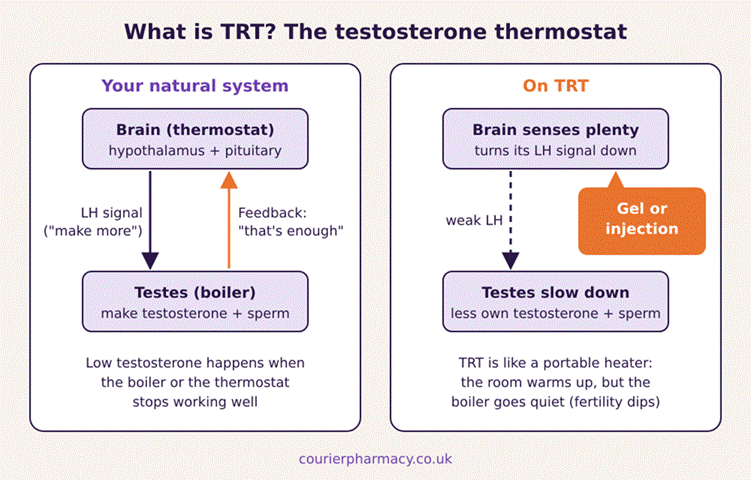
The brain-testes axis works like a thermostat, and TRT adds heat from outside the system.
Low testosterone happens when part of that system stops working well. Sometimes the testes can’t respond (primary hypogonadism). Sometimes the brain isn’t sending enough signal (secondary hypogonadism). TRT adds testosterone from outside the system, a bit like plugging in a portable heater. That explains one of its main side effects, which we’ll come to: when the thermostat senses plenty of heat, it switches off its own signal, and sperm production slows down.
Who is TRT for?
Here’s where it gets practical. TRT is for men who have both symptoms of low testosterone and blood tests that confirm it. One without the other isn’t enough. Plenty of men feel tired for reasons that have nothing to do with hormones, and some men have lowish numbers but feel perfectly fine.
What is TRT for men with low testosterone symptoms?
The NHS lists common symptoms of low testosterone, often grouped under the label “male menopause”. These include:
- low sex drive and fewer morning erections
- erectile problems
- tiredness and low energy
- low mood, irritability or poor concentration
- loss of muscle and more fat around the middle
- hot flushes or sweats (less common)
The European Male Ageing Study found that three sexual symptoms (fewer morning erections, fewer sexual thoughts and erectile problems) were the most closely linked to low testosterone. By its strict definition, only about 2% of older men had true late-onset hypogonadism (Wu et al., 2010). So it’s real, but not as common as social media might suggest.

Who TRT usually isn’t for
TRT isn’t right for everyone, even with low levels. Your prescriber will be careful, or may advise against it, if you:
- are trying for a baby now or soon
- have prostate or breast cancer, or an untreated prostate problem
- already have a high red blood cell count (haematocrit)
- have severe untreated sleep apnoea or uncontrolled heart failure
- have a recent heart attack or stroke
These points come from UK and international guidelines, including the British Society for Sexual Medicine (BSSM) and the Endocrine Society.
How is low testosterone diagnosed before TRT?
A diagnosis is a bit of detective work. Testosterone naturally peaks in the morning and dips later in the day. It also drops after a bad night’s sleep, a heavy session or a nasty cold. A single test can easily mislead.
Why two morning blood tests?
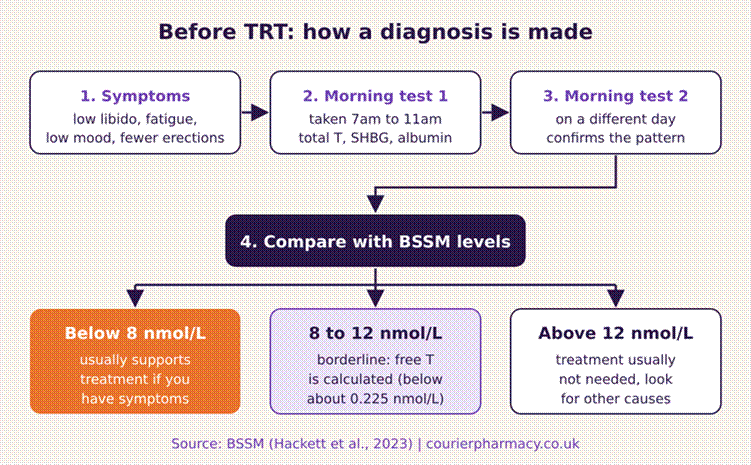
The BSSM guideline recommends two separate morning samples, taken between 7am and 11am, ideally after fasting (Hackett et al., 2023). Two results on different days show whether a low number is a pattern or a one-off. It’s like checking the weather twice before cancelling a barbecue.
Tests usually measure total testosterone, plus SHBG (a protein that carries testosterone in the blood) and albumin. From these, a calculated free testosterone shows how much hormone is actually available to your tissues. You can do this with a home blood test kit, using a simple finger-prick sample.
The BSSM action levels
The BSSM uses these broad levels to guide decisions. Symptoms still matter in every case.
| Total testosterone | What it usually means |
| Below 8 nmol/L | Usually supports treatment if you have symptoms |
| 8 to 12 nmol/L | Borderline, so free testosterone is calculated* |
| Above 12 nmol/L | Treatment usually not needed |
- Less than 14 nmol/L in pre diabetic men
Symptoms plus two morning tests, compared with BSSM action levels, guide the decision.
In the borderline zone, a calculated free testosterone below about 0.225 nmol/L supports a trial of treatment. Your prescriber will also look for causes worth treating first, such as weight, medicines, sleep problems or a pituitary issue.
What is TRT treatment like in practice?
So you’ve been diagnosed. What does treatment actually look like day to day? There are two main routes in the UK, and your prescriber picks the right one with you. They also set the dose, which is adjusted using your blood results.
Testosterone gel
Testosterone gel is rubbed onto clean, dry skin once a day, usually on the shoulders, upper arms or tummy, depending on the product. It gives steady levels and is easy to stop if needed. The catch is that it can transfer to other people through skin contact. The patient leaflet advises washing your hands, letting the gel dry and covering the area with clothing. That matters most if you have a partner or young children at home.
Testosterone injections
Injections come in different types. Shorter-acting ones, such as testosterone cypionate, are often given every week or two. Longer-acting testosterone undecanoate is usually given every 10 to 14 weeks, once levels are settled. Some men like not having to think about a daily gel. Others prefer the gel because they’re not keen on needles. Neither is “better”; it’s about what suits you and your blood results.
Bespoke and fertility-friendly options
For some men, a standard product isn’t quite the right fit. Courier Pharmacy works with a specialist compounding partner to prepare bespoke preparations when clinically appropriate. For men who want to protect fertility, prescribers may discuss other options.
What TRT can and can’t do for you
It helps to go in with realistic expectations. TRT isn’t a fountain of youth, and anyone promising that should make you suspicious.
Realistic benefits
In men with a confirmed deficiency, studies show TRT can improve sex drive, erections, mood and sometimes energy. It can also help muscle mass and bone strength over time. Some effects, like libido, can start within weeks. Others, like bone strength, take many months.
TRT won’t fix tiredness caused by poor sleep, stress or an underactive thyroid. It’s not a weight-loss treatment either, although some men find it easier to stay active once they feel better.
Honest risks and side effects
Like any medicine, TRT has downsides. The main ones are:
- thicker blood (raised haematocrit), which can raise the risk of clots
- reduced sperm production and fertility
- acne or oily skin
- breast tenderness or swelling
- fluid retention and ankle swelling
- worsening of sleep apnoea
- gel transferring to partners or children
The big question people ask is about the heart. The large TRAVERSE trial followed men with low testosterone and high heart risk. It found no increase in major heart events compared with placebo. However, the TRT group had more atrial fibrillation, acute kidney injury and blood clots in the lungs (Lincoff et al., 2023). That’s why monitoring isn’t optional.
Why monitoring is part of TRT treatment
Starting TRT is the beginning, not the finish line. Regular blood tests check that your testosterone sits in a sensible range and that side effects aren’t creeping up quietly.
The BSSM suggests checking bloods at around 3 to 6 months, then once a year. At Courier Pharmacy, our pathway checks at 1, 6 and 12 months, then yearly. Each check usually includes:
- testosterone levels, to make sure the dose is right
- haematocrit, to spot thickening blood early
- PSA, a prostate marker
- other health markers, depending on your history
A handy tip: book your next blood test when you get your current results. It’s much easier than remembering in six months. If your haematocrit climbs, your prescriber might lower the dose, change the type of treatment or pause it for a while.

Is TRT legal, and where should you get it?
Yes. Prescribed TRT from a registered UK pharmacy or clinic is completely legal. However, testosterone bought without a prescription from unregulated websites is a different story.
In the UK, anabolic steroids, including testosterone, are Class C drugs under the Misuse of Drugs Act 1971. Having them for personal use isn’t an offence, but supplying them, or importing them by post or courier, is. Products from unregulated sellers may also be counterfeit, under-dosed or contaminated. There’s no medical check and no monitoring, which is where the real harm happens.
Before using any online pharmacy, check it on the General Pharmaceutical Council register. You can see Courier Pharmacy’s GPhC entry here.
How Courier Pharmacy can help with TRT
Pay-as-you-go TRT at Courier Pharmacy
Already diagnosed with low testosterone and settled on a dose? Then you may not need a full managed programme every month. Our Pay-as-you-go TRT service is a simpler, lower-cost way to keep your treatment going. There’s no subscription and no repeat consultation fee. You pay for your treatment when you need it.
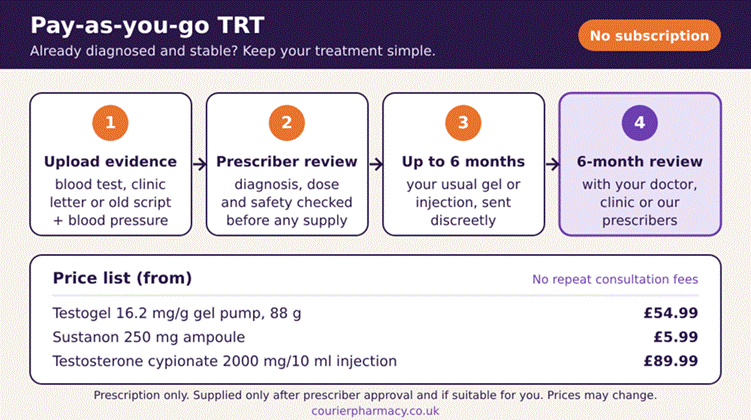
Pay-as-you-go TRT: upload your evidence, prescriber review, up to six months’ supply, then a six-month review.
How pay-as-you-go TRT works
- Upload your evidence. Send a recent blood test, your clinic letter, patient notes or previous prescription, plus a recent blood pressure reading.
- A prescriber reviews it. Nothing is supplied until a Courier prescriber has checked your diagnosis, dose and safety.
- Get up to six months’ supply. Once approved, you can order up to six months of your usual testosterone in one go, delivered discreetly.
- Have a six-month review. Before any further supply, you’ll need a review, either with your own doctor or clinic or with one of our prescribers.
Who it’s for, and who it isn’t
It suits men who are already diagnosed and stable on TRT through the NHS, a private clinic or their GP. It isn’t for men starting TRT from scratch or self-diagnosing. If you’re hoping to father children, or you’ve had prostate or breast cancer, you’ll need a fuller assessment first.
Pay-as-you-go TRT prices
Because there are no repeat consultation fees or clinic overheads built in, you only pay for the treatment itself. Here’s our current price list:
| Treatment | Price |
| Testogel 16.2 mg/g gel pump, 88 g | from £54.99 |
| Sustanon 250 mg ampoule | from £5.99 |
| Testosterone cypionate 2000 mg/10 ml (200 mg/ml) injection | from £89.99 |
Prices are correct at the time of writing and may change. All of these are prescription-only medicines. Your prescriber matches you to what you already use where possible, and won’t supply any option that isn’t safe or suitable for you. Monitoring of your testosterone, haematocrit, PSA and blood pressure still matters, at intervals agreed with your prescriber.
Want the full details? Visit our Pay-as-you-go TRT page or read our guide to pay-as-you-go TRT.
Frequently asked questions

What is TRT in simple terms?
TRT is a prescription treatment that tops up testosterone in men whose bodies don’t make enough. It’s given as a daily skin gel or a regular injection. The aim is to bring levels back into a normal range and ease symptoms like low sex drive, tiredness and low mood. It needs a proper diagnosis and regular blood tests.
What does TRT stand for?
TRT stands for testosterone replacement therapy. “Replacement” means the treatment replaces the testosterone your body isn’t making in large enough amounts. It’s sometimes also called testosterone therapy or androgen replacement. In the UK, it’s a prescription-only treatment, so you need a clinical assessment and blood tests from a doctor, pharmacist prescriber or registered clinic first.
What is TRT for men used to treat?
TRT is used to treat testosterone deficiency, also called male hypogonadism. This means low testosterone that’s confirmed by blood tests and causes symptoms. Common symptoms include low libido, erection problems, fatigue, low mood and loss of muscle. It’s not meant for men with normal levels who want better gym results or extra energy.
What is TRT therapy like day to day?
Day to day, TRT usually means rubbing a gel onto your skin each morning or having an injection every week to every few months, depending on the type. You’ll also have blood tests at set points to check your levels and safety. Most men find it fits easily into normal life once the routine is settled.
How do I know if I need TRT?
You’ll only know if you need TRT after a proper assessment. That means having symptoms of low testosterone and two low morning blood tests taken on different days. A prescriber then looks at your whole health picture. A free symptom checklist, such as the ADAM questionnaire, is a sensible first step before testing.
What testosterone level do you need for TRT?
UK BSSM guidance says total testosterone below 8 nmol/L usually supports treatment if you have symptoms. Between 8 and 12 nmol/L is borderline, so free testosterone is calculated to help decide. Above 12 nmol/L, treatment usually isn’t needed except in pre diabetic men where the cut off is 14nmol/L. Levels must be confirmed with two morning samples, and symptoms always count too.
Is TRT safe?
TRT is generally safe when it’s properly prescribed and monitored. The large TRAVERSE trial found no rise in major heart events versus placebo in high-risk men. However, it did show more atrial fibrillation, kidney injury and lung clots. Other risks include thicker blood and lower fertility, so regular blood tests matter.
Does TRT affect fertility?
Yes, TRT usually reduces sperm production, sometimes to very low levels. This happens because outside testosterone tells the brain to switch off its signals to the testes. If you’re planning a family, tell your prescriber before starting. There are fertility-preserving options, and the right choice depends on your situation and your prescriber’s advice.
Is TRT the same as taking steroids?
TRT uses testosterone, which is legally an anabolic steroid, but it’s very different from steroid misuse. TRT aims to restore normal levels under medical supervision, with regular safety checks. Steroid misuse often involves high doses, no prescription and no monitoring. That’s where most of the serious harm comes from, along with counterfeit products.
Can I get TRT online in the UK?
Yes, you can get TRT online legally from a GPhC-registered pharmacy that carries out a proper assessment, blood tests and ongoing monitoring. Always check the pharmacy on the GPhC register first. Avoid websites selling testosterone without a prescription, as products may be fake and there’s no medical safety net.
Disclaimer
Disclaimer: This information is for education only and isn’t a substitute for personal medical advice. Always follow your prescriber’s instructions.
References
TRT Guidelines
- Bhasin, S. et al. (2018) ‘Testosterone therapy in men with hypogonadism: an Endocrine Society clinical practice guideline’, Journal of Clinical Endocrinology and Metabolism, 103(5), pp. 1715-1744. Available at: https://pubmed.ncbi.nlm.nih.gov/29562364/ (Accessed: 29 October 2026).
- Hackett, G. et al. (2023) ‘The British Society for Sexual Medicine guidelines on male adult testosterone deficiency, with statements for practice’, The World Journal of Men’s Health, 41(3), pp. 508-537. Available at: https://doi.org/10.5534/wjmh.221027 (Accessed: 29 October 2026).
- Hackett, G. (2023) ‘A practical guide to the assessment and management of testosterone deficiency’, Trends in Urology & Men’s Health. Available at: https://bssm.org.uk/wp-content/uploads/2023/08/Trends-Urol-Men-s-Health-2023-Hackett-A-practical-guide-to-the-assessment-and-management-of-testosterone-deficiency-1.pdf (Accessed: 30 October 2026).
Cardiovascular safety of TRT
- Lincoff, A.M. et al. (2023) ‘Cardiovascular safety of testosterone-replacement therapy’, New England Journal of Medicine, 389(2), pp. 107-117. Available at: https://doi.org/10.1056/NEJMoa2215025 (Accessed: 29 October 2026).
TRT Screening
- Morley, J.E. et al. (2000) ‘Validation of a screening questionnaire for androgen deficiency in aging males’, Metabolism, 49(9), pp. 1239-1242. Available at: https://pubmed.ncbi.nlm.nih.gov/11016912/ (Accessed: 29 October 2026).
- National Health Service (no date) Male menopause. Available at: https://www.nhs.uk/conditions/male-menopause/ (Accessed: 29 October 2026).
- Wu, F.C.W. et al. (2010) ‘Identification of late-onset hypogonadism in middle-aged and elderly men’, New England Journal of Medicine, 363(2), pp. 123-135. Available at: https://eprints.gla.ac.uk/43001 (Accessed: 29 October 2026).
Licensed TRT medicines
- Electronic Medicines Compendium (2025) Testogel 16.2mg/g gel: Patient Information Leaflet. Available at: https://www.medicines.org.uk/emc/product/8919/pil (Accessed: 29 October 2026).
- Electronic Medicines Compendium (no date) Testosterone: products list. Available at: https://www.medicines.org.uk/emc/ingredient/77 (Accessed: 29 October 2026).
Legal status of testosterone
- Medicines and Healthcare products Regulatory Agency (no date) PT jailed for sale of steroids and unlicensed medicines online. Available at: https://www.gov.uk/government/news/pt-jailed-for-sale-of-steroids-and-unlicensed-medicines-online (Accessed: 29 October 2026).
Further reading from Courier Pharmacy
- Ahsan, S. (2026) ‘A comprehensive timeline: the development of testosterone replacement therapy’, Courier Pharmacy, 8 February. Available at: https://courierpharmacy.co.uk/a-comprehensive-timeline-the-development-of-testosterone-replacement-therapy/ (Accessed: 30 October 2026).