

The claim that testosterone “causes prostate cancer” is often traced to a 1941 experiment by Charles Huggins and Clarence Hodges. The key criticism is partly right: later historical reviews report that the specific inference that testosterone stimulated prostate cancer rested on one patient’s response. But it is misleading to leap from that point to “the whole idea is disproved.” The 1941 paper examined a wider group of men, later studies showed that testosterone can stimulate some already-established metastatic prostate cancers, and modern trials answer a narrower question: whether medically prescribed replacement testosterone increases prostate events in carefully screened men over a limited period.
Introduction
Few ideas in men’s health have proved as durable as the belief that testosterone causes prostate cancer. It shapes how clinicians talk about testosterone replacement therapy (TRT), how patients weigh treatment, and why many men with low testosterone are told it is too risky. The idea is usually traced to a 1941 study by Charles Huggins and Clarence Hodges, work that helped lay the foundations of hormone therapy for advanced prostate cancer. [1], [2]
In recent years, that origin story has been challenged. Historical reviews report that the specific inference that testosterone stimulated prostate cancer rested on the response of a single patient. [3] For some commentators, this is enough to declare the whole link between testosterone and prostate cancer a myth.
That conclusion goes too far. The 1941 paper examined a wider group of men, later studies showed that testosterone can stimulate some already-established metastatic prostate cancers, and androgen deprivation remains a mainstay of treatment for advanced disease. [1], [4], [6] Modern trials answer a narrower question: whether medically prescribed replacement testosterone increases prostate events in carefully screened men over a limited period. [7], [8]
This article sets out what Huggins and Hodges actually reported, what later evidence adds, and why the real correction lies in separating three different questions: whether testosterone starts a cancer, whether it fuels a cancer that already exists, and whether carefully monitored TRT is safe in selected men.
Key takeaways
- The 1941 Huggins and Hodges study measured serum acid phosphatase, a blood biomarker, in men with advanced prostate cancer, and the inference that testosterone stimulated cancer rested on one patient’s response. It was never evidence that testosterone initiates cancer in healthy men. [1], [2], [3]
- The one-patient criticism does not overturn androgen biology. Many prostate cancers depend on androgen-receptor signalling, and androgen deprivation can reduce tumour activity in advanced disease. [4], [5]
- A 1981 retrospective series found an unfavourable response in 45 of 52 evaluable men with metastatic prostate cancer given testosterone, so the claim that testosterone cannot stimulate prostate cancer is untenable. [6]
- In a placebo-controlled trial of 5,204 screened hypogonadal men treated for about 22 months, prostate events were uncommon and did not differ significantly between testosterone and placebo, although the high-grade cancer estimate was imprecise. [7]
- A small, 12-week 2026 trial in selected post-prostatectomy survivors found no biochemical recurrence, but its results do not apply to men with active, high-grade or untreated disease. [8]
What happened in 1941
Huggins and Hodges studied men with advanced prostate cancer, including men with bone metastases.[1] In the endocrine-treatment portion of the work, eight men underwent surgical castration, and three received testosterone injections before the procedure.[2] Their principal laboratory signal was serum acid phosphatase, now understood largely as prostatic acid phosphatase; it was a biomarker, not a direct measure of tumour size, new-cancer incidence or survival. [1] Later historical reviews report that the inference that testosterone stimulated cancer rested on one patient’s response.[3]
That distinction matters. A rise in a tumour-associated blood marker after an injection in one man with known metastatic disease is a signal worth investigating; it is not proof that testosterone initiated cancer, nor a reliable estimate of what would happen in other patients. The study was an important early clinical observation, not a controlled trial designed to establish the risks of routine testosterone replacement in otherwise cancer-free men.
A weak origin story does not erase androgen biology
The strongest correction is not “testosterone has nothing to do with prostate cancer.” Many prostate cancers depend on signalling through the androgen receptor, a cellular pathway activated by testosterone and related hormones. Suppressing androgen signalling can reduce tumour activity and is a mainstay of treatment for advanced disease; cancers can later adapt and become resistant, often while continuing to use that pathway.[4] The history of treatment therefore provides evidence beyond the one testosterone-response observation: reducing androgen exposure can benefit some men with established cancer.

Figure 1. Androgen-receptor signalling supports many prostate cancers; androgen deprivation may reduce tumour activity, while some cancers adapt and reactivate the pathway., [4], [5]
There is also later evidence that testosterone can stimulate certain existing cancers. A 1981 retrospective review examined 67 men with metastatic prostate cancer given exogenous testosterone. Among the 52 whose responses could be evaluated, 45 had an unfavourable response; the response varied with disease status and prior endocrine treatment.[6] Because this was a retrospective series without a randomised comparison group, it cannot tell us how often testosterone causes progression in all settings. But it makes an absolute claim—“testosterone cannot stimulate prostate cancer”—untenable. The defensible distinction is between stimulating some androgen-responsive tumours that already exist and causing a new cancer to arise.
What modern testosterone studies do—and do not—say
Evidence on testosterone replacement therapy (TRT) in men screened to exclude high prostate-cancer risk is more reassuring, but narrower than a blanket safety claim. In a placebo-controlled trial, 5,204 men with hypogonadism were analysed; men with PSA above 3 ng/mL or severe urinary symptoms were excluded. Over an average treatment period of about 22 months, prostate events were uncommon and did not differ significantly between testosterone gel and placebo. High-grade prostate cancer occurred in 5 of 2,596 testosterone-treated men and 3 of 2,602 placebo-treated men; the estimate was imprecise (hazard ratio 1.62, 95% CI 0.39–6.77), so the trial did not establish that risk was identical or zero.[7]
A 2026 randomised trial studied a different, carefully selected group: 136 men with low-grade, organ-confined cancer who had undergone prostatectomy and had undetectable PSA for at least two years. No biochemical recurrence occurred in either group during 12 weeks of treatment. The investigators emphasised that the trial was too small and short to establish long-term cancer safety, and its results do not apply to men with active or high-grade disease.[8] These findings challenge the idea that testosterone must always be withheld from every man with any past prostate-cancer diagnosis, but they do not settle treatment for men with untreated cancer.
One proposed explanation is the “saturation model”: prostate tissue may respond strongly when androgen levels are very low, with less additional response across much of the usual physiological range. That model may help explain why androgen deprivation can work even though higher testosterone within normal ranges does not consistently track with prostate-cancer risk. It should not be presented as settled law, however; a methodological review has questioned whether some evidence used to support the model was interpreted too broadly.[9]
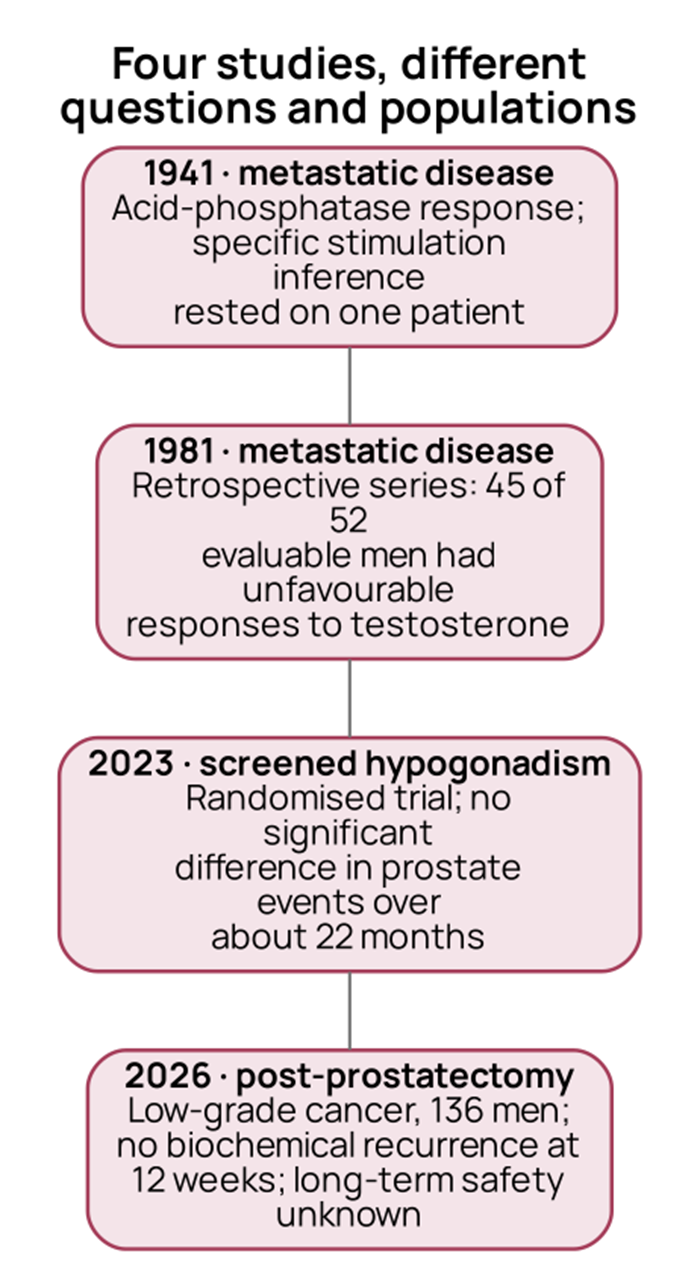
Figure 2. The 1941 testosterone-stimulation inference rested on one patient’s response; the 1981 series concerned men with metastatic disease. [3], [6] Later randomised trials studied screened hypogonadal men and selected post-prostatectomy survivors, with limited follow-up.[7], [8]
The accurate conclusion
The one-patient criticism narrows what the 1941 testosterone experiment could prove. It does not overturn the broader evidence that androgens can support the growth of some established prostate cancers. Equally, evidence that androgen deprivation treats cancer does not prove that ordinary physiological TRT causes cancer to develop. The evidence supports neither simple slogan. A fair reading is that testosterone’s effects depend on the disease context, the tumour’s biology, the dose and the patient population—and that evidence from screened men or cancer survivors after surgery must not be casually extended to men with active metastatic disease.
Bottom line: The 1941 “one man” observation is not proof that testosterone causes prostate cancer. It is also not a reason to dismiss androgen-dependent tumour growth, which is supported by broader clinical evidence. The real correction is to stop conflating cancer initiation, growth of an existing tumour and carefully monitored testosterone replacement.
Disclaimer
This information is for education only and isn’t a substitute for personal medical advice. Always follow your prescriber’s instructions.
References
- W. G. Nelson, “Commentary on huggins and hodges: “Studies on prostatic cancer”,” Cancer Research, 2016
- Huggins, C. and Hodges, C.V., 1972. Studies on prostatic cancer: I. The effect of castration, of estrogen and of androgen injection on serum phosphatases in metastatic carcinoma of the prostate. CA: a cancer journal for clinicians, 22(4), pp.232-240.
- A. Morgentaler, “Testosterone and prostate cancer: An historical perspective on a modern myth.” European Urology, 2006
- Q. Feng and B. He, “Androgen receptor signaling in the development of castration-resistant prostate cancer,” Frontiers in Oncology, 2019
- R. Kumar, L. A. Sena, S. R. Denmeade, and S. Kachhap, “The testosterone paradox of advanced prostate cancer: Mechanistic insights and clinical implications,” Nature reviews. Urology, 2023
- J. E. Fowler and W. F. Whitmore, “The response of metastatic adenocarcinoma of the prostate to exogenous testosterone,” The Journal of Urology, 1981
- S. Bhasin et al., “Prostate safety events during testosterone replacement therapy in men with hypogonadism,” JAMA Network Open, 2023
- S. Bhasin et al., “Testosterone treatment in prostate cancer survivors with hypogonadism: A randomized clinical trial.” JAMA Internal Medicine, 2026
- J. W. Kim, “Questioning the evidence behind the Saturation Model for testosterone replacement therapy in prostate cancer,” Investigative and Clinical Urology, 2020