

Introduction
Oral iron is usually the first treatment for iron deficiency and iron-deficiency anaemia. However, many people find daily tablets hard to stick with because of gastrointestinal effects such as nausea, constipation or stomach upset. That has fuelled interest in a simple change: taking iron every other day rather than every day.
The idea centres on hepcidin, a hormone that rises after an iron dose and temporarily reduces absorption of the next one. Small absorption studies support this mechanism, showing that spacing doses can improve the fraction of iron absorbed. [1], [2], [3] Clinical trials, however, do not consistently show that this translates into faster or greater haemoglobin recovery. [4], [5], [6]
This article explains the rationale behind alternate-day dosing, what the clinical trials show and how to interpret the evidence. Overall, current comparative evidence suggests that alternate-day dosing can be a practical alternative for some people, especially when tolerability is a concern, but it is not established as superior to daily treatment. The choice depends on the clinical context, elemental-iron dose, response needed and tolerance. So, the take home message is better absoption, but not a settled clinical winner
Key takeaways
- Each oral iron dose can raise hepcidin, which temporarily reduces absorption of the next dose; this is the main rationale for spacing doses. [1], [3]
- In iron-depleted women, 60 mg on alternate days gave greater total iron absorption than the same total dose on consecutive days (175 versus 131 mg), but this study measured absorption, not anaemia recovery. [1]
- Better absorption has not reliably meant better haemoglobin: in a 200-person trial, haemoglobin rose by 1.36 g/dL with daily dosing and 1.05 g/dL with alternate-day dosing, a difference that was not statistically significant. [5]
- A 2025 meta-analysis of 11 randomised trials with 1,014 participants found a small, non-significant haemoglobin advantage for daily dosing and rated the certainty of evidence as very low for most outcomes. [4]
- Alternate-day dosing is a reasonable option for some people, particularly where side effects are a problem, but the schedule should be agreed with a clinician, especially in pregnancy, severe anaemia, children or inflammatory conditions. [4], [7]
Why dosing frequency matters
Oral iron remains a common treatment for iron deficiency and iron-deficiency anaemia, but gastrointestinal effects can make regular use difficult. The dosing question is not simply whether less frequent iron is absorbed more efficiently: it is whether that absorption advantage improves clinically important outcomes while delivering enough total iron over time.
The proposed mechanism centres on hepcidin. In controlled studies, an oral iron dose increased hepcidin and reduced fractional absorption from a subsequent dose given the next day. In a study of iron-depleted women, 60 mg on alternate days yielded greater cumulative fractional absorption than the same total dose on consecutive days (21.8% versus 16.3%) and greater total absorption (175 versus 131 mg). The study measured absorption rather than treatment success in anaemia. [1]
A small isotope study in 19 women with iron-deficiency anaemia found 40–50% higher fractional absorption on an alternate-dose day than on the consecutive-dose day. This supports spacing doses to avoid the period of higher hepcidin, but it still does not establish that alternate-day treatment raises haemoglobin more quickly. [2]
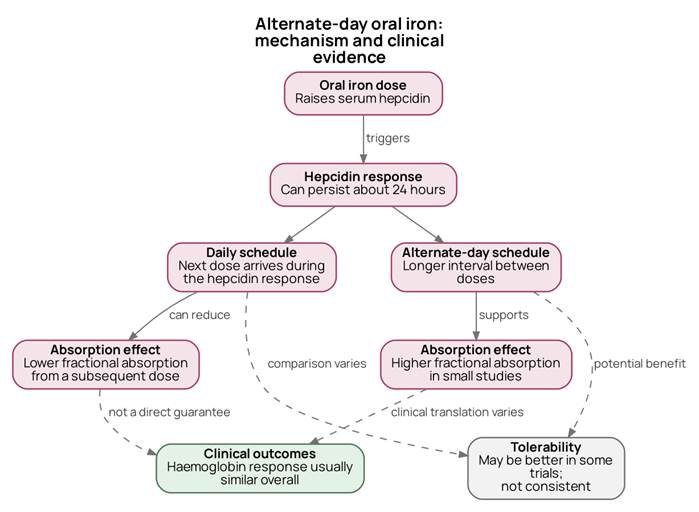
Figure 1. Proposed mechanism and clinical translation: oral iron can raise hepcidin and reduce absorption from a subsequent dose, but the clinical effect of changing schedules remains uncertain. [1], [3], [4]
What clinical trials show
The clinical trial results are mixed rather than uniformly favouring one schedule. In a double-blind trial of 200 adults with iron-deficiency anaemia, participants received 60 mg elemental iron daily or 120 mg on alternate days for eight weeks. Mean haemoglobin increased by 1.36 g/dL in the daily group and 1.05 g/dL in the alternate-day group; the difference was not statistically significant (p=0.47), and no significant differences were found in secondary outcomes. [5]
A smaller randomised trial in 68 women reported a larger haemoglobin increase with alternate-day treatment at day 28 (+2.2 versus +1.3 g/dL; p=0.003) and fewer adverse effects (9% versus 45%). By day 56, the haemoglobin difference was no longer statistically significant. The authors called for larger, longer studies, so this result is encouraging but not definitive. [6]
Pregnancy warrants particular caution in interpretation. In an 88-participant trial of pregnant women with iron-deficiency anaemia, the adjusted difference in haemoglobin change after six weeks was not statistically significant; reported adverse effects and adherence were also similar between daily and alternate-day groups. This small study does not establish that either regimen is preferable across pregnancy or across different levels of anaemia. [7]
At the review level, a 2025 meta-analysis of 11 randomised trials with 1,014 participants found a small, statistically non-significant haemoglobin advantage for daily dosing (mean difference 0.28; 95% CI ?0.01 to 0.56; p=0.06). It found no significant differences in several other iron indices. Side effects were similar overall, although metallic taste was more frequent with daily dosing; certainty was rated very low for most outcomes because of heterogeneity and imprecision. [4]
Taken together, the trials do not show a reliable haemoglobin advantage for alternate-day treatment. They leave open the possibility that its tolerability or early response may be better for some groups, but findings on side effects are inconsistent and the evidence is not precise enough to support a universal claim of superiority.
How to interpret the evidence
Absorption is a mechanistic outcome; haemoglobin recovery and replenishment of iron stores are clinical outcomes. A higher fraction absorbed per dose does not automatically mean more total iron is absorbed over a treatment course, because the schedules may differ in dose size, number of doses and treatment duration. For that reason, comparisons should be interpreted with the elemental-iron dose and total amount delivered in view.
The most defensible conclusion is that alternate-day dosing is a plausible alternative to daily dosing—not a proven upgrade for everyone. A clinician may consider the schedule alongside anaemia severity, the speed of response required, tolerance, the cause of iron loss and the possibility of impaired absorption. The evidence summarised here does not settle the best regimen for severe anaemia, children, pregnancy or inflammatory conditions; those groups need decisions grounded in their specific clinical circumstances.
Conclusion
Alternate-day oral iron has a sound absorption-based rationale, and some trials suggest comparable haemoglobin improvement with fewer adverse effects. But absorption studies are not clinical-outcome trials, and the clinical evidence remains inconsistent and often imprecise. Alternate-day treatment is best viewed as one reasonable schedule among options, with the final choice tailored to the person and monitored for response and tolerance.
References
- N. U. Stoffel et al., “Iron absorption from oral iron supplements given on consecutive versus alternate days and as single morning doses versus twice-daily split dosing in iron-depleted women: Two open-label, randomised controlled trials.” The Lancet Haematology, vol. 4 11, pp. e524–e533, 2017
- N. U. Stoffel, C. Zeder, G. Brittenham, D. Moretti, and M. Zimmermann, “Iron absorption from supplements is greater with alternate day than with consecutive day dosing in iron-deficient anemic women,” Haematologica, 2019
- D. Moretti et al., “Oral iron supplements increase hepcidin and decrease iron absorption from daily or twice-daily doses in iron-depleted young women,” Blood, 2015
- A. Dhanvijay et al., “Efficacy of daily versus alternate day oral iron supplementation for management of anaemia among general population: A systematic review and meta-analysis,” BMC Pharmacology and Toxicology, 2025
- E. Pasupathy, R. Kandasamy, K. Thomas, and A. Basheer, “Alternate day versus daily oral iron for treatment of iron deficiency anemia: A randomized controlled trial,” Scientific Reports, 2023
- M. Dhanush, K. V. Vinod, P. Manivannan, P. Adole, and D. Govindan, “Daily versus alternate day oral iron replacement for women with iron deficiency anaemia: A randomized controlled trial,” Indian Journal of Hematology and Blood Transfusion, 2025
- M. C. Lam et al., “Daily versus alternate-day iron supplementation for pregnant women with iron deficiency anemia: A randomized controlled trial,” American Journal of Perinatology, 2024