

A practical guide to tretinoin schedules, from your first week to long-term maintenance, including nightly use, short-contact application, and signs you’re overdoing it.
Ever wondered why two people on the same cream can have totally different experiences? One glows, the other peels like a sunburnt tourist. Very often, the difference isn’t the strength. It’s how often they use it. So, how often should you use tretinoin? For most people, the answer is two or three nights a week to start, slowly building up to most nights, and then settling into a routine their skin is happy with.
In this guide, we’ll share the schedules we suggest in our consultations, explain why going slowly usually gets you there faster, and help you work out the right rhythm for acne, pigmentation or anti-ageing.
Five key takeaways
- Start with two or three nights a week, spaced apart, and build up over several weeks as your skin settles.
- Many people can eventually use tretinoin every night, but it’s not a race. The best frequency is the one your skin tolerates consistently.
- Use tretinoin at night only. It breaks down in light and makes your skin more sensitive to the sun.
- Short-contact use (washing it off after 30 to 60 minutes) is a useful way to start if your skin is sensitive.
- Once you’re happy with your results, around three times a week can help maintain the benefits for sun-damaged skin.

How often should you use tretinoin? The quick answer
Here’s the short version. Start on two or three non-consecutive nights a week. If your skin feels comfortable after two weeks, add another night. Keep going like this until you reach every other night, then most nights, then nightly if your prescriber agrees.
There’s no prize for getting to nightly use first. Some people stay happily on three or four nights a week for good. Others reach nightly use within two months. Both are fine, as long as your skin is calm and you’re using it consistently.
If you’ve been prescribed Treclin, the licensed combination gel, the product information says to use it once daily at bedtime. Your prescriber may still suggest building up gradually at first. Always follow the instructions on your label.
Why going slowly gets you there faster
Tretinoin is strong stuff. It changes how your skin cells grow and shed. In the first few weeks, your skin is adjusting to that change, and it can feel dry, tight or flaky. This is often called retinisation.
Think of it like starting a new running routine. If you run 10 km on day one, you’ll be too sore to run again for a week. If you start with short jogs a few times a week, you’ll be running regularly within a month. Tretinoin works the same way.
NHS guidance for acne suggests building up the frequency and duration of application over two to three weeks, as this may reduce redness. In our experience, people who rush to nightly use often end up with sore skin, take a week off, and then start again. That stop-start pattern is one of the most common reasons we see for slow results. Our guide on how long tretinoin takes to work explains why consistency matters so much.
How often should you use tretinoin in the first eight weeks?
Here’s a simple schedule we often suggest. Treat it as a starting point, not a rule. If your skin gets sore at any stage, drop back a step.
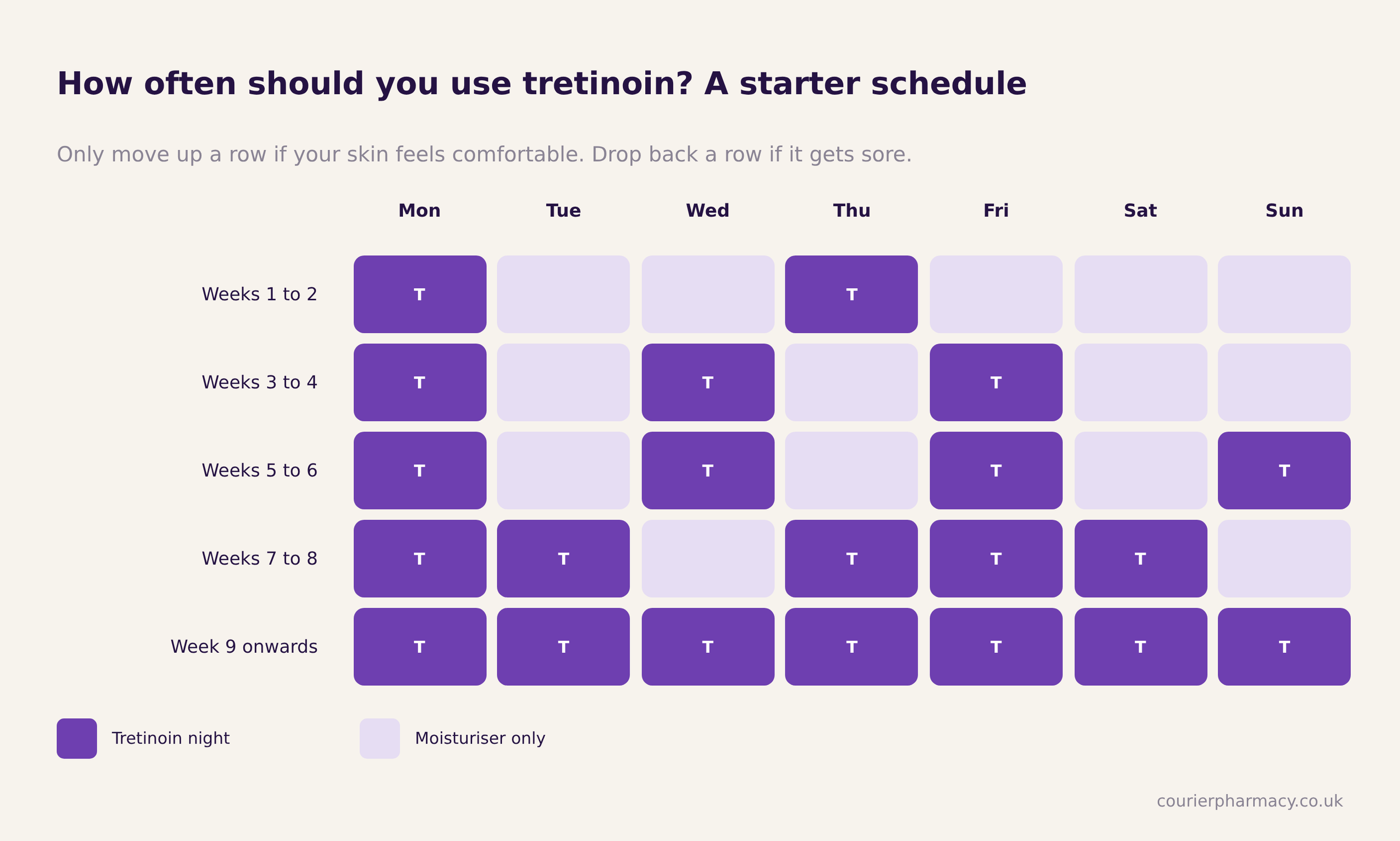
Tretinoin starter schedule grid showing how often you should use tretinoin each week for the first eight weeks
| Weeks | How often | Example nights |
| 1 to 2 | 2 nights a week | Monday and Thursday |
| 3 to 4 | 3 nights a week | Monday, Wednesday, Friday |
| 5 to 6 | Every other night | Alternate nights |
| 7 to 8 | Most nights (5 to 6) | Rest one or two nights |
| 9 onwards | Nightly, if comfortable | Or stay at your comfortable level |
On the nights in between, use a plain, gentle moisturiser and always remember to apply using the sandwich method. For more information about the application of tretinoin, read our blog, “How to apply tretinoin cream”.
Pharmacist’s tip: Pick your tretinoin nights in advance and put them in your phone calendar. “I’ll do it when I remember” usually turns into “I did it twice this month”.
Can I use tretinoin every night?
Yes, many people can use tretinoin every night once their skin has adjusted. However, not everyone needs to, and some people’s skin never fully tolerates it.
The licensed combination products are designed for once-daily use at bedtime. Many of the classic studies on sun-damaged skin also used tretinoin once daily. So nightly use is a well-trodden path. The key is arriving there gradually.
Should you use tretinoin every night from day one?
We don’t usually recommend it. Starting nightly is the fastest route to redness, peeling and stinging. That often leads to missed nights, which is the opposite of what you want. A gentle build-up over four to eight weeks is much kinder to your skin.
Can I use tretinoin daily for months or years?
Many people do use it regularly for the long term, under the care of a prescriber. For acne, NICE suggests reviewing treatment after a 12-week course. The Treclin product information also advises against continuous use for more than 12 weeks without a review.
How many times a week to use tretinoin for your skin goal
The right frequency depends partly on what you’re treating. Here’s how we tend to think about it.
How often should you use tretinoin for acne?
For spots, regular use matters most because tretinoin works by stopping new blockages forming. Most people aim to build up to nightly or near-nightly use. If you’re on a combination gel such as Treclin, the label says once daily at bedtime.
How often to use tretinoin for anti-ageing
For fine lines and texture, you have a bit more flexibility. Results come from months of steady use, so three to five nights a week can work well, especially if your skin is dry or sensitive. Using tretinoin for ageing is off-label in the UK, which means a prescriber decides whether it’s suitable for you. See our post on how tretinoin fights the signs of ageing.
How often should you use tretinoin for dark marks?
Here, gentle beats aggressive. Irritation can trigger more pigmentation, especially in darker skin tones. So a slower build-up and fewer nights a week are often wiser.
Short-contact tretinoin: the wash-off method
Short-contact therapy means applying tretinoin for a short time, then washing it off. It’s a handy way to start if your skin is sensitive, or if you’ve struggled with irritation before.
The European Academy of Dermatology and Venereology suggests that, where irritation is likely, a retinoid can be applied for a short time, 30 to 60 minutes a day, and then washed off. It also suggests starting every other day or on two non-consecutive days a week. NHS guidance similarly talks about building up both frequency and duration of application.
How to do short-contact tretinoin
- Cleanse your face and pat it fully dry.
- Apply a pea-sized amount thinly, as usual.
- Leave it on for 30 minutes to start.
- Rinse off with lukewarm water and a gentle cleanser, then moisturise.
- Every week or two, if your skin is comfortable, add a little more time, up to an hour.
- Once you’re happy at an hour, your prescriber may suggest moving to leaving it on overnight.
Who short-contact use suits
It suits people with sensitive or dry skin, people who’ve reacted to retinoids before, and anyone who wants a very gentle start. It’s less useful if your skin already tolerates tretinoin well, because overnight use gives a longer contact time.
Pharmacist’s tip: Set a timer, then go and do something else, like washing up or watching an episode of something. Thirty minutes passes quickly when you’re not staring at your face in the mirror.
Can I use tretinoin in the morning?
We advise using tretinoin at night. Tretinoin is broken down by light, and it makes your skin more sensitive to the sun. Research has shown tretinoin breaks down quickly when exposed to light, especially in the presence of benzoyl peroxide.
NHS guidance says topical retinoids are best applied at night and advises minimising sun exposure on treated skin. Whatever time you apply it, use a broad-spectrum SPF 30 or higher every morning. The Treclin product information also advises avoiding sunbeds and not using it on sunburnt skin.
How long to leave tretinoin on your face
If you’re using standard application, leave tretinoin on overnight. Apply it before bed and wash your face as normal in the morning. There’s no need to set an alarm.
If you’re using short-contact therapy, leave it on for 30 to 60 minutes, then rinse it off. Some people start at 15 to 20 minutes if their skin is very reactive.
As for timing, it’s best to apply tretinoin to fully dry skin. Our guide on how to apply tretinoin cream suggests waiting around 20 to 30 minutes after washing. Damp skin can absorb more, which can mean more irritation.
How much tretinoin to use each time
A pea-sized amount covers the whole face. The Treclin product information describes dotting a pea-sized amount on the chin, cheeks, nose and forehead, then spreading it gently. Keep it away from your eyes, eyelids, lips and nostrils.
Using more doesn’t speed up results. It mainly adds dryness and peeling. Our full step-by-step technique is in the how to apply tretinoin cream guide, so we won’t repeat it all here.
When to increase how often you use tretinoin
So, how often should you use tretinoin as you go along? Move up a step only when your skin is ready. Here’s a simple check we suggest before each step up.
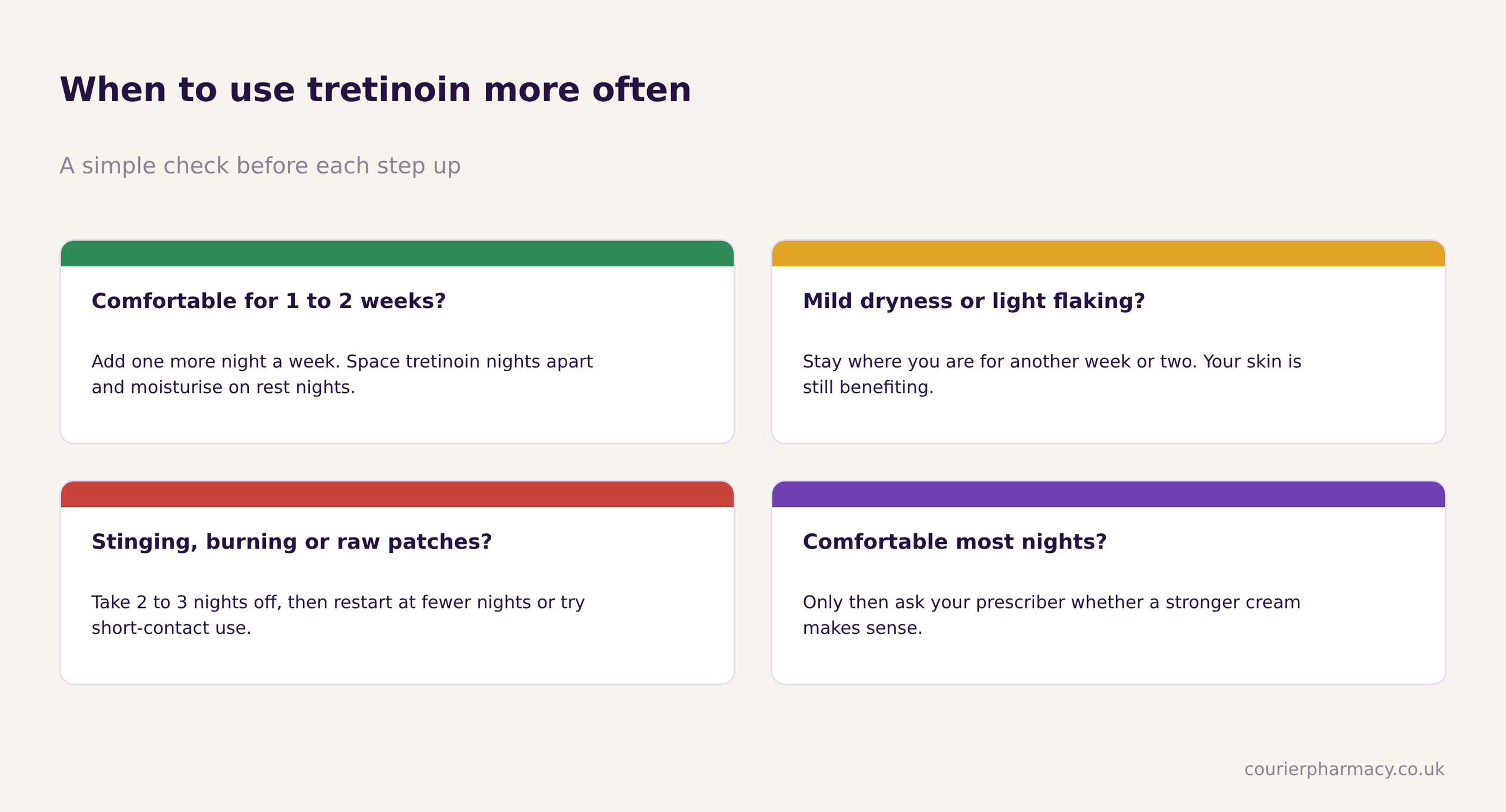
Decision cards showing when to increase how often you should use tretinoin
You’re ready to add a night if:
- Your skin has felt comfortable for at least one to two weeks.
- Any flaking is light and settles with moisturiser.
- There’s no stinging when you apply moisturiser or sunscreen.
- You haven’t had to skip nights because of irritation.
If any of those aren’t true, stay where you are for another week or two. There’s no shame in a plateau. Your skin is still benefiting.
Frequency and strength are two different dials. In general, it’s best to reach comfortable nightly or near-nightly use before thinking about a stronger cream. Our guide to tretinoin strengths explains when stepping up strength might make sense.
Signs you’re overdoing it
Some mild dryness and flaking in the early weeks is normal. However, these signs suggest you’re using tretinoin too often, or too much:
- Burning or stinging that lasts after application.
- Skin that stings when you apply a plain moisturiser.
- Redness that doesn’t settle by the next morning.
- Raw, shiny or tight-feeling patches.
- Cracking around the nose or mouth.
If this happens, take two or three nights off. Use only a gentle cleanser and moisturiser. When things calm down, restart at a lower frequency, or try short-contact use.
Stop and seek advice promptly if you get severe burning, swelling, blistering, or a rash. These aren’t normal adjustment signs.
How often should you use tretinoin once you’re happy with the results?
This is where things get interesting. Once you’ve had good results, you may not need to use tretinoin as often to keep them.
In one study, people who’d used tretinoin 0.05% daily for 48 weeks for sun-damaged skin were moved to once a week, three times a week, or no treatment for another 24 weeks. Three times a week maintained the improvement, and in some cases may have improved it further. Once a week maintained it to a lesser extent, and stopping led to some loss of benefit.
For acne, maintenance treatment after clearing helps prevent spots coming back, and a topical retinoid is often used for this. Your prescriber can suggest a maintenance plan that suits you.
Skipping nights, holidays and real life
Life happens. You’ll forget a night, go on holiday, or have a week when your skin feels a bit sensitive. Here’s how to handle it.
If you forget a night
Just carry on as normal the next scheduled night. Don’t apply twice as much to make up for it. That only adds irritation.
If you’re going somewhere sunny
Many people choose to cut back or pause tretinoin on a beach holiday, because sun exposure is higher. Talk to your prescriber before you go. If you’re taking it abroad, carry your prescription or a letter, as GOV.UK advises for medicines taken out of the UK (GOV.UK, no date).
If you take a break of a few weeks
Your skin may lose some tolerance. When you restart, drop back to two or three nights a week for a week or so before returning to your usual routine.
How long to keep using tretinoin
There’s no fixed end date. For acne, treatment is usually reviewed after 12 weeks, and then a plan is made for maintenance. For anti-ageing, benefits are linked to continued use, so many people keep going long term at a lower frequency.
The right length of time depends on your skin, your goals, and your prescriber’s advice. Regular reviews make sure it’s still the right treatment for you. Our guide on how long tretinoin takes to work covers the 12-week review in more detail.
Who should use tretinoin, and who should avoid it
Tretinoin may suit adults with acne, blackheads, post-acne marks, or early signs of sun-related ageing, who are happy to use it consistently and wear sunscreen daily.
It isn’t suitable during pregnancy or if you’re planning a pregnancy. The Treclin product information advises effective contraception during treatment and for one month after stopping, and not using it while breastfeeding. It also shouldn’t be used if you have rosacea, perioral dermatitis or acute eczema. See our page on rosacea if that applies to you.

Getting tretinoin safely through Courier Pharmacy
Tretinoin is a prescription-only medicine in the UK. The only licensed topical tretinoin products are combination acne gels, Treclin and Aknemycin Plus, both containing tretinoin 0.025%. Tretinoin-only creams are unlicensed “specials”, made for a named patient after a prescriber’s assessment.
At Courier Pharmacy, you start with an online consultation. One of our prescribers reviews your answers and decides whether treatment suits you. If it does, your cream is compounded for you, which gives it a 35-day shelf life, and sent by Royal Mail Tracked 24. Read more in our guide on how to get tretinoin in the UK safely and legally.

Frequently asked questions about how often to use tretinoin
How often should you use tretinoin when starting?
Start with two or three non-consecutive nights a week. If your skin is comfortable after two weeks, add another night. Build up gradually over several weeks towards most nights or nightly use.
Can I use tretinoin every night?
Yes, many people can use tretinoin every night once their skin has adjusted, usually after several weeks of building up. If nightly use causes ongoing redness or stinging, cut back to a frequency your skin tolerates. Consistent use matters more than nightly use.
How many times a week to use tretinoin?
Most people start at two to three times a week and build up to five to seven nights a week. For maintenance after sun damage has improved, research suggests three times a week can help keep results. Your prescriber can tailor this to you.
Can I use tretinoin in the morning?
We advise against it. Tretinoin is broken down by light and makes skin more sensitive to the sun, so it’s best applied at night. Use SPF 30 or higher every morning.
How often to use tretinoin for anti-ageing?
Three to five nights a week often works well for fine lines and texture, building up from two nights at the start. Once you’re happy with your results, three times a week was shown to maintain improvement in one study. Use for ageing is off-label in the UK, so a prescriber should guide you.
How long to leave tretinoin on face?
With standard use, leave it on overnight and wash it off in the morning. With short-contact use, leave it on for 30 to 60 minutes, then rinse. Short-contact use is a gentle way to start if your skin is sensitive.
Should I use tretinoin every night if my skin is peeling?
No. If you’re peeling heavily or your skin stings, take a few nights off and use only a gentle moisturiser. Then restart at a lower frequency. Light flaking that settles with moisturiser is normal in the early weeks.
Can I use tretinoin daily for a long time?
Many people use tretinoin long term under a prescriber’s care. Treatment should be reviewed regularly, and for acne NICE suggests a review after 12 weeks. Long-term use is often at a lower maintenance frequency.
What happens if I miss a night of tretinoin?
Nothing much. Just carry on with your next scheduled night. Don’t use extra to make up for it.
Does using tretinoin more often make it work faster?
Not if it causes irritation. Using tretinoin more often than your skin can handle often leads to missed nights, which slows progress. Steady, comfortable use gets better results over time.

Disclaimer
This information is for education only and isn’t a substitute for personal medical advice. Always follow your prescriber’s instructions.
References
Further reading from Courier Pharmacy
- Courier Pharmacy (2026) How to apply tretinoin cream. Available at: https://courierpharmacy.co.uk/how-to-apply-tretinoin-cream/ (Accessed: 30 October 2026).
- Courier Pharmacy (2026) How to get tretinoin in the UK safely and legally. Available at: https://courierpharmacy.co.uk/how-to-get-tretinoin-in-the-uk-safely-and-legally/ (Accessed: 30 October 2026).
- Courier Pharmacy (2026) Tretinoin strengths: which one is right for your skin? Available at: https://courierpharmacy.co.uk/tretinoin-strengths-which-one-is-right-for-your-skin/ (Accessed: 30 October 2026).
Licensed tretinoin
- emc (2024) Treclin 1%/0.025% w/w Gel: Summary of Product Characteristics. Available at: https://www.medicines.org.uk/emc/product/5371/smpc (Accessed: 30 October 2026).
Acne
- EADV (2019) Acne: how to treat it. EADV information leaflet for patients. European Academy of Dermatology and Venereology. Available at: https://eadv.org/wp-content/uploads/2023/04/EADV-Acne_2-How-to-treat-it.pdf (Accessed: 30 October 2026).
- NHS (2023) Acne: treatment. Available at: https://www.nhs.uk/conditions/acne/treatment/ (Accessed: 30 October 2026).
- NICE (2021) Acne vulgaris: management. NICE guideline NG198. Available at: https://www.nice.org.uk/guidance/ng198 (Accessed: 30 October 2026).
- Leyden, J., Stein-Gold, L. and Weiss, J. (2017) ‘Why topical retinoids are mainstay of therapy for acne’, Dermatology and Therapy, 7(3), pp. 293-304. Available at: https://pmc.ncbi.nlm.nih.gov/articles/PMC5574737/ (Accessed: 30 October 2026).
Taking medicines abroad
- GOV.UK (no date) Take medicine in or out of the UK. Available at: https://www.gov.uk/take-medicine-in-or-out-uk (Accessed: 30 October 2026).
Tretinoin stability
- Martin, B. et al. (1998) ‘Chemical stability of adapalene and tretinoin when combined with benzoyl peroxide in presence and in absence of visible light and ultraviolet radiation’, British Journal of Dermatology, 139(Suppl 52), pp. 8-11. Available at: https://pubmed.ncbi.nlm.nih.gov/9990414/ (Accessed: 30 October 2026).
Tretinoin and pregnancy
- MHRA (2019) Oral retinoid medicines: revised and simplified pregnancy prevention educational materials for healthcare professionals and women. Drug Safety Update, 12(11). Available at: https://www.gov.uk/drug-safety-update/oral-retinoid-medicines-revised-and-simplified-pregnancy-prevention-educational-materials-for-healthcare-professionals-and-women (Accessed: 30 October 2026).
Photodamaged skin
- Olsen, E.A. et al. (1997a) ‘Tretinoin emollient cream for photodamaged skin: results of 48-week, multicenter, double-blind studies’, Journal of the American Academy of Dermatology, 37(2 Pt 1), pp. 217-226.
- Olsen, E.A. et al. (1997b) ‘Sustained improvement in photodamaged skin with reduced tretinoin emollient cream treatment regimen: effect of once-weekly and three-times-weekly applications’, Journal of the American Academy of Dermatology, 37(2 Pt 1), pp. 227-230.