

A pharmacist’s guide to realistic tretinoin results for acne, blackheads, dark marks and fine lines, why it’s slow, and what to do if nothing seems to be happening.
Ever wondered why your friend raves about tretinoin, yet your own mirror looks exactly the same after three weeks? You’re not alone. How long does tretinoin take to work is one of the questions we hear most in our consultations, usually from someone who’s a little worried they’ve wasted their time.
The honest answer is that tretinoin is a slow burner. Most people notice early changes for acne at around 6 to 8 weeks, with clearer results at about 12 weeks. Dark marks and fine lines take longer, often 3 to 6 months or more. In this guide, we’ll walk you through what to expect, why it takes so long, and how to tell whether it’s simply too early or whether something needs to change.
Five key takeaways
- Tretinoin works slowly because it changes how your skin renews itself, and that process runs on a timescale of weeks, not days.
- For acne and blackheads, most people see early improvement by 6 to 8 weeks and a clearer picture by about 12 weeks.
- Post-acne marks and pigmentation usually need 3 to 6 months, and fine lines often need 6 months or more of steady use.
- Consistency beats strength. Using a gentle strength regularly tends to get you further than a strong one you keep pausing because of irritation.
- If you’ve seen no change after 12 weeks of regular use, it’s time for a review with your prescriber rather than giving up or doubling the dose.

How long does tretinoin take to work? The short answer
Here’s the quick version, broken down by what you’re hoping to treat. These are typical ranges based on clinical studies and what we see in practice. Your own skin may be a little faster or slower.
| Skin goal | Early signs | Clearer results |
| Acne (spots and inflammation) | 6 to 8 weeks | Around 12 weeks |
| Blackheads and whiteheads | 4 to 8 weeks | 8 to 12 weeks |
| Post-acne marks and hyperpigmentation | 4 to 12 weeks | 3 to 6 months or more |
| Fine lines, texture and dullness | 2 to 3 months (texture, glow) | 6 to 12 months |
You’ll notice that “early signs” and “clearer results” sit quite far apart. That gap is where most people lose patience. It’s also where the real work is being done.

Why tretinoin takes time to work
To understand why tretinoin takes time, it helps to know what it’s actually doing. Tretinoin is a form of vitamin A (a retinoid) that talks directly to receptors inside your skin cells. If you’d like the full science, our post on how tretinoin works goes deeper. Here’s the short version.
Your skin renews itself on its own schedule
Your outer skin is constantly being replaced. New cells form at the bottom layer, move up, and eventually flake away at the surface. This takes several weeks. Tretinoin speeds up and normalises that cycle, but it can’t skip it.
Think of it like a conveyor belt in a bakery. Tretinoin can make the belt run more smoothly, but the loaves already on it still need to reach the end. So the first few batches of “new” skin don’t show up for a while.
Microcomedones: the spots you can’t see yet
Every visible spot starts life as a tiny, invisible blockage in a pore called a microcomedone. Tretinoin’s main acne job is to stop these forming and to loosen the ones already there. Research shows this effect builds over 12 weeks, and stronger concentrations reduce microcomedones more than weaker ones.
Here’s the catch. The spots you’ll see next month are already brewing under the surface today. Tretinoin has to clear that backlog before you notice the difference. That’s also why some people get a temporary flare early on, which we’ll come to shortly.
Collagen is built, not bought
For fine lines, tretinoin encourages your skin to make new collagen, the springy protein that keeps skin firm. Early studies found new collagen forming in the upper dermis with regular tretinoin use. Building collagen is a bit like building muscle at the gym. One session won’t change much. Months of steady effort will.
How long does tretinoin take to work? A week-by-week timeline
Everyone’s skin is different, but most people follow a fairly similar pattern. Here’s roughly what to expect when tretinoin starts working.
Weeks 1 to 4: the adjustment phase
This is the “getting to know you” stage. Your skin may feel a bit dry, tight or flaky, and you might see some redness. This is often called retinisation. It’s normal and usually settles as your skin adapts. Don’t expect visible improvement yet. If you’re looking for proof that it’s working, the mild dryness is actually a sign that the cream is active.
Weeks 2 to 6: the possible purge
Some people get a short flare of spots in their usual breakout areas. This is the tretinoin purge, where blockages that were already forming come to the surface faster. Not everyone gets one. Our post on the tretinoin purge explains how to tell a purge from a true breakout, so we won’t repeat it all here.
Weeks 6 to 12: the turning point
This is when most people start to see real change. Fewer new spots, smaller blackheads, and skin that feels smoother. Dryness tends to calm down. Many people tell us this is when friends start to comment, which is always nice.
Months 3 to 6: the payoff for marks and texture
Dark marks begin to fade more noticeably. Skin tone looks more even and pores can look tidier. If you’re using tretinoin for early ageing, this is when you may notice a healthier glow and smoother texture.
Six months and beyond: the long game
Fine lines and deeper texture changes need patience. In a long study of photo-damaged skin, improvement was maintained or continued to build over 48 weeks of use. This is the stage where tretinoin starts to feel like a long-term habit rather than a treatment you’re testing.
How long does tretinoin take to work for acne and blackheads?
For spots and blackheads, most people see early signs at 6 to 8 weeks. A fair assessment usually needs about 12 weeks. NICE suggests reviewing acne treatment after a 12-week course, which matches what we see in practice (NICE, 2021).
Blackheads and whiteheads (comedones) are often the first to improve. This is because tretinoin works right at the root of these, in the pore lining. Inflamed red spots usually follow. If you’d like more detail on spots specifically, our upcoming guide to tretinoin for acne covers it in depth.
Pharmacist’s tip: Count your spots, not your feelings. On a bad skin day, it’s easy to think nothing has changed. A quick weekly tally of new spots gives you a much more honest picture.
How long does tretinoin take to work on hyperpigmentation?
Dark marks left behind by spots (post-inflammatory hyperpigmentation) are slower to shift. Most people need 3 to 6 months to see a clear difference, and some need longer.
Tretinoin helps here in two ways. It speeds up the shedding of pigmented cells at the surface, and it reduces how much pigment is passed into new skin cells. In one trial in Black patients with post-inflammatory hyperpigmentation, improvement was first noted after 4 weeks of daily tretinoin 0.1%, and dark patches were significantly lighter by the end of 40 weeks.
That same study also found that half the people using tretinoin developed some skin irritation. That matters, because irritation can trigger more pigmentation, especially in darker skin tones. So for pigmentation, going gently is often faster in the long run. Our guide to tretinoin for hyperpigmentation and our page on hyperpigmentation go into more detail.
How long for tretinoin to work for wrinkles?
For fine lines, think in months rather than weeks. Texture and brightness may improve within 2 to 3 months, but softer fine lines usually take 6 months or more.
In a 16-week double-blind study, 14 of 15 people who used tretinoin on their face showed improvement in sun-related ageing, while none of those using a plain cream improved. A 2025 review of eight trials also found that tretinoin improved both fine and coarse facial wrinkles compared with a plain cream.
Using tretinoin for ageing is off-label in the UK. That means it’s prescribed outside the use covered by a product licence, after a prescriber has weighed up whether it suits you. Our post on how tretinoin fights the signs of ageing explains what it can and can’t do for wrinkles.
Does tretinoin 0.025% take longer to work?
Sometimes, a little, but often not by as much as people expect. For acne, higher strengths reduce microcomedones more. One study found 0.1% cut them by 80% over 12 weeks, compared with 35% for tretinoin 0.025%.
For sun-related ageing, the picture is different. A 48-week study found that tretinoin 0.025% gave similar improvement to 0.1%, but with much less irritation. In other words, the gentler strength got there, just with fewer red, flaky evenings along the way.
Say you’re 34, using tretinoin 0.025% three nights a week for fine lines. You might wonder if you’re “wasting” time on a low strength. In reality, you’re building tolerance. That lets you use it more often, and frequency matters a lot. If you’re curious about choosing a strength, see our guides on tretinoin strengths and which strength to use for acne and wrinkles.
What changes how long tretinoin takes to work
There’s no secret trick to make tretinoin work overnight. However, some things clearly help, and others quietly hold you back.
Things that help
- Consistency. Regular use, even a few nights a week, beats bursts of nightly use followed by long breaks.
- Building up frequency gradually.
- Daily sunscreen. SPF 30 or higher protects your progress, especially for pigmentation and ageing.
- A plain, gentle moisturiser. Calm skin can tolerate tretinoin more often.
- The right amount. A pea-sized amount for the whole face is enough. Our guide on how to apply tretinoin cream explains the technique.
Things that slow you down
- Irritation. Red, sore skin means missed nights, and missed nights mean slower results.
- Sun exposure without protection. UV light drives pigmentation and ageing, undoing the good work.
- Too many active products. Scrubs, acids and strong toners on top of tretinoin can overwhelm your skin. See what you can use with tretinoin.
- Using more cream. Extra cream doesn’t speed things up. It mainly adds irritation.
- Stopping and starting. Each long break means your skin partly resets.
Skin type plays a part too. Oily, resilient skin often tolerates tretinoin quicker. Dry or sensitive skin may need a slower build-up, which can stretch the timeline slightly. That’s fine. Slow and steady still wins here.
Why is tretinoin not working? A troubleshooting guide
If you’ve been using tretinoin for a while and feel stuck, don’t panic. In our experience, there’s usually a clear reason. Here are the most common ones.
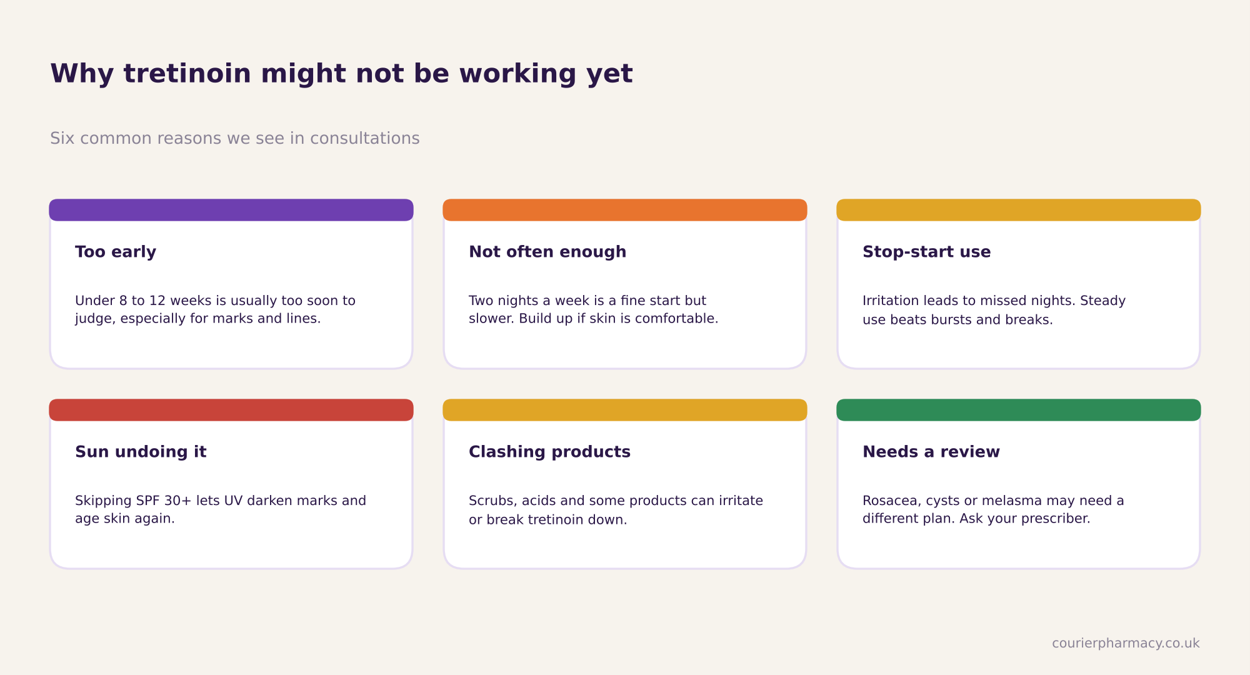
Cards showing six common reasons why tretinoin is not working yet
Is it just too early?
This is the most common reason by far. If you’re under 8 weeks in, especially for marks or fine lines, it’s probably too soon to judge. Take a fresh set of photos and compare them with day one before deciding.
Are you using it often enough?
Two nights a week is a great start, but it’s a slower way to get results. If your skin is comfortable, your prescriber may suggest gradually using it more often.
Is irritation holding you back?
If your skin keeps getting sore and you keep stopping, you’re not getting a steady dose. Try short-contact use, a buffer moisturiser, or fewer nights a week, and speak to your prescriber.
Is something else undoing the work?
Sun exposure, harsh cleansers, or mixing tretinoin with incompatible products can slow progress. For example, benzoyl peroxide combined with light can break tretinoin down quickly. If you use both, ask your pharmacist about timing.
Is it actually the right treatment?
Does tretinoin work for everyone? Not always. Deep, painful cysts, hormonal acne, rosacea and some types of pigmentation such as melasma may need a different approach or extra treatment. Spots in new areas, burning, or a rash may be a reaction rather than a purge. That’s worth a chat with your prescriber.
How long does tretinoin take to work before you review it?
We think 12 weeks of regular use is a fair point to step back and take stock. It lines up with NICE advice to review acne treatment after a 12-week course. The Treclin product information also advises against using it continuously for more than 12 weeks without a review.
At your review, ask yourself three questions:
- Has anything improved, even a little? Fewer new spots, smoother texture, or lighter marks all count.
- Is my skin comfortable at the current frequency?
- Have I been using it consistently, most weeks, for the full 12 weeks?
If you’re improving and comfortable, you probably don’t need to change anything. If you’ve seen no change despite steady use, your prescriber may suggest increasing frequency, adjusting strength, or trying a different treatment. Most people should stay at a strength for at least 3 to 4 months before stepping up. Our post on tretinoin strengths explains when stepping up makes sense.
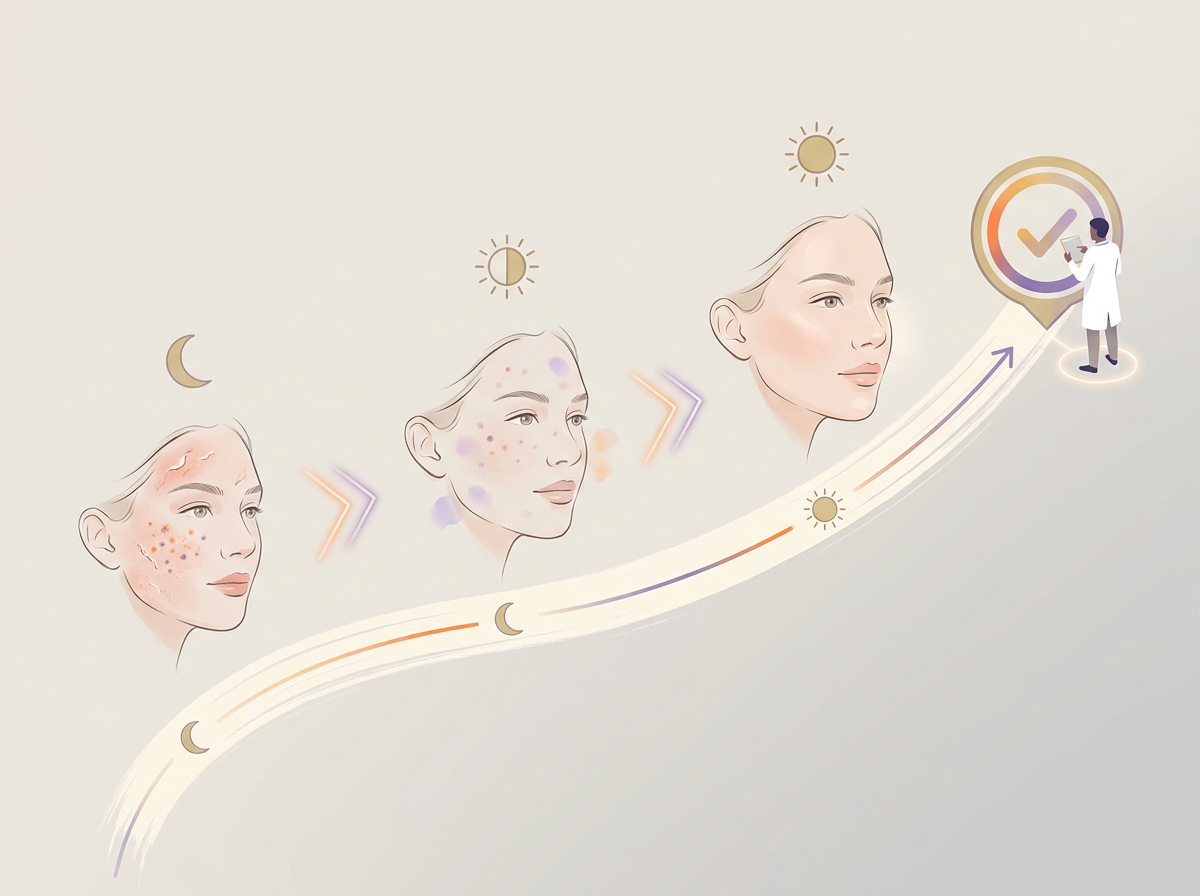
How to track your tretinoin results properly
Your memory is a terrible judge of skin. We all tend to remember the worst day. Photos are much more reliable. Here’s how to make them useful.
- Take photos on day one, then every 4 weeks.
- Use the same spot, the same light, and the same time of day. A window with daylight works well. Avoid harsh overhead bulbs.
- Take three shots: straight on, left side and right side.
- Remove makeup and don’t use filters. Yes, really.
- Keep a simple diary: nights used, any irritation, and new spots.
Pharmacist’s tip: Make a photo album on your phone called “Skin” and set a monthly reminder. Comparing week 1 with week 12 side by side is often the moment people realise tretinoin has been working all along.
Who tretinoin suits, and who should avoid it
Tretinoin may suit adults with acne, blackheads, post-acne marks, or early signs of sun-related ageing. It suits people who are happy to commit to a few months of steady use and daily sunscreen.
However, it isn’t right for everyone. Topical retinoids should not be used during pregnancy or if you’re planning a pregnancy. The Treclin product information advises using contraception during treatment and for one month after stopping, and not using it while breastfeeding. It also lists conditions where it shouldn’t be used, including rosacea, perioral dermatitis and acute eczema.
Getting tretinoin safely in the UK
Tretinoin is a prescription-only medicine in the UK. The only licensed topical tretinoin products are combination acne gels, Treclin (clindamycin with tretinoin 0.025%) and Aknemycin Plus (erythromycin with tretinoin 0.025%). Tretinoin-only creams in 0.025%, 0.05% and 0.1% strengths are unlicensed “specials”. They’re made up for a named patient after a prescriber has assessed them.
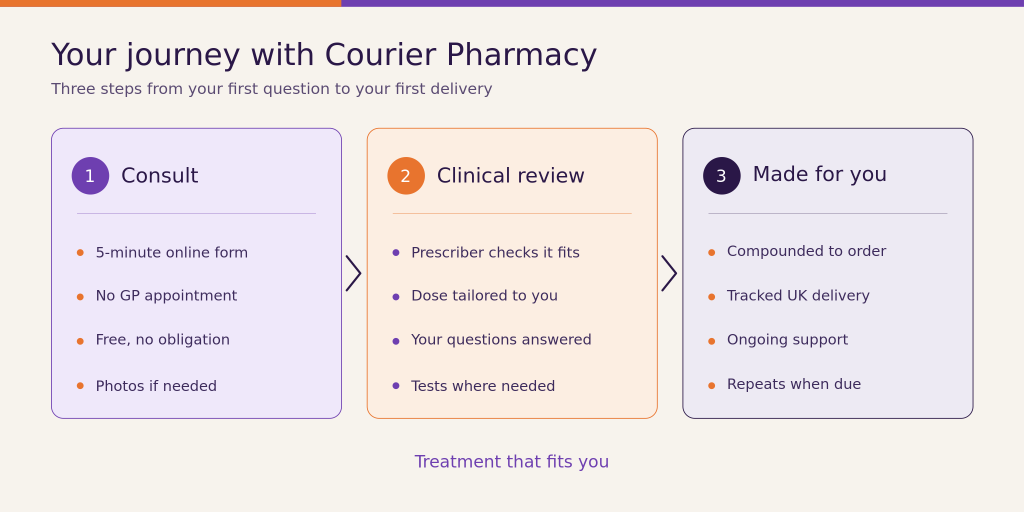
At Courier Pharmacy, the process starts with an online consultation. One of our prescribers reviews your answers and decides whether treatment is suitable. If it is, your cream is compounded for you, which is why it has a 35-day shelf life, and it’s sent by Royal Mail Tracked 24. You can read more in our guide on how to get tretinoin in the UK safely and legally.
Frequently asked questions about how long tretinoin takes to work

How long does tretinoin take to work?
For acne, most people see early improvement after 6 to 8 weeks and clearer results at around 12 weeks. Dark marks usually take 3 to 6 months. Fine lines often need 6 months or more of regular use.
When does tretinoin start working?
Tretinoin starts working on your skin cells from the first few applications, but visible changes take longer. Most people notice smoother skin or fewer blackheads at around 4 to 8 weeks. The first few weeks are mostly about your skin adjusting.
How long to see results from tretinoin for acne?
Give it at least 12 weeks of regular use. That’s the point NICE suggests for reviewing acne treatment. Blackheads often improve first, followed by inflamed spots.
How long does tretinoin 0.025 take to work?
Tretinoin 0.025% usually shows early acne improvement at 8 to 12 weeks and ageing improvements over 6 months or more. It may be slightly slower than higher strengths for acne. For ageing, one study found 0.025% gave similar results to 0.1% over 48 weeks, with less irritation.
How long does tretinoin take to work on hyperpigmentation?
Most people need 3 to 6 months to see dark marks fade clearly. In one trial, improvement was first noted after 4 weeks, with significant lightening by 40 weeks. Daily sunscreen is essential, or the marks can return.
How long for tretinoin to work for wrinkles?
Fine lines usually take 6 months or more to soften. Texture and brightness often improve sooner, within 2 to 3 months. Improvement can keep building for up to a year with steady use.
Why is tretinoin not working for me?
The most common reason is that it’s simply too early. Other reasons include using it too rarely, stopping often because of irritation, skipping sunscreen, or having a skin condition that needs a different treatment. If there’s no change after 12 weeks of regular use, speak to your prescriber.
Does tretinoin work for everyone?
No treatment works for everyone, but tretinoin has decades of evidence for acne and sun-related ageing. Some people find it too irritating, and some conditions, such as rosacea or deep cystic acne, need a different approach. A prescriber can help work out whether it suits you.
Does using more tretinoin change how long it takes to work?
No. Using more than a pea-sized amount, or a higher strength too soon, mainly increases irritation. That often means more missed nights, which slows your results overall.
How long does tretinoin take to work before I should give up?
Don’t give up after a month, as that’s too early to judge for most people. Keep going if your skin is comfortable, and take progress photos. Review your results with a prescriber at around 12 weeks.
Disclaimer
This information is for education only and isn’t a substitute for personal medical advice. Always follow your prescriber’s instructions.
References
Further reading from Courier Pharmacy
- Courier Pharmacy (2026) How to apply tretinoin cream. Available at: https://courierpharmacy.co.uk/how-to-apply-tretinoin-cream/ (Accessed: 30 October 2026).
- Courier Pharmacy (2026) Tretinoin strengths: which one is right for your skin? Available at: https://courierpharmacy.co.uk/tretinoin-strengths-which-one-is-right-for-your-skin/ (Accessed: 30 October 2026).
- Courier Pharmacy (2026) What is the tretinoin purge? Available at: https://courierpharmacy.co.uk/what-is-the-tretinoin-purge/ (Accessed: 30 October 2026).
Licensed tretinoin medicines
- emc (2024) Treclin 1%/0.025% w/w Gel: Summary of Product Characteristics. Available at: https://www.medicines.org.uk/emc/product/5371/smpc (Accessed: 30 October 2026).
Tretinoin and hyperpigmention
- Bulengo-Ransby, S.M. et al. (1993) ‘Topical tretinoin (retinoic acid) therapy for hyperpigmented lesions caused by inflammation of the skin in black patients’, New England Journal of Medicine, 328(20), pp. 1438-1443. Available at: https://pubmed.ncbi.nlm.nih.gov/8479462/ (Accessed: 30 October 2026).
Photoageing
- Griffiths, C.E.M. et al. (1995) ‘Two concentrations of topical tretinoin (retinoic acid) cause similar improvement of photoaging but different degrees of irritation’, Archives of Dermatology, 131(9), pp. 1037-1044.
- Kligman, A.M. et al. (1986) ‘Topical tretinoin for photoaged skin’, Journal of the American Academy of Dermatology, 15(4 Pt 2), pp. 836-859. Available at: https://pubmed.ncbi.nlm.nih.gov/3771853/ (Accessed: 30 October 2026).
- Olsen, E.A. et al. (1997) ‘Tretinoin emollient cream for photodamaged skin: results of 48-week, multicenter, double-blind studies’, Journal of the American Academy of Dermatology, 37(2 Pt 1), pp. 217-226.
- Huang, H.Y. and Lee, L.T.J. (2025) ‘Tretinoin for photodamaged facial skin: systematic review and meta-analysis of randomized controlled trials’, Dermatology Practical and Conceptual, 15(4). Available at: https://www.dpcj.org/index.php/dpc/article/view/5172 (Accessed: 30 October 2026).
- Weiss, J.S., Ellis, C.N., Headington, J.T., Tincoff, T., Hamilton, T.A. and Voorhees, J.J. (1988) ‘Topical tretinoin improves photoaged skin: a double-blind vehicle-controlled study’, JAMA, 259(4), pp. 527-532. Available at: https://jamanetwork.com/journals/jama/fullarticle/370378 (Accessed: 30 October 2026).
Acne
- Leyden, J., Stein-Gold, L. and Weiss, J. (2017) ‘Why topical retinoids are mainstay of therapy for acne’, Dermatology and Therapy, 7(3), pp. 293-304. Available at: https://pmc.ncbi.nlm.nih.gov/articles/PMC5574737/ (Accessed: 30 October 2026).
- NHS (2023) Acne: treatment. Available at: https://www.nhs.uk/conditions/acne/treatment/ (Accessed: 30 October 2026).
- NICE (2021) Acne vulgaris: management. NICE guideline NG198. Available at: https://www.nice.org.uk/guidance/ng198 (Accessed: 30 October 2026).
Stability
- Martin, B. et al. (1998) ‘Chemical stability of adapalene and tretinoin when combined with benzoyl peroxide in presence and in absence of visible light and ultraviolet radiation’, British Journal of Dermatology, 139(Suppl 52), pp. 8-11. Available at: https://pubmed.ncbi.nlm.nih.gov/9990414/ (Accessed: 30 October 2026).
Pregnancy
- MHRA (2019) Oral retinoid medicines: revised and simplified pregnancy prevention educational materials for healthcare professionals and women. Drug Safety Update, 12(11). Available at: https://www.gov.uk/drug-safety-update/oral-retinoid-medicines-revised-and-simplified-pregnancy-prevention-educational-materials-for-healthcare-professionals-and-women (Accessed: 30 October 2026).