

Ever wondered why the strongest tretinoin isn’t always the best one? Tretinoin strengths look simple on paper. There’s a low one, a middle one and a high one. So surely you pick the biggest number and get the fastest results? If only skin worked like that.
In real life, the tube that clears one person’s acne can leave another red and flaky. Some people are ready to quit by week three. Plus, most advice online is written for American readers. It quotes brands you can’t get here and skips the UK rules.
This guide puts that right. We’ll decode what the percentages mean. We’ll look at which strengths tend to suit acne and which suit wrinkles. Then we’ll cover what you can get in the UK. You’ll also learn how to start gently and when it makes sense to step up.
One thing before we begin. Tretinoin is a prescription-only medicine, and it must not be used in pregnancy or while trying for a baby. Nothing here replaces a proper assessment.
Five key takeaways
- Tretinoin strengths run from 0.01% to 0.1%. The top strength is ten times the bottom one, so the steps are bigger than the decimals suggest.
- Most people start low, often at 0.025% or below. You build up how often you use it before you build up the strength.
- For acne, higher strengths can do more, but only if your skin puts up with them. For wrinkles, a 48-week trial found 0.025% did as well as 0.1%, with less irritation.
- In the UK, the only licensed skin products with tretinoin also contain an antibiotic and are for acne. Plain tretinoin is unlicensed here, so a prescriber has to decide it’s right for you.
- Daily SPF 30 or higher is part of the treatment, and tretinoin must be avoided in pregnancy.
What tretinoin strengths actually mean
The percentage on the tube, decoded
The percentage tells you how much tretinoin is in the product by weight. A 0.025% cream holds a quarter of a milligram of tretinoin in every gram. A 0.1% cream holds one milligram per gram.
Those are tiny amounts, which shows how potent this medicine is. A pea-sized blob really is enough for a whole face.
Why tretinoin isn’t the same as retinol
Tretinoin is the active form of vitamin A. Its full name is all-trans retinoic acid, and it’s the form your skin cells respond to.
Retinol, the vitamin A in shop-bought serums, isn’t active yet. Your skin has to convert it in two steps before it does anything. Think of flat-pack furniture. Retinol arrives in a box, and your skin has to build it. Tretinoin turns up fully assembled.
As a result, the numbers don’t compare like for like. Retinol is often quoted as roughly twenty times weaker than tretinoin. So a 0.3% retinol serum isn’t “stronger” than 0.025% tretinoin, even though the number is bigger.
What tretinoin does at any strength
Tretinoin speeds up how quickly skin cells are made and shed. That stops dead cells clumping together and blocking pores, which is how spots begin. It also calms inflammation.
Over months, it prompts the deeper skin to make more collagen. That’s why fine lines soften slowly, and why nobody wakes up looking ten years younger after a fortnight. Sorry.

The tretinoin strengths ladder, from 0.01% to 0.1%
Around the world, tretinoin comes in seven common strengths. Here’s how they line up.
| Strength | Tretinoin per gram | Where it sits | Who it tends to suit |
| 0.01% | 0.1 mg | The gentlest rung | Very reactive skin, a cautious first try, or stepping down |
| 0.02% | 0.2 mg | Gentle | Sensitive skin that needs a softer start |
| 0.025% | 0.25 mg | The usual starting point | Most beginners, for acne or early lines |
| 0.04% | 0.4 mg | An in-between step | Skin that copes with 0.025% but found 0.05% too much |
| 0.05% | 0.5 mg | Mid-range | Settled users, oilier skin, stubborn texture or marks |
| 0.08% | 0.8 mg | Strong | Experienced users edging upwards |
| 0.1% | 1 mg | The top rung | Stubborn acne in skin with proven tolerance |
Treat this as a map, not a menu. Your prescriber picks a strength from your skin, your history and your goals, not from a chart. As you’ll see below, not every rung exists as a licensed product in the UK.
Why the jumps between tretinoin strengths are bigger than they look
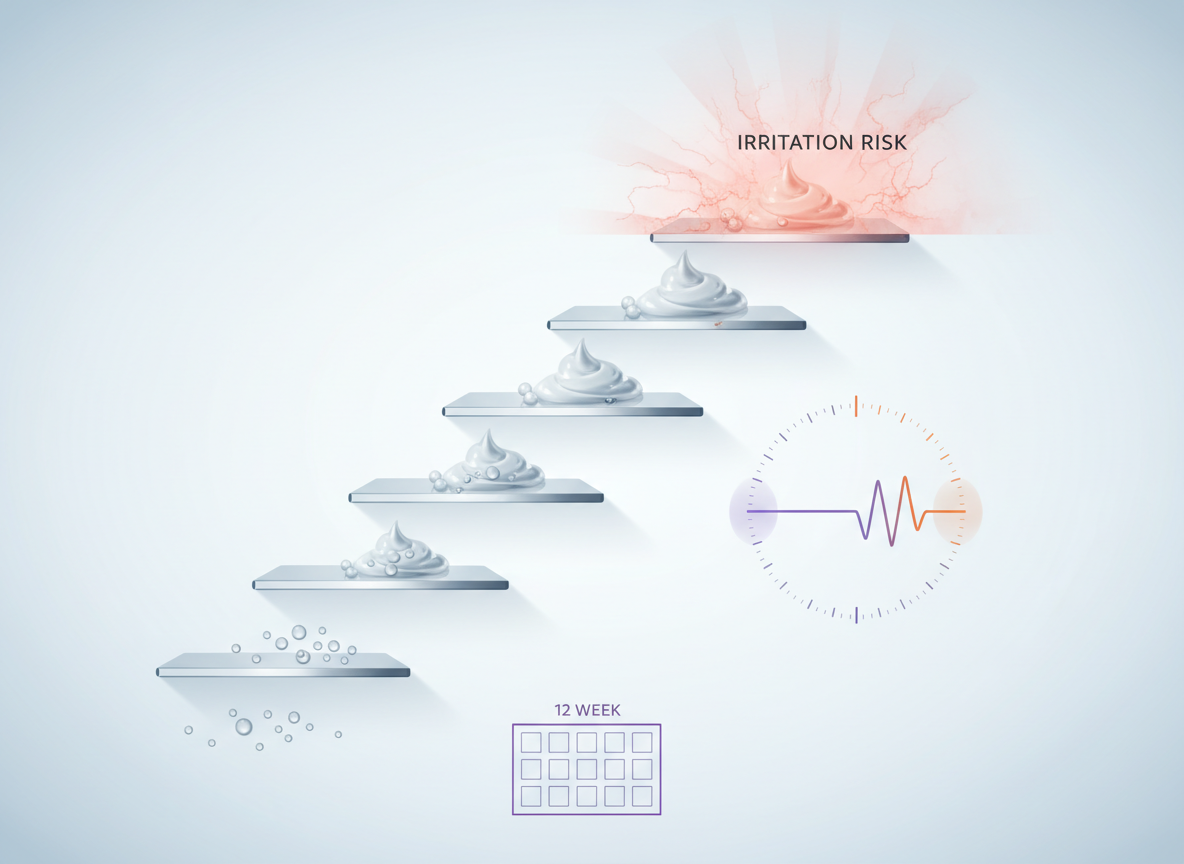
The decimals hide the size of each step. Going from 0.025% to 0.05% doubles the dose. Going from 0.05% to 0.1% doubles it again. So 0.1% is four times the usual starter strength, and ten times the gentlest one.
It’s a bit like curry night. If a korma suits you, the sensible next order is one notch hotter, not a vindaloo. That’s what the in-between strengths, 0.04% and 0.08%, are for. They give your skin a smaller step when a full doubling feels like too much.
Which tretinoin strengths suit acne?
Tretinoin has been used for acne for more than fifty years. It keeps pores clear, so it helps blackheads and whiteheads as well as red, sore spots.
What UK guidance says
NICE lists tretinoin combined with the antibiotic clindamycin as a first-line option for acne of any severity. You apply it once a day in the evening, for a 12-week course. The tretinoin in that licensed gel is 0.025%.
So for acne, the UK standard isn’t a high strength at all. It’s a low one, paired with something that tackles bacteria, used every evening for three months.
Does a higher strength clear acne faster?
Sometimes, yes. A review of the acne trials found that a retinoid tends to do more as the strength goes up. The catch is that dryness and stinging rise too.
Low strengths still pull their weight, though. In the trials behind the licensed gel, tretinoin 0.025% on its own cut spot counts by about 40% over 12 weeks. A dummy gel managed about 23%. The combination with clindamycin did best, at around 54%.
In practice, mild to moderate acne is usually treated at 0.025% to 0.05%. The 0.1% strength tends to be kept for stubborn acne in skin that has already proved it can cope.
When a cream isn’t enough
Deep, painful lumps or scarring are a different job. See your GP, because you may need tablets or a referral. Isotretinoin capsules, for severe acne, can only be prescribed by a specialist. No strength of cream replaces that.
Which tretinoin strengths suit wrinkles and sun damage?
This is where the “stronger is better” idea falls over.
What the studies found
In one well-known trial, people with sun-damaged skin used either tretinoin 0.025% or 0.1% tretinoin cream for 48 weeks. Both creams improved the skin, and by a similar amount. The 0.1% cream simply caused more redness and peeling along the way.
There is a floor, though. In a large 24-week study, a very weak 0.001% cream did no better than a plain one. Above that, the changes in the skin grew with the dose.
So for fine lines, most people land somewhere between 0.025% and 0.05%. Patience matters more than power here. A review of the trials found benefits from as early as one month. They lasted through two years of use.
A word on dark marks and melasma
Pigmentation rewards a gentle approach too. Irritated skin can make extra pigment, above all in deeper skin tones. So racing up the strengths can leave dark marks worse, not better. We explain why in our article on skin hyperpigmentation, and our hyperpigmentation page covers the options.
This use is off-label in the UK
No tretinoin product is licensed in the UK for wrinkles, sun damage or pigmentation. A prescriber can still choose to prescribe it for these, and many do. You should simply know that going in, and someone should explain it to you.
Which tretinoin strengths can you get in the UK?
Here’s the part most online guides miss.
The licensed options
Only two licensed skin products in the UK contain tretinoin. Both are for acne, and both include an antibiotic.
- Treclin gel contains tretinoin 0.025% with clindamycin 1%. It’s licensed from age 12.
- Aknemycin Plus solution contains tretinoin 0.025% with erythromycin 4%.
That’s the full list. Both sit on the same rung of the ladder. Neither is right for someone who only wants help with fine lines, because nobody needs an antibiotic for crow’s feet.
Plain tretinoin, with nothing added
There’s currently no licensed tretinoin-only cream or gel in the UK. Retin-A, the brand most people have heard of, left UK shelves years ago. NHS records list its gels as discontinued in 2012.
So if a UK prescriber wants tretinoin on its own, or at a different strength, it has to be an unlicensed medicine. That means a product imported from abroad, or a compounded medicine that a registered pharmacy prepares for one named patient.
Unlicensed doesn’t mean illegal, and it doesn’t mean unregulated. It does mean the MHRA hasn’t assessed that finished product as it would a licensed one. Your prescriber should explain this, and why they think it suits you, before anything is supplied.
Why American brand names won’t help
Many guides mention Retin-A Micro, Altreno or Renova. They’re American products, and they aren’t sold here. If a website offers to post tretinoin to you without a prescription, close the tab. A genuine UK supplier will always assess you first.

Compounding at Courier
When the standard option isn’t the right fit, we can make one to order
Courier is a compounding pharmacy. Where a prescriber decides it’s appropriate for you, we can prepare bespoke, made-to-order preparations — tailored to the individual, under full clinical governance. It’s the same principle that runs through everything we do.
Cream, gel or solution: the base matters too
The percentage gets all the attention. However, what the tretinoin is mixed into matters nearly as much.
- Creams are richer and cushion the skin. They tend to suit dry, mature or easily upset skin.
- Gels are lighter and sink in fast. They suit oily, spot-prone skin, but they can be more drying.
- Solutions are thin liquids. The licensed UK solution is alcohol-based, which can sting and dry the skin further.
Here’s a pharmacist’s tip. Read the other ingredients, not just the strength. The licensed gel, for instance, uses parabens as preservatives. Most people get on fine with them, but tell your prescriber if you’ve reacted before.
Sometimes the answer to “tretinoin doesn’t suit me” is a different base, not a lower number.

How to start, whatever strength you’re given
First, follow the directions on your own prescription. The licensed gel, for example, is used once a day at bedtime. With plain tretinoin, many prescribers suggest easing in so your skin can adjust. A gentle plan often looks like this:
- Weeks one: two or three nights a week, with a night off in between.
- Weeks two: every other night, if your skin is calm.
- Week three onwards: every night, if that still feels comfortable.
Your evening routine
- Wash with a mild cleanser and pat your skin dry. The NHS suggests waiting about 20 minutes before you apply a retinoid.
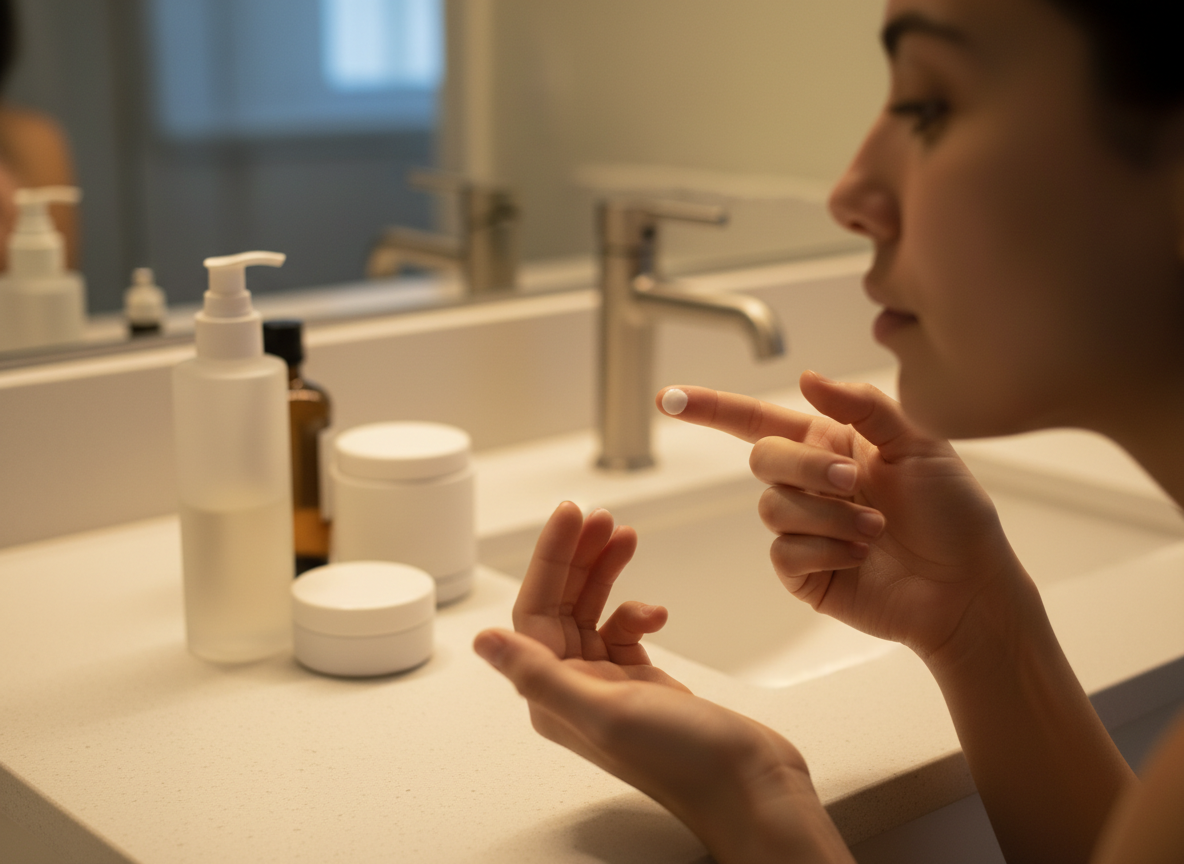
- Use a pea-sized amount for the whole face. Dab it on your forehead, cheeks, nose and chin, then spread it out.
- Keep it away from your eyes, eyelids, lips and nostrils. Wash your hands afterwards.
- Moisturiser is your friend. Leave a gap after your tretinoin before you put it on, and check your own leaflet. The licensed gel shouldn’t go on at the same moment as other products.
- Each morning, use a sunscreen of SPF 30 or higher. Yes, even in a grey British November.
- Missed a night? Skip it and carry on. Don’t double up.
More isn’t faster, by the way. The patient leaflet for the licensed gel says so in black and white. Extra gel irritates your skin without speeding anything up.
What’s normal, and what isn’t
Expect some dryness, tightness, light flaking and a little redness at first. With acne, spots can flare briefly before they settle. This adjustment phase usually peaks in the first month.
Burning that won’t ease, swelling, cracked skin or a spreading rash are not part of the deal. Stop and speak to your prescriber. You can also report side effects through the MHRA’s Yellow Card scheme.
Think of how often you apply it as a dimmer switch. If your skin complains, turn it down to twice a week. You don’t have to switch it off.
When to step up tretinoin strengths, and when to stay put
Give any strength at least 12 weeks before you judge it. NICE asks for acne treatment to be reviewed at 12 weeks too, so it makes a natural checkpoint.
A step up is worth discussing if all of these are true:
- You’ve used your current strength most nights for three months or more.
- Your skin feels comfortable, with little or no flaking.
- Things have improved, but they’ve stalled short of where you’d like.
- Your prescriber agrees.
Stay where you are if you’re still peeling, still improving, or simply happy with how things look. There’s no prize for reaching 0.1%.
Stepping down isn’t failure either. Winter weather, central heating or a sunny holiday can all change what your skin will put up with. A lower strength you use beats a higher one sitting in a drawer.
Finally, move one rung at a time. Jumping straight from 0.025% to 0.1% is the vindaloo order again.
Who should avoid tretinoin?
Tretinoin isn’t for everyone, at any strength.
- Pregnancy and trying for a baby. Tretinoin must not be used. Very little passes through the skin. Even so, the MHRA says the risk can’t be excluded, so it’s avoided as a precaution. The leaflet for the licensed gel also asks women who could get pregnant to use contraception. That applies during treatment and for one month after.
- Breastfeeding. Tretinoin isn’t recommended.
- Children under 12. The licensed gel hasn’t been shown to be safe or to work below that age.
- Rosacea, acute eczema and perioral dermatitis. The licensed gel isn’t suitable. With other tretinoin products, a prescriber weighs it up case by case.
- Skin cancer, in you or a close relative. This is another reason not to use the licensed gel, so do mention it.
- Sunburnt or broken skin. Wait until it has healed.
- Sunbeds and sun lamps. Avoid them while you’re using tretinoin.
- Other strong skincare. Benzoyl peroxide, salicylic acid, scrubs and alcohol-based toners can all add to the irritation. Ask before you combine them.
Also tell anyone doing waxing, peels or laser on your face that you use tretinoin. Skin on a retinoid can be more fragile.
Frequently asked questions about tretinoin strengths
What tretinoin strength should a beginner start with?
Most beginners start at 0.025% or lower, a few nights a week. That holds whether the goal is acne or fine lines. Very reactive skin may start at 0.01% or 0.02%. Your prescriber makes the final call.
What is the strongest tretinoin strength?
The strongest of the common tretinoin strengths is 0.1%. It’s usually kept for stubborn acne in people whose skin already copes well with lower strengths.
What is the lowest tretinoin strength?
The lowest strength in common use is 0.01%. In one large study, a far weaker 0.001% cream did no better than a plain cream.
Which tretinoin strengths are best for acne?
Mild to moderate acne is usually treated at 0.025% to 0.05%. The UK’s licensed gel pairs 0.025% with an antibiotic. Higher tretinoin strengths are for stubborn acne, once your skin has built tolerance.
Which tretinoin strengths are best for wrinkles?
Most people do well at 0.025% to 0.05%. In a 48-week trial, 0.025% improved sun-damaged skin as much as 0.1%, with less irritation. Bear in mind this use is off-label in the UK.
Is 0.1% tretinoin better than 0.05%?
Not automatically. It’s double the dose, so it irritates more. For acne it may add some benefit. For fine lines, lower strengths seem to reach much the same place with time.
How long should I stay on one strength before moving up?
Allow at least 12 weeks of regular use. Only step up if your skin is comfortable, progress has stalled and your prescriber agrees.
Can I buy tretinoin over the counter in the UK?
No. All tretinoin strengths are prescription-only in the UK. Avoid any website that sells it without assessing you first.
Is tretinoin stronger than retinol?
Yes. Tretinoin is already active, while retinol has to be converted by your skin first. That’s why even low tretinoin strengths need a prescription and retinol doesn’t.
Can I use tretinoin if I’m pregnant or breastfeeding?
No. Tretinoin must not be used in pregnancy or while trying to conceive, and it isn’t recommended while breastfeeding. Speak to your prescriber or pharmacist about safer options.
Disclaimer
Disclaimer: This information is for education only and isn’t a substitute for personal medical advice. Always follow your prescriber’s instructions.
References

- Ahsan, S. (2026) ‘Skin hyperpigmentation, pathophysiology and treatments’, Courier Pharmacy, 4 July. Available at: https://courierpharmacy.co.uk/skin-hyperpigmentation-pathophysiology-and-treatments/ (Accessed: 10 October 2026).
- Baldwin, H., Webster, G., Stein Gold, L., Callender, V., Cook-Bolden, F.E. and Guenin, E. (2021) ‘50 years of topical retinoids for acne: evolution of treatment’, American Journal of Clinical Dermatology, 22(3), pp. 315-327. Available at: https://link.springer.com/article/10.1007/s40257-021-00594-8 (Accessed: 10 October 2026).
- Bhawan, J. et al. (1991) ‘Effects of tretinoin on photodamaged skin: a histologic study’, Archives of Dermatology, 127(5), pp. 666-672. Available at: https://pubmed.ncbi.nlm.nih.gov/2024984/ (Accessed: 10 October 2026).
- Courier Pharmacy (2026a) Acne. Available at: https://courierpharmacy.co.uk/conditions/acne/ (Accessed: 10 October 2026).
- Courier Pharmacy (2026b) Hyperpigmentation. Available at: https://courierpharmacy.co.uk/conditions/hyperpigmentation/ (Accessed: 10 October 2026).
- electronic medicines compendium (emc) (2026a) Treclin 1%/0.025% w/w gel: summary of product characteristics. Available at: https://www.medicines.org.uk/emc/product/5371/smpc (Accessed: 10 October 2026).
- electronic medicines compendium (emc) (2026b) Treclin 1%/0.025% w/w gel: patient information leaflet. Available at: https://www.medicines.org.uk/emc/product/5371/pil (Accessed: 10 October 2026).
- electronic medicines compendium (emc) (2026c) Aknemycin Plus 4.0% w/w and 0.025% w/w cutaneous solution: summary of product characteristics. Available at: https://www.medicines.org.uk/emc/product/6386/smpc (Accessed: 10 October 2026).
- Griffiths, C.E.M., Kang, S., Ellis, C.N., Kim, K.J., Finkel, L.J., Ortiz-Ferrer, L.C., White, G.M., Hamilton, T.A. and Voorhees, J.J. (1995) ‘Two concentrations of topical tretinoin (retinoic acid) cause similar improvement of photoaging but different degrees of irritation’, Archives of Dermatology, 131(9), pp. 1037-1044. Available at: https://pubmed.ncbi.nlm.nih.gov/7544967/ (Accessed: 10 October 2026).
- Leyden, J., Stein-Gold, L. and Weiss, J. (2017) ‘Why topical retinoids are mainstay of therapy for acne’, Dermatology and Therapy, 7(3), pp. 293-304. Available at: https://doi.org/10.1007/s13555-017-0185-2 (Accessed: 10 October 2026).
- Medical Mojo (2024) Acne. Available at: https://medicalmojo.co.uk/conditions/acne/ (Accessed: 10 October 2026).
- Medicines and Healthcare products Regulatory Agency (MHRA) (2019) ‘Oral retinoid medicines: revised and simplified pregnancy prevention educational materials for healthcare professionals and women’, Drug Safety Update, 12(11), p. 4. Available at: https://www.gov.uk/drug-safety-update/oral-retinoid-medicines-revised-and-simplified-pregnancy-prevention-educational-materials-for-healthcare-professionals-and-women (Accessed: 10 October 2026).
- Mukherjee, S., Date, A., Patravale, V., Korting, H.C., Roeder, A. and Weindl, G. (2006) ‘Retinoids in the treatment of skin aging: an overview of clinical efficacy and safety’, Clinical Interventions in Aging, 1(4), pp. 327-348. Available at: https://pmc.ncbi.nlm.nih.gov/articles/PMC2699641/ (Accessed: 10 October 2026).
- National Institute for Health and Care Excellence (NICE) (2021) Acne vulgaris: management. NICE guideline NG198. Available at: https://www.nice.org.uk/guidance/ng198/chapter/Recommendations (Accessed: 10 October 2026).
- NHS (2023) Acne: treatment. Available at: https://www.nhs.uk/conditions/acne/treatment/ (Accessed: 10 October 2026).
- Sitohang, I.B.S. et al. (2022) ‘Topical tretinoin for treating photoaging: a systematic review of randomized controlled trials’, International Journal of Women’s Dermatology, 8(1), e003. Available at: https://pubmed.ncbi.nlm.nih.gov/35620028/ (Accessed: 10 October 2026).