

This vitamin-A derivative works by changing signals inside skin cells—helping keep pores clear and counter some of the changes caused by sun exposure.
Tretinoin is all-trans retinoic acid, a form of vitamin A used as a topical skin treatment. Unlike a simple surface exfoliant, it works through receptors inside cells. After entering a skin cell, tretinoin binds retinoic-acid receptors (RARs) in the nucleus. The receptor complex then regulates the expression of genes involved in cell growth and differentiation, altering how skin cells develop and shed. [1], [2]

Diagram 1. Conceptual illustration of receptor signaling and follicular changes discussed above.
How tretinoin helps acne
One important acne process begins in the hair follicle. When cells lining the follicle become too cohesive and do not shed normally, they can accumulate with oil and form a microscopic plug called a microcomedone. That plug may develop into a blackhead, whitehead, or other acne lesion. Tretinoin helps normalise follicular keratinisation and reduce the cohesion of these cells, making plugs less likely to form and helping existing comedones clear. [3], [4]
Tretinoin’s action is not limited to unclogging pores. Topical retinoids have also shown anti-inflammatory effects in experimental research, through effects on immune mediators and signalling pathways. This may help explain why their benefits extend beyond non-inflammatory blackheads and whiteheads. [5]
Its role in sun-damaged skin
Ultraviolet (UV) exposure can trigger the production of matrix metalloproteinases, enzymes that break down collagen and other components of the skin’s supporting matrix. In human skin experiments, pretreatment with tretinoin reduced UV-induced matrix metalloproteinase proteins and activity. Reviews also describe increased procollagen production and collagen formation with topical tretinoin. By limiting some collagen breakdown and supporting collagen production, tretinoin can improve features of photoaged skin, including roughness and fine wrinkling. [6], [7], [8]
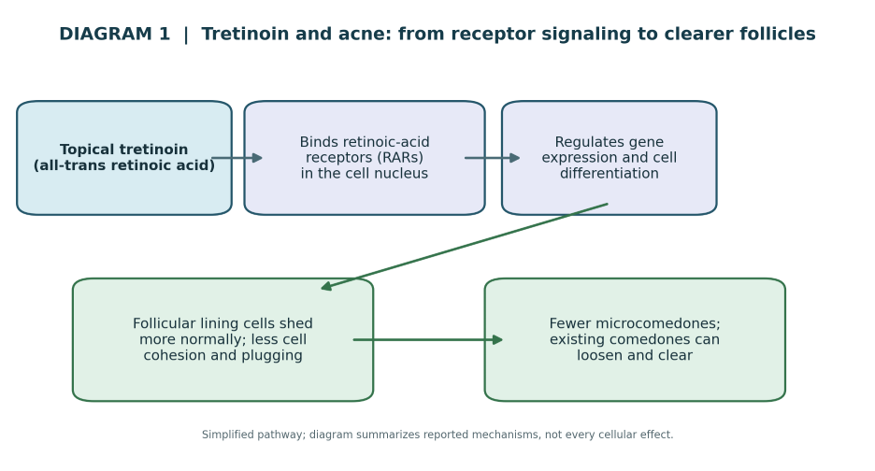
Diagram 2. Conceptual illustration of the UV-related collagen pathway and reported tretinoin effects; arrows indicate direction, not magnitude.
Why it can irritate skin
Tretinoin’s effects on skin-cell activity can also cause local dryness, redness, and peeling. These effects are dose-related and may lessen with continued treatment. [8]
The takeaway: tretinoin changes gene activity through nuclear retinoic-acid receptors. In acne, it helps normalise follicular keratinisation; in photoaged skin, it can reduce UV-triggered collagen-degrading activity and support procollagen production. [1], [3], [6], [7]
References
[1] B. Dreno, S. Kang, J. Leyden, and J. York, “Update: Mechanisms of topical retinoids in acne,” Journal of drugs in dermatology : JDD, 2022, doi: 10.36849/jdd.6890.
[2] B. A. Gilchrest, “Retinoids and photodamage,” The British journal of dermatology, 1992, doi: 10.1111/j.1365-2133.1992.tb16982.x.
[3] D. Thiboutot, “The role of follicular hyperkeratinization in acne,” Journal of Dermatological Treatment, 2000, doi: 10.1080/095466300750163645.
[4] R. M. Lavker, J. J. Leyden, and E. G. Thorne, “An ultrastructural study of the effects of topical tretinoin on microcomedones,” Clinical therapeutics, 1992, Available: https://pubmed.ncbi.nlm.nih.gov/1283729
[5] J. E. Wolf, “Potential anti-inflammatory effects of topical retinoids and retinoid analogues,” Advances in therapy, 2002, doi: 10.1007/bf02850266.
[6] G. J. Fisher, Z. Wang, S. C. Datta, J. Varani, S. Kang, and J. J. Voorhees, “Pathophysiology of premature skin aging induced by ultraviolet light,” New England Journal of Medicine, 1997, doi: 10.1056/nejm199711133372003.
[7] S. Kang, “The mechanism of action of topical retinoids,” Cutis, 2005, Available: https://pubmed.ncbi.nlm.nih.gov/15773538
[8] N. Craven, J. Voorhees, and C. Griffiths, “Topical retinoic acid for photoaged skin: Therapeutic effects and mechanisms,” Journal of Dermatological Treatment, 1996, doi: 10.3109/09546639609080606.