

Started tretinoin and suddenly look like you’ve gone back to school? When you use tretinoin, sometimes your skin gets worse before it gets better. This is called the tretinoin purge.
This guide explains what a tretinoin purge is, why it happens, how long it usually lasts, how to tell it apart from irritation, and the practical steps that make the first few weeks far easier to live with.
Five key takeaways
- A tretinoin purge is a short-lived flare of spots that some people get in the first few weeks, as tretinoin speeds up skin renewal and pushes existing blockages to the surface.
- Most purges settle within about four to eight weeks, with clearer skin usually showing from around weeks eight to twelve.
- A purge shows up where you normally get spots. New spots in new places, burning, itching or a rash are more likely to be irritation or a reaction, and need a check-in.
- Starting slowly, using a pea-sized amount, moisturising well and wearing daily SPF can make the adjustment period much gentler.
- Tretinoin is prescription-only in the UK and should not be used in pregnancy, while trying to conceive or while breastfeeding.
What is a tretinoin purge?
Ever wondered why a cream meant to clear your skin can make it look worse first? You’re not alone. It’s one of the questions we hear most often from people in their first month of treatment, usually sent with a slightly panicked photo attached.
A tretinoin purge is a temporary increase in spots that can happen when you first start tretinoin. You might also hear it called “the retinoid uglies” or “retinoid purging”. It isn’t an official medical diagnosis, but the process behind it is well understood.
Tretinoin is a retinoid, which means it’s a form of vitamin A. It has been used for acne since the late 1960s, when researchers first showed it could loosen the plugs that block pores. Today it’s also prescribed for pigmentation, fine lines and rough skin texture.
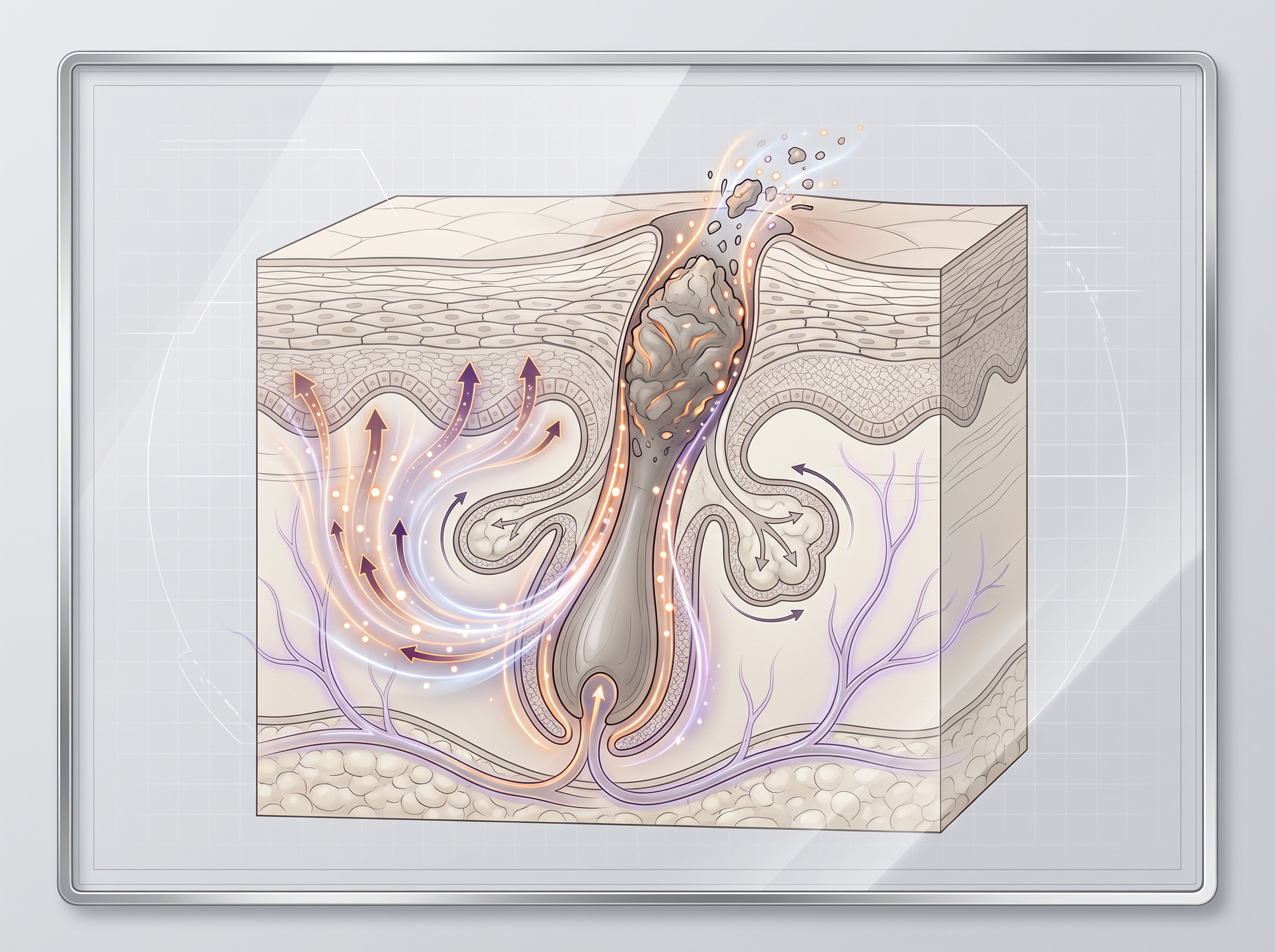
Here’s the key point. The spots you see during a purge were usually already forming beneath the surface. Tretinoin doesn’t create them. It just brings them out sooner, like a fast-forward button on a film you were going to watch anyway.
Why does tretinoin purging happen?
To understand tretinoin purging, it helps to know a little about how your skin renews itself.
Your skin’s conveyor belt
Think of your skin as a slow-moving conveyor belt. New cells are made at the bottom, travel upwards, and are shed from the top. In younger skin, this journey takes a few weeks. As we get older, the belt slows down noticeably. Sun damage and smoking can slow things further.
When the belt is sluggish, dead cells can stick together inside pores. Mix in some oil and you get a microcomedone, the tiny, invisible beginning of a blackhead, whitehead or spot.
What tretinoin changes
Tretinoin turns up the speed of the belt. It also makes the cells lining your pores less “sticky”, so they’re less likely to clump and block things up. On top of that, it has some anti-inflammatory effects.
The catch is timing. When the belt suddenly speeds up, all those hidden microcomedones get pushed to the surface at once. For a few weeks, you see a backlog of spots that would otherwise have surfaced slowly over months.
Once the backlog clears, fewer new blockages form. That’s when the good bit starts.
Why dryness and peeling come along too
Faster turnover also means your outer skin layer is a little thinner and less settled for a while. That’s why many people notice dryness, flaking, tightness or mild redness in the early weeks. These are listed as very common effects in the product information for tretinoin-containing medicines.
How long does a tretinoin purge last?
For most people, a tretinoin purge lasts somewhere between four and eight weeks. Some find it settles sooner. Higher strengths can mean a slightly longer adjustment period.
This roughly matches how long a full skin renewal cycle takes, which is why the purge isn’t endless. Your skin only has so many hidden blockages to clear.
A rough week-by-week guide
Everyone’s skin is different, but this is a typical pattern:
- Weeks 1 to 2: mild tingling, dryness or tightness. Some people notice nothing much at all.
- Weeks 2 to 6: the most likely time for purging, flaking and redness.
- Weeks 6 to 8: spots usually begin to calm, and your skin starts to tolerate the cream better.
- Weeks 8 to 12: clearer skin and smoother texture tend to become noticeable.
- Months 3 to 6: fuller results for acne, tone and texture.
If your skin is still getting steadily worse after around eight to twelve weeks, that’s not a classic purge. It’s worth speaking to your prescriber.
Purge or breakout? How to tell the difference
This is the big one. Not every spot after starting tretinoin is a purge, and mixing the two up can lead to either quitting too early or carrying on with something that isn’t suiting you.
Signs it’s probably a purge
- Spots appear in the areas where you usually break out.
- They tend to be small bumps, whiteheads or blackheads.
- They come and go faster than your usual spots.
- It started within the first few weeks of treatment.
- Things gradually improve over time.
Signs it might be irritation or a reaction
- Spots or redness in areas where you don’t normally get acne.
- Burning, stinging that doesn’t fade, itching or a rash.
- Swelling, blistering or crusting.
- Skin that feels raw or sore rather than just dry.
- No improvement at all after two to three months.
A simple test: if your skin is behaving like a more intense version of its usual self, it’s probably a purge. If it’s behaving like a completely different person, it’s time to check in.

Who is most likely to purge?
People using tretinoin for acne are the most likely to notice purging, simply because they have more blockages waiting under the surface. If your skin is prone to blackheads and whiteheads, a purge is more likely.
If you’re using tretinoin mainly for fine lines or pigmentation and rarely get spots, you may barely purge at all. You can still get dryness, peeling and sensitivity though, so the comfort tips below apply to everyone.
Strength matters too. Starting on a lower strength, such as 0.025%, is often gentler while your skin adapts.
Can you stop tretinoin purging?
Honestly? Not completely. If there’s a backlog of blockages, tretinoin will bring them up. That’s part of how it works.
However, you can make the whole experience much calmer. The aim isn’t zero spots. It’s a smoother ride, so you stay on treatment long enough to see the results you started for.
Start low and go slow
Your prescriber will usually suggest building up gradually. A common approach is to use it every third night for the first week or so, then every other night, then nightly once your skin is comfortable. NHS formulary guidance advises increasing retinoid use gradually over two to three weeks to limit irritation.
Think of it like breaking in new walking boots. Wear them for a short stroll first, not a ten-mile hike.
Use less than you think
A pea-sized amount is enough for your whole face. More cream doesn’t mean faster results. It just means more irritation. Spread it thinly over the whole area, not just on individual spots, because tretinoin works by preventing new blockages across the skin.
Apply to dry skin, at night
Wash your face gently, pat it dry, and wait around 20 to 30 minutes before applying. Damp skin can absorb more, which sounds good but often means more stinging. Tretinoin breaks down in sunlight and makes skin more sun-sensitive, so evening use makes sense.
Try the sandwich method
If your skin is sensitive, try a thin layer of plain moisturiser, wait a few minutes, apply your tretinoin, then add another layer of moisturiser on top. This “sandwich” can soften irritation without stopping the cream working. A simple hyaluronic acid serum can also help with that tight, dry feeling.
Keep the rest of your routine boring
The first couple of months are not the time to experiment with scrubs, peels or new acids. Pause exfoliating products such as AHAs, BHAs and physical scrubs, and avoid waxing treated areas. A gentle cleanser, a fragrance-free moisturiser and sunscreen are all you really need.
If you also use benzoyl peroxide, ask your prescriber how to combine them. Some forms can affect tretinoin if applied at the same time, so they’re often used at different times of day.
Wear SPF every day
Yes, even in a grey British November. Tretinoin makes your skin more sensitive to UV light. Use a broad-spectrum SPF 30 or higher each morning, and top up if you’re outdoors for long periods.
Respect the British weather
Here’s one that rarely appears in American articles. Cold wind and central heating can both make retinoid irritation worse. In winter, you may want a richer moisturiser, a scarf for windy walks, and a slightly slower build-up schedule.
Hands off
We know it’s tempting. But picking or squeezing purge spots increases the risk of marks and scarring, which is the opposite of what you’re aiming for.

Take photos: your secret weapon
Purging plays tricks on your memory. On a bad day, it’s easy to believe your skin has never looked worse.
Take a photo before you start, then one each week. Use the same room, the same lighting and the same angle. Morning light from a window works well.
It’s surprisingly reassuring to scroll back and see real progress, even when the mirror feels discouraging. These photos are also really useful if you need to discuss your progress with a prescriber.
Important safety information
Pregnancy and breastfeeding
Tretinoin should not be used if you’re pregnant, trying to conceive or breastfeeding. NICE advises that topical retinoids are not for use during pregnancy or when planning a pregnancy, and the tretinoin combination gel used in UK acne care should also be avoided when breastfeeding.
If you could become pregnant, use reliable contraception during treatment. If you find out you’re pregnant while using tretinoin, stop using it and speak to your GP or prescriber. Research suggests the risk from topical use is low, so try not to panic, but it’s still important to get advice.
Tretinoin is prescription-only in the UK
You can’t buy tretinoin over the counter in the UK. The licensed UK products are combination acne gels, such as tretinoin with clindamycin or with erythromycin. Single-ingredient tretinoin creams are supplied as prescribed as unlicensed compounded creams after a prescriber has assessed your skin.
Please avoid buying tretinoin from unregulated websites. You can’t be sure what you’re getting, and you miss out on the advice that makes treatment safer and more successful.
When to get help
Contact your prescriber, pharmacist or GP if you notice:
- severe burning, blistering, swelling or crusting
- a rash or itching that suggests an allergic reaction
- no improvement after around three months of regular use
- spots that leave dark marks or scars
You can also report suspected side effects through the MHRA Yellow Card scheme.

Why it’s worth sticking with
Here’s the honest truth. The tretinoin purge is the number one reason people give up just before things get good. It’s a bit like abandoning a jigsaw when you’re halfway through the sky.
Tretinoin is one of the most studied skin treatments available, with over five decades of evidence for acne and skin renewal. NICE includes topical retinoid combinations among first-line options for acne of any severity. If your skin can get through those first few weeks, the long-term pay-off can be clearer pores, fewer breakouts, a more even tone and smoother texture.
Frequently asked questions
1. What is a tretinoin purge?
A tretinoin purge is a temporary flare of spots in the first few weeks of treatment. Tretinoin speeds up skin renewal, which brings hidden blockages to the surface sooner than they would otherwise appear.
2. How long does a tretinoin purge last?
Most tretinoin purges last around four to eight weeks. Improvement usually becomes noticeable from about weeks eight to twelve.
3. Does everyone purge on tretinoin?
No. People using tretinoin for acne are more likely to purge. If you rarely get spots, you may only notice dryness or peeling.
4. How do I know if it’s a purge or a breakout?
A purge happens in your usual problem areas and the spots clear quickly. Spots in new areas, burning, itching or a rash suggest irritation or a reaction instead.
5. Can I stop the tretinoin purge from happening?
You can’t fully prevent it, but you can make it milder. Start slowly, use a pea-sized amount, moisturise well and avoid other harsh products.
6. Should I stop using tretinoin during a purge?
Usually not, as stopping can mean going through it all again later. However, if your skin feels very sore, you can use it less often for a while. Ask your prescriber if you’re unsure.
7. Do I apply moisturiser before or after tretinoin?
Either works, and many people do both. The sandwich method, moisturiser then tretinoin then moisturiser, is a popular way to reduce irritation.
8. Will a lower strength reduce purging?
Often, yes. Starting on a lower strength such as 0.025% can make the adjustment gentler. Your prescriber can increase it once your skin is used to it.
9. Can I use tretinoin if I’m pregnant or breastfeeding?
No. Tretinoin should be avoided in pregnancy, when trying to conceive and while breastfeeding. Use reliable contraception if you could become pregnant.
10. Can I buy tretinoin over the counter in the UK?
No. Tretinoin is a prescription-only medicine in the UK. It must be prescribed after an assessment by a qualified prescriber.

Disclaimer
Disclaimer: This information is for education only and isn’t a substitute for personal medical advice. Always follow your prescriber’s instructions.
References
- Courier Pharmacy (2026a) How tretinoin fights the signs of ageing. Available at: https://courierpharmacy.co.uk/how-tretinoin-fights-the-signs-of-ageing/ (Accessed: 19 October 2026).
- Courier Pharmacy (2026b) Tretinoin strengths: which one is right for your skin? Available at: https://courierpharmacy.co.uk/tretinoin-strengths-which-one-is-right-for-your-skin/ (Accessed: 19 October 2026).
- Courier Pharmacy (2026c) How to apply tretinoin cream. Available at: https://courierpharmacy.co.uk/how-to-apply-tretinoin-cream/ (Accessed: 19 October 2026).
- Courier Pharmacy (2026d) Tretinoin 0.05% cream. Available at: https://courierpharmacy.co.uk/product/tretinoin-0-05-cream/ (Accessed: 19 October 2026).
- Courier Pharmacy (2026e) Aknemycin Plus solution. Available at: https://courierpharmacy.co.uk/product/aknemycin-plus-solution/ (Accessed: 19 October 2026).
- Courier Pharmacy (n.d.) Hyperpigmentation. Available at: https://courierpharmacy.co.uk/conditions/hyperpigmentation/ (Accessed: 19 October 2026).
- emc (n.d.) Tretinoin: Summaries of Product Characteristics and Patient Information Leaflets (Treclin 1%/0.025% w/w Gel; Aknemycin Plus). Available at: https://www.medicines.org.uk/emc/ingredient/947 (Accessed: 19 October 2026).
- Grove, G.L. and Kligman, A.M. (1983) ‘Age-associated changes in human epidermal cell renewal’, Journal of Gerontology, 38(2), pp. 137-142. Available at: https://pubmed.ncbi.nlm.nih.gov/6827031/ (Accessed: 19 October 2026).
- Janssen-Cilag Ltd (2013) Retin-A 0.05% w/w Cream: Summary of Product Characteristics. Health Products Regulatory Authority. Available at: https://assets.hpra.ie/products/Human/20814/LicenseSPC_PA0748-033-004_04022013162044.pdf (Accessed: 19 October 2026).
- Kaplan, Y.C., Ozsarfati, J., Etwel, F., Nickel, C., Nulman, I. and Koren, G. (2015) ‘Pregnancy outcomes following first-trimester exposure to topical retinoids: a systematic review and meta-analysis’, British Journal of Dermatology, 173(5), pp. 1132-1141. Available at: https://doi.org/10.1111/bjd.14053 (Accessed: 19 October 2026).
- Kligman, A.M., Fulton, J.E. and Plewig, G. (1969) ‘Topical vitamin A acid in acne vulgaris’, Archives of Dermatology, 99(4), pp. 469-476. Available at: https://pubmed.ncbi.nlm.nih.gov/?term=Topical+vitamin+A+acid+in+acne+vulgaris+Kligman+1969 (Accessed: 19 October 2026).
- Leyden, J., Stein-Gold, L. and Weiss, J. (2017) ‘Why topical retinoids are mainstay of therapy for acne’, Dermatology and Therapy, 7(3), pp. 293-304. Available at: https://doi.org/10.1007/s13555-017-0185-2 (Accessed: 19 October 2026).
- MHRA (n.d.) Yellow Card scheme. Available at: https://yellowcard.mhra.gov.uk/ (Accessed: 19 October 2026).
- NHS (n.d.) Acne: treatment. Available at: https://www.nhs.uk/conditions/acne/treatment/ (Accessed: 19 October 2026).
- NICE (2021, updated 2026) Acne vulgaris: management. NICE guideline NG198. Available at: https://www.nice.org.uk/guidance/ng198 (Accessed: 19 October 2026).
- Yoham, A.L. and Casadesus, D. (2023) ‘Tretinoin’, in StatPearls. Treasure Island (FL): StatPearls Publishing. Available at: https://www.ncbi.nlm.nih.gov/books/NBK557478/ (Accessed: 19 October 2026).