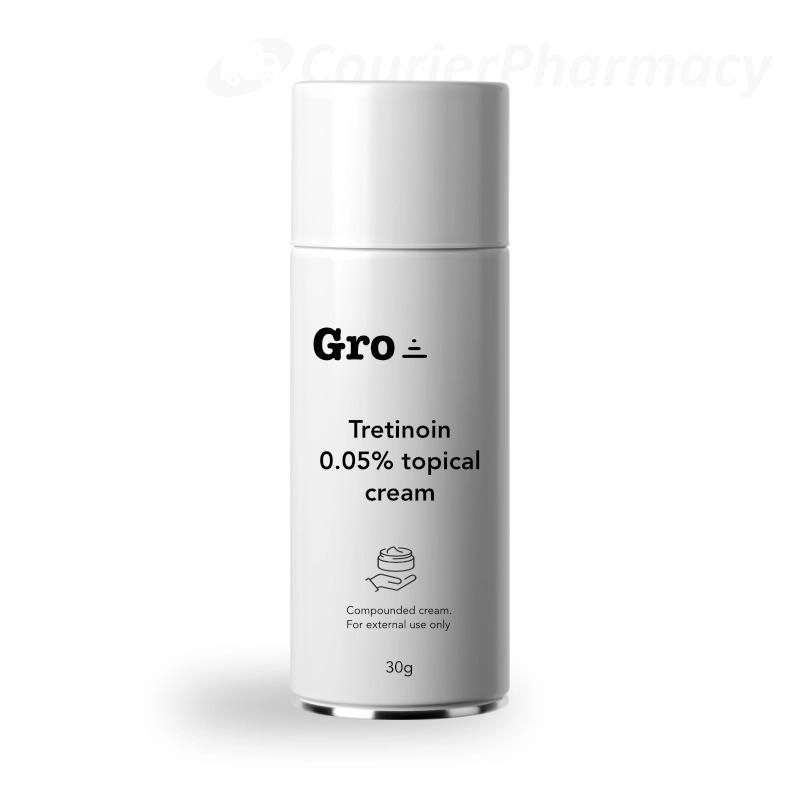
A personalised prescription-strength topical cream containing tretinoin 0.05%. Designed for adults who want a clinically proven approach to hyperpigmentation, acne scars, melasma, sun damage, and early signs of skin ageing in a cream base that supports consistent nightly use.
Topical cream format
Single active ingredient at prescription strength
Pack size: 30g tube
Expiry date: 30 days from compounding date
Prescription only
TREATS:
Hyperpigmentation
FORMAT:
Cream
Availability:
In stock
Our bespoke tretinoin range has been so popular that delivery now takes one week — because "treatment that fits you" is worth the wait.
The problem with hyperpigmentation, acne scars, and uneven skin
Skin concerns are easy to dismiss — until you catch yourself avoiding photos. Firstly, the visible signs are familiar: dark spots left behind after acne, patches of melasma across the cheeks, uneven tone that no amount of foundation quite covers. However, the less visible impact is often harder to carry. Gradually, confidence drops. Meanwhile, self-consciousness builds. As a result, the worry that things are not improving — and that nothing you have tried so far has made a real difference — becomes part of daily life.
The problem with standard treatments
For many people, the frustration goes beyond the skin concern itself. In fact, it is about the experience of trying to treat it.
Firstly, over-the-counter retinol takes months to show any real change. Additionally, many pigmentation creams either irritate the skin or produce disappointing results. Furthermore, brightening serums and acid exfoliants may help around the edges but often leave the deeper concern untouched. In particular, without a proper prescription-strength active, most routines cannot shift stubborn hyperpigmentation, established acne scars, or persistent melasma. Eventually, after enough disappointing months, giving up starts to feel reasonable.
However, giving up is exactly what stops your skin from getting the treatment it actually needs.
Why a prescription-strength approach?
Firstly, tretinoin is the gold-standard topical retinoid. Furthermore, it is significantly stronger than over-the-counter retinol — often by a factor of twenty or more. Additionally, decades of clinical evidence support its use for hyperpigmentation, acne, acne scarring, melasma, and photoageing. Meanwhile, it is only available on prescription in the UK because it needs proper medical oversight to be used safely and effectively.
Above all, a prescription-strength retinoid is not the same as a shop-bought retinol. Rather, it is a clinically proven treatment that addresses skin concerns at a level cosmetic products cannot reach.
Why cream changes things
Firstly, tretinoin comes in cream, gel, and lotion formats. However, the cream base is often the most appropriate choice for hyperpigmentation, acne scars, and melasma. In particular, cream provides slower, gentler release of the active — reducing the irritation that puts many people off retinoids entirely. Furthermore, cream includes moisturising elements that support the skin barrier. As a result, consistent nightly use becomes achievable rather than something to endure.
Meanwhile, gel formulations tend to suit oily, acne-prone skin better because they dry more quickly. However, for hyperpigmentation, scarring, and mature skin, cream typically provides the better balance of tolerability and effectiveness.
Why tretinoin 0.05%?
Firstly, tretinoin is available in three UK prescription strengths — 0.025%, 0.05%, and 0.1%. Notably, 0.05% is the most commonly prescribed strength. In fact, it sits in the middle ground: strong enough to deliver visible results for hyperpigmentation, acne scars, and photoageing, yet more tolerable than the higher 0.1% concentration. Meanwhile, 0.025% is often used for beginners or highly sensitive skin, while 0.1% is reserved for advanced use or specific clinical needs.
Furthermore, the prescriber selects 0.05% when clinical assessment indicates this is the most appropriate starting or ongoing concentration. For some patients, for example, it marks the right step up from 0.025% after their skin has adjusted. For others, however, it is the right entry point because their skin can tolerate a stronger initial dose. For others still, it is the right ongoing concentration based on individual response and tolerability.
Above all, the concentration is not a default. Instead, it is a clinical decision made for you specifically.
A medically responsible route
At Courier Pharmacy, treatment starts with a proper assessment. Firstly, the prescriber checks your suitability. Then, the decision to prescribe this compounded cream follows clinical reasoning — based on your skin, your history, and your goals.
Prescription-only compounded topical cream for hyperpigmentation, acne scars, and skin ageing
Cream base — moisturising, tolerable, suited to sensitive and mature skin
Tretinoin at 0.05% — the most commonly prescribed UK strength
A UK-qualified prescriber reviews your suitability
MOJO WISDOM
Take control of your health by understanding your condition and what this medication is doing for you.
READ:
More information about this treatment.
UK-based doctors and pharmacists
Discreet and Confidential
UK-based doctors and pharmacists
Free, Expert Advice
No video link provided.
No video link provided.
UK-based doctors and pharmacists
Free, expert advice
Discrete and confidential
Fast delivery
Giving you trusted clinical advice for over 40 conditions
A UK regulated pharmacy providing safe, effective treatments online since 2014
This compounded topical cream contains tretinoin 0.05% in a moisturising cream base. Furthermore, it is designed for adults with hyperpigmentation, acne scars, melasma, sun damage, or early signs of skin ageing who want a clinically proven, prescription-strength approach. In particular, it suits those who have found over-the-counter retinols disappointing, those whose skin can tolerate the mid-range concentration, and those wanting a cream format for its added tolerability. Above all, the aim is straightforward: normalise skin cell turnover, regulate melanin production, and stimulate collagen — in a format that makes consistent nightly use genuinely achievable.
Prescription-strength retinoid targeting hyperpigmentation, acne scars, melasma, and photoageing
Cream format is more tolerable and moisturising than gel — suited to normal, dry, and mature skin
Tretinoin at 0.05% — the most commonly prescribed UK strength
May suit people who have found over-the-counter retinols ineffective or want a clinically proven approach
Safe prescribing still matters — retinoid treatment needs proper screening, review, and follow-up
Part of the Gro Beauty range, designed for personalised prescription skincare
Skin concerns are personal
Hyperpigmentation, acne scars, and melasma are common. However, that does not make them any less personal. Firstly, many people first notice dark marks that outlast the spots that caused them. Then, many try over-the-counter products, see little result, and quietly give up — not because treatment cannot work, but because they were never on the right treatment to begin with.
A formula for people who need prescription-strength treatment
This cream suits people who want a clinically proven, prescription-strength approach — in a format they can genuinely build into a routine. In particular, it works for those whose prescriber has identified 0.05% as the most appropriate tretinoin concentration. Additionally, it suits those who have found gel formulations too drying or irritating, and those who want the moisturising benefit of a cream base.
The goal of treatment
Hyperpigmentation and skin concerns affect more than appearance. In fact, they chip away at confidence. Furthermore, they make ordinary moments feel oddly loaded — a harsh bathroom mirror, a photo taken from an unexpected angle, a bright day when you would rather not think about what is visible.
Above all, the goal of treatment is not perfection. Rather, it is to improve tone, soften texture, fade marks, and help you feel more in control — with a plan that makes clinical sense and a format that makes nightly use something you can actually stick to.
Cream benefits and ease of use
Cream is more tolerable than gel
Unlike a gel base, cream does not dry the skin out as it delivers the active. Furthermore, the moisturising base slows the release of tretinoin, which reduces the peak irritation many people experience with gel or lotion formats. Additionally, this makes cream a better fit for normal, dry, sensitive, and mature skin. As a result, retinoid irritation — the single most common reason people abandon tretinoin — becomes less of a barrier.
Cream supports the skin barrier
Firstly, cream includes moisturising elements that work alongside the active. Furthermore, this helps counter the transient dryness and flaking that can occur early in retinoid treatment. Additionally, a supported skin barrier heals more efficiently and shows results more quickly. Some people find this difference small. Others find it transformative. Either way, cream removes friction points that have caused many people to stop using tretinoin altogether.
Adherence is everything
Firstly, a treatment that sits in the bathroom cabinet because it is too irritating to use every night is not a treatment that works. However, if a cream base makes application more comfortable and easier to fit into your existing evening routine, that practical advantage compounds over time — in exactly the way good skincare treatment should.
Why the cream vehicle matters
Above all, the cream base is clinically relevant as well as practically comfortable. Specifically, it delivers the active steadily, supports the skin barrier, and reduces the practical friction that stops people applying treatment consistently — which is one of the most important factors in whether any topical skincare treatment succeeds.
Why compounding?
What compounding means
Firstly, compounding means a medicine is prepared to order by a licensed pharmacy for an individual patient. So it is not a mass-produced one-size-fits-all product. Furthermore, in the UK, this sits within a regulated framework and should only be supplied when clinically appropriate.
Why compounding matters for this formula
Firstly, some people choose a compounded cream because standard products do not offer the concentration they need. Additionally, others come to compounding because they want a base tailored to their skin type. Meanwhile, others want the flexibility to combine tretinoin with other actives — such as hydroquinone or azelaic acid — where clinical assessment indicates this would be beneficial.
Above all, the 0.05% tretinoin concentration in this formula reflects the strength chosen for the individual — not a mass-market default. In fact, compounding makes it possible to prescribe exactly what the prescriber has decided is right for you.
Personalised medicine in practice
Firstly, skin is not identical from one person to the next. Similarly, the right tretinoin concentration for one patient is not the right concentration for another. Furthermore, the right base for oily acne-prone skin is not the right base for dry mature skin. As a result, compounding makes it possible to tailor the active, concentration, and base to the individual being treated. Above all, the medicine is shaped around the patient, not the other way around.
Why single-ingredient tretinoin can be the right choice
Firstly, not every patient needs a multi-ingredient formula from the outset. For some, tretinoin alone at a carefully selected concentration is the most clinically appropriate starting point. Furthermore, it allows the prescriber to assess individual response before considering combination formulas. Additionally, single-ingredient treatment is simpler to introduce, easier to titrate, and often the right choice while the skin adjusts to prescription-strength retinoid use.
As a result, if response is good, the formula can be built upon over time — for example, by adding hydroquinone for stubborn hyperpigmentation or azelaic acid for combined acne and pigmentation concerns. Above all, compounding makes either path possible.
The Gro Beauty range
What is the Gro Beauty range?
Firstly, Gro Beauty is the compounded prescription skincare range from Courier Pharmacy. In fact, it exists because skincare treatment should not feel one-size-fits-all.
For example, some people need prescription-strength tretinoin for hyperpigmentation. Others need hydroquinone combinations for stubborn melasma. Meanwhile, others need azelaic acid for combined acne and pigmentation concerns. Additionally, others benefit from prescription-strength alternatives when over-the-counter products have failed. As a result, Gro Beauty brings compounded prescription options together under one brand — matching treatment to the person using it, not the other way around.
Why Gro Beauty is different
Gro Beauty was built around three practical goals:
Choice of formulation: cream, gel, or lotion — matched to your skin type
Personalisation: single-active and combination formulas across multiple concentrations
Better tolerability: every format is designed to reduce the friction that stops people from maintaining their routine
Ingredients used across the Gro Beauty range
Depending on the product selected, Gro Beauty formulations may include:
Tretinoin
Hydroquinone
Azelaic acid
Niacinamide
Kojic acid
Furthermore, these can be prescribed alone or in combination, and at varying concentrations, depending on the individual treatment plan.
Gro Beauty product options
The Gro Beauty range includes the following compounded skincare options, each supplied as a 30g tube.
Tretinoin only
Tretinoin 0.025% — cream, gel, or lotion
Tretinoin 0.05% — cream, gel, or lotion (this product)
Firstly, Gro Beauty makes personalised prescription skincare accessible and liveable.
Furthermore, you get compounded prescription-strength active ingredients at a concentration chosen for you, in a base matched to your skin type. Above all, if you want a tailored treatment that fits your skin, your treatment stage, and your daily life — not a generic protocol — the Gro Beauty range gives you more than one route without making the choice complicated.
Buy Tretinoin 0.05% cream (prescription only)
Firstly, this is a Prescription Only Medicine. Furthermore, you can request it from courierpharmacy.co.uk by completing a quick online consultation, reviewed by a UK-qualified prescriber for suitability and safety. Then, if appropriate, Courier Pharmacy will dispense the compounded cream and deliver it discreetly.
Complete the online consultation
Prescriber reviews your answers for suitability and safety
Prescription issued if clinically appropriate
Dispensed and delivered discreetly to your door
However, if the treatment is not suitable, we will explain this clearly and suggest the next best option.
Why buy from Courier Pharmacy?
Dr Ada Jex-Cori — our brand pharmacist
Firstly, our service is shaped by the philosophy of Dr Ada Jex-Cori, our brand pharmacist. In fact, she represents the spirit of the pharmacy. Furthermore, she is evidence-led, community-rooted, and willing to challenge one-size-fits-all medicine. Additionally, she is named in honour of three pioneering women in science — Ada Lovelace, Sophia Jex-Blake, and Gerty Cori.
In our fictional world of Etherwell, Dr Ada fights against standardised approaches to healthcare. Meanwhile, in the real world, she represents what we stand for. Above all, her view is straightforward. You are not broken. The system is.
Independent, UK-registered, and patient-led
Firstly, Courier Pharmacy is an independent UK community pharmacy registered with the General Pharmaceutical Council. So every prescription starts with proper clinical review. Furthermore, every supply follows GPhC standards. Above all, we treat skincare concerns as genuine clinical matters, not cosmetic afterthoughts.
Compounded to specialist standards
Furthermore, our compounded formulas are prepared by APC Labs Ltd — a GPhC-registered specialist compounding pharmacy in Southampton. In fact, this matches the standard used by NHS and private specialist prescribers. Additionally, every batch is prepared to order for the individual patient. As a result, you receive a medicine made specifically for you, not pulled from a warehouse shelf.
Prescriber-led, not algorithm-led
Firstly, a UK-qualified independent prescriber reviews every consultation. Secondly, that prescriber decides whether treatment is clinically appropriate. Furthermore, if it is not, the prescriber will explain why and suggest what might work better. Above all, no automated system decides your treatment.
Personalisation as standard
Firstly, our Gro Beauty range exists because skin is not identical from one person to the next. So we offer cream, gel, and lotion formulations. Additionally, we offer single-active and combination formulas. Furthermore, our prescribers can adjust concentration and combine actives based on your skin type and concerns. As a result, treatment is shaped around you.
Ongoing support after supply
Above all, treatment does not end at delivery. Furthermore, our team is available for follow-up questions, review, and treatment adjustment throughout your prescription. Additionally, if the formula needs to evolve — increasing concentration, adding hydroquinone, or switching base — we can adjust it. As a result, your treatment can grow with you.
Transparent pricing
Firstly, our Gro Beauty range is priced simply and clearly. Furthermore, there are no hidden subscription traps. Additionally, there is no pressure to buy more than you need.
More than a prescription: our community
Above all, we believe healthcare should not only happen when you are paying for it. So every fortnight we run free drop-in clinics at Insomnia, Derby, from 10am to 12 noon. Furthermore, anyone can come — no appointment, no cost, no pressure.
Additionally, we cover weight management, GLP-1 therapy, MCAS, menopause, women’s health, men’s health, chronic pain, digestive health, allergies, asthma, sleep, migraine, skincare, acne, hair loss, alcohol use disorder support, and whatever else people bring through the door. As a result, you get real support and treatment that fits.
Trust earned, not claimed
Firstly, we are GPhC-regulated. Furthermore, our content is grounded in evidence. In particular, decades of published research on tretinoin for hyperpigmentation, acne, and photoageing inform our approach. Additionally, we reference the Bulengo-Ransby et al 1993 New England Journal of Medicine landmark study on tretinoin for hyperpigmented lesions, and the Griffiths et al 1995 comparison study on tretinoin for photoageing.
Above all, if tretinoin 0.05% cream is not the right answer for your situation, we will tell you honestly.
Summary
Prescription-only compounded topical cream for hyperpigmentation, acne scars, melasma, sun damage, and skin ageing
Vitamin A derivative — normalises skin cell turnover, stimulates collagen, regulates melanin production
Cream base — moisturising and tolerable, suited to normal, dry, sensitive, and mature skin
Tretinoin at 0.05% — the most commonly prescribed UK strength
May help patients who have found over-the-counter retinols ineffective or need prescription-strength treatment
Good outcomes depend on consistency, sun protection, and realistic expectations
Comes in a 30g tube designed to last around two to three months
Tretinoin 0.05% cream — Active ingredient
Tretinoin 0.05%
Firstly, tretinoin is a topical retinoid — a derivative of vitamin A also known as all-trans retinoic acid. Furthermore, applied to the skin, it works through several mechanisms: it speeds up skin cell turnover, stimulates collagen production, regulates melanin production, normalises keratinisation, and improves blood flow to the skin. In fact, this combination is why tretinoin remains effective across such a wide range of concerns — from acne and hyperpigmentation to melasma, photoageing, and shallow acne scars. Above all, at 0.05%, this matches the most commonly prescribed UK strength — a considered clinical choice offering the best balance of effectiveness and tolerability for most patients.
Why the cream vehicle matters
Furthermore, the cream base is also clinically relevant. Specifically, it delivers the active steadily, supports the skin barrier with moisturising elements, and reduces the peak irritation that puts many people off gel formulations. As a result, cream tretinoin is often the right choice for patients with normal, dry, sensitive, or mature skin, or those new to prescription retinoids.
What is Tretinoin 0.05% cream used for?
Hyperpigmentation and dark marks
Firstly, tretinoin fades post-inflammatory hyperpigmentation (PIH) — the dark marks left behind after acne, injury, or inflammation. Furthermore, it addresses melasma, sun spots, and age spots. In fact, by accelerating cell turnover, tretinoin pushes pigmented cells to the surface faster, where they are shed and replaced by new, evenly pigmented skin. Meanwhile, it also regulates melanin production, reducing the underlying tendency towards uneven pigmentation.
Acne and acne scars
Firstly, tretinoin is one of the most effective topical treatments for acne. Additionally, it prevents clogged pores by normalising skin cell shedding. Furthermore, it reduces inflammation and helps prevent new comedones from forming. Meanwhile, for shallow acne scars, tretinoin can soften texture and help fade the marks left by past breakouts. However, deep ice-pick or boxcar scarring may need additional treatments such as needling, chemical peels, or laser therapy.
Sun damage and photoageing
Firstly, tretinoin stimulates collagen production and reverses some of the visible signs of sun damage. Furthermore, it softens fine lines, evens tone, and improves skin texture. Above all, the Griffiths et al 1995 landmark study demonstrated meaningful improvement in photoageing signs with regular tretinoin use.
The problems of skin concerns
Firstly, the practical problem is visible marks, dark patches, or ongoing acne. Meanwhile, the internal problem is the loss of confidence that builds quietly alongside them. Above all, the deeper issue is that people should not have to feel dismissed or left to navigate treatment alone for something that so clearly affects daily life.
Who this formula is for
Firstly, some patients come to this formula because their clinical profile indicates that prescription-strength tretinoin is the right route — and they want it in a cream base for its added tolerability. Meanwhile, others arrive after over-the-counter retinols have failed to deliver meaningful results. Additionally, others come because they have specific concerns — persistent PIH, established melasma, or moderate photoageing — that require prescription-level intervention. Above all, in all cases, a compounded tretinoin cream at 0.05% offers a more considered, personalised path than anything available off the shelf.
How does Tretinoin 0.05% cream work?
Firstly, tretinoin works through multiple complementary mechanisms. Furthermore, this is why it remains effective across such a wide range of skin concerns.
Speeding up cell turnover
Firstly, tretinoin binds to receptors in skin cells and accelerates the natural cell turnover cycle. In fact, this pushes older, damaged, and pigmented cells to the surface more quickly, where they are shed and replaced. Furthermore, this is how tretinoin fades hyperpigmentation, evens tone, and improves texture. Additionally, faster turnover helps prevent the buildup of dead cells that contributes to clogged pores and acne.
Stimulating collagen production
Meanwhile, tretinoin stimulates collagen production in the dermis. As a result, this softens fine lines, improves skin firmness, and helps reverse some of the visible signs of sun damage. Furthermore, increased collagen production also supports the softening of shallow acne scars over time.
Regulating melanin production
Firstly, tretinoin helps regulate melanocyte activity — the cells responsible for producing melanin. Furthermore, this addresses the underlying cause of hyperpigmentation, sun spots, and melasma. As a result, tretinoin does not just push existing pigmented cells to the surface — it also reduces the ongoing production of excess pigment.
Normalising keratinisation
Additionally, tretinoin normalises the way skin cells develop and shed. In particular, this prevents the abnormal keratinisation that leads to clogged pores and acne. As a result, tretinoin is highly effective for both active breakouts and preventing new comedones from forming.
Improving blood flow
Finally, tretinoin also improves blood flow to the skin. Furthermore, this contributes to healthier skin function and the more radiant appearance many people notice after several months of consistent use.
How do you use Tretinoin 0.05% cream?
Firstly, this formulation is a topical cream and should only be used exactly as prescribed. Furthermore, the usual direction is:
Apply a pea-sized amount to clean, dry skin at night, 3–5 nights per week to start. Wait 20 minutes after cleansing before applying. Follow with moisturiser.
Start slowly
Firstly, tretinoin needs to be introduced gradually. Additionally, most patients start with 3 nights per week for the first week. Then, if tolerated, increase to 4 nights per week for the next week. Finally, progress to nightly use as tolerated. Above all, going too fast too soon is the single biggest cause of retinoid irritation.
Weeks 1: apply every third night
Weeks 2: apply every other night if tolerated
Weeks 3 onwards: nightly application if tolerated
If irritation is severe, go back down a step and rebuild more slowly
The pea-sized amount
Firstly, a pea-sized amount is enough for the entire face. In fact, more is not better — excess tretinoin does not improve results but does increase irritation. Furthermore, apply in a thin, even layer, avoiding the delicate skin around the eyes, corners of the nose, and lips.
Wait after cleansing
Firstly, apply tretinoin to completely dry skin. Furthermore, damp skin absorbs tretinoin faster, which increases irritation. Additionally, wait at least 20 minutes after cleansing before applying tretinoin — this is one of the simplest ways to reduce initial redness and flaking.
Moisturise afterwards
Firstly, follow tretinoin with a bland, non-comedogenic moisturiser. Furthermore, this supports the skin barrier while the active does its work. Additionally, some patients apply moisturiser both before and after tretinoin (the sandwich method) to further reduce irritation.
Sunscreen is essential
Above all, tretinoin increases photosensitivity significantly. In fact, sun exposure while using tretinoin can worsen hyperpigmentation — undoing the progress you have made. As a result, a broad-spectrum SPF 30 or higher every morning is non-negotiable, even on cloudy days and even indoors near windows.
Building a routine that works
Firstly, many people find it easiest to apply as part of their evening routine — after cleansing, before moisturiser. Furthermore, the cream base makes the application experience far more comfortable than a gel or lotion. As a result, applied consistently, treatment has the best possible conditions to work.
What to do if you miss a dose
Firstly, resume at the next usual night. However, do not apply extra to make up for it. Above all, consistent use over months matters far more than compensating for a missed night.
Tretinoin 0.05% cream — Warnings and precautions
Who should not use this product
Firstly, this product is not suitable for everyone. Furthermore, extra care is needed if you are pregnant, trying to become pregnant, or breastfeeding. Additionally, tretinoin is contraindicated in these groups because oral retinoids are known teratogens — and while topical absorption is minimal, use during pregnancy is not recommended.
Pregnancy and breastfeeding
Firstly, tretinoin must not be used during pregnancy or by women planning imminent pregnancy. Furthermore, reliable contraception is recommended throughout treatment for women of childbearing age. Additionally, breastfeeding mothers should not use tretinoin. Above all, any suspicion of pregnancy requires immediate treatment cessation.
Sun exposure
Firstly, tretinoin significantly increases photosensitivity. Furthermore, sun exposure can worsen hyperpigmentation — the very thing tretinoin is treating. As a result, broad-spectrum SPF 30 or higher is essential every day. Additionally, avoid deliberate sun exposure and tanning while using tretinoin.
Skin conditions
Firstly, tretinoin is not suitable for eczema, active rosacea, seborrhoeic dermatitis, or other inflammatory skin conditions. Furthermore, use with caution if you have very sensitive skin. Additionally, do not apply to broken, sunburned, or irritated skin. Above all, treat any underlying skin condition first before starting tretinoin.
Age considerations
Firstly, tretinoin is not typically prescribed for adolescents under 18 without specific clinical indication. Furthermore, the prescriber will assess suitability case by case for adolescent acne treatment.
Initial irritation
Firstly, some initial irritation is normal — most patients experience some dryness, flaking, or mild redness in the first 2 to 6 weeks. Furthermore, this typically settles as the skin adjusts. However, if irritation is severe or does not settle, reduce frequency, contact the prescriber, and consider whether the 0.025% strength would be more suitable.
Compounded does not mean casual
Firstly, the cream base and mid-range concentration do not reduce the need for proper prescribing review. In fact, the same thorough safety and suitability checks apply here as with any other prescription treatment. Furthermore, a full medical history — including pregnancy status, current medications, skin conditions, and previous retinoid use — will be reviewed during consultation.
Tretinoin 0.05% cream — Side effects
Common side effects
Firstly, common side effects include dryness, flaking, mild redness, and temporary irritation — especially during the first 2 to 6 weeks. Furthermore, some patients experience a temporary worsening of acne (retinoid purge) in the first weeks as clogged pores clear. Above all, this typically settles as the skin adjusts. Additionally, sun sensitivity increases significantly during treatment.
The retinoid purge
Firstly, some patients experience a temporary flare of acne in the first 4 to 6 weeks. In fact, this happens as tretinoin brings clogged pores to the surface faster than they would naturally clear. Furthermore, this is different from irritation — it involves increased spots rather than red, dry skin. Above all, the purge typically settles by week 6 to 8, followed by meaningful clearing.
Persistent irritation
Firstly, if severe or persistent irritation occurs, reduce application frequency. Additionally, consider using a bland moisturiser both before and after tretinoin (the sandwich method). Furthermore, contact the prescriber if irritation does not settle. Above all, do not stop treatment abruptly without advice — the prescriber may recommend stepping down to 0.025% instead.
Photosensitivity
Firstly, tretinoin significantly increases photosensitivity. As a result, sun exposure can cause increased burning, worsening pigmentation, and skin damage. Furthermore, this is why daily broad-spectrum SPF is essential throughout treatment and for several weeks after stopping.
Rare side effects
Firstly, rare side effects include allergic contact dermatitis, severe skin peeling, or hypersensitivity reactions. Above all, signs of severe allergic reaction — marked facial swelling, breathing difficulty, or widespread rash — require immediate medical attention.
When to seek advice
Firstly, seek advice if you develop marked irritation, persistent redness, severe dryness, signs of allergy, or any other concerning symptoms. Above all, persistent or severe reactions should be reported promptly.
Tretinoin 0.05% cream — Drug interactions
Why interactions still matter with topical treatment
Firstly, tretinoin has fewer systemic interactions than oral medicines. However, topical interactions with other skincare products can significantly affect tolerability and results.
Products to avoid using at the same time
Firstly, avoid using benzoyl peroxide directly with tretinoin — it inactivates the retinoid. Furthermore, avoid vitamin C serums, glycolic acid, salicylic acid, and other acids in the same routine as tretinoin. Additionally, avoid other retinoids (retinol, adapalene, tazarotene) at the same time. Meanwhile, avoid physical exfoliants and harsh scrubs while using tretinoin.
Products that can be used carefully
Firstly, hyaluronic acid and ceramide moisturisers pair well with tretinoin. Additionally, niacinamide is generally compatible and can support the skin barrier. Furthermore, azelaic acid can be used alongside tretinoin under prescriber guidance. Meanwhile, sunscreen every morning is essential, not optional.
Alternating routines
Firstly, some patients use vitamin C serum in the morning and tretinoin at night. Furthermore, this separation allows both actives to work without interfering with each other. Additionally, benzoyl peroxide can be used in the morning if the prescriber advises. Above all, the prescriber will guide you on how to integrate tretinoin into your existing routine.
Photosensitising medications
Firstly, some oral medications increase photosensitivity — including certain antibiotics (doxycycline, tetracycline), diuretics, and NSAIDs. Furthermore, combining these with tretinoin can significantly increase sun sensitivity. Above all, disclose all current medications during consultation.
Tretinoin 0.05% cream — FAQs
How long does it take to see results?
Firstly, tretinoin needs patience. In fact, most people need 3 to 6 months of regular use before they can judge whether treatment is helping. Furthermore, hyperpigmentation typically starts fading at 8 to 12 weeks. Additionally, acne improvement often begins around week 8 to 12, after the initial purge settles. Above all, photoageing and collagen benefits develop over 6 to 12 months of consistent use.
Is this suitable for both men and women?
Yes. Firstly, tretinoin suits men and women equally. However, women who are pregnant, planning imminent pregnancy, or breastfeeding must not use it. Furthermore, reliable contraception is recommended for women of childbearing age during treatment.
Why 0.05% rather than 0.025% or 0.1%?
Firstly, 0.05% is the most commonly prescribed UK strength. Furthermore, it offers the best balance of effectiveness and tolerability for most patients. Additionally, 0.025% is often used for beginners or highly sensitive skin, while 0.1% is reserved for advanced use or specific clinical needs. Above all, the prescriber selects the strength based on your skin type, concerns, and previous retinoid experience.
Why cream rather than gel?
Firstly, cream is more moisturising and tolerable than gel. Furthermore, this makes it a better fit for normal, dry, sensitive, and mature skin. Meanwhile, gel tends to suit oily, acne-prone skin better because it dries more quickly. Above all, the prescriber will recommend the format that suits your skin type best.
What is compounding and why does it matter?
Firstly, compounding is the preparation of a medicine to order for an individual patient by a licensed pharmacy. Furthermore, it allows the ingredients, concentrations, and format to be tailored specifically to the person being treated. Above all, compounding makes it possible to combine tretinoin with other actives — such as hydroquinone or azelaic acid — when that would benefit you clinically.
Can I combine tretinoin with hydroquinone for hyperpigmentation?
Yes. Firstly, tretinoin and hydroquinone is one of the most effective combinations for hyperpigmentation and melasma. Furthermore, it is available as a compounded formula through our Gro Beauty range. Above all, discuss with your prescriber whether a combination formula would suit your specific concerns.
Will I experience the retinoid purge?
Firstly, some patients experience a temporary flare of acne in the first 4 to 6 weeks. However, not everyone does. Furthermore, the purge typically settles by week 6 to 8. Above all, if you have a history of severe cystic acne, mention this during consultation — the prescriber may recommend starting at 0.025% to reduce initial reactivity.
Can I use tretinoin around my eyes?
Firstly, avoid applying directly to the delicate skin around the eyes. Furthermore, this skin is thinner and more prone to irritation. However, tretinoin applied to the surrounding skin can still benefit fine lines around the eyes through diffusion. Above all, do not apply directly to the eyelids.
Do I really need sunscreen every day?
Yes. Firstly, tretinoin significantly increases photosensitivity. Furthermore, sun exposure can worsen the hyperpigmentation you are trying to treat. Additionally, tretinoin repairs sun damage — sunscreen protects that repair. Above all, broad-spectrum SPF 30 or higher every morning is non-negotiable throughout treatment.
Will I need a prescription?
Yes. Firstly, this is a Prescription Only Medicine. Furthermore, a UK-qualified prescriber must review suitability before supply. Additionally, the consultation can be completed online at courierpharmacy.co.uk.
Can I stop if I see improvement?
Firstly, do not stop or change treatment without advice. Furthermore, benefits gradually reverse if treatment stops. Above all, most patients use tretinoin long-term for maintenance — either at the same strength or stepping down to a maintenance frequency.
What is the Gro Beauty range?
Firstly, Gro Beauty is the compounded prescription skincare range from Courier Pharmacy. Furthermore, it offers cream, gel, and lotion formulations across multiple actives and concentrations.
How long does a 30g tube last?
The compounded cream has an expiry of 30 days.
Can I use it if I have sensitive skin?
Firstly, sensitive skin may find 0.05% too strong initially. However, starting slowly (3 nights per week) and using the sandwich method (moisturiser before and after) can make it manageable. Above all, if 0.05% proves too strong, stepping down to 0.025% is an option — discuss with your prescriber.
What if I have acne AND hyperpigmentation?
Firstly, tretinoin is effective for both. Furthermore, it targets the acne itself, prevents new comedones, and fades the pigmentation left behind. Additionally, if your acne is severe, the prescriber may recommend combining tretinoin with topical antibiotics or other treatments.
Can I use tretinoin with a chemical peel or laser treatment?
Firstly, tretinoin needs to be paused around chemical peels, laser treatments, or microneedling. Furthermore, most practitioners recommend stopping tretinoin 5 to 7 days before and after in-clinic treatments. Above all, coordinate with your practitioner and prescriber.
Will tretinoin thin my skin?
No — this is a common myth. Firstly, tretinoin actually thickens the deeper layers of skin by stimulating collagen production. Furthermore, the surface layer (stratum corneum) may thin slightly initially but stabilises as the skin adjusts. Above all, the overall effect is stronger, healthier skin.
Can I use makeup while on tretinoin?
Yes. Firstly, makeup does not interfere with tretinoin. Furthermore, apply makeup after the tretinoin has absorbed and moisturiser has settled. However, avoid heavy exfoliating primers or serums that may increase irritation.
Disclaimer
This article is for informational purposes only and does not constitute medical advice. Above all, always consult a qualified healthcare professional before starting any new treatment.
Bulengo-Ransby, S.M., Griffiths, C.E.M., Kimbrough-Green, C.K., Finkel, L.J., Hamilton, T.A., Ellis, C.N. and Voorhees, J.J. (1993) 'Topical tretinoin (retinoic acid) therapy for hyperpigmented lesions caused by inflammation of the skin in black patients', New England Journal of Medicine, 328(20), pp. 1438–1443. Available at: https://doi.org/10.1056/NEJM199305203282002
Griffiths, C.E.M., Kang, S., Ellis, C.N., Kim, K.J., Finkel, L.J., Ortiz-Ferrer, L.C., White, G.M., Hamilton, T.A. and Voorhees, J.J. (1995) 'Two concentrations of topical tretinoin (retinoic acid) cause similar improvement of photoaging but different degrees of irritation', Archives of Dermatology, 131(9), pp. 1037–1044. Available at: https://doi.org/10.1001/archderm.1995.01690210067011
Kligman, A.M., Grove, G.L., Hirose, R. and Leyden, J.J. (1986) 'Topical tretinoin for photoaged skin', Journal of the American Academy of Dermatology, 15(4), pp. 836–859. Available at: https://doi.org/10.1016/s0190-9622(86)70242-9
Zasada, M. and Budzisz, E. (2019) 'Retinoids: active molecules influencing skin structure formation in cosmetic and dermatological treatments', Advances in Dermatology and Allergology, 36(4), pp. 392–397. Available at: https://doi.org/10.5114/ada.2019.87443
How this content was created
This content was created using UK clinical guidance, peer-reviewed evidence, and patient-focused healthcare writing principles. Above all, it supports safe understanding, not self-prescribing, and has been reviewed in line with pharmacy standards.