

Coenzyme Q10 (CoQ10) may support reproductive cells by helping them produce energy and by contributing to antioxidant defenses. But evidence that supplements reliably increase the chance of a live birth is still limited. The strongest clinical rationale is for people undergoing fertility treatment with diminished ovarian reserve and for some men with abnormal semen parameters—not as a proven fertility enhancer for everyone. [1], [2]
What CoQ10 does
CoQ10 is a lipid-soluble carrier in the mitochondrial electron-transport chain and also helps maintain antioxidant balance in cells. [3] Researchers study whether supplementation can support mitochondrial activity and reduce oxidative stress in reproductive cells. [3] This is a plausible biological pathway, but improvements in cell or laboratory markers do not automatically translate into more pregnancies or live births.
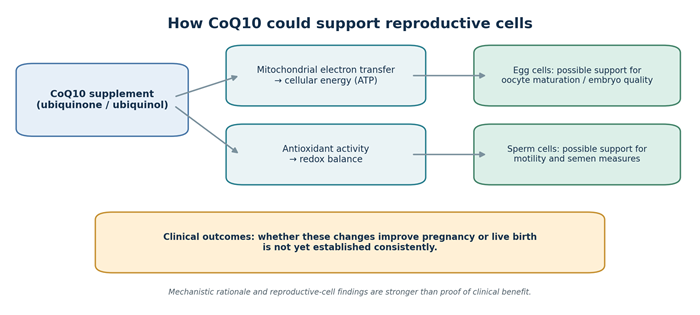
Diagram showing the proposed CoQ10 pathway from mitochondrial energy and antioxidant activity to reproductive-cell measures, with the clinical-outcome link marked as uncertain.
Figure 1. Conceptual schematic of the proposed CoQ10 pathways and the distinction between reproductive-cell measures and clinical outcomes.
Evidence in women
The clearest potential benefit is among women with diminished ovarian reserve or a poor response to ovarian stimulation, particularly during IVF/ICSI. A 2018 randomised trial in younger women with poor ovarian reserve found that 60 days of pretreatment was associated with more retrieved eggs, higher fertilisation, and more high-quality embryos. The trial did not establish a statistically significant improvement in clinical pregnancy or live birth. [4]
A 2024 meta-analysis of six randomised trials involving 1,529 women with diminished ovarian reserve reported a higher clinical-pregnancy rate and more eggs retrieved after CoQ10 pretreatment. The authors cautioned that the underlying trials were relatively limited in size and their methods were not well described. [2] An earlier meta-analysis of five randomised trials (449 women) also found a higher clinical-pregnancy rate, but no statistically significant difference in live-birth or miscarriage rates. [5] Taken together, these results suggest a possible improvement in ovarian response and clinical pregnancy during assisted reproduction; they do not yet show reliably that CoQ10 increases live births.
Evidence in men
CoQ10 is present in semen, and seminal CoQ10 concentrations have been associated with sperm count and motility. [6] In a randomised, placebo-controlled trial of 212 men with idiopathic oligoasthenoteratospermia, 300 mg daily for 26 weeks improved sperm density and motility compared with placebo. The trial did not determine whether treatment increased pregnancy rates. [7]
A 2025 meta-analysis of nine studies involving 781 men reported improvements in sperm concentration, total motility and seminal CoQ10; it also found higher odds of clinical pregnancy. [8] Another meta-analysis reported significant between-study heterogeneity and called for larger, well-designed randomised trials. [9] Better semen measurements are therefore more consistently supported than a definite increase in a couple’s chance of pregnancy.
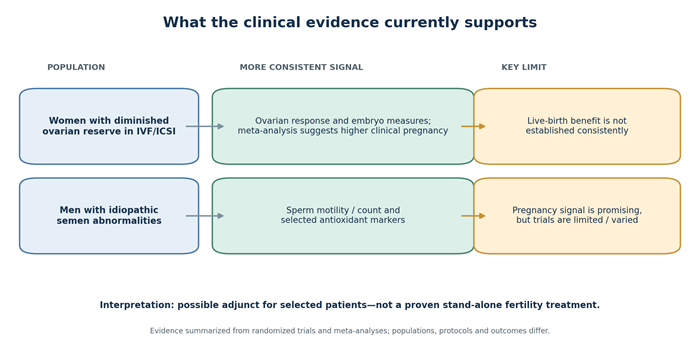
Diagram comparing clinical evidence for CoQ10 in women undergoing IVF/ICSI and men with idiopathic semen abnormalities, alongside the main uncertainty for each group.
Figure 2. Evidence-map schematic comparing the populations, outcomes and limitations discussed in the sections above.
What remains uncertain—and what to do
Results vary by population, dose, treatment duration and outcome measured. In women, evidence is concentrated in assisted reproduction and diminished ovarian reserve; in men, many studies focus on semen quality rather than live birth. [1], [4] CoQ10 should not be expected to reverse age-related fertility decline or replace evaluation of both partners and evidence-based fertility care.
There is no single regimen established for everyone: studies tested different doses and durations, and reviews describe substantial variation in protocols. [1] If you are considering CoQ10 while trying to conceive or undergoing fertility treatment, discuss it with your clinician, who can consider your diagnosis, current treatment and other supplements or medicines. The evidence is promising for selected fertility measures, but it is not strong enough to promise that CoQ10 will lead to pregnancy or live birth.
Evidence note: This article is based on retrieved academic abstracts; full-text papers were not fetched. Findings should be interpreted in light of the study limitations described above.
References
[1] D. Vaamonde, A. C. Hackney, C. Algar-Santacruz, M. J. Garcia-Moreno, and J. M. G. Manso, “Coenzyme Q10 in fertility and reproduction,” Coenzyme Q in Aging, 2020, doi: 10.1007/978-3-030-45642-9_14.
[2] G. Lin, X. Li, S. L. J. Yie, and L. Xu, “Clinical evidence of coenzyme Q10 pretreatment for women with diminished ovarian reserve undergoing IVF/ICSI: A systematic review and meta-analysis,” Annals of Medicine, 2024, doi: 10.1080/07853890.2024.2389469.
[3] X. Nie, X. Dong, Y. Hu, F. Xu, C. Hu, and C. Shu, “Coenzyme Q10 stimulate reproductive vatality,” Drug Design, Development and Therapy, 2023, doi: 10.2147/DDDT.S386974.
[4] Y.-Y. Xu et al., “Pretreatment with coenzyme Q10 improves ovarian response and embryo quality in low-prognosis young women with decreased ovarian reserve: A randomized controlled trial,” Reproductive Biology and Endocrinology, 2018, doi: 10.1186/s12958-018-0343-0.
[5] P. Florou, P. Anagnostis, P. Theocharis, M. Chourdakis, and D. Goulis, “Does coenzyme Q10 supplementation improve fertility outcomes in women undergoing assisted reproductive technology procedures? A systematic review and meta-analysis of randomized-controlled trials,” Journal of Assisted Reproduction and Genetics, 2020, doi: 10.1007/s10815-020-01906-3.
[6] A. T. Alahmar, A. E. Calogero, S. Rajender, R. Cannarella, P. Sengupta, and S. Dutta, “Coenzyme Q10, oxidative stress, and male infertility: A review,” Daehan saengsik uihak hoeji/Clinical and experimental reproductive medicine, 2021, doi: 10.5653/cerm.2020.04175.
[7] M. Safarinejad, “Efficacy of coenzyme Q10 on semen parameters, sperm function and reproductive hormones in infertile men.” Journal of Urology, 2009, doi: 10.1016/j.juro.2009.02.121.
[8] S. Bakri et al., “Efficacy and safety of coenzyme Q10 in idiopathic male infertility: A systematic review and meta-analysis of randomized trials.” The World Journal of Men’s Health, 2025, doi: 10.5534/wjmh.250159.
[9] T. M. Akhigbe et al., “Does coenzyme Q10 improve semen quality and circulating testosterone level? A systematic review and meta-analysis of randomized controlled trials,” Frontiers in Pharmacology, 2025, doi: 10.3389/fphar.2024.1497930.