Home » Treatment » Azelaic acid 20% and Niacinamide 4% topical cream
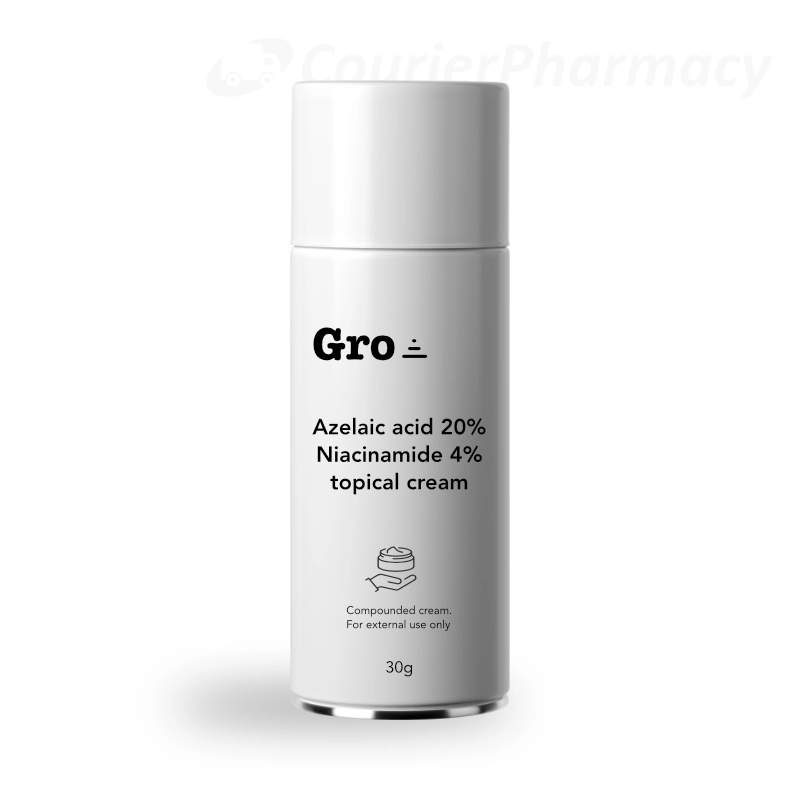
Azelaic acid 20% and Niacinamide 4% topical cream
from£39.99
UK pharmacy-compounded combination cream — azelaic acid 20% (licensed strength from Skinoren) plus niacinamide 4% (vitamin B3) in an emollient cream base
Versatile use for mild-to-moderate acne, rosacea (particularly papulopustular), post-inflammatory hyperpigmentation, and melasma — often when concerns overlap in the same patient
Well-tolerated and safe in pregnancy and breastfeeding; daily SPF 30+ essential for pigmentation results; part of the Gro skincare range
Skin concerns often overlap. After all, someone with acne frequently has post-inflammatory hyperpigmentation. Someone with rosacea often has associated redness and background pigmentation. Someone with melasma may have coexisting sensitivity or general uneven tone.
So single-active products often address only part of the picture — leaving patients layering multiple products, dealing with compatibility issues, and struggling to maintain complex routines. Combining well-tolerated actives with complementary mechanisms can genuinely simplify skincare while broadening coverage.
This azelaic acid 20% + niacinamide 4% cream addresses multiple skin concern pathways in a single application. Specifically, azelaic acid brings tyrosinase inhibition, antimicrobial action, and keratinisation normalising. Niacinamide brings melanosome transfer inhibition, sebum regulation, and barrier support.
As a result, the combination covers acne, rosacea, and pigmentation through different but complementary mechanisms. However, honest framing matters: this is a versatile mid-strength combination, not the strongest option for any single concern. So it fits patients with mild-to-moderate multi-concern situations rather than those needing intensive single-concern treatment.
How the two actives complement each other
The combined mechanisms cover multiple pathways:
For acne
Azelaic acid: antimicrobial action against P. acnes bacteria
So this combination typically sits at Step 4 — the compounded combination layer. In short, it’s a next step after single-active approaches, or a sensible starting point for patients with multiple concerns wanting broader coverage from the start.
This cream vs licensed Skinoren 20% cream
Same azelaic acid strength, different overall formulation:
Skinoren 20% cream: licensed monotherapy by Bayer
In contrast, this cream combines azelaic acid 20% with niacinamide 4%
Both contain the same licensed strength of azelaic acid
This combination adds niacinamide’s complementary mechanisms
Skinoren is licensed specifically for acne
This combination broadens coverage to include niacinamide’s pigmentation and barrier benefits
Skinoren has full Marketing Authorisation
This combination is a compounded preparation
In general, Skinoren fits pure acne monotherapy; this combination fits multi-concern situations
This cream vs licensed Finacea 15% gel
Different strengths and formulations for different indications:
Finacea 15% gel: licensed for papulopustular rosacea
In contrast, this cream uses 20% azelaic acid with added niacinamide
Finacea is a gel formulation — can be drying for some patients
This is a cream base — generally better tolerated
Finacea is licensed specifically for rosacea
This combination covers rosacea plus acne and pigmentation
Finacea has Marketing Authorisation
This combination is compounded
In general, Finacea fits pure rosacea; this combination fits mixed concerns
This cream vs OTC azelaic acid products
Prescription-strength vs OTC alternatives:
OTC azelaic acid: typically 5-10% concentration
In contrast, this cream uses the licensed prescription-strength 20%
OTC options are widely available and often cheaper
However, higher strengths have stronger evidence base
OTC options don’t usually combine with niacinamide at this level
Also, this combination offers pharmacist-guided use
In general, OTC options are a starting point; this fits patients wanting prescription-strength combination
This cream vs niacinamide 3% cream alone (also in the Gro range)
Single active vs combination:
Niacinamide 3% cream: single active focused on foundation skincare
In contrast, this combination adds azelaic acid for stronger targeted action
Niacinamide alone fits foundation skincare and mild pigmentation
This combination fits more active concerns needing multiple mechanisms
Niacinamide alone is gentler for very sensitive skin
Azelaic acid can cause initial tingling for 1-2 weeks
In general, start with niacinamide 3% for foundation; step up to this combination for more targeted action
This cream vs tretinoin 0.025% (also in the Gro range)
Different mechanism and tolerability profiles:
Tretinoin: prescription-strength retinoid, causes retinization, contraindicated in pregnancy
In contrast, this combination uses well-tolerated actives, pregnancy-safe
Tretinoin delivers stronger anti-aging results
This combination delivers broader multi-concern coverage without retinization
Tretinoin causes photosensitivity
This combination doesn’t cause photosensitivity
Both can be used together (this combination morning, tretinoin evening)
In general, tretinoin fits intensive anti-aging; this fits mild-to-moderate multi-concern situations
This cream vs hydroquinone-containing formulas
Different pigmentation approaches:
Hydroquinone: potent tyrosinase inhibitor, limited to 3-6 month courses
In contrast, this combination uses safer long-term actives
Hydroquinone is more potent for stubborn or advanced pigmentation
However, hydroquinone can cause ochronosis long-term
Also, hydroquinone can’t be used in pregnancy
This combination is safer for long-term maintenance
Some patients use hydroquinone short-term then this combination for maintenance
In general, hydroquinone fits severe pigmentation; this fits mild-to-moderate and maintenance
This cream vs Kligman’s formula
Prescription combination vs pharmacy compounded combination:
Adults with severe rosacea flushing (may need oral treatment or laser)
Adults with known allergy to azelaic acid, niacinamide, or vitamin B3
Adults with severe eczema or dermatitis on treatment area
Adults with active herpes simplex on face
Adults wanting immediate results
Adults who won’t apply consistently
Adults who won’t use daily SPF (pigmentation results won’t be visible)
Adults happy with OTC options that meet their needs
Courier Pharmacy supply
This is a pharmacy-compounded skincare preparation from the Gro skincare range. So supply happens after our pharmacist reviews your skin concerns through a consultation. The consultation covers:
Your specific skin concerns (acne, rosacea, pigmentation, or combinations)
Azelaic Acid 20% and Niacinamide 4% Topical Cream — Compounded Combination Skincare from the Gro Skincare Range
This is a UK pharmacy-compounded skincare preparation combining two evidence-based actives — azelaic acid 20% (the licensed strength found in Skinoren cream) and niacinamide 4% (a form of vitamin B3) — in an emollient cream base. So each tube delivers two complementary mechanisms in a single product: azelaic acid inhibits tyrosinase (reducing melanin production), reduces P. acnes bacteria, and normalises keratinisation, while niacinamide reduces melanosome transfer to surface skin cells, regulates sebum, and supports skin barrier function. As a result, this combination fits patients dealing with acne, rosacea, hyperpigmentation, or combinations of these concerns — offering a broader mechanism than either active alone. Important: this is a compounded skincare preparation. So the individual actives are used in licensed products (azelaic acid as Skinoren and Finacea), but this specific combination is prepared for individual patients under our pharmacy compounding process. Part of the Gro skincare range at Courier Pharmacy.
At Courier Pharmacy, we believe in treatment that fits the person — but only where it’s honest, safe, and consented to.
This page covers what azelaic acid 20% + niacinamide 4% cream is, how the two actives work together, who it might suit for acne, rosacea, or pigmentation, and how it compares to licensed monotherapies and other skincare options.
Regulatory position — please read first
Before going further, we want to be straight with you about three things:
First, this is a pharmacy-compounded skincare preparation combining two individually well-established actives. Azelaic acid at 20% is licensed as Skinoren cream (Bayer) for acne and Finacea 15% gel (Leo Pharma) for rosacea. Niacinamide is widely available in OTC skincare products at concentrations up to 10%. So the individual actives are well-known — but this specific combination is prepared as a compounded preparation for individual patients rather than a licensed combination product.
Second, the combination approach targets multiple mechanisms at once. Azelaic acid works on tyrosinase inhibition, antimicrobial action, and keratinisation. Niacinamide works on melanosome transfer, sebum regulation, and barrier support. As a result, one product covers multiple pathways — useful for patients dealing with combinations of acne, rosacea, and pigmentation.
Third, both actives are genuinely well-tolerated. Unlike hydroquinone (limited long-term use) or tretinoin (retinization phase, pregnancy contraindicated), both azelaic acid and niacinamide have clean long-term safety profiles and are considered safe in pregnancy and breastfeeding. So this combination fits situations where stronger prescription options aren’t wanted or aren’t suitable.
If any of these points raise concerns, please talk to our pharmacist before proceeding. After all, the honest picture is important — even for well-tolerated combination preparations.
Five key takeaways
This is a pharmacy-compounded combination skincare preparation from the Gro skincare range. So supply happens through pharmacist consultation covering your specific skin concerns (acne, rosacea, pigmentation, or combinations) and treatment goals
Two actives, complementary mechanisms: azelaic acid 20% inhibits tyrosinase (reducing melanin production) plus antimicrobial and keratinisation-normalising effects. Niacinamide 4% reduces melanosome transfer to surface skin cells, regulates sebum, and supports the skin barrier. As a result, one product covers acne, rosacea, and pigmentation pathways
Genuinely versatile — fits mild-to-moderate acne, rosacea (particularly papulopustular and erythematotelangiectatic types), post-inflammatory hyperpigmentation, melasma, or combinations of these concerns. Particularly useful when a single product across multiple concerns fits better than a routine of separate products
Well-tolerated safety profile — both actives are safe long-term, safe in pregnancy and breastfeeding, and don’t cause photosensitivity or retinization. Azelaic acid can cause initial tingling that typically settles within 2 weeks
Realistic timeline: early tolerability adjustment in weeks 1-2, acne improvements at 4-8 weeks, rosacea redness improvements at 8-12 weeks, pigmentation improvements at 12-24 weeks. Daily broad-spectrum SPF 30+ is essential for pigmentation results
Why choose Courier Pharmacy for the Gro skincare range
At Courier Pharmacy, our approach starts with a simple idea: treatment should fit the person, not force the person to fit the system.
Dr Ada Jex-Cori
Our service is shaped by the philosophy of Dr Ada Jex-Cori, our brand pharmacist.
Dr Ada represents the spirit of the pharmacy: evidence-led, community-rooted, and willing to challenge the one-size-fits-all approach to medicine. She is named in honour of three pioneering women in science: Ada Lovelace, the mathematician and visionary; Sophia Jex-Blake, the first female doctor in the UK who fought the medical establishment; and Gerty Cori, the biochemist and Nobel Prize winner.
In our fictional world of Etherwell, Dr Ada fights against pharma’s standardised approach to medicine. In the real world, she represents what we stand for. Her view is straightforward: you are not broken. The system is. And we are here to change that.
Skin concerns deserve serious attention
Skin concerns often overlap and get inadequately treated. Courier Pharmacy is different. So we recognise that:
Many patients have combinations of acne, rosacea, and pigmentation simultaneously
Single-active products often address only part of the picture
Layering multiple products creates compatibility and compliance issues
Skin concerns affect confidence, mental health, professional life
Depression and anxiety are significantly more common in visible skin concerns
Getting the right combination approach matters
The right treatment approach depends on the person, not a standard protocol
After all, skin concerns rarely present in isolation. So our pharmacist takes overlapping concerns seriously.
Honest framing about combination approaches
We’ll be straight about what combinations can and can’t do:
Combinations cover more mechanisms than single actives
However, combinations aren’t automatically stronger than well-chosen single actives
The strength of a combination is in mechanism coverage, not raw potency
For severe single-concern situations, focused prescription treatment often works better
For multi-concern situations, combinations often simplify and improve outcomes
We won’t oversell combinations vs licensed monotherapies
When to consider adding tretinoin from the Gro range
When to consider prescription options (hydroquinone, antibiotics, oral treatments)
When to consider procedural options
When specialist referral makes sense
Sometimes the visible concern is the visible part of a wider picture worth talking through.
Pharmacist support before and after supply
Our team is here to discuss:
Whether this combination fits your specific mix of concerns
Whether licensed monotherapies would suit you better
How to build a skincare routine around this product
How to manage the initial tingling phase
How to integrate with prescription retinoids if applicable
SPF recommendations for your skin type and goals
Realistic expectations for each of your concerns
Review at 3 months to assess response
Trust earned, not claimed
We are GPhC-regulated, and our content is grounded in published clinical literature on azelaic acid (Skinoren SmPC, Finacea SmPC, multiple clinical trials since the 1990s), the landmark Hakozaki 2002 study on niacinamide and melanosome transfer, subsequent clinical studies on both actives, British Association of Dermatologists guidance on acne, rosacea, and hyperpigmentation, NICE Clinical Knowledge Summaries on acne and rosacea, MHRA guidance on compounded preparations, and the real experience of patients managing multi-concern skin situations.
If this combination isn’t the right answer for your situation, we’ll tell you honestly. After all, getting the right treatment matters more than fulfilling a request.
How supply works
This is a pharmacy-compounded skincare preparation, so supply happens through consultation.
How our service works
Complete the online consultation on courierpharmacy.co.uk
Our UK-qualified pharmacist reviews your skin concerns and history
Our pharmacist may request photos for baseline assessment
Our pharmacist may ask follow-up questions about your specific mix of concerns
If suitable, the pharmacist arranges compounding of your cream
Your order is dispatched in plain, discreet packaging
Free pharmacist support is available throughout use
Review at 3 months to assess response
When other options might suit better
If this combination isn’t right, we’ll explain why. Other options may include:
Licensed Skinoren 20% cream — for pure acne focus
Licensed Finacea 15% gel — for pure rosacea focus
Niacinamide 3% cream alone (from the Gro range) — for gentler foundation approach
Tretinoin 0.025% cream (from the Gro range) — for stronger anti-aging or acne
OTC niacinamide serums — for cheaper foundation approach
Prescription antibiotic gels — for inflammatory acne needing faster action
Prescription hydroquinone — for stubborn or resistant pigmentation
Kligman’s formula — for advanced melasma
Oral acne therapy (antibiotics, spironolactone) — for resistant acne
Oral tranexamic acid — for stubborn melasma
Chemical peels — for surface pigmentation with faster results
Laser or light-based treatments — for pigmentation or rosacea vessels
Dermatology referral for complex or resistant cases
Our community service
Our free fortnightly drop-in clinics at Insomnia, Derby run every other week from 10am to 12pm.
Healthcare shouldn’t only happen when you’re paying for it. So we show up, even when it’s free.
We cover skincare, acne, rosacea, pigmentation, hair loss, dermatology, MCAS, weight management, menopause, women’s health, men’s health, chronic pain, digestive health, allergies, asthma, sleep, and whatever else people bring through the door. No appointment needed, no charge, no pressure.
In short, azelaic acid is one of the few actives with strong evidence across acne, rosacea, and pigmentation simultaneously. After all, when an active has three overlapping clinical uses with good tolerability, it earns its place in combination approaches.
Why the 20% strength for azelaic acid
The 20% strength is specifically chosen because it matches licensed evidence:
Matches the licensed strength in Skinoren cream (Bayer)
Based on decades of clinical trial evidence at this concentration
Higher than the 15% gel (Finacea) which is licensed specifically for rosacea
Higher than typical OTC azelaic acid concentrations (usually 5-10%)
Evidence-supported concentration for acne, rosacea, and pigmentation
Balance of efficacy and tolerability at the licensed strength
After all, matching the licensed strength means the clinical evidence applies directly. So this isn't an experimental concentration — it's the well-studied dose in combination form.
Why niacinamide
Niacinamide brings complementary mechanisms:
A form of vitamin B3 (nicotinamide)
Different from niacin (nicotinic acid) — doesn't cause flushing
Water-soluble and well-absorbed by skin
Landmark Hakozaki 2002 study showed 35-68% reduction in melanosome transfer
Multiple clinical trials for acne, pigmentation, and skin barrier
Works through mechanisms genuinely different from azelaic acid
Well-tolerated and safe long-term
Suitable in pregnancy and breastfeeding
In short, niacinamide adds pathways that azelaic acid doesn't cover. After all, combining transfer inhibition (niacinamide) with production inhibition (azelaic acid) covers more of the pigmentation pathway than either alone.
Why the 4% strength for niacinamide
The 4% strength is specifically chosen for combination use:
Matches the concentration used in the landmark Shalita 1995 acne study
Sits in the evidence-supported range for skincare use (2-5%)
Slightly higher than the 3% used in monotherapy pigmentation formulations
Complements azelaic acid without adding to potential tingling
Well-tolerated at this concentration
Suitable for daily long-term use
After all, the 4% strength matches the acne evidence base while providing meaningful pigmentation and barrier support. So it fits the multi-concern positioning of this combination.
Why the combination approach
The two actives work through genuinely different but complementary pathways:
Azelaic acid: inhibits tyrosinase, reducing new melanin production
Niacinamide: reduces melanosome transfer, so less pigment reaches visible skin layers
Azelaic acid: antimicrobial action against P. acnes bacteria
Niacinamide: sebum regulation reducing acne substrate over time
Niacinamide: skin barrier support and anti-inflammatory action
Together: broader coverage of acne, rosacea, and pigmentation pathways
Single application improves compliance vs two separate products
In short, treating multiple mechanisms with one product often gives better results than layering separate actives. So this combination fits patients wanting simpler routines with broader mechanism coverage.
Why the cream base
The base matters as much as the actives:
Emollient cream base with moisturising properties
Reduces the tingling that azelaic acid can cause in gel formulations
Supports skin barrier during treatment
Suitable for morning use under SPF
Suitable for evening use as a base layer or before other actives
Absorbs cleanly without pilling under other products
Better tolerated than azelaic acid gel formulations for many patients
After all, azelaic acid is more likely to cause tingling in gel form than in cream form. So the cream base makes the combination more sustainable for consistent daily use.
Other ingredients
The cream base contains standard emollient and stabilising excipients:
Versapro cream base
Ethoxy digycol
Propylene glycol
Specific excipients are listed on the individualised label. So mention any known allergies during your consultation.
Pack details
Tube designed to last approximately one to two months with facial use
Opaque container to protect from oxidation
Sealed for freshness on delivery
Individualised label with patient name, batch number, and expiry date
What is this cream for?
This compounded combination cream is designed for patients whose skin concerns cross multiple categories — acne with pigmentation, rosacea with acne, pigmentation with sensitivity, or general uneven skin that involves several pathways. So instead of layering separate products for each concern, this combination addresses multiple mechanisms in a single application. As a result, it fits patients wanting simpler routines with broader mechanism coverage.
Who might this cream suit?
This product may suit:
Adults with mild-to-moderate acne alongside post-inflammatory hyperpigmentation
Adults with rosacea (particularly papulopustular and mixed types)
Adults with rosacea plus pigmentation concerns
Adults with post-inflammatory hyperpigmentation after acne
Adults with melasma looking for a well-tolerated dual-mechanism approach
Adults with darker skin tones prone to post-inflammatory hyperpigmentation from acne
Adults who couldn't tolerate tretinoin or hydroquinone
Adults wanting a single product for multiple concerns
Pregnant or breastfeeding women dealing with acne or pigmentation (both actives are pregnancy-safe)
Adults with sensitive skin needing effective but well-tolerated treatment
Adults preparing for or maintaining after procedural treatments (peels, laser)
Adults committed to daily SPF (essential for pigmentation results)
What this combination may help with
Based on clinical evidence for the individual actives:
Mild-to-moderate acne (comedonal and inflammatory)
Rosacea (papulopustular type — bumps and pustules)
Rosacea (erythematotelangiectatic type — redness and flushing)
Post-inflammatory hyperpigmentation after acne or inflammation
Mild-to-moderate melasma
Sun-induced pigmentation and uneven tone
Sebum regulation (less oily skin over time)
Skin barrier support
Reduced facial redness and background flushing
Antimicrobial action against acne bacteria
General skin clarity and texture improvements
Important honesty point: this is a versatile combination, but it's not the strongest option for any single concern. After all, hydroquinone works faster for severe pigmentation, tretinoin works better for advanced photoaging, and oral treatments fit severe acne. So this combination fits patients with mild-to-moderate multi-concern situations, not those needing single-concern intensive treatment.
What this cream doesn't claim to do
Honest framing matters:
It doesn't treat severe cystic or nodular acne (which usually needs prescription oral treatment)
It doesn't treat severe or resistant melasma (Kligman's formula or oral tranexamic acid fits better)
It doesn't treat rosacea flushing triggered by systemic factors alone
It doesn't cause dramatic anti-aging effects like tretinoin
It doesn't remove scars (only pigmentation and mild texture improve)
It doesn't work as fast as prescription-strength single-active approaches for specific concerns
It doesn't guarantee response — individual variation exists
It doesn't work without daily SPF for pigmentation goals
How this combination works
Understanding the two mechanisms helps explain why this combination covers so many concerns.
How azelaic acid works
Azelaic acid acts through multiple pathways:
Applied to the skin
Absorbed through the outer skin layer
Inhibits tyrosinase enzyme — the enzyme that converts tyrosine to melanin
This reduces melanin production in hyperactive melanocytes
Also has antimicrobial action against P. acnes bacteria
Reduces the bacterial load contributing to acne inflammation
Normalises keratinisation in pores
Reduces comedone (blocked pore) formation
Anti-inflammatory action reduces papules and pustules
Scavenges reactive oxygen species (mild antioxidant)
In short, azelaic acid tackles acne bacteria, blocked pores, inflammation, and melanin production simultaneously. After all, this is why the same molecule is licensed for both acne and rosacea.
How niacinamide works
Niacinamide brings complementary mechanisms:
Applied to the skin
Absorbed through the outer skin layer
Converted in skin cells to NAD+ and NADP+ (cellular energy molecules)
Reduces melanosome transfer from melanocytes to keratinocytes by 35-68%
Less pigment reaches visible skin layers
Increases ceramide production in the outer skin layer
Strengthens the skin barrier and reduces water loss
In short, niacinamide supports skin barrier, regulates sebum, blocks pigment transfer, and reduces inflammation. After all, this makes it a genuinely broad-spectrum active.
Why the combination covers more ground
The mechanisms complement rather than overlap:
For pigmentation specifically
Azelaic acid stops melanin being made (production inhibition)
Niacinamide stops melanin reaching the surface (transfer inhibition)
Combined: covers two different steps of the pigmentation pathway
Result: better coverage than either mechanism alone
Benzoyl peroxide — space out or use on different days (can add irritation)
AHAs and BHAs — space out or use on alternating days initially
High-strength vitamin C (L-ascorbic acid) — introduce gradually if using at same time
Physical exfoliants — reduce during initial adjustment phase
Prescription treatments
Prescription tretinoin: often used together (this combination morning, tretinoin evening)
Prescription hydroquinone: often combined short-term for stubborn pigmentation
Prescription antibiotics: fine to combine, often complementary for acne
Oral acne treatments (spironolactone, antibiotics, isotretinoin): fine to combine
Oral tranexamic acid: complementary for melasma
Systemic medicines
Topical use has minimal systemic effects, so systemic drug interactions are essentially not a concern. However, mention any medicines to our pharmacist during consultation.
Deeper indented scars: minimal impact — need procedural treatment
Best used as part of broader scar management
How should I store the cream?
Room temperature (below 25°C)
Away from direct sunlight
Cap on securely after use
Out of reach of children
Use within expiry date on individualised label
Is my packaging discreet?
Plain packaging with no mention of contents
Suitable for delivery to home or workplace
How do I order from Courier Pharmacy?
Complete the consultation on courierpharmacy.co.uk. Our pharmacist will review your skin concerns and arrange dispensing if suitable. Your order goes out in plain, discreet packaging with support available throughout your use.
More than a prescription: our community
Healthcare shouldn't only happen when you're paying for it.
Every fortnight we run free drop-in talks and clinics at Insomnia, Derby, from 10am to 12pm. So we show up, even when it's free.
Bring a question, bring a friend, bring a stack of bewildering letters from another clinic. We'll sit with you.
We cover skincare, acne, rosacea, pigmentation, hair loss, dermatology, MCAS, weight management, menopause, women's health, men's health, chronic pain, digestive health, allergies, asthma, sleep, and whatever else people bring through the door. No appointment. No cost. No pressure. Just real support and treatment that fits.
This page is for information only and isn't a substitute for personal medical advice. This cream is a pharmacy-compounded skincare preparation combining two well-established actives. Results build gradually — acne improvements at 4-8 weeks, rosacea improvements at 8-12 weeks, pigmentation improvements at 12-24 weeks with consistent use plus daily SPF 30+. Daily broad-spectrum SPF is essential for pigmentation results. Any new, changing, or unusual pigmentation needs medical review before topical treatment. Always discuss any new or worsening symptoms with our pharmacist, your GP, or seek urgent medical advice if symptoms are severe. Signs of severe allergic reaction (facial swelling, breathing difficulty, widespread rash) need immediate medical attention.
How this content was created
Written by the Courier Pharmacy editorial team and reviewed by a GPhC-registered pharmacist.
The content is grounded in the licensed Skinoren 20% cream Summary of Product Characteristics, the licensed Finacea 15% gel Summary of Product Characteristics, the landmark Hakozaki 2002 study on niacinamide reducing melanosome transfer by 35-68%, subsequent clinical studies on both azelaic acid and niacinamide for acne, rosacea, and pigmentation, British Association of Dermatologists guidance on acne, rosacea, and hyperpigmentation, NICE Clinical Knowledge Summaries on acne vulgaris and rosacea, MHRA guidance on compounded preparations, and the real experience of patients managing multi-concern skin situations under pharmacist-guided care. In addition, it draws on the real questions patients bring to our consultation pathway and drop-in clinics in Derby.