

A plain-English guide for men. What is testosterone replacement therapy, what’s it made of and who is it for? This guide covers how low testosterone is diagnosed, the main forms of treatment and who it doesn’t suit, with links to deeper guides on each topic.
Have you ever wondered what is testosterone replacement therapy or TRT, beyond the gym chat and the social media ads? You’re not alone. We hear this question a lot at Courier Pharmacy. It’s often asked quietly, by a man who’s felt flat for months and can’t say why.
Here’s the short answer. Testosterone replacement therapy, or TRT, is a medical treatment. It tops up testosterone in men whose bodies can’t make enough, once blood tests have shown the problem. It’s prescription-only, it needs regular checks, and it isn’t the stuff passed round in changing rooms.
This guide is for curious men, their partners, and anyone who wants a clear, honest start. Think of it as the front door. We’ll cover the basics, then point you to deeper guides.
Five key takeaways
- TRT is a prescription treatment. It brings testosterone back to normal in men with a proven lack of it, known as male hypogonadism.
- It’s made of testosterone itself. It’s made in labs from plants, then given as a gel or an oil-based jab.
- Diagnosis needs both ongoing symptoms and low testosterone on two separate morning blood tests. One without the other isn’t enough.
- TRT isn’t for everyone. It’s unsuitable for men with prostate, breast cancer or sever heart failure, and the right sort of TRT has to be used by men trying for a baby.
- Treatment needs regular blood tests and reviews. That’s because testosterone affects red blood cells, the prostate and more.
What is testosterone, and what does it do?
Before we answer what is testosterone replacement therapy in full, it helps to know what’s being replaced.
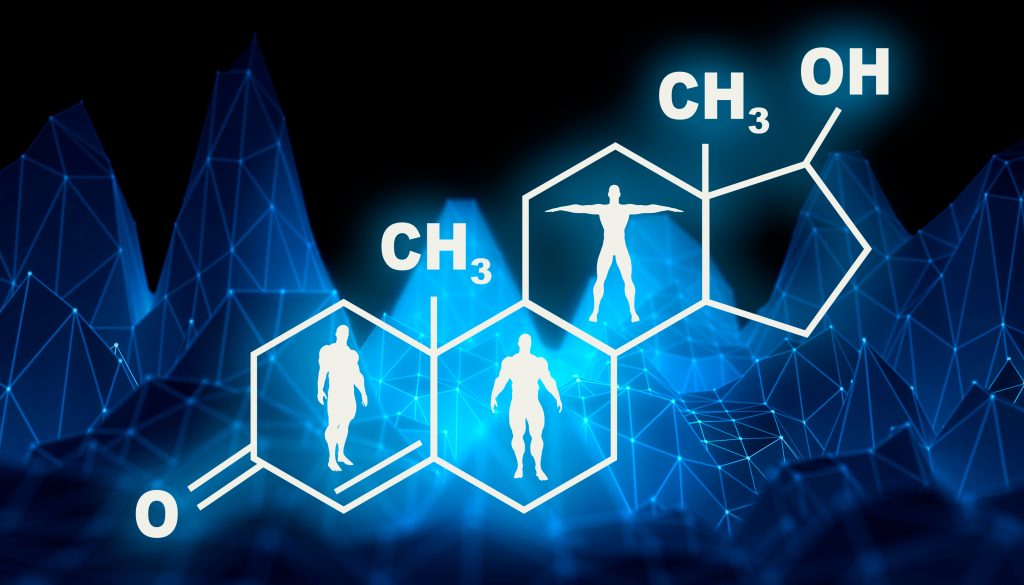
Testosterone is the main male sex hormone. Most of it is made in the testes, with a little from the adrenal glands. Women make it too, just in much smaller amounts.
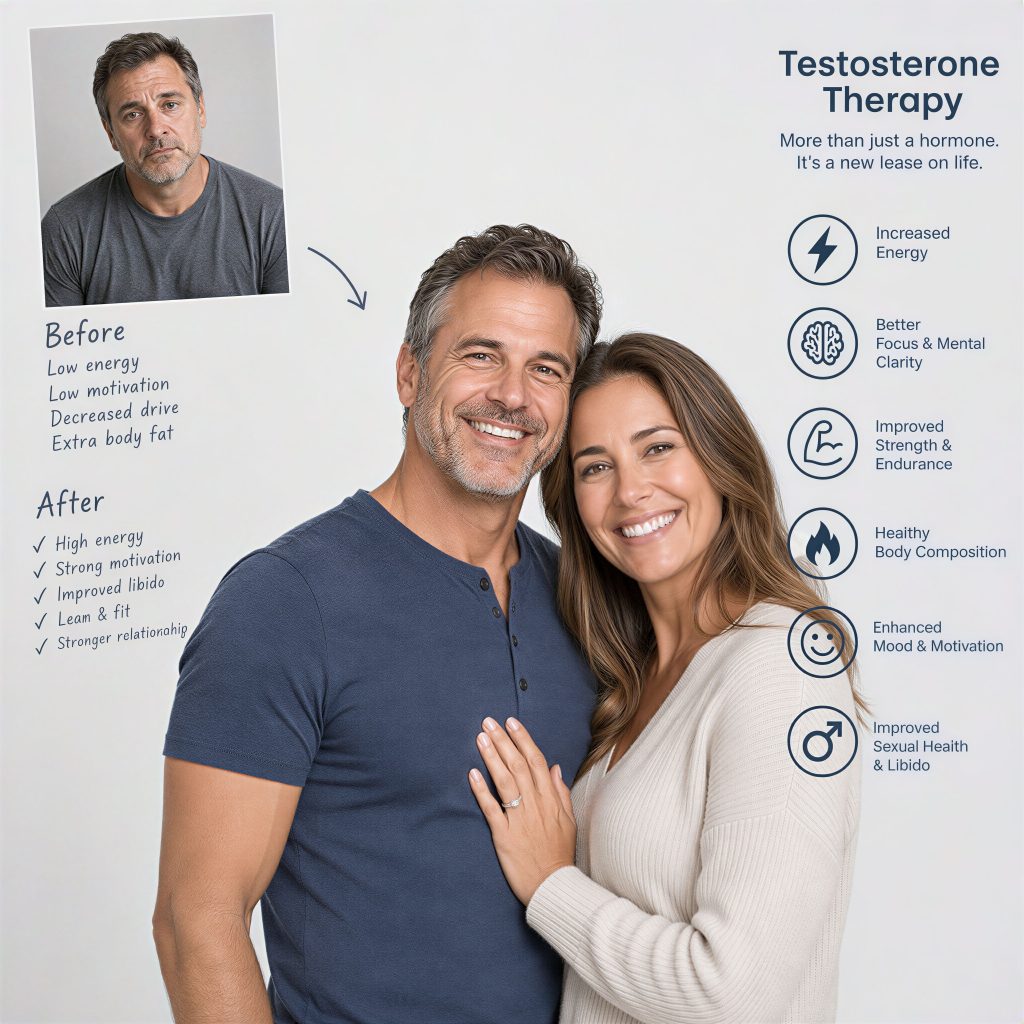
It’s a busy hormone. Testosterone drives your sex drive and helps with erections. It keeps muscles and bones strong and helps you make red blood cells. Testosterone also plays a part in mood, energy and focus. It even shapes where you store fat and how much body hair you grow.
The thermostat in your head
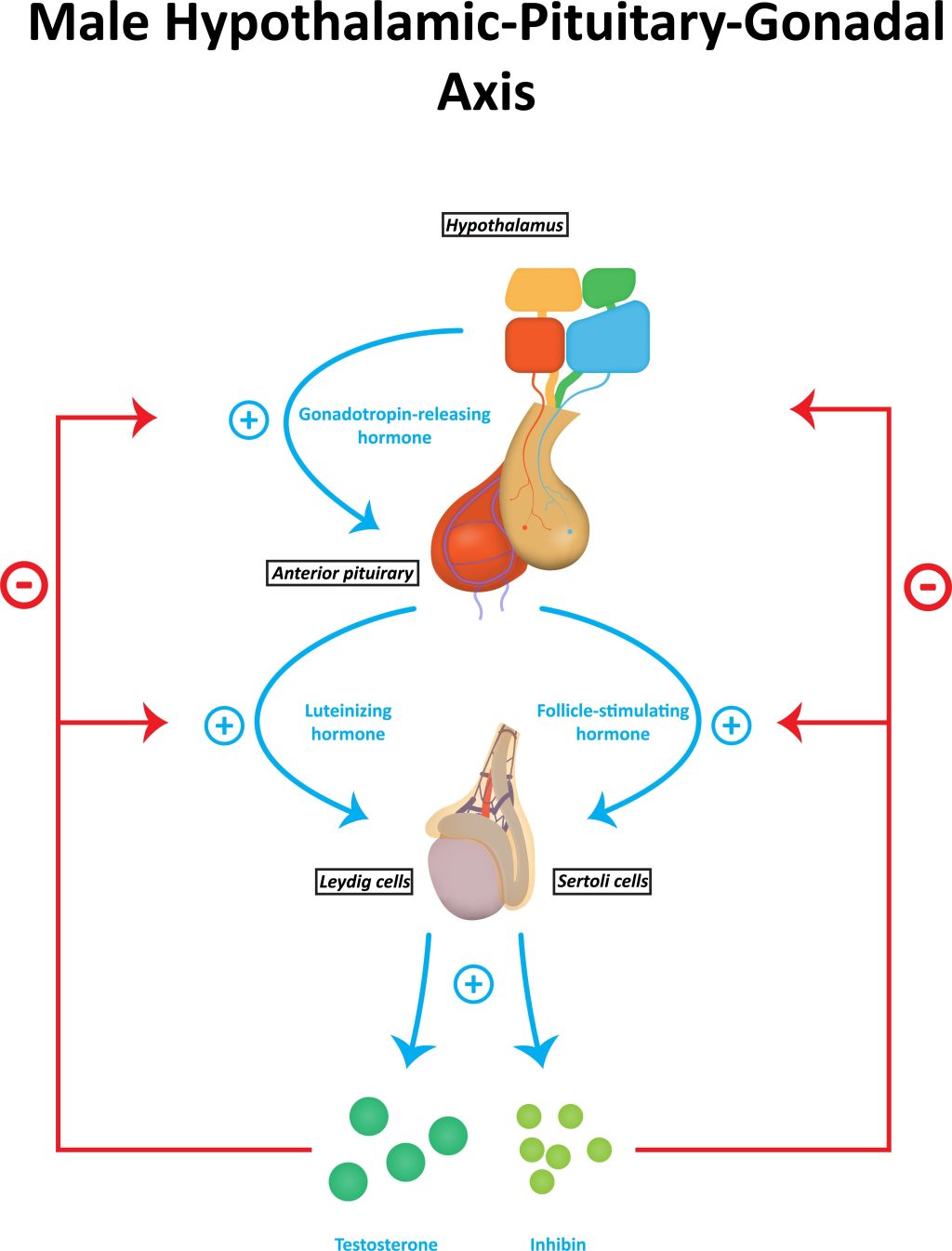
Your testosterone system works like central heating with a thermostat.
The thermostat sits in your brain, in two areas called the hypothalamus and the pituitary gland. When levels drop, the pituitary sends out two messenger hormones. These are LH (luteinising hormone) and FSH (follicle-stimulating hormone). They tell the testes to turn up the heat and make more testosterone and sperm. When levels are high enough, the brain eases off.
Doctors call this the HPG axis (hypothalamic-pituitary-gonadal axis). You don’t need to remember the name. Just remember that problems can start at the boiler (the testes) or at the thermostat (the brain). That matters for treatment.
What is testosterone replacement therapy for men?
So, what is testosterone replacement therapy for men, in real terms? It tops your levels back up to normal when your own system can’t.
The key word is replacement. The goal isn’t to push levels sky high. It’s to bring them back to where a healthy man’s levels would sit, and hold them there. That’s the aim set out in UK guidance. The two key sets of guidance come from the British Society for Sexual Medicine (BSSM) and the Society for Endocrinology.
Want the one-line version? TRT gives back the testosterone your body is missing. It eases the symptoms of a proven deficiency, with regular checks to keep it safe.
Why “replacement” matters so much
This one word is what sets medical TRT apart from steroid misuse. Bodybuilders often push levels far above normal, with several drugs at once and no checks. TRT does the opposite. It aims for normal, it uses properly prescribed medicines, and it comes with blood tests.
Does that still make TRT a steroid? It’s a fair question, and the answer may surprise you.
What is testosterone replacement therapy made of?
People are often a bit shy to ask this one, so let’s clear it up. What is testosterone replacement therapy made of? Mostly, testosterone. It’s the same molecule your body makes.
Medical testosterone is made in labs, usually from plant sterols. These are natural, cholesterol-like compounds found in plants. Chemists turn them, step by step, into testosterone that matches the hormone your testes make.
So no, it doesn’t come from animals. And it isn’t a “copy” in the sense of being a different chemical. Once it’s in your blood, your body treats it just like its own.
Swallowed testosterone doesn’t work well, so it needs another way in. In the UK, the two main routes are:
- gels, where testosterone is mixed into a clear gel that you rub onto your skin each day
- injections, where testosterone is mixed into oil and injected into a muscle or the fat under the skin
Esters: the slow-release trick
With injections, the testosterone usually has a small chemical “tail” attached, called an ester. You’ll see names like undecanoate, cypionate or enanthate.
Think of the ester as a time-release coat. It controls how fast the testosterone leaks out of the oil and into your blood. A short tail lets go quickly, so you need jabs more often. A long tail, like undecanoate, lets go slowly over weeks. Once the tail comes off in the body, what’s left is plain testosterone.
What is testosterone replacement therapy used for?
What is testosterone replacement therapy used for? Its main job is to treat male hypogonadism. That’s the medical name for when the body doesn’t make enough testosterone, and this causes symptoms.
There are a few types. Knowing which one you have can change the plan.
Boiler problems and thermostat problems
In primary hypogonadism, the testes themselves don’t work properly. Causes include injury, infection, surgery, cancer drugs, or a genetic condition such as Klinefelter syndrome. The brain is shouting for more (LH and FSH are high), but the testes can’t answer.
In secondary hypogonadism, the testes are fine but the brain isn’t sending the right signals. A growth, an injury or a high level of the hormone prolactin can affect the brain’s signals. Long-term use of some medicines, such as opioids, can do it too. Obesity and type 2 diabetes are also strongly linked. So is past use of anabolic steroids, which can switch the thermostat off for a long time.
Late-onset hypogonadism and the “male menopause”
Late-onset hypogonadism is when a deficiency develops in middle or later life. It often comes with weight gain, diabetes or poor sleep. It’s real, but it’s less common than adverts suggest. A large European study found it in about 2% of men aged 40 to 79, rising with age. That study defined it as three sexual symptoms plus low testosterone.
You’ll also hear the phrase “male menopause”. The NHS says it’s misleading. Testosterone does drift down with age, but slowly. It falls by less than 2% a year from around 30 to 40. That gentle fall alone is unlikely to cause problems. Many symptoms blamed on it have other causes, like stress, low mood, poor sleep, drink or weight gain.
So TRT isn’t an anti-ageing treatment. It’s for a diagnosed medical condition.
Who is TRT for, and who isn’t it for?
TRT may suit men who have both ongoing symptoms and low testosterone on proper testing. The most common symptoms are:
- a lower sex drive
- fewer early-morning erections
- erection problems
Others include tiredness, low mood or a short temper, poor focus and loss of muscle and strength. You might also notice more belly fat, poor sleep, hot flushes, less body hair, or nodding off after dinner.
The BSSM also says some men should be screened for low testosterone. That includes men with erection problems or low libido, type 2 diabetes, a BMI over 30 or a waist over 102 cm. It also covers men on some long-term medicines. These include opioid painkillers, antipsychotics and epilepsy medicines.
TRT isn’t suitable if you have, or may have, prostate or breast cancer. Extra care is needed with heart, kidney or liver failure, high blood pressure or clotting disorders. The same goes for epilepsy, migraine, untreated sleep apnoea, or blood thinners like warfarin.
There’s a big one for younger men, too. Testosterone tells the brain to switch off LH and FSH. So the testes slow down sperm production, sometimes to zero. That means TRT on its own isn’t right if you’re trying for a baby. Other medicines may be used instead or alongside, but that’s a specialist chat.
How is low testosterone diagnosed?
Here’s the outline every man should know.
Guidelines agree that you need ongoing symptoms and low testosterone on repeat tests. Neither alone is enough. A short quiz, such as the 10-question ADAM questionnaire, can flag a possible problem. But it’s a starting point, not a diagnosis.
Timing really matters
Testosterone peaks in the morning and falls during the day. So blood should be taken between about 7am and 11am, ideally before breakfast. You’ll need two morning samples on different days. Don’t test when you’re unwell, as illness can drop your levels for a while.
In our experience at Courier Pharmacy, a common cause of a false low result is simple. The test was done in the afternoon. A level that looks low at 3pm might be fine at 8am.
The BSSM gives these action levels for total testosterone:
- below 8 nmol/L usually supports treatment
- 8 to 12 nmol/L is a grey zone, where free testosterone helps decide (this uses SHBG, a protein that carries testosterone)
- above 12 nmol/L usually doesn’t need treatment (except for those men with type II diabetes)
Your prescriber will also check LH, FSH and prolactin. These show whether it’s a boiler or a thermostat problem. They may check iron stores too, to rule out haemochromatosis (iron overload).

What is testosterone replacement therapy given as? The main forms
So, what is used for testosterone replacement therapy in the UK? Here’s a quick tour. The right form depends on you.
Testosterone gel
You rub it onto clean, dry skin on your shoulders or upper arms once a day. Let it dry for a few minutes, cover it with clothing and wash your hands. The big safety point is skin-to-skin transfer. Partners and children can absorb it. So cover up, and wash the area before close contact.
Injections and other options
A long-acting testosterone undecanoate injection goes deep into a muscle. A healthcare professional gives it. After a loading dose, it’s usually given every 10 to 14 weeks. It’s handy if you don’t fancy a daily routine.
A mixed testosterone esters injection (Sustanon) usually goes into a muscle about every 3 weeks. Levels can peak and dip between doses, and some men feel these ups and downs.
Testosterone cypionate and enanthate are shorter-acting. They’re often given once or twice a week. Some go into the fat under the skin with a small needle. Cypionate isn’t licensed in the UK, so it’s prescribed as an unlicensed medicine.
Patches, implants and oral forms exist but are less used in the UK. Courier Pharmacy is also a compounding pharmacy. That means we can make up bespoke forms when a prescriber decides it’s right.

How does TRT work, and is it safe?
Once testosterone is back in the normal range, the hope is that symptoms ease. Sex drive often picks up first, within weeks. Mood, energy, erections and body shape can take months.
When it’s done properly, with checks, TRT has a reassuring record in large trials. But it isn’t risk-free.
The main thing to watch is haematocrit, the share of your blood made up of red cells. Testosterone boosts red cell production. If blood gets too thick, it’s like a motorway at rush hour. Things slow down and the risk of clots goes up. That’s why regular blood tests are part of the deal.
Before you start, your prescriber should check your blood count and PSA (prostate-specific antigen). Your liver, cholesterol and blood pressure get checked too. Then you’ll need checks at set times. At Courier Pharmacy, our pathway checks at 1, 6 and 12 months, then yearly.
A quick bit of history
TRT isn’t new. Testosterone was first isolated and made in the 1930s. Since then, it’s moved from early implants to today’s gels and long-acting jabs.
UK prescribing rose sharply between 2001 and 2010. There was concern that some men started without a solid diagnosis. That’s partly why today’s guidelines are so firm about proper testing. Like a good backstory? Read our a full timeline of TRT.
Frequently asked questions about what is testosterone replacement therapy

What is testosterone replacement therapy in simple terms?
Testosterone replacement therapy tops up testosterone in men who don’t make enough. It’s prescription-only. It’s only started once symptoms and two low morning blood tests confirm the problem. The aim is to bring levels back to normal, not beyond.
What is TRT short for?
TRT stands for testosterone replacement therapy. You might also see it called testosterone therapy or testosterone treatment. In a medical setting, they all mean the same thing.
What is testosterone replacement therapy made of?
It’s made of testosterone, the same hormone your body makes. It’s made in labs from plant sterols and given as a skin gel or an oil-based injection. Injections usually have an ester attached, a chemical tail that controls how fast it’s released.
What is testosterone replacement therapy used for?
It’s used to treat male hypogonadism. That means the body doesn’t make enough testosterone, and this causes symptoms. The cause may be in the testes, in the brain’s signals, or a deficiency that starts later in life. It isn’t a lifestyle or anti-ageing treatment.
What is used for testosterone replacement therapy in the UK?
The most common UK options are testosterone gel and testosterone injections. Some injections last for weeks or months. Others are shorter-acting and given once or twice a week. Your prescriber helps you choose based on your lifestyle, health and wishes.
Is TRT the same as taking steroids?
Not in the way most people mean it. Testosterone is a steroid hormone, chemically speaking. But TRT replaces what’s missing at normal doses, with medical checks. Steroid misuse pushes levels far above normal, often with several drugs and no checks.
Can women have testosterone replacement therapy?
This guide is about TRT for men with hypogonadism. Women do make testosterone, and some are prescribed it for specific reasons. But that’s a different treatment, with different doses and guidance. Speak to your GP or a specialist if this applies to you.
How do I know if I need TRT?
You might need TRT if you have ongoing symptoms plus low testosterone on two morning blood tests. Typical symptoms are low sex drive, fewer morning erections or erection problems. Many symptoms have other causes, so a proper assessment is key.
Does TRT affect fertility?
Yes, it can. Testosterone switches off the brain signals that drive sperm production. So sperm counts often drop, sometimes to zero. If you want children now or soon, tell your prescriber before you start, as other options may suit you better.
Is TRT a lifelong treatment?
For many men, TRT is long-term, especially if the testes or pituitary are damaged for good. If the cause can be fixed, for example by losing weight or changing a medicine, some men can stop. Never stop suddenly without speaking to your prescriber first.
Disclaimer
Disclaimer: This information is for education only and isn’t a substitute for personal medical advice. Always follow your prescriber’s instructions.
References
Testosterone replacement therapy history
- Ahsan, S. (2026) A comprehensive timeline: the development of testosterone replacement therapy. Courier Pharmacy. Available at: https://courierpharmacy.co.uk/a-comprehensive-timeline-the-development-of-testosterone-replacement-therapy/ (Accessed: 24 October 2026).
Testosterone replacement therapy Guidelines
- Bhasin, S., Brito, J.P., Cunningham, G.R., Hayes, F.J., Hodis, H.N., Matsumoto, A.M., Snyder, P.J., Swerdloff, R.S., Wu, F.C. and Yialamas, M.A. (2018) ‘Testosterone therapy in men with hypogonadism: an Endocrine Society clinical practice guideline’, Journal of Clinical Endocrinology and Metabolism, 103(5), pp. 1715-1744. Available at: https://doi.org/10.1210/jc.2018-00229 (Accessed: 24 October 2026).
- Hackett, G., Kirby, M., Rees, R.W., Jones, T.H., Muneer, A., Livingston, M. et al. (2023) ‘The British Society for Sexual Medicine guidelines on male adult testosterone deficiency, with statements for practice’, World Journal of Men’s Health, 41(3), pp. 508-537. Available at: https://doi.org/10.5534/wjmh.221027 (Accessed: 24 October 2026).
- Jayasena, C.N., Anderson, R.A., Llahana, S., Barth, J.H., MacKenzie, F., Wilkes, S. et al. (2022) ‘Society for Endocrinology guidelines for testosterone replacement therapy in male hypogonadism’, Clinical Endocrinology, 96(2), pp. 200-219. Available at: https://onlinelibrary.wiley.com/doi/abs/10.1111/cen.14633
Suppression of spermatogenesis
- Desai, A., Yassin, M., Cayetano, A., Tharakan, T., Jayasena, C.N. and Minhas, S. (2022) ‘Understanding and managing the suppression of spermatogenesis caused by testosterone replacement therapy (TRT) and anabolic-androgenic steroids (AAS)’, Therapeutic Advances in Urology, 14, 17562872221105017. Available at: https://pubmed.ncbi.nlm.nih.gov/35783920/ (Accessed: 24 October 2026).
Testosterone preparations
- electronic medicines compendium (2025a) Testogel 16.2 mg/g gel: summary of product characteristics. Besins Healthcare (UK) Ltd. Available at: https://www.medicines.org.uk/emc/product/8919/smpc (Accessed: 24 October 2026).
- electronic medicines compendium (2025c) Nebido 1000 mg/4 ml solution for injection: summary of product characteristics. Grunenthal Ltd. Available at: https://www.medicines.org.uk/emc/product/14631/smpc (Accessed: 24 October 2026).
Miscellaneous TRT
- Gan, E.H., Pattman, S., Pearce, S.H.S. and Quinton, R. (2013) ‘A UK epidemic of testosterone prescribing, 2001-2010’, Clinical Endocrinology, 79(4), pp. 564-570. Available at: https://doi.org/10.1111/cen.12178 (Accessed: 24 October 2026).
- Morley, J.E., Charlton, E., Patrick, P., Kaiser, F.E., Cadeau, P., McCready, D. and Perry, H.M. (2000) ‘Validation of a screening questionnaire for androgen deficiency in aging males’, Metabolism, 49(9), pp. 1239-1242. Available at: https://doi.org/10.1053/meta.2000.8625 (Accessed: 24 October 2026).
- NHS (2022) The ‘male menopause’. Available at: https://www.nhs.uk/conditions/male-menopause/ (Accessed: 24 October 2026).
- Wu, F.C.W., Tajar, A., Beynon, J.M., Pye, S.R., Silman, A.J., Finn, J.D. et al. (2010) ‘Identification of late-onset hypogonadism in middle-aged and elderly men’, New England Journal of Medicine, 363(2), pp. 123-135. Available at: https://doi.org/10.1056/NEJMoa0911101 (Accessed: 24 October 2026).