

A realistic guide by skin concern.Have you thought about what tretinoin actually does once it’s on your face, beyond the glowing before-and-after photos? This guide explains what tretinoin does for your skin, concern by concern, from blackheads and spots to fine lines and dark patches. We also cover what it doesn’t do, what the first few weeks really feel like, and a month-by-month picture of when to expect results.
Tretinoin is one of the most studied skin medicines around. It’s also one of the most misunderstood. Some people expect miracles in a week. Others give up just before it starts working.
So let’s set realistic expectations, skin concern by skin concern, with a pharmacist’s honest take on each one.
Five key takeaways
- Tretinoin is a prescription-only vitamin A medicine that resets how skin cells grow and shed, which keeps pores clear and refreshes the skin surface.
- For acne, it prevents blackheads and whiteheads from forming and calms some inflammation, with clear results usually seen around 8 to 12 weeks.
- For ageing skin, it can soften fine lines, smooth rough texture and fade uneven pigment, but these changes take 3 to 6 months or longer.
- It doesn’t cure acne, bleach healthy skin or thin your skin long term. It actually thickens the outer living layer of skin.
- Dryness, flaking, redness and a possible “purge” in the first weeks are common and usually settle as your skin adjusts.
What does tretinoin do? The short answer
So, what does tretinoin do? Tretinoin is the active form of vitamin A. It tells skin cells to grow, mature and shed in a healthier, more orderly way. That keeps pores from clogging, reduces spots, smooths texture, fades uneven pigment and, over months, helps build collagen. It’s a slow, steady skin reset, not a quick fix.
Think of your skin as a busy high street. Old cells are meant to leave on time, like shoppers heading home at closing. When that system gets sluggish, dead cells pile up in doorways (your pores). Tretinoin acts like a firm but fair shop manager who keeps everyone moving.
What does tretinoin do to the skin at cell level?
We’ll keep the science light here. Tretinoin enters skin cells and attaches to retinoic acid receptors in the nucleus. These receptors work like light switches for genes that control how skin cells behave.
Flip those switches, and cells turn over faster, stick together less inside pores and produce more collagen over time. If you love the detail, our guide on how tretinoin works: the science behind a skin-care staple goes much deeper.
What does tretinoin do for blackheads and whiteheads?
This is where tretinoin really earns its reputation. Blackheads and whiteheads (comedones) start as tiny, invisible plugs called microcomedones. They form when cells lining the pore don’t shed properly and clump together with oil.
Tretinoin loosens that “glue” and normalises shedding. Existing plugs work their way out, and new ones are less likely to form. That’s why it’s described as comedolytic, which simply means it breaks up and prevents clogged pores.
A practical point: because it works on spots that haven’t appeared yet, you need to apply it to the whole area, not just dab it on visible blackheads. Spot treating is like weeding only the flowers you can see while the roots carry on underneath.
What does tretinoin do for inflamed spots?
Red, sore spots usually start life as a blocked pore. Bacteria and oil build up inside, and the skin’s immune response kicks in. By keeping pores clear, tretinoin removes the starting point for many inflamed spots.
If you’re unsure which approach suits your skin, our acne condition page sets out the main options.
What does tretinoin do for post-acne marks and scars?
Not all marks are scars, and this matters. Many people have flat brown or purple patches left after spots heal. These are called post-inflammatory hyperpigmentation, and they’re pigment, not damaged tissue.
Tretinoin speeds up skin turnover, so pigmented cells reach the surface and leave sooner. It also reduces how much pigment gets passed into new skin cells. Flat marks often fade noticeably over a few months.
Pitted scars are a different story. Tretinoin may soften shallow, rolling scars a little by encouraging collagen, but deep “ice pick” scars usually need procedures in a clinic. Our article on how tretinoin for scars works explains which scar types respond best.
Tretinoin benefits for fine lines and wrinkles
Here’s where patience pays. Over months, tretinoin increases collagen in the deeper layer of skin and reduces how quickly existing collagen breaks down. Collagen is the scaffolding that keeps skin firm, a bit like the frame of a flat-pack wardrobe.
Clinical trials show improvement in fine wrinkles and roughness in sun-damaged skin. A 2022 systematic review found topical tretinoin to be safe and effective for long-term treatment of photoageing, which is skin ageing caused by sun exposure.
Interestingly, a higher strength isn’t always better. One trial found that tretinoin 0.025% and 0.1% tretinoin gave similar improvement over 48 weeks, but the stronger cream caused more irritation. For more on this, see how tretinoin fights the signs of ageing.
One honest note: no UK tretinoin product is licensed for wrinkles. If a prescriber recommends it for ageing, it’s an off-label or unlicensed use, and they should explain what that means for you.

What does tretinoin do for skin texture?
Rough, bumpy or dull skin often comes down to a build-up of dead cells on the surface. As tretinoin refreshes the outer layer, skin tends to look smoother and reflect light more evenly. People often describe it as “glowier”, which is a lovely word that isn’t in any textbook.
It also has a modest anti-inflammatory effect of its own. However, for moderate or inflamed acne it’s often paired with something else. In the UK, the licensed product Treclin combines tretinoin with the antibiotic clindamycin. NICE recommends this combination, used once daily in the evening, as a first-line option for acne of any severity, with a review after 12 weeks.
Texture is usually one of the earlier cosmetic changes people notice, often within a few months. It’s not dramatic overnight, but it builds quietly, a bit like the way you don’t notice a child growing until a relative visits.
Sun spots and melasma: what does tretinoin do for pigment?
Tretinoin can help even out patchy pigment, including sun spots and melasma. Melasma is a condition where brown patches appear, often on the cheeks, forehead or upper lip, and it’s frequently linked to hormones and sunlight.
In a vehicle-controlled trial, tretinoin 0.1% improved melasma over 40 weeks. A separate trial in Black patients found a 32% improvement in melasma severity scores with tretinoin, compared with 10% with the plain base cream, though two-thirds had some skin irritation.
That irritation point is important. In deeper skin tones, irritation itself can trigger new dark patches. So going slowly and protecting your skin barrier really matters. Our article on skin hyperpigmentation, pathophysiology and treatments covers the wider treatment picture.
Does tretinoin dry up oily skin? The oiliness myth
A question we hear a lot is, “Will tretinoin stop my skin being so greasy?” The honest answer is probably not much. Topical tretinoin isn’t known for shrinking oil glands the way the oral acne tablet isotretinoin does.
What it can do is help keep oil flowing out of pores rather than getting trapped. That means fewer clogs, even if your forehead still shines by lunchtime.
Some people also mistake the tight, dry feeling of early tretinoin use for “less oil”. That’s actually the skin barrier being irritated. Dry and oily can exist at the same time, which is why a light moisturiser still matters for oily skin.
What tretinoin does not do
Knowing the limits is just as useful as knowing the benefits. It saves a lot of frustration.
It doesn’t cure acne
Tretinoin controls acne while you use it. It doesn’t permanently switch it off. If you stop, the pore-clogging process often picks up again and spots can return. Think of it like brushing your teeth, not like a one-off filling.
It doesn’t work overnight
Most acne improvement shows up around 8 to 12 weeks, and the Treclin product information gives a similar timeframe. Anti-ageing changes take longer still. Applying more won’t make it work faster, it just makes your skin cross.
It doesn’t bleach your skin
Tretinoin fades excess pigment slowly by speeding up its removal. It doesn’t strip colour from healthy skin. If you notice lightening or darkening in odd patches, that’s usually irritation and worth mentioning to your prescriber.
It doesn’t thin your skin long term
This myth refuses to go away. Early on, the very top layer of dead cells sheds faster, so skin can feel more delicate. However, the living outer layer (the epidermis) actually becomes thicker with ongoing use, and collagen beneath it increases. Research even shows tretinoin can partly protect against the skin thinning caused by strong steroid creams.
What does tretinoin do in the first few weeks?
Before the good bits, there’s usually an adjustment phase. Researchers have measured skin dryness from retinoic acid after about nine days, along with faster turnover of the outer layer. That’s the barrier being temporarily disrupted, so more water escapes.
Common early effects include:
- Dryness and tightness
- Flaking or peeling, especially around the nose and mouth
- Redness and mild stinging
- Extra sensitivity to sun and wind
- A possible “purge”, where hidden clogs surface as spots
A purge usually appears in areas where you normally break out and tends to settle within 4 to 8 weeks. Our guide on what is the tretinoin purge explains how to tell a purge from a reaction.
British weather doesn’t help. Cold wind outside and central heating inside can make dryness worse, so winter starters may need a richer moisturiser. Our dry skin page has extra tips.
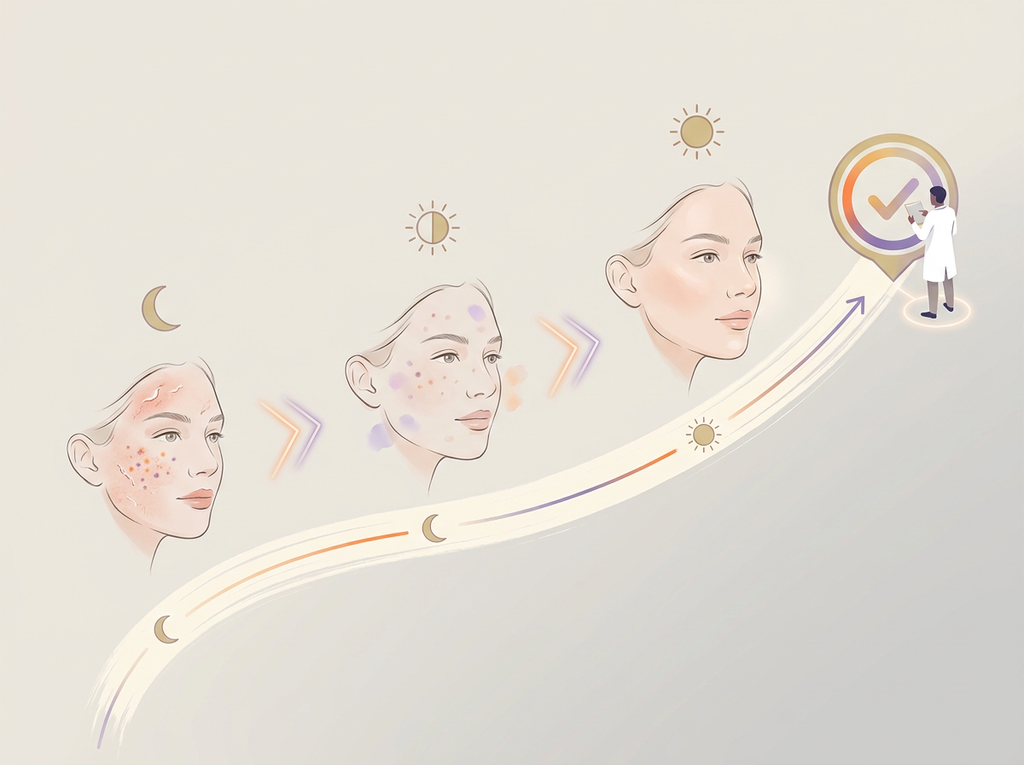
A realistic timeline: what does tretinoin do week by week?
Everyone’s skin is different, so treat this as a rough guide, not a deadline.
Weeks 1 to 2
Not much visible change. You might feel slight tightness or notice light flaking. This is a good time to start slowly, for example every other night.
Weeks 2 to 6
The adjustment phase peaks. Dryness, redness and peeling are common, and some people purge. It’s sensible to build up how often you apply it over 2 to 3 weeks. NICE suggests alternate days or short contact (washing it off after an hour) to reduce irritation.
Weeks 6 to 12
Skin usually settles. Breakouts start to calm, blackheads become fewer and texture often looks smoother. This is when many people start to see why they bothered.
Months 3 to 6
Acne should be clearly better if tretinoin suits you. NICE advises reviewing acne treatment at 12 weeks. Pigment marks fade further, and early changes in fine lines may appear.
Six months and beyond
Anti-ageing benefits keep building for a year or more. In one study, people who used tretinoin daily for 48 weeks then cut down to three times a week kept, and sometimes improved, their results. Those who stopped saw some benefits slowly fade.
Who is tretinoin for, and who should avoid it?
Tretinoin can suit people with blackheads, whiteheads and mild to moderate acne, as well as adults with sun damage, rough texture or uneven pigment. Picture a 34-year-old with occasional breakouts and early fine lines around the eyes. Tretinoin may address both concerns at once, though this is just an illustration.
It isn’t suitable for everyone. Tretinoin should not be used during pregnancy, when trying to conceive or while breastfeeding. According to the Treclin product information, it’s also unsuitable for people with rosacea, perioral dermatitis, acute eczema, or a personal or family history of skin cancer. The clindamycin in Treclin adds further cautions, such as a history of inflammatory bowel disease or antibiotic-associated colitis.
Tretinoin is prescription-only in the UK, so a prescriber needs to assess you first. You can speak to your GP, a dermatologist, or a GPhC-registered online pharmacy that carries out a proper prescriber assessment.

How to get the most from tretinoin
A few practical habits make a big difference:
- Apply a pea-sized amount at night to clean, fully dry skin. The NHS suggests waiting around 20 minutes after washing.
- Start two or three nights a week and build up as your skin allows.
- Use a gentle, non-foaming cleanser and a simple moisturiser.
- Keep it away from the corners of your nose, mouth and eyes.
- Wear broad-spectrum SPF every day, even when it’s grey outside, and avoid sunbeds.
- Don’t layer strong exfoliating acids or harsh scrubs at the start.
- Take photos in the same light every month. Progress is easier to see in pictures than in the mirror.
Our step-by-step guide on how to apply tretinoin cream covers technique in more detail. If side effects feel more than mild, speak to your prescriber, and you can report suspected side effects through the MHRA Yellow Card scheme.
Frequently asked questions about what tretinoin does
What does tretinoin do for your skin in simple terms?
Tretinoin helps skin cells grow and shed in a healthier way. This keeps pores clear, reduces spots, smooths texture, fades uneven pigment and, over months, supports collagen.
What does tretinoin do to the skin in the first week?
Usually not much you can see. Some people notice mild tightness, dryness or slight flaking as the skin starts adjusting.
How long does tretinoin take to work for acne?
Most people see clear improvement around 8 to 12 weeks. NICE recommends reviewing acne treatment after a 12-week course.
What does tretinoin do for wrinkles?
It can soften fine lines by boosting collagen and slowing its breakdown. Results usually take 3 to 6 months and keep improving with ongoing use.
Does tretinoin get rid of dark spots?
It can gradually fade sun spots, melasma and post-acne marks by speeding up the removal of pigmented cells. It works slowly and needs daily sun protection alongside it.
Does tretinoin thin your skin?
No, not long term. The top layer of dead cells sheds faster at first, but the living outer layer of skin actually gets thicker with continued use.
What does tretinoin do for oily skin?
It helps stop oil and dead cells from clogging pores, but it isn’t known for greatly reducing oil production. Your skin may still feel oily while spots improve.
Is the tretinoin purge normal?
Yes, a short-lived flare of spots in your usual breakout areas is common in the first few weeks. It usually settles within 4 to 8 weeks.
What happens if I stop using tretinoin?
There’s no withdrawal effect. However, acne often returns and anti-ageing benefits slowly fade, so many people continue at a lower frequency.
Can I get tretinoin without a prescription in the UK?
No. Tretinoin is a prescription-only medicine in the UK, so you need an assessment from a GP, dermatologist or registered online prescriber.

Disclaimer
Disclaimer: This information is for education only and isn’t a substitute for personal medical advice. Always follow your prescriber’s instructions.
References
Further reading from Courier Pharmacy
- Ahsan, S. (2026a) ‘Skin hyperpigmentation, pathophysiology and treatments’, Courier Pharmacy, 4 July. Available at: https://courierpharmacy.co.uk/skin-hyperpigmentation-pathophysiology-and-treatments/ (Accessed: 24 October 2026).
- Ahsan, S. (2026b) ‘What is the tretinoin purge?’, Courier Pharmacy, 19 October. Available at: https://courierpharmacy.co.uk/what-is-the-tretinoin-purge/ (Accessed: 24 October 2026).
- Courier Pharmacy (2026) ‘How to apply tretinoin cream’. Available at: https://courierpharmacy.co.uk/how-to-apply-tretinoin-cream/ (Accessed: 24 October 2026).
- Courier Pharmacy (2026) ‘How tretinoin fights the signs of ageing’. Available at: https://courierpharmacy.co.uk/how-tretinoin-fights-the-signs-of-ageing/ (Accessed: 24 October 2026).
- Courier Pharmacy (2026) ‘How tretinoin for scars works’. Available at: https://courierpharmacy.co.uk/how-tretinoin-for-scars-works/ (Accessed: 24 October 2026).
- Courier Pharmacy (2026) ‘How tretinoin works: the science behind a skin-care staple’. Available at: https://courierpharmacy.co.uk/how-tretinoin-works-the-science-behind-a-skin-care-stable/ (Accessed: 24 October 2026).
Tretinoin in licensed medicines
- electronic medicines compendium (emc) (2026) Treclin 1%/0.025% w/w gel: summary of product characteristics. Available at: https://www.medicines.org.uk/emc/product/5371/smpc (Accessed: 24 October 2026).
- electronic medicines compendium (emc) (2026) Treclin 1%/0.025% w/w gel: summary of product characteristics. Available at: https://www.medicines.org.uk/emc/product/5371/smpc (Accessed: 24 October 2026).
Acne
- Leyden, J., Stein-Gold, L. and Weiss, J. (2017) ‘Why topical retinoids are mainstay of therapy for acne’, Dermatology and Therapy, 7(3), pp. 293-304. Available at: https://doi.org/10.1007/s13555-017-0185-2 (Accessed: 24 October 2026).
- National Institute for Health and Care Excellence (NICE) (2021, updated 2023) Acne vulgaris: management. NICE guideline NG198. Available at: https://www.nice.org.uk/guidance/ng198 (Accessed: 24 October 2026).
- NHS (n.d.) Acne: treatment. Available at: https://www.nhs.uk/conditions/acne/treatment/ (Accessed: 24 October 2026).
Skin Ageing
- Griffiths, C.E.M., Kang, S., Ellis, C.N., Kim, K.J., Finkel, L.J., Ortiz-Ferrer, L.C., White, G.M., Hamilton, T.A. and Voorhees, J.J. (1995) ‘Two concentrations of topical tretinoin (retinoic acid) cause similar improvement of photoaging but different degrees of irritation’, Archives of Dermatology, 131(9), pp. 1037-1044. Available at: https://pubmed.ncbi.nlm.nih.gov/7544967/ (Accessed: 24 October 2026).
- Mukherjee, S., Date, A., Patravale, V., Korting, H.C., Roeder, A. and Weindl, G. (2006) ‘Retinoids in the treatment of skin aging: an overview of clinical efficacy and safety’, Clinical Interventions in Aging, 1(4), pp. 327-348. Available at: https://pmc.ncbi.nlm.nih.gov/articles/PMC2699641/ (Accessed: 24 October 2026).
- Olsen, E.A., Katz, H.I., Levine, N., Nigra, T.P., Pochi, P.E., Savin, R.C., Shupack, J., Weinstein, G.D., Lufrano, L. and Perry, B.H. (1997) ‘Sustained improvement in photodamaged skin with reduced tretinoin emollient cream treatment regimen: effect of once-weekly and three-times-weekly applications’, Journal of the American Academy of Dermatology, 37(2 Pt 1), pp. 227-230. Available at: https://doi.org/10.1016/s0190-9622(97)80129-6 (Accessed: 24 October 2026).
- Sitohang, I.B.S., Makes, W.I., Sandora, N. and Suryanegara, J. (2022) ‘Topical tretinoin for treating photoaging: a systematic review of randomized controlled trials’, International Journal of Women’s Dermatology, 8(1), e003. Available at: https://pubmed.ncbi.nlm.nih.gov/35620028/ (Accessed: 24 October 2026).
Melasma
- Griffiths, C.E.M., Finkel, L.J., Ditre, C.M., Hamilton, T.A., Ellis, C.N. and Voorhees, J.J. (1993) ‘Topical tretinoin (retinoic acid) improves melasma: a vehicle-controlled, clinical trial’, British Journal of Dermatology, 129(4), pp. 415-421. Available at: https://doi.org/10.1111/j.1365-2133.1993.tb03169.x (Accessed: 24 October 2026).
- Kimbrough-Green, C.K., Griffiths, C.E.M., Finkel, L.J., Hamilton, T.A., Bulengo-Ransby, S.M., Ellis, C.N. and Voorhees, J.J. (1994) ‘Topical retinoic acid (tretinoin) for melasma in black patients: a vehicle-controlled clinical trial’, Archives of Dermatology, 130(6), pp. 727-733. Available at: https://pubmed.ncbi.nlm.nih.gov/8002642/ (Accessed: 24 October 2026).
Miscellaneous tretinoin
- Effendy, I., Kwangsukstith, C., Lee, J.Y. and Maibach, H.I. (1995) ‘Functional changes in human stratum corneum induced by topical glycolic acid: comparison with all-trans retinoic acid’, Acta Dermato-Venereologica, 75(6), pp. 455-458. Available at: https://pubmed.ncbi.nlm.nih.gov/8651024/ (Accessed: 24 October 2026).
- McMichael, A.J., Griffiths, C.E.M., Talwar, H.S., Finkel, L.J., Rafal, E.S., Hamilton, T.A. and Voorhees, J.J. (1996) ‘Concurrent application of tretinoin (retinoic acid) partially protects against corticosteroid-induced epidermal atrophy’, British Journal of Dermatology, 135(1), pp. 60-64. Available at: https://pubmed.ncbi.nlm.nih.gov/8776360/ (Accessed: 24 October 2026).